Pentecost is the Christian feast that commemorates the coming of the Holy Spirit on the first followers of Jesus in Jerusalem, as told in the second chapter of the Acts of the Apostles. It is kept on the fiftieth day of the Easter season, counting Easter Sunday itself as the first day, and the name comes from the Greek pentēkostē, meaning “fiftieth.” Churches in every major family of Christianity observe it, although they differ on how they name the feast, which calendar they use to date it, and which customs surround it.
The narrative at its center is short but vivid. Acts reports a sound like a rushing wind, tongues like fire resting on the disciples, and speech in languages that visitors from many regions could understand, followed by a sermon from the apostle Peter and the baptism of about three thousand people. Christians generally read the scene as the moment the Spirit promised by Jesus was given to the community, which then began its public witness. Catholic teaching describes Pentecost as the opening of the “time of the Church,” and many Christians use the popular phrase “birthday of the church,” which is a customary expression rather than a formal doctrinal definition.
Luke, the author of Acts, sets the event during a Jewish pilgrimage festival, the Feast of Weeks (Shavuot), when Jerusalem was crowded with visitors. That detail explains the date and the audience, and it is treated here as historical background for the Christian feast, not as a comparison of two faiths. Pentecost also closes the season that begins with Easter, so the feast cannot be understood apart from the fifty days that lead up to it. Its roots in scripture run through the Bible, from the Pentateuch’s harvest laws to the Gospel of John’s account of the Spirit.
This article moves from definition and dating to the Acts narrative, Christian teaching about the Holy Spirit, the history of the feast, its symbols, its worship, and its local customs. It also explains how the feast differs from the twentieth-century Pentecostal movement, whose name is borrowed from it, and it corrects several common misunderstandings. Where Christian traditions differ, the differences are named and attributed instead of blended into a single voice. Scripture quotations come from the public-domain World English Bible unless another edition is named.
Pentecost at a Glance: Definition, Name, and Core Meaning
What Pentecost Commemorates
The Short Answer
Christians who keep Pentecost remember the day on which, according to Acts 2, the Holy Spirit came upon Jesus’s disciples gathered in Jerusalem. The disciples are described as being “filled with the Holy Spirit” and beginning to speak in other languages, and the crowd that gathered heard them declare “the mighty works of God.” The feast celebrates the Spirit’s gift to the church, and it is observed on a Sunday, the day Christians customarily gather for worship. Britannica’s entry on the festival describes it as marking the start of the church’s mission to the world, and that framing is common across traditions.
The meaning of the feast is therefore both historical and ongoing. Historically, it recalls a particular event in Jerusalem in the first century CE. Devotionally and liturgically, it is understood as a present reality: Catholic, Orthodox, Anglican, Lutheran, and many other churches pray at Pentecost that the Spirit who came to the first disciples would also be given to those worshiping today. The feast is thus less a birthday party than a renewal of an invitation, and its prayers tend to ask for gifts such as unity, courage, and understanding.
Where the Story Appears in the Bible
The classic account is Acts 2:1-13, followed by Peter’s sermon in 2:14-41. Acts is the second volume of a two-part work that begins with the Gospel of Luke, and it opens with the risen Jesus telling his followers to wait in Jerusalem for the promise of the Father (Acts 1:4-5). The Gospel of John contains a different scene of Spirit-giving: on the evening of Easter Sunday, in John 20:22, Jesus breathes on the disciples and tells them to receive the Holy Spirit. Christian interpreters have long discussed how the two accounts relate, and the Pentecost readings of several churches draw on both, as later sections explain.
Names, Vocabulary, and Related Terms
Pentecost, Whitsunday, and Other Names
The English word “Pentecost” comes from Greek pentēkostē (hēmera), “the fiftieth (day),” by way of ecclesiastical Latin and Old English. The same Greek word was already in use among Greek-speaking Jews for the harvest festival that fell fifty days after Passover, which is why Acts can refer to “the day of Pentecost” without explanation. In English the feast is also called Whitsunday or Whit Sunday, and the days around it Whitsuntide. The usual explanation is that the name means “White Sunday,” recalling the white garments worn by those baptized at the Pentecost vigil. The 1549 First Prayer Book of Edward VI used “Whitsunday” officially, and Anglican churches have kept the name in their prayer books.
Other languages preserve the Greek root in different forms. German has Pfingsten and Dutch Pinksteren, both derived from pentēkostē, while French uses Pentecôte. Eastern Orthodox churches call the feast Pentecost or the Descent of the Holy Spirit, and they often combine it with a celebration of the Holy Trinity, so that the day is also called Trinity Sunday. Western churches, by contrast, observe Trinity Sunday on the following Sunday, a separate feast.
Key Terms Used in This Article
Several technical terms recur below, and the table gathers them for quick reference. Each is explained again in context.
| Term | Origin or language | Meaning in this context |
|---|---|---|
| Pentecost | Greek pentēkostē | “Fiftieth (day)”; the Christian feast of the Spirit’s descent, and in early usage the whole fifty-day Easter season |
| Whitsunday / Whitsuntide | English | Traditional English names for Pentecost Sunday and the days around it, usually explained as “White Sunday” |
| Shavuot (Feast of Weeks) | Hebrew | The Jewish harvest and pilgrimage festival that forms the setting of Acts 2 |
| Paraclete | Greek paraklētos | A title for the Spirit in the Gospel of John, variously translated “Advocate,” “Helper,” or “Comforter” |
| Ruach / pneuma | Hebrew / Greek | Words that can mean wind, breath, or spirit, which shapes how Acts 2 is read |
| Glossolalia | Greek glōssa + lalia | “Speaking in tongues,” a term applied to the phenomenon described in Acts 2 and 1 Corinthians 12 to 14 |
| Eastertide / Paschal season | English / Greek pascha | The fifty days from Easter Sunday through Pentecost Sunday in the Western calendar |
| Pentekostarion | Greek | The Eastern liturgical book that covers the season from Pascha to the Sunday of All Saints |
| Vigil | Latin vigilia | An evening or night service before a major feast, including a Pentecost vigil in some traditions |
Who Observes Pentecost and How Widely
Churches That Keep the Feast
Pentecost is among the oldest and most widely shared observances of the Christian year. Roman Catholic, Eastern Orthodox, Oriental Orthodox, Anglican, Lutheran, Reformed, and Methodist churches all mark it, and the Orthodox rank it among the Great Feasts of the Lord, second only to Pascha. Many Baptist, nondenominational, and Pentecostal congregations also hold special services, although churches that do not follow a liturgical calendar may treat the day less formally. The Catholic, Eastern Orthodox, and Oriental Orthodox traditions have the fullest cycles of Pentecost prayer and hymnody, and each is described in more detail in its own article.
Participation is not uniform even within a single tradition. Some parishes celebrate with a vigil, a procession, and a choir singing the ancient sequence Veni Sancte Spiritus, while others hold a single morning service with red paraments and a sermon on Acts 2. What the traditions share is the reading of the Acts account and the central intention of thanksgiving for the gift of the Spirit.
Pentecost in the Christian Year
In the Western calendar Pentecost ends the Easter season and leads into what the Catholic calendar calls Ordinary Time. The 2026 U.S. Catholic calendar, for example, lists Pentecost Sunday on May 24 and notes that Ordinary Time resumes on the following Monday. In the Eastern calendar the festal season continues longer: the Pentekostarion carries the church from Pascha through the Sunday of All Saints, which follows Pentecost. Together with Easter and Christmas, Pentecost belongs to the group of feasts that many churches regard as the principal annual celebrations. For the season of preparation that comes before Easter, see the article on Lent; for the other great feast of the Incarnation, see Christmas.
The Fifty Days: How Pentecost Is Counted and Dated
The Counting Rule
From Easter Sunday to the Fiftieth Day
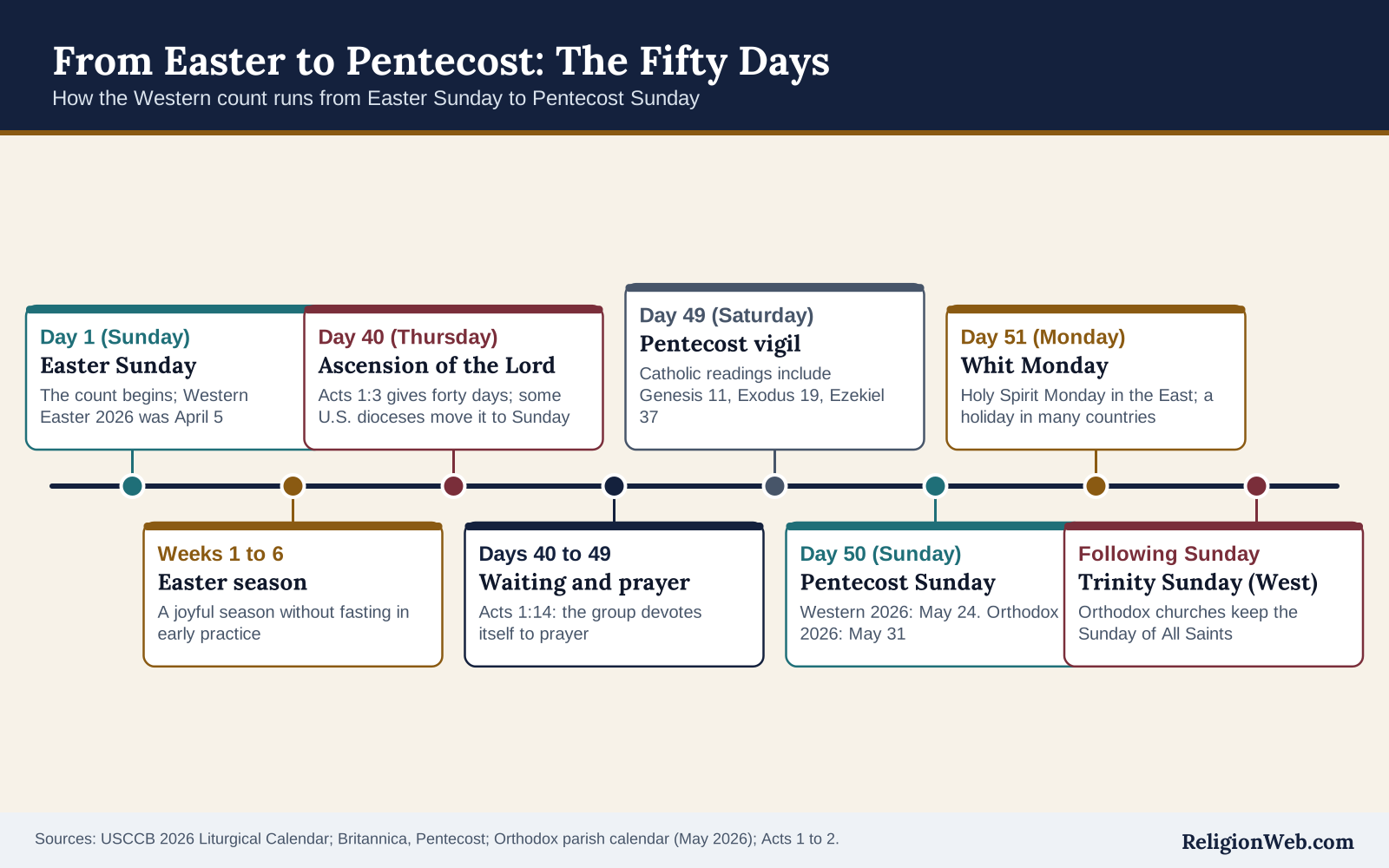
The rule is simple to state. Easter Sunday is the first of the fifty days, and Pentecost is the fiftieth, which falls exactly seven weeks later. Equivalently, Pentecost is the Sunday that comes 49 days after Easter. Because Easter is a Sunday and the count runs through seven full weeks, the fiftieth day is again a Sunday. That is why Pentecost is always the seventh Sunday after Easter.
The Gospel of Luke and Acts give the numbers behind this arrangement in a different way. Acts 1:3 says Jesus appeared to his followers over a period of forty days, and Christian tradition marks the fortieth day as the Ascension, which falls on a Thursday. Pentecost follows ten days later. In practice, many Catholic dioceses in the United States transfer the Ascension to the Sunday before Pentecost, but the fifty-day count to Pentecost does not change.
Why Pentecost Is Always on a Sunday
Pentecost falls on a Sunday by arithmetic, and the church’s calendar treats that as meaningful. Christians gather on Sunday because it is the day of the resurrection, and the Pentecost Sunday brings the seven-week Easter journey to its conclusion on the same weekly day with which it began. Early Christian writers described the whole fifty days as a single extended celebration of the resurrection, and the early church treated them as a time without fasting. Canon 20 of the Council of Nicaea (325 CE) is usually read as directing worshipers to pray standing, not kneeling, on Sundays and during the days of Pentecost, a practice that Eastern churches still recall when they return to kneeling at Pentecost Vespers.
Why the Date Moves and Differs
The Lunisolar Link to Easter
The date of Pentecost depends entirely on the date of Easter. The first Council of Nicaea in 325 CE is traditionally credited with the principle that Easter should be kept on a Sunday, and later church practice defined it as the first Sunday after the ecclesiastical full moon that falls on or after March 21. That rule yields a movable date. In the Gregorian calendar used by Western churches, Easter can fall anywhere from March 22 to April 25, which puts Pentecost between May 10 and June 13. The earliest extreme is rare: an Easter on March 22 last occurred in 1818 and will next occur in 2285, so Pentecost in the present century falls between May 11 and June 13. The detailed calculation of Easter is covered in the article on Easter.
Western and Eastern Calendars
Most Eastern Orthodox churches calculate Easter, which they call Pascha, using the Julian calendar’s computation, which now runs thirteen days behind the Gregorian calendar. As a result, Orthodox Pentecost can fall between May 23 and June 26 in Gregorian civil dates during this century. Western and Eastern Pentecost coincide in some years and are weeks apart in others. In 2026, Western Easter fell on April 5 and Pentecost on May 24, as the U.S. Conference of Catholic Bishops’ calendar shows, while Orthodox Pascha fell on April 12 and Orthodox Pentecost on May 31, according to an Orthodox parish calendar for that year. The table below sets out these dates and the next few years.
| Year | Western Easter | Western Pentecost | Orthodox Pascha | Orthodox Pentecost |
|---|---|---|---|---|
| 2026 | April 5 | May 24 | April 12 | May 31 |
| 2027 | March 28 | May 16 | May 2 | June 20 |
| 2028 | April 16 | June 4 | April 16 | June 4 |
| 2029 | April 1 | May 20 | April 8 | May 27 |
The 2026 dates were checked against church calendars, and the later years follow from the standard computation, so a parish’s own calendar is the authority for local services. Some national calendars also differ in whether they keep Whit Monday as a holiday, a point taken up in the section on customs.
The Jewish Festival Setting: Weeks, Firstfruits, and Pilgrims in Jerusalem
The Feast of Weeks in the Hebrew Bible
Firstfruits and the Count of Fifty Days
Acts places the coming of the Spirit on “the day of Pentecost,” and to the first readers of Luke’s Greek that phrase named a festival they already knew. In the Hebrew Bible the festival is called the Feast of Weeks (Shavuot), and several passages in the Torah, the first five books of the Bible, describe it as a celebration of the wheat harvest. Exodus 34:22 calls it the feast of weeks and ties it to the firstfruits of the wheat harvest, and Numbers 28:26 speaks of a day of firstfruits. The fullest instructions are in Leviticus 23, which tells the people to count from the offering of the sheaf of grain at the start of the harvest until the fiftieth day.
And ye shall count unto you from the morrow after the day of rest, from the day that ye brought the sheaf of the waving; seven weeks shall there be complete; even unto the morrow after the seventh week shall ye number fifty days; and ye shall present a new meal-offering unto the LORD.
Leviticus 23:15-16, The Holy Scriptures: A New Translation (Jewish Publication Society, 1917)
The structure matters for understanding the Christian name. The festival is defined by a count: seven complete weeks, then a fiftieth day on which a new grain offering is presented. Deuteronomy 16:9-12 gives a parallel instruction to count seven weeks from the time the sickle is first put to the standing grain, and it adds that the people are to rejoice before God together with household members, servants, the Levite, the stranger, the orphan, and the widow. The joy of the harvest and the obligation to include the vulnerable are both part of the festival’s biblical description, and both were remembered in later Jewish practice.
The festival also acquired a covenantal character in the centuries before the New Testament. The Book of Jubilees, a Jewish text probably composed in the second century BCE, presents the Feast of Weeks as a day of covenant renewal, and the festival’s later association with Sinai in rabbinic tradition continued that development. For the purposes of this article it is enough to note that by the first century the festival carried both an agricultural meaning and a memory of covenant, and readers of Acts could hear either or both.
A Pilgrimage Festival in Second Temple Jerusalem
Deuteronomy 16:16 names Weeks as one of three pilgrimage festivals, together with Unleavened Bread and Booths, when men were expected to appear at the place God would choose, which in the Second Temple period meant Jerusalem. By the first century CE the city drew large numbers of pilgrims from the Judean countryside and from Jewish communities scattered around the Mediterranean and Mesopotamia. Greek-speaking Jews used the ordinal pentēkostē for the festival. The name appears in the deuterocanonical books of Tobit (2:1) and 2 Maccabees (12:32), and the first-century Jewish historian Josephus also uses it, so Luke was using an established term. Elsewhere in the New Testament, Paul writes that he plans to stay in Ephesus until Pentecost (1 Corinthians 16:8) and Acts 20:16 notes that he hurried to be in Jerusalem for the day.
Ancient Jewish groups did not all count the fifty days from the same starting point. The wording of Leviticus, “the morrow after the day of rest,” was interpreted in different ways, and the difference affected on which date the festival fell. This variation is one reason that scholars speak cautiously about the exact day of the year on which Acts imagines the event. The Christian tradition, for its part, has fixed the commemoration by counting from Easter, which is the reckoning described in the previous section.
Why the Setting Matters for the Acts Account
A Crowd from Many Lands
The pilgrimage context accounts for the setting of the story. A feast that drew Jews and converts from across the Mediterranean world explains why Acts 2:5 speaks of “Jews, devout men, from every nation under the sky,” living or staying in Jerusalem. It also accounts for why a public disturbance in a courtyard or street could draw a multitude within minutes. The festival gave Luke a natural stage on which a message could be heard in many languages at once, without requiring any unusual narrative device beyond the event itself.
This observation is a matter of historical context, not of doctrine. Christian tradition understands the Spirit’s descent as the act of God that gives the day its meaning, whatever the date on the calendar. Historians add that the festival’s size and travel patterns make the details of the setting plausible.
How Interpreters Read Luke’s Choice of Day
Interpreters have long asked whether the festival carries a theological meaning for Luke beyond setting. The association of the festival with the giving of the law at Sinai is well attested in later Jewish tradition, and Britannica notes that the feast, which began as thanks for the firstfruits of the wheat harvest, was later linked to the giving of the law at Sinai. Some Christian writers, beginning at least by the time of Augustine in the early fifth century, drew a parallel between the law given at Sinai and the Spirit given at Pentecost, and Britannica describes the church’s version of the feast as connecting the gift of the Spirit with a new covenant. Others read the harvest imagery: the first believers as firstfruits of a larger ingathering of the nations.
Modern scholars are divided on how much of this Luke himself intended. Some see an explicit Sinai typology in details such as fire and sound, while others argue that the text itself says nothing about Sinai and that the connection was drawn later. The responsible summary is that the Christian feast is rooted in the Jewish festival calendar, that Christian interpreters from late antiquity onward saw correspondences with Sinai and with harvest, and that the degree to which Luke shared those associations remains a matter of discussion. Jewish readers have their own understanding of the festival, which is described in the article on Judaism.
Acts 2: The Narrative of the First Christian Pentecost
Preparation and Arrival of the Spirit
Luke’s Two-Volume Work and Its Setting
The only full account of the first Pentecost is in the Acts of the Apostles, the second volume of a work that opens with the Gospel of Luke. Church tradition from the second century onward attributes both volumes to Luke, a companion of Paul mentioned in letters such as Colossians 4:14 and Philemon 24, and the “we” passages in the later chapters of Acts are often cited as evidence that the author traveled with Paul. Neither book names its author, however, and modern scholars are divided on the question. Many date Luke-Acts to the last decades of the first century CE, while a minority argue for an earlier date, so the written account is generally understood to be a generation or more removed from the events it describes.
Historians of ancient literature also point out that the speeches in Acts, including Peter’s sermon, follow the conventions of Greek and Roman historical writing, in which an author composes speeches that fit the occasion and the speaker. Some scholars therefore treat the sermons as Luke’s summaries or compositions based on early tradition, while others regard them as closer to what was actually said. Christian tradition receives Acts as inspired scripture, and the question of how it relates to the historian’s methods is a matter on which believers and scholars continue to reflect. What can be said with confidence is that no independent non-Christian description of the event survives, and that the Pentecost narrative reaches us through Luke’s carefully structured work.
Before the Day: Acts 1
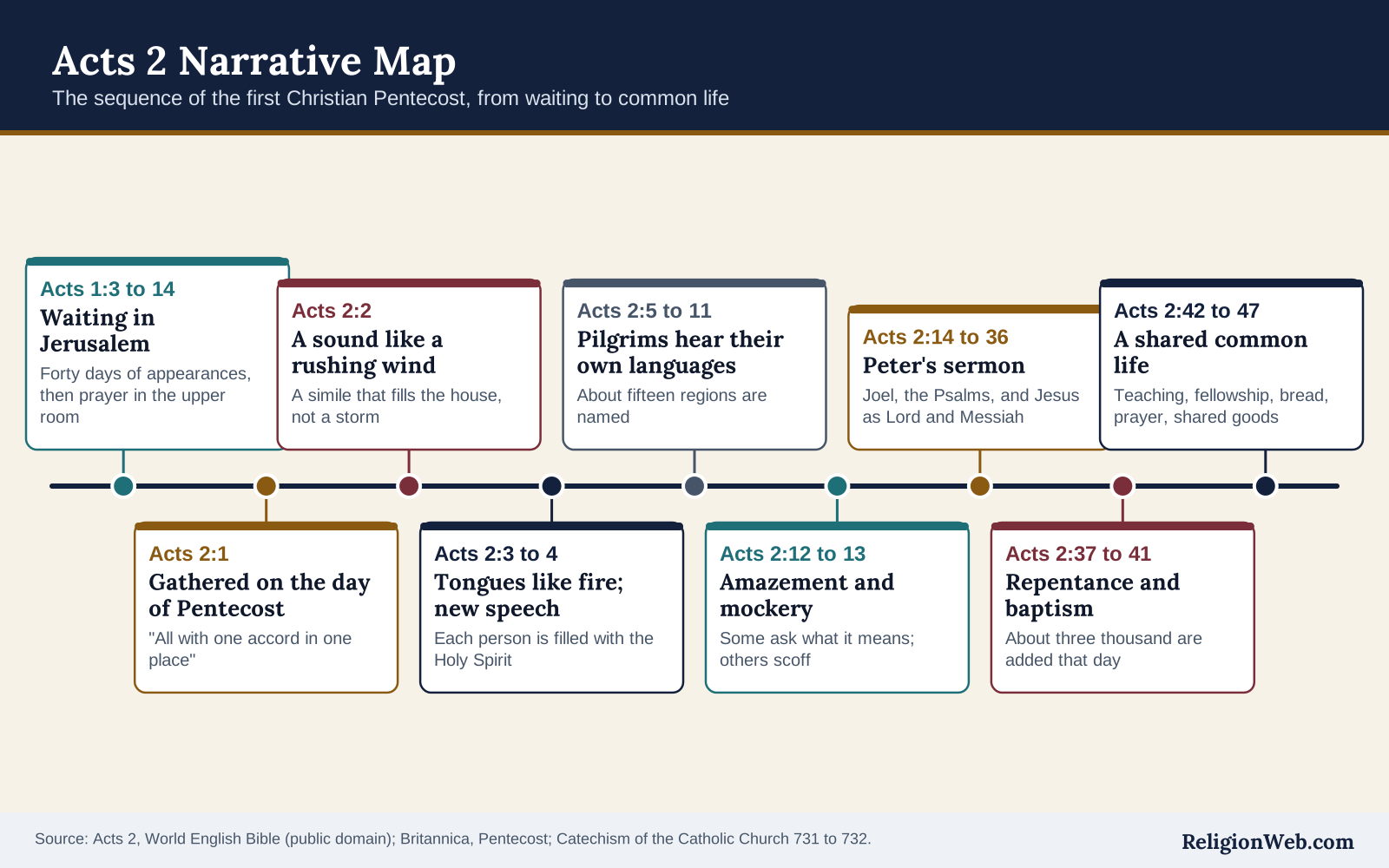
The Pentecost scene begins in the previous chapter. Acts 1:3 says that Jesus presented himself alive to his followers over forty days after his suffering, and 1:4-5 records his instruction to wait in Jerusalem for the promise of the Father, a baptism in the Holy Spirit that would come within days. After the Ascension, the followers returned to an upper room, where Acts 1:13-14 lists the eleven apostles, several women, Mary the mother of Jesus, and his brothers, who were devoted to prayer together. Acts 1:15 gives the number of believers as about one hundred twenty, and the group chose Matthias to replace Judas as the twelfth apostle.
These details raise a question that interpreters answer differently: who is meant by “they were all” in Acts 2:1? Some readers take it to mean the twelve apostles alone, while others take the larger group of about 120 who had been praying together. The grammar of the passage allows both, and the choice affects whether the gift is read as given first to the apostolic leadership or to the community as a whole. The Catholic and Orthodox traditions tend to emphasize the apostles as the foundation of the church’s ministry, while many Protestant and Pentecostal readers emphasize the whole gathered community, including women, on the strength of Peter’s citation of Joel.
Wind, Fire, and Speech (Acts 2:1-4)
The central scene unfolds in four verses. The setting is a house in Jerusalem, and the text opens with a time marker and a statement of unity.
Now when the day of Pentecost had come, they were all with one accord in one place. Suddenly there came from the sky a sound like the rushing of a mighty wind, and it filled all the house where they were sitting.
Acts 2:1-2, World English Bible
Tongues like fire appeared and were distributed to them, and one sat on each of them. They were all filled with the Holy Spirit and began to speak with other languages, as the Spirit gave them the ability to speak.
Acts 2:3-4, World English Bible
Luke’s wording is carefully qualified. The sound is “like” a rushing wind, and the appearance is of tongues “like” fire. In the Greek, the first image uses a word for a violent blast, and the second is introduced with a particle meaning “as if of fire.” Interpreters across traditions have noticed that Luke does not say there was a literal windstorm or a literal blaze. The text describes an experience that the community could only express through comparison, and it reports that the fire-like tongues were distributed, one resting on each person. The result in verse 4 is speech: the Spirit gives the disciples the ability to speak in languages other than their own.
The Crowd and the Languages
The Nations Listed in Acts 2:9-11
The sound draws a crowd, and verses 5 to 11 describe what the crowd heard. According to Acts 2:6, the multitude “came together and were bewildered, because everyone heard them speaking in his own language.” The speakers are identified as Galileans, and the listeners respond with a catalog of origins: Parthians, Medes, Elamites, residents of Mesopotamia, Judea, Cappadocia, Pontus, Asia, Phrygia, Pamphylia, Egypt, and the parts of Libya near Cyrene, visitors from Rome, both Jews and proselytes, and Cretans and Arabians. The crowd concludes, “we hear them speaking in our languages the mighty works of God!”
The list names roughly fifteen regions, running from the Persian and Mesopotamian east through Anatolia and the eastern Mediterranean to North Africa and Rome. Many commentators regard the catalog as Luke’s way of signaling that the message is addressed to the whole inhabited world of his time. Whether the list reflects a source document, a literary design, or an actual roll call of those present is debated, but its function in the narrative is clear: the gift of the Spirit is directed outward, toward people of every language and region.
Speaking or Hearing: Interpretive Questions
A longstanding question concerns where the miracle lies. Acts 2:4 says the disciples spoke in “other languages,” while 2:6 emphasizes that each person heard in his own. Some interpreters have concluded that the disciples spoke in actual foreign languages, a phenomenon sometimes called xenolalia, whereas others suggest that the listeners were enabled to understand ordinary speech in their own tongue. The fourth-century bishop Gregory of Nazianzus, in a sermon for Pentecost, discussed whether the wonder was in the speakers or the hearers. A different set of questions arises from comparison with 1 Corinthians 12 to 14, where Paul discusses speaking in tongues in the Corinthian congregation as speech that requires interpretation. Scholars and churches differ on whether the Corinthian phenomenon and the Acts phenomenon are the same, and Pentecostal and Catholic charismatic communities generally treat them as closely related, while other traditions distinguish them.
The crowd’s reaction is divided. Some are amazed and ask what this could mean, while others mock the disciples and say they have had too much new wine (Acts 2:12-13). Peter answers the second reaction in verse 15 by observing that it is only the third hour of the day, roughly nine in the morning, too early for drunkenness. The brief exchange shows that Luke’s account anticipates skepticism and does not present the event as self-evident to every onlooker.
Peter’s Sermon and the First Converts
The Speech from Joel and the Psalms
Peter, speaking with the other eleven, explains the event by citing the prophet Joel. In the Hebrew numbering the passage is Joel 3:1-5, and in most English Bibles Joel 2:28-32.
‘It will be in the last days, says God, that I will pour out my Spirit on all flesh. Your sons and your daughters will prophesy. Your young men will see visions. Your old men will dream dreams.
Acts 2:17, World English Bible (quoting Joel 2:28)
For Peter, the pouring out of the Spirit “on all flesh” inaugurates the last days, a period that Christians understand as the time between Christ’s first coming and his return. The sermon continues with Psalms 16 and 110 to argue that Jesus’s resurrection and exaltation fulfill promises made to David, and it concludes in verse 36 that God has made Jesus both Lord and Messiah. Because this speech has sometimes been quoted to blame Jewish people collectively for the crucifixion, it is worth noting that Peter is portrayed as a Jewish leader addressing fellow Jews in Jerusalem, and that Catholic teaching since the Second Vatican Council’s declaration Nostra Aetate (1965) has stated that the events of the Passion cannot be charged against all Jews of that time or against Jews today. Many other churches have made similar statements.
Baptism, Three Thousand, and a Shared Life
Deeply moved by the sermon, the crowd asks what to do. Peter’s reply in verse 38 became a foundational text for Christian initiation.
Repent and be baptized, every one of you, in the name of Jesus Christ for the forgiveness of sins, and you will receive the gift of the Holy Spirit.
Acts 2:38, World English Bible
Acts 2:41 reports that those who gladly received his word were baptized and that about three thousand were added that day. Churches differ in how they connect baptism, the gift of the Spirit, and confirmation, a topic treated in the article on baptism. The chapter ends with a summary of communal life: the new believers “continued steadfastly in the apostles’ teaching and fellowship, in the breaking of bread, and prayer” (2:42), and the verses that follow describe sharing possessions with those in need. Many Christians see in this passage the roots of regular worship, which includes the Eucharist, and of the church’s care for the poor.
| Verses | Event in the text | What the passage emphasizes | Common interpretation |
|---|---|---|---|
| 2:1 | The group gathers on the day of Pentecost | “All with one accord in one place” | Unity of the community; the festival setting |
| 2:2 | A sound like a rushing mighty wind fills the house | Sound from the sky, simile of wind | The Spirit as divine breath and power; wind and breath share a word in Hebrew and Greek |
| 2:3 | Tongues like fire are distributed, one on each person | Visible sign, comparison with fire | Divine presence resting on each person; the gift is personal and shared |
| 2:4 | All are filled with the Spirit and speak other languages | The Spirit gives the speech | Empowerment for witness; sometimes read as a reversal of the division of languages at Babel |
| 2:5-11 | Pilgrims from many regions hear in their own languages | List of about fifteen regions | The message is for all nations |
| 2:12-13 | Amazement and mockery | Questions about meaning; the charge of too much new wine | The event calls for explanation and is not universally accepted |
| 2:14-36 | Peter’s sermon citing Joel and the Psalms | Last days, resurrection, Jesus as Lord and Messiah | The Spirit’s coming is linked to Jesus’s resurrection and exaltation |
| 2:37-41 | Repentance, baptism, about three thousand added | “Repent and be baptized” and the “gift of the Holy Spirit” | Pattern for Christian initiation |
| 2:42-47 | Common life of teaching, fellowship, bread, and prayer | Shared goods, daily worship | Model for church life and charity |
Acts 2 in the Wider Narrative of Acts
Later Outpourings of the Spirit
Pentecost is not the only moment in Acts when the Spirit is poured out. In Acts 4:31 the building where the believers have prayed is shaken, and they are filled with the Spirit and speak boldly. In Acts 8:14-17 Peter and John travel to Samaria, pray for the new believers there, and lay hands on them so that they receive the Spirit. In Acts 10:44-47 the Spirit falls on the household of the Roman officer Cornelius while Peter is still speaking, and Peter concludes that they should be baptized. In Acts 19:1-6 Paul lays hands on a group of disciples in Ephesus, and they speak in tongues and prophesy.
Christian readers have drawn different lessons from this pattern. Many Pentecostal and charismatic Christians see in the repeated episodes a model for the continuing experience of the Spirit, while other traditions regard the episodes as stages in the church’s expansion from Jerusalem to Samaria and then to non-Jewish peoples, a movement previewed in Acts 1:8, where Jesus tells the disciples they will be his witnesses in Jerusalem, Judea, Samaria, and to the ends of the earth. Both readings agree that Acts presents the Spirit as the one who directs the church’s mission.
Pentecost and the Mission to the Nations
Because the list in Acts 2:9-11 spans so many regions, the chapter is commonly read as a preview of the mission that fills the rest of the book. The Catholic vigil of Pentecost pairs Acts with the story of Babel in Genesis 11:1-9, and an Orthodox hymn for the feast contrasts the division of languages at Babel with the unity to which the tongues of fire call the nations. Interpreters from late antiquity onward have used this contrast to say that Pentecost does not erase the diversity of languages so much as gather it into a shared message. Acts itself does not mention Babel, and the connection is a theological reading drawn by later readers, though one with a long history.
The Holy Spirit in Christian Teaching
Biblical Foundations
Wind, Breath, and Spirit: Ruach and Pneuma
To read Acts 2 with the vocabulary of the first Christians, it helps to know that the Hebrew word ruach and the Greek word pneuma can each mean wind, breath, or spirit. The Hebrew Bible opens with the ruach of God moving over the waters (Genesis 1:2), and it speaks of the same divine ruach empowering judges, prophets, and kings. Ezekiel’s vision of dry bones brought to life by breath from the four winds (Ezekiel 37), which is one of the Catholic vigil readings for Pentecost, draws on the same range of meanings. When Acts compares the sound at Pentecost to a mighty wind and then says the disciples were filled with the Holy Spirit, a reader fluent in these languages would have heard both images at once.
The Hebrew Bible also anticipates a future outpouring of the Spirit on the whole community. The prophet Joel, whom Peter quotes, envisions sons and daughters, young and old, receiving prophetic gifts, and Isaiah 11 speaks of the Spirit resting on a coming ruler as a spirit of wisdom, understanding, counsel, might, knowledge, and fear of the Lord. Christian teaching reads Pentecost as a fulfillment of such promises, while recognizing that the texts have their own meaning in their original setting.
The Paraclete in the Gospel of John
The Gospel of John supplies the most developed New Testament teaching about the Spirit before Pentecost. In the farewell discourse (John 14 to 16), Jesus promises to send another helper, the paraklētos or Paraclete, who will teach the disciples, remind them of what he said, testify about him, and guide them. Translators render the Greek word as Advocate, Helper, or Comforter, and each captures part of its range. Later Christian writers used these chapters to explain that the Spirit is not merely a force but a personal presence who continues Jesus’s work in the community.
John also has its own scene of Spirit-giving. On the evening of Easter Sunday, according to John 20:22, Jesus breathes on his disciples and tells them to receive the Holy Spirit. Christian interpreters have not all explained the relationship between that scene and Acts 2 in the same way. Some see two distinct moments in a single gift, a first bestowal tied to the resurrection and a public manifestation at Pentecost, while others regard John and Luke as telling the same reality through different narrative frames. The Catholic lectionary for Pentecost Sunday in 2026 pairs Acts 2:1-11 with John 20:19-23, which treats the two accounts as complementary rather than competing.
How Christian Traditions Understand the Spirit
Trinitarian Teaching
In the Nicene tradition shared by Catholic, Orthodox, Oriental Orthodox, Anglican, and most Protestant churches, the Holy Spirit is understood as the third person of the Trinity, one God in three persons. The Nicene-Constantinopolitan Creed, finalized in the late fourth century, confesses the Spirit as Lord and giver of life, who proceeds from the Father and is worshiped and glorified together with the Father and the Son. Pentecost is therefore treated not only as the arrival of a power but as a revelation of God’s own life. The Catechism of the Catholic Church (paragraphs 731 and 732) puts this directly: at Pentecost the Holy Trinity is fully revealed, and the Spirit’s continuing coming begins the “last days,” the time of the Church.
Christians disagree about one point in this teaching. The Western churches added a phrase, Filioque (“and the Son”), to the Latin creed to say that the Spirit proceeds from the Father and the Son, while Eastern Orthodox churches confess that the Spirit proceeds from the Father alone. The dispute has a long history and remains a topic of ecumenical conversation. It affects how some churches phrase their Pentecost hymns and prayers, though all agree that the Spirit is fully God and that Pentecost celebrates the Spirit’s gift to the church. For the wider doctrinal background, see the article on Christianity.
Gifts, Fruit, and Mission
Christian teaching about the Spirit’s work at Pentecost usually involves three themes. The first is the gifts of the Spirit. Paul writes in 1 Corinthians 12 that there are varieties of gifts but the same Spirit, and that these are given for the common good; Catholic tradition also speaks of seven gifts drawn from Isaiah 11. The second is the fruit of the Spirit, which Paul lists in Galatians 5:22-23 as love, joy, peace, patience, kindness, goodness, faithfulness, gentleness, and self-control, qualities that churches treat as marks of a life shaped by the Spirit. The third is mission: Acts frames the gift at Pentecost as empowerment for witness, and later chapters show the message moving outward from Jerusalem.
The Spirit is also associated with prayer. Paul writes in Romans 8:26 that the Spirit helps believers in their weakness, a passage within the Romans 8:22-27 reading assigned to the Catholic Pentecost vigil, and the Catechism (paragraph 741) calls the Spirit the master of prayer. The connection is one reason that Pentecost is a natural season for reflecting on the Lord’s Prayer and on other forms of common prayer.
Differences of Emphasis Among Traditions
Christian traditions agree that the Spirit was given at Pentecost, but they stress different aspects of how that gift continues. Catholic teaching emphasizes the Spirit’s work through the sacraments, in particular baptism, confirmation, and the Eucharist, and through the apostolic ministry of the church. Eastern Orthodox theology emphasizes the Spirit’s role in the transformation of believers toward union with God, known as theosis, and in the sacramental life through chrismation and the invocation (epiclesis) of the Spirit in the Divine Liturgy. Many Protestant traditions emphasize the Spirit’s illumination of scripture and the inner conviction that leads to faith.
Pentecostal and charismatic Christians add a further emphasis. As the Pew Research Center summarizes the Pentecostal position, members hold that all Christians should seek a post-conversion “baptism of the Holy Spirit,” which can bring gifts such as prophecy, healing, and speaking in tongues. Other traditions teach that all Christians receive the Spirit in baptism and do not expect a separate, later experience. These differences are real, and they influence how churches interpret Acts 2, but they do not remove the shared center of the feast: gratitude for the gift of the Spirit and prayer that the Spirit would continue to guide the community.
How the Feast Developed: A History of Pentecost
Earliest Evidence and the Fifty Days
Pentecost as a Season of Fifty Days
The New Testament describes the event but does not command an annual commemoration, so the origins of the feast are found in the practice of the early churches. Britannica notes that it is not known when Christians first celebrated Pentecost, that a second-century document called the Epistola Apostolorum mentions it, and that Origen and Tertullian refer to it in the third century. Early Christians often treated the whole fifty-day period after Easter as Pentecost, a season of joy during which fasting was set aside, and the Catholic Encyclopedia describes the feast as originally a one-day observance on a Sunday that was closely tied to Easter, appearing as the close of the Paschal season.
This earliest usage helps explain why the Greek word names both a day and a season. The fifty days, in other words, were first a single great festival of the resurrection, and only later did the last of them become a feast of its own. A fourth-century pilgrim usually identified as Egeria (or Silvia in older scholarship) described the solemn observance of Pentecost in Jerusalem, and the account is among the earliest detailed descriptions of how the feast was kept in the church’s mother city.
Baptism and the Vigil
From an early date, Pentecost was a major occasion for baptism. Around the year 205, the North African writer Tertullian described it as a most joyous time for conferring baptisms, after Easter itself. Catechumens who had not been baptized at Easter were baptized on the Saturday evening vigil, and the vigil services resembled those of Holy Saturday. The white garments worn by the newly baptized are the usual explanation for the English name Whitsunday. Britannica adds that in northern Europe Pentecost later became a more popular baptismal date than Easter.
This baptismal association shaped the feast’s theology. If Acts 2 ends with the baptism of three thousand, a church that baptizes on Pentecost is reenacting that pattern. The link remains visible in churches that schedule baptisms and confirmations on Pentecost or the vigil. For the larger story of the rite, see the article on baptism.
Medieval and Modern Developments
Ascension, Octave, and the Medieval Year
During the fourth century, churches began to mark the fortieth day after Easter as a separate feast of the Ascension, which narrowed the meaning of Pentecost to the fiftieth day alone. A week of celebration, or octave, followed the feast in the West, though the Catholic Encyclopedia says that it was adopted at a late date and that as late as the eleventh century the monastic writer Berno of Reichenau indicated that an octave was still debated. In the Middle Ages, Pentecost became one of the principal holidays of the Western year, with the Monday and Tuesday after it observed as days of rest in many regions. The Catholic Encyclopedia reports that the Tuesday rest was abolished in 1771 and that Pope Pius X ended the Monday rest for the whole church in 1911.
Medieval communities developed colorful ways of dramatizing the feast. The same source describes rose petals scattered from church ceilings in Italy, which gave the feast the name Pascha rosatum, trumpets blown during services in France to recall the mighty wind, and Whitsun ales and horse races in England. These customs are discussed further below. The liturgy itself produced enduring hymns, including Veni Creator Spiritus, sung at Terce, and the sequence Veni Sancte Spiritus, which is still sung in Catholic Masses on Pentecost.
The Reformation and the Modern Calendar
The sixteenth-century Reformation kept Pentecost in most traditions. The English Prayer Book of 1549 used the name Whitsunday officially, and Anglican churches retained it. Lutheran churches kept Pfingsten as a major feast, and the Reformed and Methodist traditions generally observed it as well, although some Reformed churches in the Puritan and Scottish traditions pared back the church year and kept fewer feasts.
In the twentieth century, the Roman Catholic Church’s liturgical reform after the Second Vatican Council reshaped the Pentecost season. The 1969 calendar revision removed the octave and set the Monday after Pentecost as the first day of Ordinary Time. Since 2018 the Catholic calendar has marked that Monday as the memorial of the Blessed Virgin Mary, Mother of the Church, a detail reflected in the 2026 U.S. calendar. In the Orthodox calendar the Monday is the day of the Holy Spirit and the first day of the afterfeast, with hymns of Pentecost repeated, and the Sunday of All Saints follows.
| Date or period | Development | Notes |
|---|---|---|
| First century CE | Acts 2 describes the coming of the Spirit on the day of Pentecost | Traditionally placed in the early 30s CE, soon after the crucifixion |
| Second century | Epistola Apostolorum mentions Pentecost | Mentioned in a second-century text, according to Britannica |
| c. 200-250 | Tertullian and Origen refer to the feast | Pentecost is a fifty-day season and a baptismal occasion |
| 325 | Council of Nicaea, canon 20, on prayer in the days of Pentecost | Usually read as directing standing prayer on Sundays and in the fifty days |
| Fourth century | Ascension becomes a separate feast on the fortieth day | Pentecost narrows to the fiftieth day |
| Late fourth century | Pilgrim account describes Pentecost services in Jerusalem | Early eyewitness description of the feast |
| Middle Ages | Octave, hymns, and local customs develop in the West | Whit Monday and Tuesday observed as days of rest in many regions |
| 1549 | First Prayer Book of Edward VI uses the name Whitsunday | Anglican churches have retained the name |
| 1901 and 1906 | Topeka and Azusa Street events launch the Pentecostal movement | The movement takes its name from Acts 2 |
| 1969 | Roman Catholic calendar revision removes the Pentecost octave | Ordinary Time resumes on the Monday after Pentecost |
| 2018 | Monday after Pentecost becomes the memorial of Mary, Mother of the Church | Reflected in the 2026 U.S. Catholic calendar |
Symbols and Sacred Art of Pentecost
The Elements: Wind, Breath, and Fire
Wind and Breath
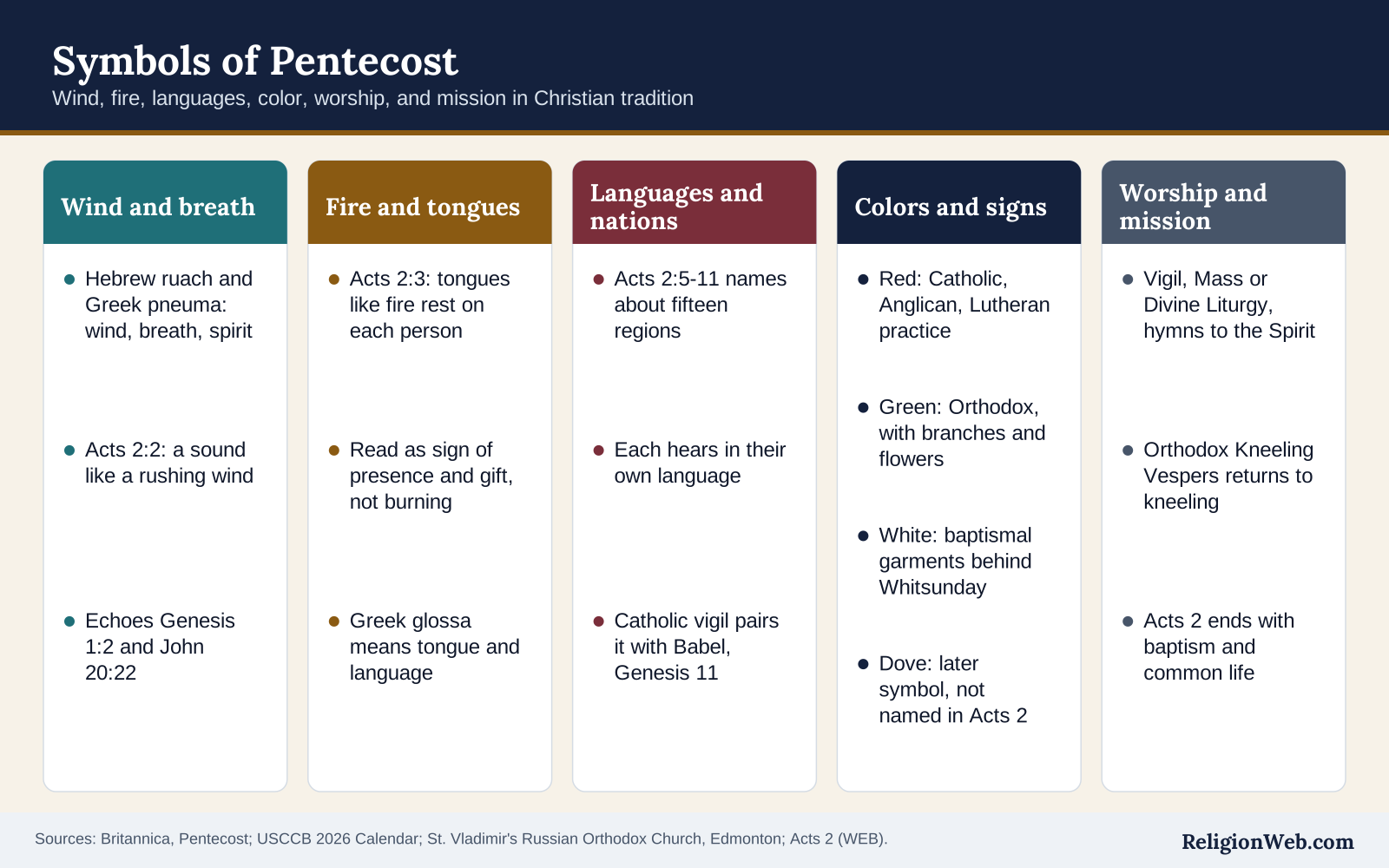
Wind is the first symbol the text offers, and it has a long reach in Christian art and speech. Because ruach and pneuma mean wind and breath as well as spirit, preachers and hymn writers have connected the sound in the house with the breath of God in creation and the breath of Jesus on the disciples in John 20. The medieval French custom of blowing trumpets during the service, recorded in the Catholic Encyclopedia, recalled the rushing sound of Acts 2 in this spirit.
Wind also conveys an idea that Christians find meaningful in the Pentecost story: the Spirit is not controlled. Jesus says in John 3:8 that the wind blows where it chooses, and Acts shows the Spirit moving unexpectedly across boundaries. The symbol therefore emphasizes both presence and freedom.
Fire and Tongues
Fire has deep roots in biblical accounts of the presence of God, including the burning bush in Exodus 3 and the fire on Mount Sinai in Exodus 19, which is a reading at the Catholic Pentecost vigil. At Pentecost the fire appears as tongues, and the double meaning of the word is hard to miss. The Greek word glōssa means both the physical tongue and a language, so the image fuses a flame with the gift of speech. The tongues are “distributed” and rest on each person individually, and many preachers observe that the fire does not consume but empowers. Churches often carry the symbol in worship through candles, red paraments, and banners with flame motifs.
Interpreters generally read the fire as a sign of divine presence and purification, and the flames over each head as an affirmation that every member of the community receives the gift. The text itself does not say that the fire burned anyone or anything, a point taken up in the section on misconceptions.
Color, Image, and Place
Red, Green, and White
The liturgical colors of Pentecost vary by tradition. In the Roman Catholic calendar the day is red, and the U.S. calendar lists Pentecost Sunday as a red solemnity; Britannica notes that red vestments represent the tongues of fire and that some congregations wear red as well. Anglican, Lutheran, and many other Western churches also use red on the Day of Pentecost. In Orthodox practice, by contrast, green is the liturgical color of the feast, and churches, especially in Slavic traditions, are decorated with green branches, grass, and flowers, which are said to express new life and the Spirit. The English name Whitsunday points to a third color, white, recalling the baptismal garments of the vigil.
The Dove, the Icon, and Western Painting
The dove is the most familiar symbol of the Holy Spirit, but its source is not Acts 2. The Gospels describe the Spirit descending like a dove at Jesus’s baptism (for example, Mark 1:10), and the image of the dove was later associated with Pentecost in Western art and hymns. Many churches display a dove alongside the tongues of fire on Pentecost banners, which can leave the impression that Acts mentions a dove when it does not.
In the Orthodox tradition the feast is typically shown in an icon with the apostles seated in a semicircle and rays or tongues of fire descending toward each. Many icons include a dark space at the bottom with a crowned figure who represents the world, or cosmos, waiting for the message, and the place at the top of the semicircle is often left empty, a convention commonly explained as indicating the invisible presence of the Spirit. Western painters from Giotto to Titian and El Greco depicted the scene differently, often placing Mary at the center of the gathered disciples with flames above them, in line with the mention of Mary in Acts 1:14. Both traditions use art as a form of teaching, much as the lectionary and hymnody do.
The Upper Room Tradition
Acts mentions an upper room in Jerusalem in chapter 1 and “the house” in chapter 2 but gives no address. Christian tradition identifies the setting with the Cenacle on Mount Zion, a medieval building that sits above a site long associated with the Last Supper and Pentecost. Historians treat the identification cautiously because the earliest explicit evidence for the location comes centuries after the events. For many Christian pilgrims, however, the Cenacle has long been a place for reading Acts 2 and praying for the Spirit.
| Symbol | Source | Usual meaning in Christian teaching | Where it appears |
|---|---|---|---|
| Wind or breath | Acts 2:2; Hebrew ruach and Greek pneuma; John 20:22 | The Spirit as divine breath, power, and freedom | Hymns, trumpet or organ effects, readings |
| Tongues of fire | Acts 2:3 | Divine presence, purification, and the gift of speech given to each person | Red paraments, candles, banners, icons |
| Dove | Gospel baptism scenes, such as Mark 1:10 | The Spirit’s gentle descent; peace | Banners, stained glass, art |
| Red | Roman and Western liturgical practice | Fire, love of the Spirit, and sometimes the martyrs | Vestments and altar cloths in Catholic, Anglican, and Lutheran churches |
| Green | Orthodox practice | New life and the Spirit’s renewal | Branches, grass, and flowers in Orthodox churches |
| White | Baptismal garments; the Whitsunday name | Baptism and new life in Christ | Baptismal gowns, Whitsuntide customs |
| Languages and nations | Acts 2:5-11 | The message addressed to all peoples | Multilingual readings and prayers |
Worship on Pentecost: Liturgy, Prayer, and Practice
Catholic and Other Western Liturgical Practice
The Vigil and the Mass of the Day
In the Roman Catholic Church the celebration of Pentecost begins on Saturday evening, with a vigil Mass that echoes the structure of the Easter Vigil. The 2026 U.S. Catholic calendar lists the vigil readings as Genesis 11:1-9 (the tower of Babel), Exodus 19:3-8 and 16-20 (the covenant at Sinai with fire and thunder), Ezekiel 37:1-14 (the valley of dry bones), or Joel 3:1-5, followed by Romans 8:22-27 and John 7:37-39, which speaks of rivers of living water. The vigil is thus a compact survey of the biblical themes that Christians associate with the Spirit: scattered languages, covenant, new life from breath, and prophetic promise. An extended vigil with additional readings, hymns, and blessings is also permitted.
On Sunday itself the Mass of the Day is celebrated in red vestments. The first reading is Acts 2:1-11 in every year of the lectionary cycle. In 2026 the second reading was 1 Corinthians 12:3-7 and 12-13, on the variety of gifts and the one body, and the Gospel was John 20:19-23. The Gospel varies in other years of the three-year cycle. Before the Gospel the assembly sings the sequence Veni Sancte Spiritus (“Come, Holy Spirit”), a medieval poem that has traditionally been attributed to several authors, including King Robert of France, according to the Catholic Encyclopedia. The Paschal candle, the large candle lit at the Easter Vigil, is traditionally kept in the sanctuary through Pentecost Sunday and then moved to the baptistry.
Hymns, Prayers, and Preaching
Pentecost has produced some of the best-loved hymns in Western worship. Veni Creator Spiritus (“Come, Creator Spirit”), traditionally attributed to the ninth-century writer Rabanus Maurus, is sung at ordinations, confirmations, and other occasions that invoke the Spirit, and the Catholic Encyclopedia notes its use at the hour of Terce on Pentecost. English-speaking congregations sing “Come, Holy Ghost” and other translations or paraphrases, and Lutheran churches sing hymns such as “Komm, Heiliger Geist, Herre Gott,” which Martin Luther adapted from a medieval antiphon. The prayers of the day ask for the gifts of unity, courage, wisdom, and love, and the preaching typically takes Acts 2, 1 Corinthians 12, or one of the Johannine passages as its starting point.
Many congregations today also mark the feast by reading the Acts passage in several languages, a practice that recalls the list of nations in Acts 2:9-11. In multilingual parishes, which are common in cities where immigrant communities share a building, this can be a simple expression of the community’s own diversity. It is a modern custom, however, and not a rite prescribed by the liturgical books.
The Return to Ordinary Time and Trinity Sunday
For Catholics, Pentecost Sunday ends the Easter season, and Ordinary Time resumes on the following Monday, the Memorial of the Blessed Virgin Mary, Mother of the Church. The Liturgy of the Hours also moves to the volume for Ordinary Time at that point. The Sunday after Pentecost is Trinity Sunday in the West, which turns attention from the event of the Spirit’s coming to the doctrine of the Trinity, and the feast of the Body and Blood of Christ follows, kept on the Thursday after Trinity Sunday or transferred to the Sunday in many countries.
Eastern Orthodox and Oriental Orthodox Practice
The Divine Liturgy and Kneeling Vespers
For Eastern Orthodox Christians, Pentecost is one of the Great Feasts of the Lord, second only to Pascha in importance, and it is observed with a vigil, the Divine Liturgy, and a distinctive service of Vespers. According to a description published by an Orthodox parish, Kneeling Vespers is served immediately after the Liturgy and marks the first time since Pascha that the congregation kneels. Three long prayers, attributed to Saint Basil the Great, are read while the congregation is on its knees. They address the Father and focus on the Holy Spirit, asking for mercy, the Spirit’s indwelling, strength for the Christian life, and rest for those who have died.
The act of kneeling carries weight because of the discipline of the fifty days. Throughout the Paschal season the early church prayed standing as a sign of resurrection joy, as the earlier discussion of Nicaea noted, and Pentecost evening is the point at which kneeling returns. In Orthodox tradition the feast is also called Trinity Sunday, and an icon of the Holy Trinity, often the one known as the Hospitality of Abraham, is commonly placed at the center of the church, as the same parish source describes.
Greens, Flowers, and Remembrance of the Departed
Orthodox churches, especially in Slavic traditions, are decorated for Pentecost with green branches, grass, and flowers, and worshipers sometimes hold branches or flowers during the services. Green is the color of the feast, and the decorations are explained as signs of new life and of the Spirit who renews creation. The Catholic Encyclopedia similarly records that Russians carried flowers and green branches on the feast. In many Orthodox communities the Saturday before Pentecost is also a day of prayer for the departed, though local calendars differ on the details.
The days after Pentecost continue the celebration. Monday is the day of the Holy Spirit, the first day of the afterfeast, and the following Sunday is the Sunday of All Saints, which opens the next liturgical period. The Eastern Catholic churches, which are in communion with Rome and follow Byzantine liturgical customs, share much of this pattern.
The Oriental Orthodox Churches
The Oriental Orthodox churches, including the Coptic, Ethiopian, Armenian, and Syriac traditions, also keep the fifty days and the feast of Pentecost according to their own liturgical books and calendars. In the Coptic tradition, as in the Byzantine, the fifty days are a time without fasting, and kneeling prayers are taken up again at their close. Local usage varies, and readers who want details about a particular church should consult its own calendar or the article on the Oriental Orthodox churches.
Anglican, Lutheran, Reformed, and Other Protestant Observance
Whitsunday and the Prayer Book Tradition
In Anglican churches the day is called Pentecost, the Day of Pentecost, or Whitsunday. The First Prayer Book of Edward VI (1549) established the name Whitsunday, and later editions retained it. In the Church of England’s modern service books red is the usual color, and the season of Whitsuntide has traditionally been a time for baptisms and confirmations. The Anglican Communion is internationally diverse, so practice ranges from Prayer Book Evensong to informal services. Since 2016, a prayer initiative called Thy Kingdom Come, launched by the archbishops of Canterbury and York, has invited Christians to pray between Ascension Day and Pentecost for friends and neighbors to come to know Christ, and many other denominations have joined in.
Confirmation, Baptism, and Church Celebrations
Lutheran churches treat Pentecost as one of the principal feasts of the church year and use red paraments, and the day has long been popular for baptisms and for confirmation, the rite in which baptized young people affirm their faith. In parts of Europe, confirmation traditionally falls in the spring around Easter or Pentecost, and families gather for a meal afterward. Catholics, by contrast, confirm at various times determined by the local bishop, and the Orthodox administer chrismation immediately after baptism. Because denominations differ about the relationship among baptism, confirmation, and the gift of the Spirit, the Pentecost connection is felt differently from church to church. The wider Protestant family includes traditions that observe the day with great solemnity and others that mark it more simply.
Churches Without a Liturgical Calendar
Many evangelical, Baptist, and independent congregations do not follow a formal church calendar, though most mention Pentecost in preaching or hold a special service. In Pentecostal and charismatic congregations the day often receives special emphasis because of the movement’s identification with Acts 2, as the later section on the movement explains. Services may include prayer for the Spirit’s gifts, testimonies, and worship in several languages. How a particular congregation marks the day depends on its own tradition and leadership.
| Tradition | Typical color | Distinctive practices | Following feast or season |
|---|---|---|---|
| Roman Catholic | Red | Saturday vigil with Old Testament readings; Acts 2:1-11 on Sunday; the sequence Veni Sancte Spiritus | Ordinary Time resumes on Monday; Trinity Sunday follows |
| Eastern Orthodox | Green | Divine Liturgy followed by Kneeling Vespers with three prayers attributed to Saint Basil; churches decorated with greenery and flowers | Monday of the Holy Spirit; Sunday of All Saints |
| Oriental Orthodox | Varies by church | Fifty-day season followed by feast and prayers according to each church’s books; kneeling resumed in some traditions | Follows each church’s own calendar |
| Anglican | Red | Day of Pentecost or Whitsunday; baptisms and confirmations; Thy Kingdom Come prayer period beforehand | Trinity Sunday |
| Lutheran | Red | Hymns of the Holy Spirit; confirmations in some regions | Trinity Sunday |
| Pentecostal and charismatic | No set color | Special services stressing the Spirit’s gifts, prayer, testimonies, multilingual worship | Varies by congregation |
Customs, Holidays, and Local Traditions Around the World
Whit Monday and Public Holidays
A Holiday in Much of Europe
In many countries Pentecost is not a one-day event, because the Monday after it, known as Whit Monday or Pentecost Monday, is a public holiday. The list of countries where this applies includes Germany, Austria, Belgium, Denmark, France, Hungary, Luxembourg, the Netherlands, Norway, and most of Switzerland, though the legal status of the holiday differs from place to place. In Germany the days around the feast carry the name Pfingsten and are a long weekend for travel and family gatherings, in some regions with local processions or festivals. The United Kingdom observed Whit Monday as a bank holiday until 1964, trialed a late-May Monday for several years, and in 1971 replaced it with a fixed Spring Bank Holiday on the last Monday in May, so the holiday no longer follows the Christian calendar.
What the Monday Means in Church
Within the churches the Monday has its own character. For Eastern Orthodox and Eastern Catholic Christians it is the day of the Holy Spirit, when many Pentecost hymns are repeated and special canons to the Spirit are sung. For Roman Catholics it is now the Memorial of Mary, Mother of the Church, which marks the return to Ordinary Time. Historically the Monday and Tuesday after Pentecost were also days of rest in Western Europe, as the Catholic Encyclopedia records, which helps explain why the Monday survives as a civil holiday in many countries even where regular church attendance has declined.
Seasonal and Folk Customs
Greenery, Flowers, and Spring
Pentecost falls in late spring in the Northern Hemisphere, and many traditions have joined the feast to the greening of the landscape. In Russia and other Eastern Slavic cultures, the feast, often called Trinity Day, is associated with decorating churches and homes with fresh branches and flowers, and in Ukraine and Poland, popular names for the season such as “Green Holidays” refer to the same custom. In parts of Germany and neighboring countries, villages traditionally set up decorated trees or branches around Pentecost, a custom that overlaps with older spring celebrations. These practices are best understood as local expressions that Christians attached to the feast, not as part of its liturgy.
Roses, Trumpets, and Whitsun Fairs
The Catholic Encyclopedia, writing in 1912, records some of the most distinctive older customs. In Italy, rose petals were scattered from the ceilings of churches to recall the tongues of fire, giving the feast the name Pascha rosatum. In France, trumpets were blown during the services to evoke the sound of the mighty wind. In England, Whitsun brought horse races and “Whitsun ales,” festive gatherings with plays, which had become nearly obsolete by the early twentieth century. A related custom is reported at the Pantheon in Rome, a church known as Santa Maria ad Martyres, where rose petals are dropped through the opening in the dome on Pentecost. Whitsun processions and “Whit Walks” by churches and Sunday schools were also a feature of industrial towns in northern England well into the twentieth century. In the Church of England a “pentecostal” was also the name of an offering made at Whitsuntide.
Pentecost and Pentecostalism: A Feast and a Movement
A Movement Named for the Feast
Topeka, Los Angeles, and Azusa Street
The word “Pentecostal” in modern usage most often refers to a family of Christian churches that arose in the early twentieth century, not to the observance of the feast. The movement grew out of the nineteenth-century Holiness movement and took its name from the Pentecost story, because its members sought a renewal of the experience described in Acts 2. In 1901 a student named Agnes Ozman at Charles Parham’s school in Topeka, Kansas, spoke in tongues, and Parham taught that speaking in tongues was the “Bible evidence” of baptism in the Holy Spirit. William J. Seymour, an African American preacher who had attended Parham’s school in Houston, brought the teaching to Los Angeles in 1906.
Seymour preached from Acts 2:4, and in April 1906 he and others spoke in tongues at a home on Bonnie Brae Street. Services soon moved to a former church building on Azusa Street, which held several hundred people and drew visitors from across the country. The mission was unusual for its time in that Black and white worshipers prayed together under a Black pastor, and Seymour hoped the shared experience of the Spirit would cross racial and denominational lines. Frank Bartleman, a participant whose reports were widely reprinted in the Holiness press, wrote that “Pentecost has come to Los Angeles.” Seymour’s paper, The Apostolic Faith, circulated widely, and visitors carried the message elsewhere. The Assemblies of God was formed in 1914.
The Charismatic Renewal and Global Growth
A second wave, usually called the charismatic movement, began among mainline Protestants in the United States in 1960, according to the Pew Research Center, and it extended similar beliefs and practices into Catholic, Orthodox, and other non-Pentecostal churches. The Pew Research Center’s 2011 report on global Christianity, using estimates for about 2010 from the Center for the Study of Global Christianity, counted about 279 million Pentecostals and about 305 million charismatics, together roughly 27 percent of all Christians and more than 8 percent of the world’s population. About 44 percent of Pentecostals lived in sub-Saharan Africa and 37 percent in the Americas. Pew notes that these figures come mainly from Christian organizations rather than censuses and surveys, so they are best treated as estimates, and they describe the situation around 2010, not today.
Keeping the Terms Apart
Feast and Movement: How the Words Differ
Confusion between the two meanings is common, and it matters for reading news, church directories, and search results. “Pentecost” names the day and the season, observed by a wide range of churches. “Pentecostal” names a set of churches and a theology, whose members may or may not hold a special service on the feast day. Many Catholics, Orthodox Christians, Anglicans, and Lutherans celebrate Pentecost and are not Pentecostal in the movement’s sense, and the reverse is also true of some Pentecostal congregations that do not follow a church calendar.
| Term | What it refers to | Typical users | Common confusion |
|---|---|---|---|
| Pentecost | The Christian feast on the fiftieth day after Easter, and the biblical event in Acts 2 | Catholic, Orthodox, Anglican, Lutheran, and many other churches | Assumed to be a fixed-date holiday or the name of a denomination |
| Whitsunday / Whitsuntide | Traditional English names for Pentecost Sunday and the days around it | Anglican and British usage | Taken to be a separate festival |
| Pentecostalism | A movement of churches dating from the early twentieth century that stresses baptism in the Holy Spirit and spiritual gifts | Assemblies of God, Church of God in Christ, and many independent churches | Equated with the feast |
| Charismatic movement | Renewal beginning about 1960 that spread similar practices into Catholic, Orthodox, and Protestant churches | Members of non-Pentecostal denominations and independent networks | Treated as identical to Pentecostalism |
| Speaking in tongues (glossolalia) | A form of spiritual speech described in Acts 2 and 1 Corinthians 12 to 14 | Pentecostal and charismatic Christians; also discussed by scholars of all traditions | Assumed to be required of all Christians |
How Pentecostal Churches Mark the Day
For Pentecostal Christians, Acts 2 is a model for the church’s life, and many hold special services on Pentecost Sunday, often with prayer for the Spirit, testimonies, and multilingual worship. Others do not emphasize the liturgical calendar, treating every Sunday as an occasion for the Spirit’s work. The difference between a church that uses a calendar and a church that emphasizes experience of the Spirit is not a difference of reverence for Acts 2, and readers should avoid assuming that either group is more or less devoted to the Pentecost story.
Common Misconceptions About Pentecost
Misconception 1: Pentecost and Pentecostalism Are the Same Thing
Where the misunderstanding comes from
The confusion is understandable because the two words share a root, and because the Pentecostal movement named itself deliberately after the biblical event. When a news story mentions a Pentecostal church, readers may assume it is a church that celebrates Pentecost, and when they see a Pentecost Sunday service, they may assume it belongs to a Pentecostal congregation. Search results and church directories add to the mix by listing both meanings under the same word. The movement’s own history strengthens the link: its founders sought a renewal of the Acts 2 experience, and Frank Bartleman’s report that “Pentecost has come to Los Angeles” shows how closely they tied their work to the feast’s name.
What the evidence and tradition actually show
The feast and the movement are distinct in history, scope, and practice. Pentecost is an observance with roots in the early centuries of the church, kept by Catholic, Orthodox, Anglican, Lutheran, and many other Christians who do not belong to the Pentecostal movement. Pentecostalism is a family of churches that emerged in the early twentieth century, associated with events in Topeka in 1901 and Los Angeles in 1906, and it stresses a post-conversion baptism of the Holy Spirit and gifts such as speaking in tongues. Pew Research Center estimated about 279 million Pentecostals around 2010, a figure that describes a movement within Christianity, while the feast is observed by a much larger and more varied group.
Naming conventions add further complications. Some denominations carry the word in their official names, such as the Pentecostal Holiness churches or the United Pentecostal Church International, while a parish of Catholic or Orthodox Christians may hold a “Pentecost” service without any link to the movement. In many languages the words are close cousins, which is why translators and journalists sometimes need to clarify which sense is meant.
The reverse also holds. Many Pentecostal churches mark Pentecost Sunday, but some do not follow a liturgical calendar, and their identity does not depend on the feast. A reader who wants to understand either subject accurately should treat them as related but separate, as the terminology table in the previous section shows.
Misconception 2: Pentecost Always Falls on a Fixed Calendar Date
Where the misunderstanding comes from
Many well-known Christian holidays are tied to a fixed date, such as December 25 for Christmas, and it is natural to expect the same of Pentecost. Public-holiday calendars that list “Whit Monday” in a different spot each year can add to the puzzle, and it is not obvious to most readers that the date of Pentecost is generated by a counting rule rather than assigned to a day of the month. In addition, the story of Acts 2 is set on a Jewish festival with its own calendar, so some assume that Christians simply follow that date. The Jewish festival is kept on a fixed date in the Hebrew calendar, the sixth day of the month of Sivan, and readers who know that detail sometimes expect the Christian feast to match it. The Christian date is instead set by the count from Easter, so the two observances may fall close together in some years and several weeks apart in others.
What the evidence and tradition actually show
Pentecost is a movable feast. It is always the seventh Sunday after Easter, the fiftieth day when Easter Sunday is counted as the first, and because Easter moves, so does Pentecost. In the Western calendar it falls between May 10 and June 13, although in the present century the earliest date is May 11. In 2026 it fell on May 24 for Western churches and on May 31 for Orthodox churches, which calculate Easter by the Julian reckoning, and in 2027 the dates are May 16 and June 20 respectively. In the Orthodox calendar Pentecost can fall between May 23 and June 26 in Gregorian dates during this century.
The reason is partly historical. The earliest Christians who celebrated the fifty days tied them to the resurrection, and the resurrection was remembered on a Sunday that itself depended on the date of the Jewish Passover and later on the ecclesiastical full moon. The result is a feast whose date is calculated, not assigned, and a church year in which many observances, from Ash Wednesday to Pentecost, are measured from Easter.
The same logic applies to related observances. Ascension Day, forty days after Easter, moves with it, as does Whit Monday and the Western Trinity Sunday. A calendar that treats Pentecost as a fixed date is therefore mistaken, and anyone planning a service, trip, or holiday should consult the year’s Easter date first. The section on dating above explains the rule in more detail.
Misconception 3: Acts Describes Ordinary Fire Physically Burning the Disciples
Where the misunderstanding comes from
Popular retellings, children’s illustrations, and films often show flames dancing above the apostles’ heads, sometimes with dramatic effects, and some versions imply a literal blaze. Because fire is dangerous in daily experience, readers who take the image at face value may picture the disciples in physical peril or may dismiss the story as implausible. English translations also use the word “fire” in a way that can sound more literal than the original, and the idea of “tongues” of flame can seem to describe a natural phenomenon.
What the evidence and tradition actually show
The text does not describe burning. The World English Bible says that “tongues like fire appeared and were distributed to them, and one sat on each of them.” The key word is “like”: the Greek phrase indicates a likeness to fire, in the same way that the sound is described as being like a rushing wind. Nothing in Acts says anyone was harmed, that anything was set alight, or that the phenomenon was ordinary combustion. Fire in biblical writing often signals the presence of God without destroying what it touches, as in the burning bush of Exodus 3, and Christian interpreters have generally read the Pentecost fire in that tradition.
Christians vary in how they understand the nature of the appearance. Some regard it as a visible manifestation, some as a vision or symbol, and some leave the question open, but mainstream commentary across Catholic, Orthodox, and Protestant traditions treats it as a sign of the Spirit’s presence and gifts, not as a natural fire. The image that a flame rests on each person, not on the group alone, is read as meaning that the gift is given to each member of the community. Preachers and teachers also point out that artists have taken liberties, adding flames that the text does not require, and that the Orthodox icon tradition typically shows rays or small tongues of light, not a blaze. Readers can test any retelling against the four short verses of Acts 2:1-4 and see which details are in the text and which belong to later art.
Misconception 4: The Holy Spirit First Appeared at Pentecost
Where the misunderstanding comes from
Because Pentecost is described as the day the Spirit “came,” many readers assume that the Spirit was absent before then. Popular summaries sometimes say that Pentecost is when the Holy Spirit “arrived” or “was born,” and the phrase “birthday of the church” adds to the impression of a single starting point. The Acts narrative itself is dramatic, and it is easy to overlook the earlier scriptural references. Hymns and prayers that ask the Spirit to “come” at Pentecost can leave the same impression, since they speak as though the Spirit were absent and awaited. Liturgical language of invocation, however, expresses a request for renewed presence and gifts, and it does not by itself assert that the Spirit had never been active before.
What the evidence and tradition actually show
The Bible speaks of the Spirit of God long before Acts 2. The Spirit moves over the waters in Genesis 1:2, empowers leaders and prophets in the Hebrew Bible, and is associated with the conception and baptism of Jesus in the Gospels. In John 20:22, the risen Jesus breathes on his disciples and tells them to receive the Holy Spirit, weeks before Pentecost in the narrative sequence. In the life of Jesus as the Gospels tell it, the Spirit is active throughout.
What Christian teaching claims about Pentecost is more specific. The Catechism of the Catholic Church says that at Pentecost the Holy Trinity is fully revealed and that the Spirit’s coming opens the time of the Church. Other traditions use different language but similar ideas, speaking of a new and public outpouring that empowers the community for witness. The better summary is that Pentecost marks a new mode of the Spirit’s presence in the life of the church, not the Spirit’s first appearance. Christians also differ on how to harmonize the Johannine and Lukan accounts, as the section on the Holy Spirit explains, and the Nicene tradition affirms that the Spirit is eternally God and therefore not a new arrival in any sense.
Frequently Asked Questions About Pentecost
Questions About Meaning and Timing
What does the word Pentecost mean?
Pentecost comes from the Greek pentēkostē, meaning “fiftieth.” It named a Jewish harvest festival that fell fifty days after Passover, and Christians adopted it for the feast of the Spirit’s coming because Acts places the event on that day. In early Christianity the word could also refer to the entire fifty-day season after Easter, which is why some older texts speak of “the days of Pentecost.”
When is Pentecost in 2027?
In 2027, Western churches keep Pentecost on May 16, and Orthodox churches on June 20, according to the standard calculation of Easter and the fifty-day count. Western Easter falls on March 28 in 2027 and Orthodox Pascha on May 2. Because local calendars can differ, a parish or diocesan calendar is the best source for a specific service time.
Why is Pentecost fifty days after Easter?
The interval comes from two sources. In the Jewish calendar of the first century, the festival of Weeks was counted as seven weeks plus a day from the start of the grain harvest, and the Christian feast was linked to it by Acts, which sets the Spirit’s coming on that festival. In the church’s own calendar the count runs from Easter Sunday, so the fiftieth day is a Sunday seven weeks later. The result gives a full “week of weeks” of resurrection joy.
Questions About Practice and Belief
What color is worn at Pentecost and why?
Red is the usual color in Catholic, Anglican, Lutheran, and many other Western churches because it recalls the tongues of fire. In Orthodox practice green is the color of the feast, with churches decorated with branches and flowers to suggest new life. Some traditions also recall white, the color of the baptismal garments after which Whitsunday is traditionally named. Congregations sometimes ask worshipers to wear red as a sign of unity.
Is Pentecost the birthday of the church?
Many Christians describe it that way, and the phrase is common in sermons, but it is a popular expression and not a formal definition. Catholic teaching speaks of the Spirit’s coming as opening the time of the Church, and other traditions express similar ideas in their own language. Some scholars point out that Acts shows a community of followers already gathered before Pentecost, so they prefer to speak of the church’s public beginning or empowerment.
Do all Christians celebrate Pentecost?
Most Christian churches do, though in different ways and with different degrees of emphasis. Catholic, Orthodox, Oriental Orthodox, Anglican, Lutheran, Reformed, and Methodist churches have set services for the day, while some evangelical and independent churches may mention the feast without holding a formal observance. Pentecostal churches often give the event special attention, and the earlier section on the movement explains the relation between the two.
Conclusion: What Pentecost Shows
What the History and Practice Show
A Feast of Fifty Days That Became a Day
Pentecost began as a Jewish harvest pilgrimage, entered the Christian story through the narrative of Acts 2, and grew into a season and then a single feast marked by vigil, baptism, hymn, and symbol. The fifty-day count that gives it its name remains visible in the way Easter and Pentecost are linked, and it explains why the feast moves each year. Its history shows how Christian communities have used the calendar to interpret an event they understood as the beginning of their public mission.
One Story, Several Emphases
The traditions that keep Pentecost tell the same story and emphasize different parts of it. Catholic worship highlights the sacramental life of the church, Orthodox worship the Trinity and the Spirit’s renewal of creation, Anglican and Lutheran worship baptism and the prayer of the Spirit, and Pentecostal churches the continuing experience of the Spirit’s gifts. Each reads Acts 2 through its own tradition, and each has a place in the wider story of Christianity.
How to Keep Exploring
Related Articles on ReligionWeb.com
To place Pentecost in the larger Christian year, read the articles on Lent, Easter, and Christmas. For the central rites that the Acts account joins to the Spirit’s coming, see baptism and the Eucharist. For the scriptural background, the article on the Bible explains how Acts fits into the New Testament.
Reading Acts 2 for Yourself
The most direct way to understand the feast is to read the second chapter of Acts in a translation you trust, together with the first chapter and Leviticus 23, and then to notice how different churches read the passage in their worship. Readers can compare how their local parish or congregation marks the day, ask a pastor or priest about the customs, and consult the church’s own calendar for dates. The questions the passage raises about language, community, and the work of the Spirit are ones that Christians continue to discuss.
Sources
The table below lists the principal external sources behind this article. Facts, dates and figures were checked against these and related primary, institutional and academic materials.
| # | Source | Publisher and type | Used for | Link |
|---|---|---|---|---|
| 1 | World English Bible, Acts 2 | eBible.org (World English Bible, public domain) · Primary text | Quoted Acts 2 passages (2:1-6, 2:9-11, 2:17, 2:38, 2:41-42) | ebible.org |
| 2 | Leviticus 23:15-16, The Holy Scriptures: A New Translation (JPS 1917) | Sefaria · Primary text | Quoted fifty-day count of the Feast of Weeks in Leviticus 23 | sefaria.org |
| 3 | Pentecost (Whitsunday), The Catholic Encyclopedia (1912) | New Advent · Encyclopedia | Name, early evidence, vigil and baptism, octave, medieval customs | newadvent.org |
| 4 | Pentecost (Christianity) | Encyclopaedia Britannica · Encyclopedia | Definition, date rule, Whitsunday, early references, red vestments | britannica.com |
| 5 | 2026 Liturgical Calendar | United States Conference of Catholic Bishops · Institutional | Western Easter and Pentecost 2026, vigil and Day readings, red, return to Ordinary Time | usccb.org |
| 6 | Catechism of the Catholic Church, paragraphs 731-741 | The Holy See (Vatican) · Institutional | Catholic teaching on Pentecost, the Trinity, and the time of the Church | vatican.va |
| 7 | The Feast of Pentecost: explanation and practice | St. Vladimir's Russian Orthodox Church, Edmonton · Institutional | Orthodox Kneeling Vespers, green, Trinity icon, Monday of the Holy Spirit | stvladimirs.ca |
| 8 | May 2026 parish calendar (Orthodox) | Orthodox parish, Hawaii · Institutional | Orthodox Pentecost and Kneeling Vespers on May 31, 2026 | orthodoxhawaii.org |
| 9 | Global Christianity: Movements and Denominations | Pew Research Center (2011; data circa 2010) · Demographic data | Pentecostal and charismatic definitions, estimates, and regional shares | pewresearch.org |
| 10 | Pentecostalism: William Seymour (Vinson Synan, Christian History, 2000) | Christian History Institute · Academic reference | Topeka 1901, Seymour, Azusa Street Mission 1906, Assemblies of God 1914 | christianhistoryinstitute.org |
Last fact-check date: 2026-10-21.