Shabbat is the Jewish day of rest and holiness, observed every week from shortly before sunset on Friday until nightfall on Saturday. It is the first sacred time that the Torah names. The creation account in Genesis calls the seventh day blessed and holy before Israel, the commandments or the Temple appear in the story, and Jewish tradition has treated the weekly day as a fixed point around which the rest of Jewish religious life is arranged. English speakers usually translate the word as “Sabbath,” and the two terms are used interchangeably in this article, with Shabbat preferred because it is the name Jews themselves use.
What happens on Shabbat is more than a pause from labor. The day opens with candles lit in the home and a service that welcomes the day, continues with wine, bread and a festive meal on Friday night, moves through morning prayer and a public reading from the Torah on Saturday, and closes with Havdalah, a short ceremony of wine, spices and flame that separates the holy day from the weekdays. Alongside these positive observances stands a body of rabbinic law that forbids certain categories of creative activity, called melakhot, so that the day is set apart from ordinary productive time.
The tradition is observed in very different ways. Many Orthodox and Haredi Jews keep the full structure of the day under halakha, or Jewish religious law. Conservative Jews generally keep it within a framework of law that their rabbis interpret more permissively on some questions. Reform Jews understand observance as a matter of informed personal choice, and many other Jews mark Shabbat with a family dinner, a candle or a quiet day without observing the legal restrictions. Surveys point to the same range. In a Pew Research Center study of American Jews, fieldwork for which ran from late 2019 to mid-2020, 39 percent said they at least sometimes marked Shabbat in a way that was meaningful to them, though not necessarily according to Jewish law.
This article explains the day in the order a participant would meet it: its name and vocabulary, its timing, its biblical and rabbinic foundations, the preparations and rituals of Friday night, the prayer and Torah reading of Saturday, and Havdalah. It then turns to the legal categories of rest, the variations among households and movements, and the day’s place in contemporary life. Dates follow the common era, and a note on language applies throughout: Hebrew terms are transliterated in the forms most common in English, so that variants such as Shabbos (the Ashkenazi pronunciation) or Shacharit and Shaharit refer to the same things.
Shabbat at a Glance: Meaning, Name and Core Vocabulary
What Shabbat Is and What It Means
A weekly holy day grounded in the Torah
Jewish tradition understands Shabbat as a commandment, a gift and a sign. It is a commandment because the Torah instructs Israel to remember and observe the seventh day. It is a gift because rabbinic sources describe it as a day of delight, with special food, rest and company. It is a sign because the Torah itself, in the passage in Exodus 31, calls Shabbat a sign between God and the people of Israel. Unlike the festivals, it does not depend on the moon, the harvest or a historical anniversary. It recurs every seven days in a count that Jewish communities understand to have continued without interruption, whatever the month or season.
The day is also the hinge of the Jewish week. The Hebrew names of the weekdays are numbered rather than named: Sunday is “first day,” Monday “second day,” and so on, with Friday as the “sixth day” and Saturday as Shabbat itself. The numbering means that every weekday points forward to the next Shabbat. The festivals of the year, such as Passover and Rosh Hashanah, are tied to the Hebrew calendar and can fall on any day of the week, but Shabbat keeps its own pattern and can coincide with them.
Rest as sanctification, not only recovery
It would be easy to describe Shabbat as a day off, and for many people the rest it provides is a real and welcome part of it. Yet the Hebrew Bible and the later tradition frame the day as kedushah, holiness, before they describe it as relaxation. In the creation story God does not simply stop; God blesses the seventh day and sanctifies it. Jewish teaching therefore asks participants to treat the time itself as set apart, and rest becomes a way of entering that time. The Hebrew word menuchah, often rendered “rest,” carries the sense of settledness and repose rather than mere inactivity.
That framing explains why the day includes obligations as well as prohibitions. Observant Jews are expected to honor Shabbat (kavod) by preparing for it, and to take delight in it (oneg) through meals, song, study, and time with family and friends. A person who rests on Shabbat by avoiding the forbidden labors but spends the day without prayer, meals or company would, in the tradition’s terms, have kept only half of it.
The Name and Its Uncertain Origins
Shabbat, shavat and the English “Sabbath”
The Hebrew noun Shabbat is generally connected to the verb shavat, meaning “to cease” or “to rest,” a verb used in the creation account when God rests from the work of creation. The relationship between noun and verb is not as simple as it looks, however. Scholars have long noted that it is unclear whether the verb gave rise to the noun or the noun to the verb, and some reference works observe that the word’s deeper origin is obscure. The English “Sabbath” reached English through Greek and Latin forms of the Hebrew word, and “Shabbos,” common among Ashkenazi Jews of Eastern European descent, reflects the way the final consonant was pronounced in that region.
Because the origin of the word is uncertain, this article does not rely on any single etymology. The next sections describe what the biblical texts say about the day and what historians can and cannot say about its earliest history. The point to hold for now is that, whatever the earlier background, the word and the institution have been continuously Jewish for well over two thousand years.
Greetings, names of special Shabbatot and the Talmud tractate
The ordinary greeting on the day is Shabbat Shalom, “a peaceful Shabbat,” or Good Shabbos among Yiddish speakers. After the day ends, people say shavua tov, “a good week.” Certain Shabbatot carry names of their own because of the Torah portion or the season. Shabbat Shuvah falls between Rosh Hashanah and Yom Kippur, Shabbat HaGadol precedes Passover, Shabbat Zakhor comes before Purim, and Shabbat Nachamu follows the summer fast of Tisha B’Av. These names show how the weekly cycle absorbs the annual one.
The word also names a major section of Jewish law. Tractate Shabbat of the Babylonian Talmud, which comments on the Mishnah’s own tractate of that name, is among the longest in the entire work and is the principal place where the legal definition of forbidden labor is analyzed. Later sections of this article draw on it.
Key Hebrew Terms for Shabbat
Terms for time, ritual and food
A short vocabulary makes the rest of the article easier to follow. The table lists the terms that recur most often, grouped loosely by the part of Shabbat in which they appear. The entries are brief definitions; each one is explained in context in the sections that follow, and spellings are those most common in English-language Jewish publications.
| Term | Meaning | Where it appears |
|---|---|---|
| Erev Shabbat | “Eve of Shabbat,” Friday | Preparation and candle lighting |
| Kabbalat Shabbat | “Welcoming Shabbat,” a Friday evening service of psalms and the hymn Lekha Dodi | Synagogue, Friday evening |
| Kiddush | “Sanctification,” the blessing over wine that declares the day holy | Friday night meal and Saturday lunch |
| Challah | Braided or round loaves used for the Shabbat meals | Each festive meal |
| Seudat Shabbat | A festive Shabbat meal; three are customary | Friday night, Saturday midday, late Saturday afternoon |
| Melakhah (plural melakhot) | The category of creative labor forbidden on Shabbat, often translated “work” | Rabbinic law of Shabbat |
| Oneg Shabbat | “Delight of Shabbat,” enjoyment of the day | Meals, song, rest, gatherings |
| Muktzeh | Objects not to be handled on Shabbat, such as tools or money | Daily conduct |
| Eruv | A symbolic enclosure that allows carrying within a defined area | Communities with an established eruv |
| Havdalah | “Distinction,” the ceremony that ends Shabbat | Saturday night after nightfall |
Terms for law, limits and community
Several of the terms in the table deserve a sentence of context. Melakhah is a technical legal word, and its relationship to the English word “work” is the subject of the section on rest and prohibited labor below. Muktzeh literally means “set aside,” and it refers to the rabbinic extension of the day’s restraint to the handling of tools, money and other objects associated with weekday labor. An eruv is a ritual boundary, often built from existing fences, utility poles and wires, within which the rabbinic prohibition on carrying objects from one domain to another is relaxed. Observant communities that maintain one treat it as part of the shared infrastructure of the neighborhood.
These terms matter because they signal that Shabbat is not a single practice but a structured system with a legal vocabulary, a liturgical vocabulary and a domestic one. A visitor at a Friday night table might hear all three in a single evening: the blessing over the wine, a comment on whether a particular object may be moved, and a hymn welcoming the day.
When Shabbat Begins and Ends: Sunset to Nightfall
Why the Jewish Day Begins at Evening
The pattern of evening and morning in Genesis
A Jewish day does not run from midnight to midnight. It runs from nightfall to the following nightfall, and the traditional reason is the pattern of the creation account, which says of each day that there was evening and there was morning. Following that sequence, the rabbis counted evening as the first part of the day. The result is that every festival and every Shabbat begins on the evening before the date a civil calendar would assign to it. Friday’s sunset belongs to Saturday, and Saturday’s sunset belongs to Sunday.
This is the main reason newcomers are sometimes surprised that the “real” Shabbat meal is Friday night, not Saturday. For observant Jews, Friday evening is not the eve of the day in a sentimental sense; it is the opening of the day itself, and the first prayer, blessing and meal of Shabbat all fall within it. The same reckoning governs the festivals described in the articles on Yom Kippur and other holy days.
From sunset to nightfall: the working rule
In practice, Jewish law does not ask people to guess the moment of nightfall. It sets a conservative boundary at each end. Because there is uncertainty about exactly when night begins, rabbinic law treats the period of twilight, called bein hashmashot, as doubtful time, and in cases of doubt about a rule that comes from the Torah, the cautious course is followed. Shabbat is therefore treated as beginning at sunset (shekiah) and as ending only when night has clearly arrived (tzeit hakochavim, “the emergence of the stars”). A contemporary halakhic commentary, Rabbi Eliezer Melamed’s Peninei Halakha, describes the Talmudic discussion in which the sages disagree about how long twilight lasts and how it is measured, and it notes that later authorities differ on the length of the interval.
Many communities also add a few minutes at the beginning of Shabbat by lighting candles before sunset. The custom, called tosefet Shabbat, “addition to Shabbat,” means that a person accepts the sanctity of the day a little ahead of the exact boundary. Taken together, the early start and the late finish give Shabbat a length of roughly twenty-five hours.
Candle Lighting, Sunset and Nightfall in Practice
Local times and the eighteen-minute default
Because sunset changes from day to day and from place to place, Shabbat starts at a different clock time every week and in every city. Calendars solve this by publishing a local candle-lighting time. Hebcal, one of the most widely used Jewish calendar services, sets the default at eighteen minutes before sunset on the eve of Shabbat and festivals, with longer intervals by local custom for some cities: forty minutes before sunset in Jerusalem, and thirty minutes in Haifa and Zikhron Ya’akov. Chabad.org gives the same eighteen-minute figure and notes that Jerusalem lights earlier, and it also records that the earliest permissible time for lighting is plag haminchah, about an hour and a quarter before the end of the halakhic day on Friday afternoon.
The result is that in northern cities at midwinter, Shabbat can begin in the middle of a Friday afternoon, while in midsummer it may begin close to nine in the evening in cities such as London. Observant families plan the week around the local time, and many work calendars, school schedules and synagogue programs in Jewish communities are adjusted in winter for this reason.
When Shabbat ends: three stars, degrees and longer customs
The end of Shabbat is determined by tzeit hakochavim, the appearance of three stars. Traditional sources describe “three medium stars,” because large stars may be seen by day and small ones only at full night. Hebcal’s default rule translates the appearance of stars into an astronomical measure, taking nightfall as the moment the sun is 8.5 degrees below the horizon. Many communities add a fixed interval after sunset instead, with common choices of 42, 50 or 72 minutes. The longest of these, seventy-two minutes, is associated with the medieval authority Rabbeinu Tam, whose view of twilight is more stringent than the one followed by most Jewish communities. According to Peninei Halakha, customary practice in the Land of Israel follows the earlier authorities, called Geonim, and not Rabbeinu Tam, although some people adopt the 72-minute standard as an additional stringency.
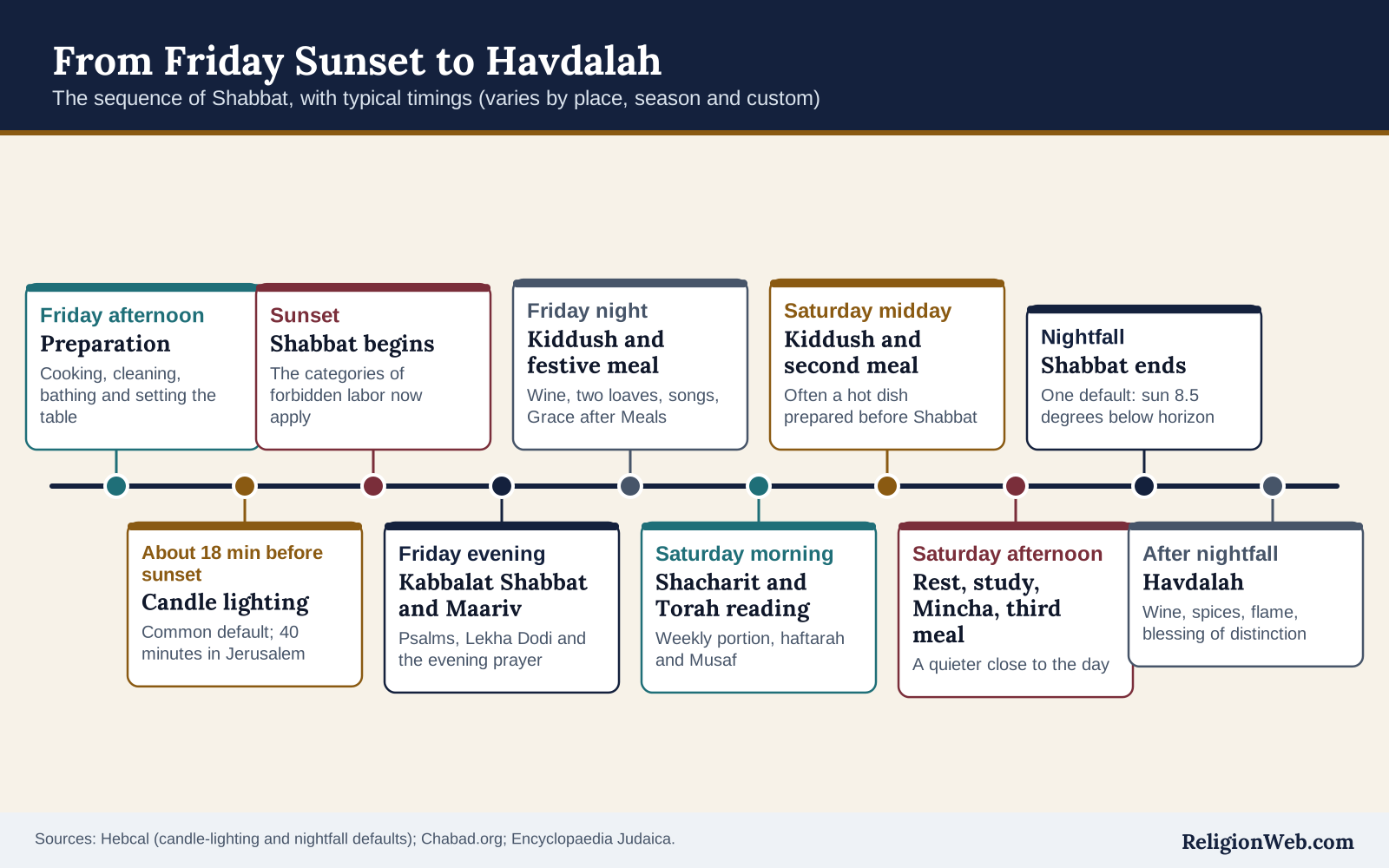
The table gathers the whole sequence of the day in order, and shows where each ritual falls in relation to the sun. Every time listed after the first is approximate, because the exact minutes depend on the place, the season and the custom of the community.
| Stage | Approximate timing | What happens |
|---|---|---|
| Preparation | Friday, before candle lighting | Cooking, cleaning, bathing, setting the table; food and light arranged in advance |
| Candle lighting | About 18 minutes before sunset in many communities (40 in Jerusalem) | Candles are lit and the blessing recited; for many, this marks the acceptance of Shabbat |
| Shabbat begins | Sunset | The categories of forbidden labor now apply |
| Evening prayer | Early Friday night | Kabbalat Shabbat and Maariv in the synagogue |
| Friday night meal | After the evening service | Kiddush, two loaves, courses, songs and Grace after Meals |
| Morning service | Saturday morning | Shacharit, Torah reading, haftarah and Musaf |
| Midday meal | After services | Kiddush and the second festive meal |
| Afternoon | Saturday afternoon | Rest, study, walks, visits; Mincha prayer and the third meal |
| Shabbat ends | Nightfall (for example, sun 8.5° below horizon) | Evening prayer and the transition back to weekday time |
| Havdalah | After nightfall | Wine, spices, flame and the blessing of distinction |
Biblical Foundations and the Early History of Shabbat
What the Hebrew Bible Says About the Seventh Day
Creation: God rests, blesses and hallows the seventh day
The first appearance of the seventh day is in the opening chapters of Genesis, where it comes at the end of the creation account. The passage does not command anyone to rest. It describes God’s own rest and the blessing placed on the day, which is why Jewish readers have long treated it as the foundation on which the later commandments rest.
And on the seventh day God finished His work which He had made; and He rested on the seventh day from all His work which He had made. And God blessed the seventh day, and hallowed it; because that in it He rested from all His work which God in creating had made.
Genesis 2:2-3, Jewish Publication Society translation (1917), public domain
Classical Jewish commentary noticed an apparent puzzle: if the work was finished on the sixth day, how can God “finish” on the seventh? One traditional answer, associated with the medieval commentator Rashi, is that the rest was itself the last act of creation, so that the world was not complete until repose entered it. Whether or not one adopts that reading, the text ties rest and holiness together, and it gives the weekly day a place in the structure of the cosmos that no later festival has.
The Decalogue in two versions: remember and observe
The commandment itself appears twice in the Ten Commandments, with different reasons attached. In Exodus 20 the instruction begins with “Remember” and grounds the day in creation. In Deuteronomy 5 it begins with “Observe” and grounds the day in Israel’s release from slavery, with a pointed addition: the rest extends to servants, animals and the resident stranger, so that none are exploited.
Remember the sabbath day, to keep it holy.
…for in six days the LORD made heaven and earth, the sea, and all that in them is, and rested on the seventh day; wherefore the LORD blessed the sabbath day, and hallowed it.
Exodus 20:8, 20:11 (verses 9-10 omitted), JPS 1917, public domain
…and the LORD thy God brought thee out thence by a mighty hand and by an outstretched arm; therefore the LORD thy God commanded thee to keep the sabbath day.
Deuteronomy 5:15 (second half), JPS 1917, public domain
The rabbis did not treat the two versions as a contradiction. A Talmudic tradition, found in tractate Shevuot, holds that “remember” and “observe” were spoken as a single utterance, and this reading shaped later practice. “Remember” is taken to ground the positive acts, such as Kiddush and the festive meals, while “observe” grounds the prohibitions. The pairing of creation and liberation also matters for interpretation. Readers in the tradition have often heard in the Deuteronomy version a social and ethical meaning for Shabbat, a weekly interval in which hierarchy and compulsory labor are suspended.
A covenant sign, the prophets and the first legal cases
A third passage, in Exodus 31, calls the day a sign between God and the Israelites. It is this passage that the later liturgy sings, under the heading of its first word, V’shamru, “and they shall keep.”
Wherefore the children of Israel shall keep the sabbath, to observe the sabbath throughout their generations, for a perpetual covenant. It is a sign between Me and the children of Israel for ever; for in six days the LORD made heaven and earth, and on the seventh day He ceased from work and rested.
Exodus 31:16-17, JPS 1917, public domain (closing quotation mark of the original omitted)
The Torah also supplies early examples of what the day excludes without defining labor in general. Exodus 16 shows the people gathering a double portion of manna on the sixth day so that nothing need be gathered on the seventh. Exodus 35:3 forbids kindling fire in the dwellings on the Sabbath day, and Numbers 15 tells of a man found gathering wood and the penalty that followed. The prophets later treat observance as a test of covenant faithfulness. Isaiah, in a chapter that the synagogue also reads on Yom Kippur morning, describes a way of keeping the day that turns away from business and treats it as a pleasure.
If thou turn away thy foot because of the sabbath, From pursuing thy business on My holy day; And call the sabbath a delight,…
Isaiah 58:13 (opening clauses), JPS 1917, public domain
Jeremiah and Nehemiah address carrying burdens and trade on the day, and Nehemiah, after the return from exile, orders the gates of Jerusalem closed as the Sabbath approaches so that merchants cannot enter. These texts show that by the Persian period at the latest the weekly Sabbath was a recognized public institution, enforced as well as taught.
Historical Development From Second Temple Times to the Mishnah
Origins debated: a Babylonian parallel and other theories
Historians have asked where the weekly day came from, and the honest answer is that its earliest history is not settled. Some scholars have pointed to the Akkadian term shapattu, a mid-month day associated with the full moon, and have proposed a connection. As Reform Rabbi Rifat Sonsino summarizes the discussion, the Babylonian idea is one of several proposals, along with a link to a word for “seventh day,” and none has been found fully convincing. Encyclopedias of religion likewise record that the character of the Babylonian days is described differently by different scholars, and that no persuasive account explains how a monthly observance would have become a weekly one.
The biblical sources present the Sabbath as ordained by God from the creation of the world, and Jewish tradition accepts that account as a matter of faith and teaching. Academic historians work with a different set of questions about the development of Israelite practice, and their reconstructions vary. This article follows the tradition’s own understanding when it describes belief, and labels the historians’ proposals as proposals.
Second Temple strictness and the Maccabean decision
By the Second Temple period (roughly 516 BCE to 70 CE), different Jewish groups understood the Sabbath with differing degrees of rigor. The Book of Jubilees, a work that did not enter the Jewish canon but was widely read, prescribes severe penalties, death among them, for violating the day. The first-century historian Josephus reports that the Essenes were so strict that they avoided even relieving themselves on the Sabbath.
The clearest early evidence for how legal reasoning could change comes from the Maccabean revolt of the second century BCE. According to 1 Maccabees, which is preserved in the Christian canons and not in the Hebrew Bible, a group of Jews who had withdrawn to the wilderness were attacked by the Seleucid army on the Sabbath and refused to resist, and about a thousand of them died. The book says that Mattathias and his companions mourned them and reasoned that if everyone behaved the same way, they would soon be destroyed. They resolved to fight anyone who attacked them on the Sabbath. The decision became an early precedent for the principle, developed fully in rabbinic law, that the preservation of life can override the Sabbath’s restrictions.
Rabbinic consolidation in the Mishnah and Talmud
After the destruction of the Temple in 70 CE, the rabbinic sages gave Shabbat its lasting legal form. The Mishnah, edited around 200 CE, devotes entire tractates to it, among them Shabbat and Eruvin, and lists the thirty-nine principal categories of forbidden labor in Shabbat 7:2. The Mishnah in another place describes the laws of Shabbat as being like mountains hanging by a hair, since a few scriptural verses support a large body of detailed rules. The later discussion in the Talmud, which is far more extensive, connects the categories to the labors of the Tabernacle, a point developed in the section on forbidden labor below, and the Talmud also records the earliest forms of many customs: welcoming the day as a bride or a queen, reciting Kiddush over wine, and eating three meals.
| Source | Period | What it contributes |
|---|---|---|
| Genesis 2:1-3 | Biblical text | The seventh day blessed and hallowed; the basis for Kiddush |
| Exodus 20 and Deuteronomy 5 | Biblical text | The commandment in its two versions, grounded in creation and in the exodus from Egypt |
| Exodus 31 and 35 | Biblical text | The covenant sign; the prohibition on kindling fire |
| Mishnah tractates Shabbat, Eruvin and Beitzah | Edited around 200 CE | The thirty-nine categories, carrying, boundaries and the rules for festival days |
| Babylonian Talmud, tractate Shabbat | Redacted in roughly the fifth to seventh centuries CE | Extended analysis of forbidden labor, candles, meals and Kiddush |
| Shulchan Arukh (Joseph Karo), with glosses by Moses Isserles | Sixteenth century | Codified rules for Shabbat followed in many Orthodox communities |
Preparing for Shabbat and Lighting the Candles
Preparation Before the Day Begins
Cooking, cleaning and setting the table
Because most cooking and cleaning are among the activities restricted on Shabbat, Friday is a day of preparation, and the tradition treats that preparation as part of the observance. The Torah’s manna story already links the sixth day to getting ready, and a rabbinic saying holds that one who prepares on Friday will have something to eat on Shabbat. In a household that observes the day fully, the week’s main meals are cooked on Thursday and Friday, the table is set, the home is tidied, and the food that will be eaten hot is placed so that it stays warm without any new cooking taking place.
Several devices serve that last goal. A hotplate or covered stovetop (often called a blech) may be left on from before Shabbat, with the food already cooked, and many ovens have a Shabbat setting that holds a constant temperature. Timers turn lights on and off without a person’s involvement. Food preparation follows the rules of kashrut, which govern the ingredients and the kitchen throughout the week, including on Shabbat. The Mishnah in tractate Shabbat even lists three questions that a householder should ask at twilight on Friday: whether the produce has been tithed, whether the eruv has been set, and, if both are done, the instruction to light the lamp.
Bathing, clothing and charity
Honoring Shabbat (kavod Shabbat) includes personal preparation. Many Jews bathe before the day, put on clean or special clothing, and set aside a distinct outfit for the synagogue. Some communities have distinctive customs, such as the long coat and fur hat (shtreimel) worn on Shabbat by men in some Hasidic communities. In many others, Shabbat clothing is simply a nicer version of ordinary dress. The point of the custom is that the arrival of the day should be visible in the way a person looks and in the state of the home.
Giving to charity before the candles are lit is another established custom. Chabad.org records that it is customary to give tzedakah before lighting, and in many homes a charity box, called a pushke, stands near the candlesticks for the purpose. The gesture belongs to the idea that the rest of Shabbat is not a private escape from obligation, and that the person who has everything needed for the day is expected to remember those who do not.
Lighting the Shabbat Candles
How the candles are lit and who lights them
Candle lighting is the act that, for most observant Jews, begins Shabbat in the home. It is customarily performed by a woman of the household, although the practice is open to anyone, and a man living alone lights for himself. According to Chabad.org, women are primarily responsible for the commandment, girls begin lighting around the age of three, single women light one candle, and after marriage a woman lights two, with some families adding one candle for each child. Other communities do not follow all of these details. The two candles are commonly said to correspond to the two versions of the commandment, “remember” and “observe.”
The order in which the steps occur varies by community. In the custom described by Chabad.org, the person lights the candles, covers her eyes with her hands, recites the blessing over the light, and then uncovers her eyes to see the lit candles for the first time as a blessed light. Some Sephardic communities recite the blessing before lighting. Once the candles are lit, the person has usually accepted Shabbat, and from that moment the candles may not be moved or extinguished. The family greets one another with “Shabbat Shalom.”
Why candles: peace, delight and the question of fire
The tradition offers several reasons for the practice. The Mishnah’s instruction to light the lamp at twilight on Friday indicates that it was already an expected household task in the early rabbinic period. Later sources connect it to shalom bayit, peace in the home, since a lit room allows people to eat and move without stumbling, and to oneg, the delight of the day. Rabbi Daniel Stein, writing in a newspaper column on the Torah portion, adds that light also recalls creation, which began with light, and that in practical terms it keeps people from stubbing a toe in the dark.
The practice also reflects a point of legal interpretation. Exodus 35:3 prohibits kindling a fire in the Israelite dwellings on the Sabbath day. Rabbinic law reads this as forbidding the kindling of new fire while permitting a flame lit before Shabbat to burn through it, so that the home is lit. Karaite Jews, a medieval-era movement that rejects the rabbinic oral tradition, read the verse more literally and refrain from any fire during the Sabbath. The same column suggests that the two Shabbat candles may have become a public sign of rabbinic affiliation in contrast to the Karaite view, and he presents this as a possibility rather than an established fact.
Friday Night: Welcoming Shabbat in the Synagogue and at Home
Kabbalat Shabbat and the Evening Service
Safed and the origins of Kabbalat Shabbat and Lekha Dodi
The synagogue service that welcomes Shabbat, Kabbalat Shabbat, is among the youngest major parts of Jewish liturgy, although it draws on old images. The Talmud tells of two sages of the second century CE, Rabbi Hanina and Rabbi Yannai, who dressed in special robes as the day approached and went out to greet it, one calling it a queen and the other a bride. Maimonides later codified the practice in masculine imagery, speaking of a king, while the Zohar, the central text of Jewish mysticism, returned to the feminine one. According to Noam Zion of the Shalom Hartman Institute, the service in its present form was formalized in the second half of the sixteenth century among the mystics of Safed, in the Galilee.
The best-known piece of that circle is the hymn Lekha Dodi (“Come, my beloved”), written by Shlomo Alkabetz (c. 1505–1584), a native of Salonica who had studied with Joseph Karo, the author of the Shulchan Arukh, and who settled in Safed. The poem has nine stanzas and a refrain that invites the community to go out and greet the Sabbath bride. In Zion’s account, one Safed kabbalist, Haim Vital, took the invitation literally and went out to the fields at sunset to welcome the day, while Moses Cordovero, Alkabetz’s student and brother-in-law, argued that Shabbat comes down from above and not from the fields. Isaac Luria adopted the hymn for his own circle, and Alkabetz’s version spread among Ashkenazi and Sephardic communities alike. Congregations customarily stand and turn toward the entrance for the final stanza, as if receiving the arriving bride, a custom that gives the abstract image a physical gesture.
The shape of the Friday evening service
Kabbalat Shabbat opens with six psalms, 95 to 99 and 29, which tradition matches to the six days of the week now ending. After that comes Psalm 92, the psalm whose heading names it a song for the Sabbath day, and then Lekha Dodi. In Zion’s description, it is at this point, not at the opening psalms, that the community crosses from weekday time to the holy day. The regular evening prayer, Maariv, follows, built around the Shema and its blessings and the central standing prayer, the Amidah. On Shabbat the Amidah has seven blessings in place of the nineteen of weekdays: the weekday petitions are replaced by a single middle blessing on the holiness of the day. The passage from Exodus 31 quoted earlier, V’shamru, is sung as part of the evening service.
At the end of the service in Ashkenazi synagogues outside Israel, the leader often recites Kiddush aloud over a cup of wine. The Encyclopaedia Judaica explains that the custom arose despite some rabbinic opposition and was justified by the ancient practice of housing travelers in rooms attached to the synagogue, who fulfilled the obligation through the public recitation. The Encyclopaedia adds that the practice survives only in the Ashkenazi rite and not in Israel. Services differ in other ways. Orthodox congregations pray in Hebrew with a fixed liturgy, Conservative congregations follow a similar structure, and many Reform congregations hold their principal Shabbat service on Friday evening, often later in the evening, with more English, instruments in some cases and a shortened liturgy.
The Friday Night Table
Shalom Aleichem, the blessing of children and Eshet Chayil
When the family returns home, the meal begins with several short rituals. Many households sing Shalom Aleichem, a hymn that greets the angels who, in a Talmudic tradition, accompany a person home from the synagogue on Friday night. The hymn itself is a later composition, and the precise date of its appearance is uncertain. Parents then customarily bless their children, using a formula based on the blessing the patriarch Jacob gave to his grandsons Ephraim and Manasseh for boys, and a parallel formula naming the matriarchs for girls, followed by the three verses of the priestly blessing from the Book of Numbers.
The husband in many families then sings Eshet Chayil (“A woman of valor”), the closing poem of the Book of Proverbs (31:10–31), to his wife. Its meaning is read in different ways: as a tribute to the woman of the household, as an allegory of the Torah or the Shabbat itself, or as praise for the whole household’s labor and generosity. In some families the poem is read by the whole table or dedicated to whoever helped prepare the meal, which shows how an old form can carry changing relationships.
Kiddush and the two loaves
The central act of the meal is Kiddush, the blessing of sanctification said over a cup of wine. The Encyclopaedia Judaica describes the Friday night text as beginning with the passage from Genesis 1:31 and 2:1–3 about the completion of creation, followed by the blessing over wine and a blessing for the holiness of the day. The Encyclopaedia records that eating is forbidden on Friday night before Kiddush has been said, and that, on the basis of the Talmud (Berakhot 20b), women are obligated in Kiddush even though they are generally exempt from time-bound positive commandments, because the words “remember” and “observe” include them. Wine is preferred; where it is unavailable, the Encyclopaedia notes, two loaves of bread can be used.
The bread is itself part of the ritual. Two loaves, called lechem mishneh (“double bread”), are placed on the table, typically covered, and the blessing over bread is said over them. Rabbi Binyamin Tabory of Yeshivat Har Etzion explains that the practice goes back to the manna story in Exodus 16, in which a double portion fell on Friday so that none would fall on Shabbat, and to a Talmudic discussion in tractate Shabbat 117b. Later authorities argued about how many loaves to slice and whether the requirement is rabbinic or biblical, which is one example of how a custom with a clear basis still leaves room for variation. Challah, the braided loaf familiar in many Ashkenazi homes, is the form used by many households, while many communities of Middle Eastern and North African origin use other breads.
The meal, the songs and Grace after Meals
The Friday night meal is the most formal and the most family-oriented of the three. It typically includes several courses, fish, soup and a main dish in many Ashkenazi homes, and a different set of dishes in Sephardic and Mizrahi homes. The food is prepared in advance, and the table conversation is encouraged to be unhurried. Between courses families sing zemirot, Shabbat table songs in Hebrew, Aramaic and sometimes Yiddish or Ladino, and many offer a short teaching on the week’s Torah portion, called a dvar Torah.
The meal ends with Birkat Hamazon, the Grace after Meals, with additions for Shabbat. The practice of ending the meal with a blessing is rooted in the Torah’s instruction to bless God after eating and being satisfied, and the Shabbat additions refer to the day of rest. In many households the table remains in place after the meal for conversation, games, study or a walk. The tradition treats this time as part of the delight of the day, which is part of why Friday night is, for many Jews, the most vivid memory of it.
Saturday: Morning Prayer, Torah Reading, Meals and Rest
Saturday Morning in the Synagogue
Shacharit, the Shabbat Amidah and Musaf
The central public event of Saturday is the morning service, called Shacharit. It begins with psalms and blessings of praise, continues with the Shema and its blessings, and reaches the Amidah, which on Shabbat again speaks of the holiness of the day. In many congregations the morning service is the most heavily attended of the week, and in some it is the only one to which people come.
After the Torah reading comes an additional service, Musaf, recited on Shabbat, festivals and the first day of each Hebrew month. The Steinsaltz Center’s Concise Guide to Jewish law notes that it has seven blessings, and that some communities sing liturgical poems at its end, such as Anim Zemirot. Musaf recalls the additional offering that was brought in the Jerusalem Temple on Shabbat, a link to the ancient sacrificial service. Non-Orthodox movements treat it differently. Many Reform congregations omit it, and Conservative congregations commonly retain it, with variations in the wording that speaks of the sacrifices.
The Torah service: aliyot, maftir and haftarah
The Torah reading is the heart of the morning. The scroll is taken from the ark, carried through the congregation, and read from a raised platform. The weekly portion, called a parashah, is divided into at least seven sections, called aliyot (“ascents”), and a person is called up to say a blessing before and after each section. A kohen, a descendant of the priestly line, is called first if one is present, then a Levite, then other Israelites. After the seventh section a further person, the maftir, is called to the Torah, and then reads the haftarah, a short selection from the Prophets that usually echoes a theme of the portion. The haftarah is also the reading most often assigned to a young person on the day of a bar or bat mitzvah.
The weekly cycle completes the Torah in a year in most communities, ending and beginning again at the festival of Simchat Torah. Some Conservative congregations read over three years instead. Practices around the reading itself differ: according to the Steinsaltz Center, Sephardim lift the scroll before the reading and Ashkenazim after it, and Sephardic scrolls are kept in a hard case. Who may be called to the Torah is a point of denominational difference. Most Orthodox synagogues call only men, while Conservative, Reform and some other congregations call women as well.
Kiddush after services and the community meal
When services end, people typically gather for a second Kiddush. The Encyclopaedia Judaica describes this as the “Great Kiddush,” a shorter text than the Friday night one, composed of verses about the Sabbath and the blessing over wine, with bread or another drink used if wine is unavailable. In many congregations it has also become a social hour, where food, conversation and welcome for visitors and new members take place. A general guide to the morning service by Rabbi Daniel Kohn on My Jewish Learning lists Kiddush as the closing event, after the Mourner’s Kaddish. Many synagogues also use it to mark events, such as a newborn’s naming or a coming wedding.
The Rest of Saturday: Meals, Rest, Study and Afternoon Prayer
The midday meal and the question of hot food
After Kiddush at home or in the synagogue hall, the second festive meal begins. It is customarily held with two loaves again, and often includes hot dishes. Because cooking is among the activities restricted on Shabbat, hot food is prepared before the day and kept warm. The classic example is the slow-cooked stew known as cholent among Ashkenazi Jews, hamin in many Sephardic and Mizrahi communities, and dafina in Morocco, a name that means “covered.” A page reprinted from a Sephardic cookbook on My Jewish Learning explains that Talmudic-era writings treated eating hot food on Shabbat as a good deed and that the dish grew out of that practice, with the stew started before sundown on Friday and left in a very slow oven overnight.
The stew expresses the practical creativity of the tradition: a day of restraint is made warm and generous by preparation done in advance. The meal usually includes songs, a teaching on the week’s portion and the blessing after meals.
Rest, walks, study and visits
The afternoon is the quietest part of the day. Many people sleep, read, walk or visit friends, and the tradition regards a Shabbat nap as part of the delight, not a lapse from it. Children play games and spend time with grandparents. Study is a common activity, from reading the week’s portion with a commentary to attending a class at the synagogue. In many Ashkenazi communities there is a custom of studying a chapter of the ethical tractate Pirkei Avot on Shabbat afternoons between Passover and Rosh Hashanah. In observant neighborhoods, streets are quiet and pedestrians fill them, because the car, the telephone and other devices are not used.
Visiting and hospitality are central. Inviting guests (hachnasat orchim) to a Shabbat meal is considered a particular virtue, and many congregations have members who host visitors, students or people who would otherwise be alone. For people who live in places with few other Jews, a Shabbat meal with friends may be the main thing that keeps the weekly rhythm in view.
Mincha, the third meal and the approach of evening
As the day draws on, the afternoon prayer, Mincha, is recited. On Shabbat it includes a short public reading of the opening section of the following week’s Torah portion. The third meal, seudah shlishit, follows. Rabbi Binyamin Tabory notes that authorities differ on the details of the third meal, though the Shulchan Arukh treats it as required. The meal is typically light, with bread, salads and fish, and a quieter atmosphere than the earlier meals. According to the Encyclopaedia Judaica, Hasidic and Shabbatean groups attached special significance to particular Shabbat meals, and in Hasidic communities the third meal is often the occasion for a gathering at which the rebbe or a community leader teaches.
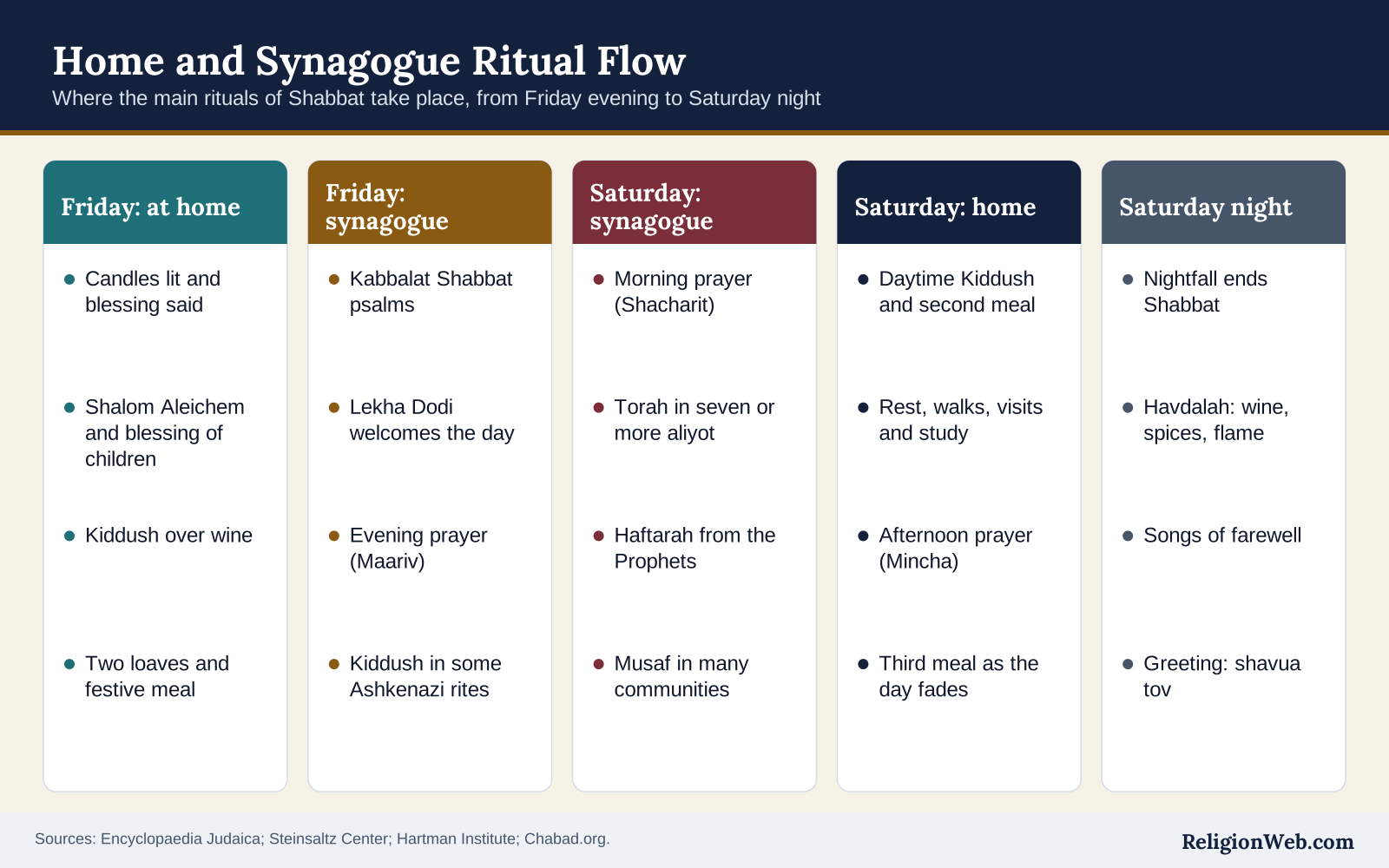
Through this meal, light fades, and the mood of the day turns reflective. It is a moment in which many people feel the approach of the weekday most keenly, and the tradition marks it with songs of longing as well as of delight. The table below collects the main rituals of the day in order, with the part of the day to which each belongs and the idea each carries.
| Ritual | When and where | Core elements | Central idea |
|---|---|---|---|
| Candle lighting | Friday before sunset, at home | Candles, blessing, greeting | Light, peace in the home, acceptance of the day |
| Kabbalat Shabbat and Maariv | Friday evening, synagogue | Psalms, Lekha Dodi, evening prayer | Welcoming Shabbat as a bride or queen |
| Kiddush and the Friday night meal | Friday night, at home | Wine, two loaves, songs, Grace after Meals | Sanctifying the day; remembering creation |
| Morning service and Torah reading | Saturday morning, synagogue | Shacharit, weekly portion, haftarah, Musaf | Public study and prayer; the covenant |
| Daytime Kiddush and lunch | Saturday midday | Wine, loaves, hot dishes | Delight; the second festive meal |
| Afternoon rest and study | Saturday afternoon | Rest, walks, visits, learning, Mincha | Settled repose (menuchah) |
| Third meal | Late Saturday afternoon | Light meal, songs, teaching | Holding on to the day as it fades |
| Havdalah | After nightfall | Wine, spices, flame, blessing | Distinguishing holy time from ordinary time |
Havdalah: Ending Shabbat and Returning to the Week
How Havdalah Is Performed
When and how the ceremony takes place
Havdalah, the Hebrew word for “distinction,” is the ceremony that marks the end of Shabbat. It is held after nightfall on Saturday, at home or sometimes in the synagogue, and it is normally led by one person while the others listen and respond. Some families gather everyone in a room with the lights lowered, so that the single flame is the main source of light. Children are often given the spice box or the candle to hold, and the ceremony is short, usually only a few minutes.
According to the Encyclopaedia Judaica, the Talmud credits the Men of the Great Assembly with instituting Havdalah, and some authorities hold that the obligation derives from the Torah itself. The Encyclopaedia explains that the blessing was first placed in the Amidah prayer, later moved to a cup of wine in more prosperous periods, and returned to the prayer in harder times, and that current practice follows the majority of the early sages by reciting it over wine, with a mention also in the Amidah. In the Ashkenazi version the ceremony opens with verses from Isaiah 12:2–3, then three blessings, over wine, spices and light, followed by the Havdalah blessing itself, which praises God who distinguishes between the holy and the ordinary and, in the common Ashkenazi text, between several other pairs, such as light and darkness and the seventh day and the six days of work.
Wine, spices and flame: what each element means
Each element has its own explanation. The wine follows the pattern of Kiddush at the start of the day. The flame is connected in the sources to the first fire, since Jewish tradition holds that fire was first made on the night after the first Shabbat. The spices, held in a small container and passed around, are the element whose reason is least obvious. The Encyclopaedia Judaica states that the reason for the spice blessing is unclear, though medieval commentators linked it to an “additional soul” believed to leave with the Sabbath. Rabbi Yehonasan Gefen, writing on Aish.com, traces the idea to the Talmud’s reading of a word in Exodus 31:17, which the sages understood as suggesting that a person receives an extra measure of spirit on Shabbat that departs when it ends. In this tradition the fragrance eases the sadness of the departure.
Three senses are involved at once: taste in the wine, smell in the spices and sight in the flame, along with the sound of the blessings and the touch of the cup. Whether or not that combination was the original design, the effect is to make the transition from sacred to ordinary time something felt through the body, as well as stated in words.
The Candle and the Closing Gestures
The candle, the fingernails and the extinguishing
The candle itself carries several customs. Because the blessing mentions many “lights,” the ideal, according to the account of the Shulchan Aruch HaRav on Chabad.org, is a torch with several wicks, though a single candle is acceptable because its flame has several colors. The same account records that one should be close enough to the flame to distinguish coins of different countries, that the custom is to look at the fingernails while holding the cup, and that the blessing is not said over a flame kindled on Shabbat in violation of the day. The reason given for the blessing itself is that fire was first made on the first Saturday night, when, according to a Talmudic tradition, Adam struck stones together.
Other customs are recorded in the Encyclopaedia Judaica: overfilling the cup to signal an overflowing blessing, pouring a little wine on the ground, touching the last drops to the eyes, and extinguishing the flame in the wine that remains. People then greet one another with shavua tov or, in Yiddish, a gutn vokh, “a good week.”
Songs, Melaveh Malkah and the first acts of the week
After Havdalah, it is customary to sing songs that mix hope with the end of the day. The Encyclopaedia Judaica mentions hymns including one originally tied to the end of Yom Kippur and one about the prophet Elijah, who in Jewish tradition will announce the redemption. Many Hasidic and other communities hold a further meal, Melaveh Malkah, “escorting the Queen,” so that the departing day is accompanied as a guest would be.
The calendar occasionally produces intersections. When a festival begins on Saturday night, a combined ritual of Kiddush and Havdalah is used, and during Hanukkah the lights are kindled on Saturday night after Havdalah, as Hebcal notes in its description of the holiday’s rules. When a festival ends on a weekday evening, Havdalah is said without the candle and spices, as the Encyclopaedia Judaica records. Details like these show how the closing ceremony interacts with the festivals described in the articles on Hanukkah and other holidays.
Rest, Prohibited Labor and the Categories of Observance
What Melakhah Means and Does Not Mean
More than “work”: creative acts, not simply effort
The Torah forbids melakhah on the seventh day, and English translations nearly always render the word as “work.” That translation can mislead. In rabbinic law, melakhah does not mean effort, exertion or employment. It means a particular kind of purposeful, creative or transformative act, and a person can perform it with one finger and almost no strength. Turning on a lamp is not strenuous, but it may count as melakhah; carrying a heavy book from one room of a home to another does not, because moving things within a private domain is not among the forbidden acts, although other rules, such as those on muktzeh, may apply.
The Torah never defines the term in a single verse. As Rabbi Richard Hidary explains in a scholarly article on TheTorah.com, the Torah prohibits melakhah on Shabbat without saying systematically what counts, and the Mishnah (Shabbat 7:2) provides a list of thirty-nine principal categories, without citing a source. They run from agricultural labors (sowing, plowing, reaping, threshing, winnowing) through the preparation of bread (grinding, kneading, baking), the making of clothing (shearing, spinning, weaving, sewing), the preparation of leather, writing and erasing, building and dismantling, extinguishing and kindling a fire, striking with a hammer (traditionally understood as the finishing blow of a craft), and carrying an object from one domain to another. The Mishnah in tractate Chagigah describes the laws of Shabbat as mountains hanging by a hair, because relatively little scripture supports so much detailed law.
Primary categories, derivatives and the Tabernacle link
The thirty-nine categories are called avot melakhah, “fathers” or primary types of labor, and the rabbis recognized derivative acts, toledot or “offspring,” that share the same purpose. The Talmud offers several explanations of where the thirty-nine come from. According to Hidary, the Babylonian Talmud prefers a link to the labors involved in building the Tabernacle, the portable sanctuary described in Exodus, so that the list reflects the kinds of work that went into making a dwelling for God’s presence. He also reports that modern scholars such as Yitzhak Gilat see the list as belonging to a later stratum of the Mishnah and as owing more to standard lists of ordinary work than to the Tabernacle, and that the number thirty-nine may simply be the total of items in such lists. The tradition and academic scholarship thus offer different accounts, and this article does not choose between them.
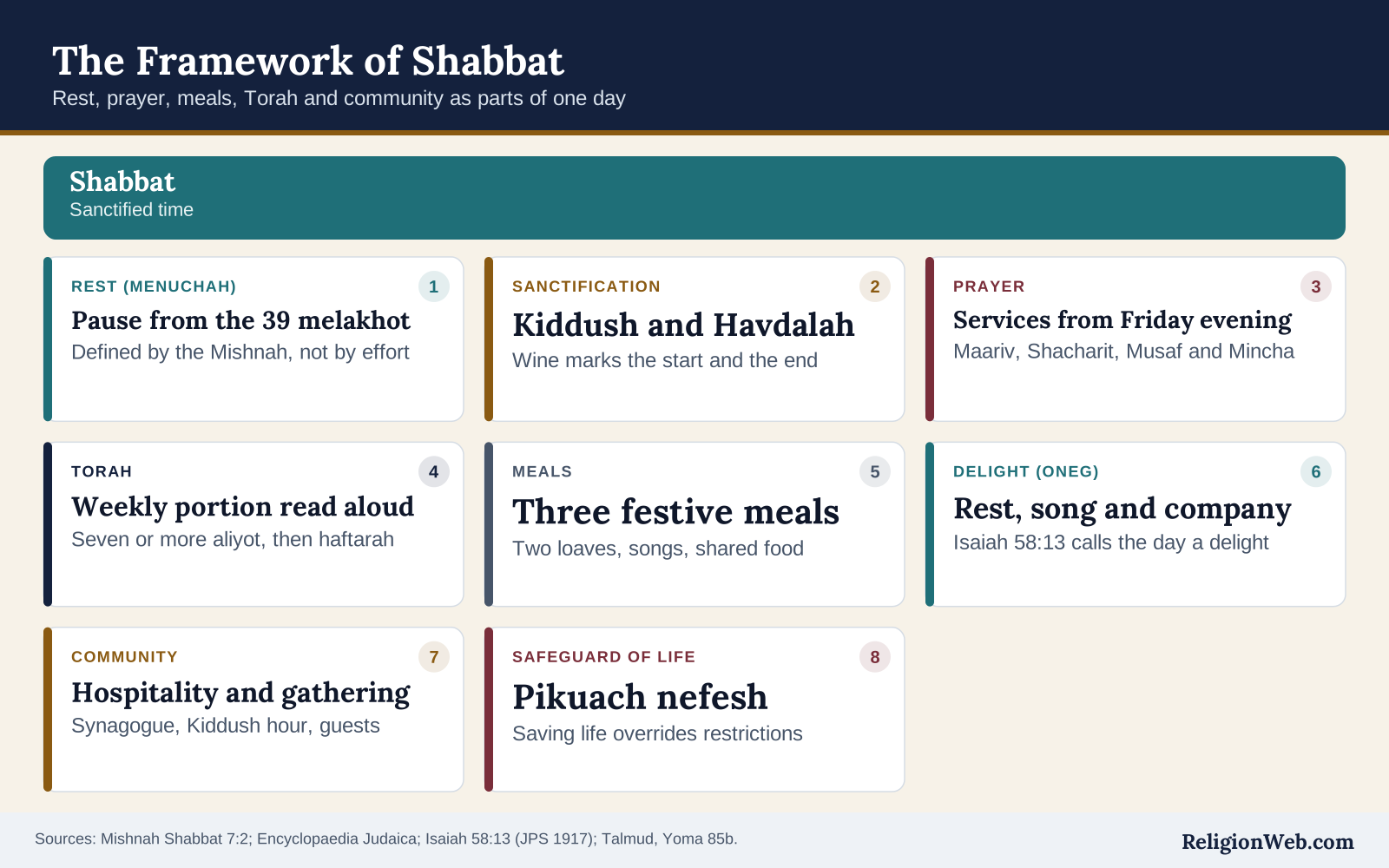
The practical effect of the system is that cooking, writing, building, lighting a fire and carrying in public are the best-known restricted categories, but the legal reasoning extends to many modern acts by analogy. The table summarizes how the main layers of Shabbat observance relate to one another, from the biblical prohibitions to the community customs built around them.
| Category | Examples | Basis | Comment |
|---|---|---|---|
| Forbidden labor (melakhot) | Cooking and baking, writing, building, kindling a fire, carrying between domains | Torah, defined by the Mishnah’s thirty-nine categories | The core of the legal system; applied by analogy to new technology |
| Rabbinic safeguards (shevut, muktzeh) | Handling tools or money; activities that might lead to forbidden labor | Rabbinic enactments | Protect the day’s character |
| Boundaries (techum, eruv) | A 2,000-cubit limit outside a city; carrying inside an eruv | Rabbinic law | An eruv extends the area in which carrying is permitted |
| Positive obligations | Kiddush, three meals, prayer, Torah reading, Havdalah | “Remember” in Exodus 20, as the rabbis read it | Define what the day is for, not only what it excludes |
| Delight (oneg) and honor (kavod) | Festive food, special clothing, song, rest, hospitality | Isaiah 58:13 and rabbinic interpretation | Treated as a commandment in its own right |
| Overriding principle (pikuach nefesh) | Medical treatment and rescue in an emergency | Talmud, Yoma 85b | Saving life overrides Shabbat restrictions |
Safeguards, Emergencies and Modern Technology
Fences, boundaries and the eruv
The rabbis surrounded the biblical prohibitions with safeguards, which the Encyclopaedia Judaica describes as “fences,” including restrictions on handling tools or money. Shabbat also has a spatial dimension. Rabbinic law limits how far a person may walk outside a settlement to about two thousand cubits, a boundary known as the techum Shabbat, and it forbids carrying objects between a private and a public domain. An eruv is a symbolic enclosure that, in communities that maintain one, lets residents carry keys, books or a stroller within the marked area. Mishnah tractate Eruvin is devoted to these rules. The result for observant families is a Shabbat in which the Saturday walk to the synagogue is natural and the car is left in the garage.
Saving a life and the limits of the rules
All of these rules yield to a higher principle. Pikuach nefesh, the duty to save a life, overrides nearly every other commandment. The Talmud, in tractate Yoma 85b, reads a verse from Leviticus about keeping God’s statutes, “which if a man do, he shall live by them,” to mean that a person should live by the commandments and not die by them. Rabbi Simon Glustrom, in The Language of Jewish Life, writes that when a life is in danger the Sabbath laws are not merely permitted to be set aside but required to be, and he cites the Shulchan Arukh to the effect that hesitation in such a case is harmful.
That principle has practical consequences. An observant Jew who is ill, or caring for someone who is, will call an ambulance, drive to a hospital or take necessary medication on Shabbat, and rabbis encourage people not to delay out of doubt. Religious observance is not understood as a substitute for medical care, and Jewish law itself requires seeking it. Questions that fall short of danger, such as a minor illness, are decided case by case, usually with a rabbi’s guidance.
Electricity, phones and cars: how communities reason
Modern technology has produced the most active legal discussion of Shabbat. Rabbi Yehoshua Pfeffer, in a summary of the halakhic debate, notes that virtually all authorities over the past century forbid turning on electric lights and appliances on Shabbat, but they disagree about the reason. The Chazon Ish, a leading twentieth-century authority, treated closing a circuit as a biblical case of building, while Rabbi Shlomo Zalman Auerbach rejected that analysis and nonetheless concluded that the custom of stringency should be kept. Incandescent bulbs are seen as the strictest case because the heated filament resembles fire, and LEDs and other electronics are treated differently. Orthodox communities also use devices designed for Shabbat, from timers to elevators that stop at every floor automatically.
Not all Jewish movements reach the same conclusion. In 1950 the Committee on Jewish Law and Standards of the Conservative movement, in a responsum by Rabbis Morris Adler, Jacob Agus and Theodore Friedman, approved driving to the synagogue on Shabbat for the first time. In 2023 the same committee published two opposing opinions on electric cars, both affirming the importance of Shabbat, with some authors arguing that using an electric vehicle for Shabbat purposes is acceptable and others that driving any vehicle for non-emergency reasons should be avoided. Reform Judaism, discussed in the next section, leaves such decisions to informed individual choice.
Variations Among Households, Movements and Communities
Differences Among the Jewish Movements
Orthodox and Haredi observance
In Orthodox Judaism, Shabbat is kept according to halakha as the tradition has interpreted it, which means the full system of thirty-nine categories of labor, the rabbinic safeguards and the boundaries described above. Within that framework there is considerable variety. Modern Orthodox Jews, who combine traditional observance with active participation in the wider society, may use eruvin, attend services in a synagogue near their home, and engage with the arts and education during the week. Haredi communities, often called ultra-Orthodox by outsiders, tend to observe stricter standards on dress, devices and recreation, and Hasidic groups follow the customs of their own rebbes. The article on Orthodox Judaism describes these currents in more detail.
The data reflect the difference between this group and others. In Pew Research Center’s 2015 survey of Israeli Jews, published in 2016, none of the Haredi and Dati (religious Zionist) respondents said they handled money on the Sabbath, and none said they rode in a car, bus or train. Among American Jews, Pew’s 2020 report found that marking Shabbat in a meaningful way was most common among Orthodox Jews and least common among Jews with no denominational affiliation.
Conservative and Masorti approaches
The Conservative movement, called Masorti in Israel and much of the world outside North America, understands Jewish law as binding and as developing in history. Its Committee on Jewish Law and Standards issues rulings, and individual rabbis and congregations apply them. The best-known example is the 1950 responsum permitting driving to synagogue, based on the view that attending services strengthens community and Shabbat observance in suburban settings; the committee’s 2023 opinions on electric vehicles show that the discussion continues. Conservative synagogues usually keep an Orthodox-style structure of services, with a mix of Hebrew and English, and the movement’s Shabbat observance in practice ranges widely. The article on Conservative Judaism explains its approach to law.
Pew’s Israel survey gives a sense of the range in the Masorti group there: 53 percent of Masortim said they travel by car, bus or train on Shabbat and 41 percent said they avoid it, and more Masorti men than women refrained from handling money (58 percent against 48 percent).
Reform and other liberal approaches
Reform Judaism, which began in nineteenth-century Germany, treats Jewish law as a source of guidance and does not regard its detailed Shabbat rules as binding in the way Orthodox Judaism does. Reform Jews are encouraged to study the tradition and to make informed choices. The Union for Reform Judaism’s 2007 resolution on Shabbat, as summarized on its website, urges congregations to support Reform Jews so that they “feel commanded without feeling coerced,” and it calls for emphasis on “Thou shalts” rather than “Thou shalt nots.” It describes Shabbat as a response to a 24/7 culture in which work crowds out rest, and it expresses concern that many synagogues have stopped holding regular congregational worship on Saturday mornings, in part because the services have become overshadowed by b’nei mitzvah celebrations. Many Reform communities hold their main worship on Friday evening.
Other forms of liberal observance include Reconstructionist and community-based approaches, and many Jews who identify with no movement create their own Shabbat practices. The article on Reform Judaism gives a fuller account of the movement’s history and worship.
Differences of Culture, Region and Household
Ashkenazi, Sephardi and Mizrahi customs
Within any movement, the customs of the ancestral community shape the day. Ashkenazi Jews, whose heritage lies in Central and Eastern Europe, and Sephardi and Mizrahi Jews, whose heritage lies in Spain, North Africa and the Middle East, share the same law but differ in details of melody, food and ritual. The differences already noted include the order of the candle blessing, when the Torah scroll is lifted, whether the scroll is kept in a hard case, whether Kiddush is recited in the synagogue on Friday night, and the names and recipes of the Shabbat stew. Tunes for the Friday night hymns vary widely between communities, and the foods on the table reflect the places in which Jews lived: gefilte fish and chicken soup in many Ashkenazi homes, and in many Sephardi and Mizrahi homes dishes built around rice, herbs, spices and slow-cooked meat.
Hasidic gatherings and the Karaite dissent
Hasidic communities add practices of their own, centered on the leadership of the rebbe. Many hold a public gathering, a tisch (“table”), at which the rebbe leads songs and teaches while followers gather around, and, as the Encyclopaedia Judaica notes, Hasidic groups gave special significance to particular Shabbat meals. These customs illustrate how Shabbat can take a public, communal form as well as a domestic one.
At the other pole, the Karaites, a movement that arose in the early medieval Middle East and rejects the rabbinic oral tradition, interpret the Torah’s prohibition on kindling fire to mean that no fire may burn in the home at all on Shabbat. A modern rabbi, Daniel Stein, notes that the difference over Exodus 35:3 produced centuries of debate. Karaite communities, now small, remain an example of the range of ways the written Torah has been read.
Secular and cultural observance
Many Jews who do not follow the legal rules still mark Shabbat. They light candles, hold a Friday night dinner with family or friends, attend an occasional service, or simply set aside time without work. In Israel, this is a visible pattern. Pew’s 2015 survey found that about one in five secular Israeli Jews (Hilonim) said that they or someone in their household always or usually lights Sabbath candles, while nearly half said they never do. Among American Jews, the 39 percent who marked Shabbat at least sometimes in a meaningful way include many who do not keep the legal restrictions. This kind of selective observance is sometimes criticized by those who keep the full law, and sometimes defended as a way of sustaining ties to the tradition, and this article reports it without judging between the views. The table summarizes typical differences between settings.
| Setting | Typical approach to the legal restrictions | Typical Shabbat services | Home customs and notes |
|---|---|---|---|
| Haredi and Hasidic | Full observance of the thirty-nine categories and rabbinic safeguards; no electricity, driving or phones | Traditional services in Hebrew; separate seating for men and women | Community customs vary by group; tisch gatherings in Hasidic courts |
| Modern Orthodox | Full halakhic observance, often with an eruv and engagement with wider society | Traditional liturgy; women’s roles vary by congregation | Strong family meals; Kiddush after services as a social event |
| Conservative and Masorti | Framed by halakha as interpreted by the movement’s rabbis; many congregations allow driving to synagogue | Traditional structure with Hebrew and English; in most North American congregations women are counted and called to the Torah | Observance ranges widely among members |
| Reform | Informed personal choice rather than binding rules | Often a main Friday evening service; shortened liturgy and more English | Home rituals such as candles, Kiddush and a family dinner are encouraged |
| Sephardi and Mizrahi communities | Same legal framework as other Orthodox or traditional Jews | Distinct tunes; some differences in Torah service customs | Dishes such as hamin and dafina; blessing before lighting in some communities |
| Cultural or secular practice | Selective: for instance a family dinner or candles without restrictions | Occasional or none | Pew finds about one in five secular Israeli Jews usually light candles |
Shabbat Today: Observance Data, Public Life and Modern Thought
How Many Jews Observe Shabbat, and How
United States: Pew Research Center, 2020
The most recent comprehensive survey of American Jews is Pew Research Center’s 2020 study, published in May 2021, based on a survey of about 4,700 Jewish adults carried out between November 2019 and June 2020. It found that 39 percent of U.S. Jews mark Shabbat in some way that is meaningful to them at least sometimes, 20 percent often and 19 percent sometimes, with activities such as resting, attending services, lighting candles, gathering with friends or doing community service. Pew notes that this is not the same as following Jewish law, and that the practice is more common among Jews by religion than Jews of no religion, among married couples who are both Jewish, and, by denomination, most common among Orthodox Jews and least among Jews with no denomination.
The figures should be read with their limits in mind. They describe adults who identify as Jewish in a national survey and they ask about meaning rather than legal compliance, so they say little about the share who keep the full set of restrictions. Pew’s 2020 survey was conducted mostly before the COVID-19 pandemic, which changed congregational life for a time.
Israel: Pew Research Center, 2015
Pew’s 2015 survey of Israeli Jews, published in 2016, asked more specific questions. About 56 percent said that they or someone in their household always or usually lights candles on Friday evening; 55 percent said they handle money on Shabbat; and 62 percent said they ride in a car, bus or train. The averages hide very different profiles by group. Among the secular (Hiloni), 88 percent said they handle money and 95 percent said they travel on Shabbat, while the Haredi and Dati groups reported none of either. The data are now about a decade old and describe the survey period, not the present, but they remain the clearest published picture of how patterns of observance divide in Israel.
Shabbat in Public Life and Modern Thought
Israel’s weekly day of rest
In the State of Israel the day has legal and political significance. Shuki Friedman of the Israel Democracy Institute explains in a 2017 analysis that a 1947 letter from David Ben-Gurion to the Haredi party Agudat Yisrael pledged that the legal day of rest in the Jewish state would be Shabbat, and that the Hours of Work and Rest Law of 1951 bars the employment of Jewish workers on that day, with permits for essential sectors. Public buses generally do not run on Shabbat, with exceptions such as Haifa and Eilat, and local authorities set their own rules on business hours. Friedman argues that the arrangement, often called the status quo, has weakened in practice. This is a subject of ongoing public debate, and the article describes the framework as of that analysis, not as a settled or final one.
The digital pause and weekly rhythm
Many Jews who are not strictly observant describe Shabbat as a counterweight to constant connectivity, and the language of the Reform resolution quoted earlier, which describes the day as a response to a culture in which work crowds out rest, reflects the same thought. For some, switching off the phone for twenty-five hours is the central appeal. For others, the discipline of the traditional system, which rules out the device altogether, is part of what makes the day different from a weekend. The tradition of marking Shabbat has thus found new audiences among people who might not describe themselves as religious.
Thinkers on the meaning of the day
Two modern voices are often cited. The essayist Ahad Ha’am, a founder of cultural Zionism, is widely quoted as saying that more than Jews have kept Shabbat, Shabbat has kept the Jews; Amy Kalmanofsky, a professor of Bible at the Jewish Theological Seminary, uses the line as the starting point for a commentary on the Torah portion Ki Tissa. The rabbi and philosopher Abraham Joshua Heschel, in his 1951 book The Sabbath, described the day as a “palace in time,” a phrase that Reuven Kimelman of Brandeis University, in a review in the journal Shofar, calls a classical kabbalistic image. In Heschel’s view, the tradition builds its sacred space in time and not in a place. These formulations are interpretations by individual thinkers, not the teaching of any movement, but they have shaped how many Jews describe what the day is for.
Common Misconceptions About Shabbat
Misconception 1: Shabbat is simply a ban on work in the modern employment sense
Where the misunderstanding comes from
The confusion starts with translation. The Torah’s word melakhah is usually rendered “work,” and in contemporary English “work” suggests a job, a paycheck or physical effort. Readers who bring that meaning to Exodus 20 conclude that Shabbat is a Jewish version of a day off, in which an accountant stays away from the office and a laborer from the site. The assumption is reinforced by the way modern societies regulate rest, through weekend laws, overtime rules and holiday closings that treat the question as one of employment.
Popular accounts of Shabbat observance often add to the impression by listing prohibitions in everyday terms: no cooking, no driving, no phone. Because these items look like a random collection of inconveniences, the underlying logic is easy to miss, and some writers conclude that the rules are arbitrary, or that they must be about avoiding exhausting tasks.
What the evidence and tradition actually show
In rabbinic law, melakhah is a technical category. The Mishnah lists thirty-nine principal types, and they are defined by the kind of act, not by effort or by whether it earns money. A person may spend a Saturday afternoon carrying a toddler, walking several miles or rearranging furniture inside a home without performing a forbidden act, while switching on a lamp, writing a note or cooking a meal falls within the restricted categories, whether done for profit or for pleasure. The restriction also reaches those with no employer at all: the self-employed, the retired and every member of the household, as the Deuteronomy version of the commandment stresses by naming servants, animals and the resident stranger.
The employment sense of the English word also misses what the day adds. Rabbinic law supplements the prohibitions with duties, including Kiddush, three festive meals and prayer. The rabbis read the verse in Isaiah about “pursuing thy business” as extending to discussing business matters, so that the day’s restraint covers speech and attention as well as action. Shabbat is therefore better described as a day of transformed time than as a day without a job.
Israeli law illustrates the gap between the two senses. The Hours of Work and Rest Law of 1951 bars the employment of Jewish workers on Shabbat, but Shuki Friedman of the Israel Democracy Institute points out that the statute is socially oriented and does not define observance in halakhic terms. A person can therefore comply fully with the employment law and still do many things that halakha counts as forbidden labor, or can refrain from every listed category while holding no job at all. The two systems overlap in practice and answer different questions.
Misconception 2: Every Jewish household observes Shabbat the same way
Where the misunderstanding comes from
Two images tend to dominate public impressions. One is the strictly observant Orthodox family that does not use electricity or drive, often seen in films and news reports. The other is the assumption that “modern” Jews have abandoned the day altogether. Both treat a diverse population as a single group, and both draw on the fact that Judaism is both a religion and a people. Anyone who encounters one community’s Shabbat can easily take it for the standard form, particularly if it is the only one they have seen.
The assumption can also come from within Jewish life. People raised in one movement or region may regard their own custom as the norm and a neighbor’s as a departure.
What the evidence and tradition actually show
Surveys describe a wide spectrum. In Pew’s 2020 U.S. survey, 39 percent of Jewish adults said they at least sometimes marked Shabbat in a way meaningful to them, and Pew noted that this was not necessarily in accord with Jewish law. In Pew’s 2015 Israel survey, the shares who said they handle money, travel or light candles on Shabbat ranged from none among the Haredi and Dati respondents to large majorities among the secular, and the Masorti group fell between them. Beyond those differences among groups, there are differences within each, since a family may keep some customs strictly and others loosely.
The variations also run along cultural lines. Ashkenazi, Sephardi and Mizrahi communities share the same legal framework but differ in food, melody and many liturgical details, and Karaite Jews follow a distinct reading of the Torah’s fire prohibition. The earlier section on the movements shows that Orthodox, Conservative and Reform Jews also differ in how they relate to law, though not in the importance they give to the day. No description of one household’s Shabbat can stand for all of them.
Variation is also old. The Mishnah in tractate Berakhot (8:5) records a disagreement between the schools of Shammai and Hillel about the order of the blessings at the close of Shabbat and even about the wording of the blessing over the flame, and the later tradition kept both memories while following one ruling. Shabbat has never been a single uniform act. What the communities share is the structure of the day, with its evening beginning, its sanctifying blessing, its meals and its ending in Havdalah, and a willingness to argue about details.
Misconception 3: Shabbat lasts from Saturday morning to Saturday night
Where the misunderstanding comes from
Because the best-known public event of Shabbat is the Saturday morning service, many people think of Shabbat as a Saturday day, parallel to a Sunday or a weekend day. Calendars add to the impression, since they print “Saturday” under a midnight-to-midnight grid. A person who sees only the morning service, or who knows Shabbat only from a school or workplace conversation about “not being available on Saturdays,” could fairly conclude that it covers that stretch of daylight.
What the evidence and tradition actually show
In Jewish reckoning the day starts at evening, following the pattern of Genesis, in which each day is described as evening and then morning. Shabbat therefore begins shortly before sunset on Friday, when the candles are lit and the evening service and festive meal take place, and it ends on Saturday night after nightfall with Havdalah. Calendar services such as Hebcal publish a local candle-lighting time and a nightfall time every week, and a typical Shabbat is of about twenty-five hours.
That timing also explains why Friday night is, for many Jews, the most characteristic part of the day. The first Kiddush, the first festive meal and the first prayers of Shabbat all fall on Friday evening. A description of Shabbat that begins on Saturday morning omits the evening on which, in the tradition’s terms, the day actually begins.
The same reckoning applies to the Hebrew date. A Jewish calendar changes its date at nightfall, so the Saturday of the civil calendar carries two Hebrew dates in succession, and the festivals shift in the same way, which is why the Passover seder and the Yom Kippur evening service both take place on the night before the date on which the holiday is listed. Many people also begin Shabbat a few minutes before sunset by lighting candles early, the custom called tosefet Shabbat, so the day can be said to open slightly earlier than the exact astronomical boundary.
Misconception 4: Shabbat is a day of gloom and prohibition
Where the misunderstanding comes from
Lists of forbidden acts are easy to quote and easy to find, and they tend to dominate outside accounts of the day. When the prohibitions are presented without their purpose, Shabbat can look like a series of lost conveniences. A person who has met the rules only as a rulebook might reasonably expect a somber day.
What the evidence and tradition actually show
The sources describe the opposite. The verse from Isaiah quoted earlier tells the reader to call the Sabbath “a delight.” The rabbis made delight (oneg) a positive obligation, to be met with good food, fine clothes, song, rest and company. Traditional practice suspends public mourning customs on the day, and fasting is not observed on Shabbat, with Yom Kippur as the one fast that overrides this when it falls on the day. In tractate Berakhot (57b), the Talmud calls Shabbat a sixtieth part of the world to come, a foretaste of it.
The restrictions are best understood as the frame for that experience: setting aside the tools and tasks of the week makes room for the meal, the conversation and the quiet. The tradition does not claim that everyone feels the delight at every moment, and the Pew data show that practice varies, but its stated purpose is joy.
The medieval authorities reflect the same emphasis. According to the Encyclopaedia Judaica, Maimonides saw the day as teaching the doctrine of creation and as providing rest, Judah Halevi valued it as a sixth of life given to complete rest, and the Safed mystics welcomed it as a bride. The Talmud’s image of the two sages who greeted the day as a queen or a bride, preserved in the same liturgy that Jews sing on Friday evening, sets the tone: the day is received as an honored guest.
Frequently Asked Questions About Shabbat
Questions About Timing and Terms
How long does Shabbat last, and when does it end?
Shabbat lasts roughly twenty-five hours. It begins at sunset on Friday, with candles usually lit about eighteen minutes earlier in many communities, and ends on Saturday night at nightfall, which Hebcal defines by default as the point at which the sun is 8.5 degrees below the horizon. Some communities add a fixed interval after sunset, such as 42, 50 or 72 minutes. The exact clock time depends on the place and the season, so most people consult a local calendar.
What does “Shabbat Shalom” mean?
It means “a Sabbath of peace,” and it is the standard greeting from Friday afternoon until the day ends. Yiddish speakers say “Good Shabbos,” and after Havdalah people say shavua tov, “a good week.” The phrase is used among Jews of all backgrounds, and non-Jewish friends and neighbors often use it as a courtesy.
Is “Shabbat” the same as “the Sabbath”?
Yes. “Sabbath” is the older English form that derives from the Hebrew word, and in Jewish contexts the two refer to the same day, from Friday evening to Saturday night. This article uses Shabbat as the main term because it is the name Jews use for the day.
Questions About Practice
Can people use phones, cars or electricity on Shabbat?
It depends on the community. Orthodox authorities generally forbid turning electrical devices on or off and driving, and observant families use timers and other arrangements prepared before the day. Conservative practice varies: a 1950 ruling approved driving to synagogue, and more recent opinions debate electric vehicles. Reform Judaism leaves such choices to the individual. Within each group there is a further range, and the answer in any one household depends on its customs.
What happens if there is a medical emergency on Shabbat?
Jewish law requires that a life in danger be saved, even if doing so means violating Shabbat. The principle, pikuach nefesh, is drawn from the Talmud and is understood as a duty, not a concession. Anyone who is seriously ill or injured should seek emergency medical care without delay, and religious practice does not replace professional medical help. For questions that fall short of an emergency, observant Jews typically consult a rabbi, but nobody is expected to wait if there is doubt about danger.
Can someone who is not Jewish attend a Shabbat service or dinner?
Many synagogues and families welcome guests, and hospitality is a recognized value of the day. A guest can ask the host in advance about customs, such as dress, phones and photography, which are often set aside on Shabbat in observant settings. Some rituals, such as being called to the Torah, may be reserved for Jews, depending on the community. Hosts usually explain what is happening, and a guest is not expected to take part in anything that would feel inappropriate to them.
Conclusion: What Shabbat Shows About Jewish Time and Practice
What the History and Practice Show
A structure that combines law, liturgy and home
Shabbat is built from three kinds of material. There is law, in the thirty-nine categories of labor and their safeguards. There is liturgy, in Kabbalat Shabbat, the Torah reading and Havdalah. And there is the home, in the candles, the table and the songs. Take one away and the day looks incomplete. The tradition holds them together by treating rest, holiness and delight as parts of one commandment, rooted in the Torah’s picture of the seventh day as blessed and set apart.
A tradition that has changed and stayed recognizable
The record also shows development. Maccabean fighters redefined what the day permitted when survival was at stake, the rabbis compiled the categories of labor, the mystics of Safed added the welcome of the bride, and twentieth-century rabbis and communities debated the car and the light switch. Yet the core has remained recognizable for centuries: a weekly day beginning at evening, with candles, wine and bread, ending with wine, spices and flame.
How to Keep Exploring
Related topics on ReligionWeb.com
Readers who want to continue can look at the main article on Judaism for the wider tradition, the article on the Torah for the weekly reading, and the article on the Talmud for the source of the legal discussion. The festivals that share Shabbat’s liturgical vocabulary are described in the articles on Passover and Yom Kippur, and the dietary rules that shape the Shabbat table are covered in the article on kashrut.
Reading with care across communities
Anyone seeking to understand Shabbat in a particular community is best served by listening to how that community describes its own practice. The descriptions in this article are general, and the details of candle lighting, prayer, food and law differ by movement, region and household. Where a practice matters to a decision, whether for attending a service, hosting a guest or understanding a neighbor’s day, asking a rabbi or a member of the community is the most reliable course.
Sources
The table below lists the principal external sources behind this article. Facts, dates and figures were checked against these and related primary, institutional and academic materials.
| # | Source | Publisher and type | Used for | Link |
|---|---|---|---|---|
| 1 | The Holy Scriptures: A New Translation (JPS 1917): Exodus 20:8-11, Deuteronomy 5:12-15, Genesis 2:1-3, Exodus 31:16-17, Isaiah 58:13-14 (public domain edition hosted on Sefaria) | Jewish Publication Society / Sefaria · Primary text | Edition and public-domain status of all five Hebrew Bible quotations in the article | sefaria.org |
| 2 | Mishnah Shabbat 7:2 (William Davidson Edition; also consulted: Shabbat 1:1 and 2:7, Berakhot 8:5, Chagigah 1:8, Eruvin 4:3) | Sefaria / Koren-Steinsaltz · Primary text | The 39 categories of labor; candle-lighting question; Hillel and Shammai on the flame blessing (paraphrased) | sefaria.org |
| 3 | Havdalah (Encyclopaedia Judaica; also consulted: entries Kiddush and Sabbath) | Encyclopaedia Judaica, via Encyclopedia.com · Encyclopedia | Structure and customs of Havdalah; Kiddush rules; Second Temple, rabbinic and medieval history of the day | encyclopedia.com |
| 4 | Blessings & Instructions for Shabbat Candles | Chabad.org (Chabad-Lubavitch Media Center) · Institutional | Candle-lighting time, who lights, number of candles, order of blessing, plag haminchah | chabad.org |
| 5 | The Laws Governing the Havdalah Candle (Shulchan Aruch HaRav, Orach Chayim 298) | Chabad.org · Primary text | Torch of several wicks, braided candles, fingernail custom, origin of the flame blessing | chabad.org |
| 6 | Candle Lighting, Havdalah and Fast Times | Hebcal · Institutional | 18-minute default, Jerusalem and Haifa intervals, 8.5-degree nightfall rule, alternative Havdalah customs | hebcal.com |
| 7 | Lcha Dodi and the Kabbalist Background to Kabbalat Shabbat (Noam Zion) | Shalom Hartman Institute · Academic reference | Talmudic roots and sixteenth-century Safed origins of Kabbalat Shabbat and Lekha Dodi | hartman.org.il |
| 8 | Four Ways to Derive the Thirty-Nine Avot Melakhot (Richard Hidary) | TheTorah.com · Academic reference | Rabbinic derivations of the 39 categories and modern scholarly views of the list | thetorah.com |
| 9 | Jewish Beliefs and Practices (Israel’s Religiously Divided Society, 2015 survey) | Pew Research Center · Demographic data | Shabbat candles, handling money and travel among Israeli Jews by group (survey 2014-2015, published 2016) | pewresearch.org |
| 10 | Jewish Practices and Customs (Jewish Americans in 2020) | Pew Research Center · Demographic data | 39% of U.S. Jews mark Shabbat meaningfully at least sometimes (survey Nov. 2019 to June 2020) | pewresearch.org |
Last fact-check date: 2026-10-21.