Passover, known in Hebrew as Pesach (also spelled Pesah), is the Jewish spring festival that commemorates the liberation of the Israelites from slavery in Egypt as told in the Book of Exodus. It begins at nightfall on the eve of the fifteenth day of the month of Nisan and lasts seven days in the Land of Israel and eight in most communities outside it. Its best-known feature is the Seder, a ritual meal held at home on the first night (and, in many diaspora communities, the second), at which a text called the Haggadah guides participants through four cups of wine, symbolic foods, questions, songs, and the retelling of the Exodus. For people who live by the Jewish calendar, as described in the broader article on Judaism, Passover is the festival around which the whole year turns.
What distinguishes Passover from many other holidays is that its central act is teaching. The Torah tells parents to explain the Exodus to their children, and the rabbis of the Mishnah turned that instruction into an evening of structured questions, answers, rituals, and storytelling. Participants do not merely recall the departure from Egypt. They are asked to eat the bread of affliction, taste bitterness, recline as free people do, and understand themselves as part of a story that continues. The festival also reshapes the household for a week: leavened grain products called chametz are removed from homes, and matzah, the flat unleavened bread, takes their place.
Several layers sit inside the single word “Passover,” and keeping them apart makes the holiday easier to understand. There is the biblical festival, with its dated sacrifice and week of unleavened bread. There is the Temple-era pilgrimage, when the paschal lamb was offered in Jerusalem. There is the rabbinic Seder, which took shape after the Temple’s destruction in 70 CE and which most people mean today when they say “Passover.” And there are the many customs of Ashkenazi, Sephardi, and Mizrahi communities, of Orthodox, Conservative, Reform, and secular households, and of Israel and the diaspora, which give the festival a different flavor from one table to the next.
This article follows those layers in order. It explains the name and the calendar, the biblical narrative and commands, the history of the festival, the rules about chametz and matzah, the order and meaning of the Seder, the Haggadah and its Four Questions, the symbolic foods, the synagogue services and remaining days of the week, the variety of community practice, and the place of Passover in Jewish life today. Dates are given for 2027, because the 2026 festival ended in April.
Passover at a Glance: Name, Meaning, and Dates
What Passover Is and What the Name Means
Pesach: the Hebrew name and the idea of passing over
The Hebrew word Pesach is the name of the festival, and in the Torah it is also the name of the lamb offered on its eve. The Book of Exodus ties the word to a verb for “passing over” or sparing: on the night of the tenth plague, God is described as passing over the houses of the Israelites that bore the sign of blood on their doorposts, while the firstborn of Egypt were struck. English “Passover” is a translation of that idea, and it entered the language in the sixteenth century through the English Bible. Some interpreters also connect pesach with other senses of the root, such as “protecting” or “hopping,” and the Hebrew Bible itself uses the verb in more than one way. The mainstream Jewish reading, expressed in the verses studied at every Seder, is that the name commemorates sparing and deliverance.
That origin explains why Passover is not described by Jewish tradition as a celebration of an abstract idea of freedom, although freedom is central to it. It is a commemoration of a specific act of rescue, remembered with a specific cluster of foods and actions. The Mishnah lists three things that a person who leads the Seder must explain: the paschal lamb, the matzah, and the bitter herbs. Each one stands for part of the story: God’s passing over, the haste of departure, and the bitterness of slavery.
Other names the tradition uses
Passover has several other names, and each one highlights a different aspect. The Torah also calls it the Festival of Unleavened Bread, Chag HaMatzot, which names the week-long ban on leaven. Liturgy calls it Zman Cheruteinu, “the season of our freedom,” a phrase that appears in the Kiddush and in the festival prayers. The Torah’s association of the festival with the spring barley harvest, the month of aviv, has given it the name Chag HaAviv, “the spring festival.” Encyclopedias such as Britannica list these alongside Pesach as standard alternative names.
The coexistence of these names is a reminder that the festival has agricultural, historical, and liturgical dimensions at once. Households in New York, Tel Aviv, and Casablanca may give more attention to one aspect or another at different points in the week, and nothing in the tradition asks them to choose among them.
When Passover Is Observed
The calendar rule: 15 Nisan in a lunisolar year
The Torah dates the festival precisely. Leviticus 23 places the Passover offering on the fourteenth day of the first month at dusk, with the Festival of Unleavened Bread beginning the next day, on the fifteenth. Because the Jewish calendar counts each day from nightfall, the fifteenth of Nisan begins on the evening of what the civil calendar calls the fourteenth, which is why the Seder is held at night, at the start of the festival day.
The Jewish calendar is lunisolar. Its months follow the moon, and a year of twelve lunar months is about eleven days shorter than the solar year. To keep Nisan in the spring, a thirteenth month, a second Adar, is added in seven years out of every nineteen. This is the reason Passover wanders within a window of roughly a month on the civil calendar, from late March to late April, instead of moving through the seasons as a purely lunar calendar would. The reference to aviv, the ripening of the barley, is the traditional scriptural basis for the principle that the festival must fall in spring. Under the fixed calendar that has been used for well over a thousand years, Passover also never begins on a Monday, Wednesday, or Friday. Readers who want the structure of the year as a whole can find it in the discussions of Rosh Hashanah and the other holy days.
Seven days in Israel, eight in much of the diaspora
In the Land of Israel the festival lasts seven days, from 15 to 21 Nisan, with a single Seder on the first night. Outside Israel, Orthodox and Conservative communities traditionally observe eight days, from 15 to 22 Nisan, with Seders on the first two nights. The extra day goes back to the era before a fixed calendar, when communities far from the court in Jerusalem could not be certain which day the new month had been declared, and a second day of observance guarded against error. The practice was kept after calculation replaced observation. Reform Jews and many other liberal communities outside Israel generally observe seven days, and many hold one Seder, though practice varies from family to family.
The next Passover begins at sundown on Wednesday, April 21, 2027, according to Hebcal’s published schedule. In the diaspora, the first day of the festival is Thursday, April 22, and the final day is Thursday, April 29, ending at nightfall. In Israel the festival ends at nightfall on Wednesday, April 28. The 2026 festival, which ran from sundown on April 1 to nightfall on April 9 in the diaspora, has already passed. These are calendar facts for a given year, and the same rules produce different civil dates every year.
Key Terms at a Glance
A short glossary of Passover vocabulary
A handful of Hebrew and Aramaic terms recur throughout any discussion of the festival. The table below collects the main ones, with the plain-English sense of each and the place it occupies in practice. Fuller treatment of each follows in the sections that explain the rituals.
| Term | Meaning | Role in the festival |
|---|---|---|
| Pesach | Passover; also the paschal lamb of Temple times | Name of the festival, 15 to 21/22 Nisan |
| Seder | “Order” | The structured ritual meal held on the first night (and often the second) |
| Haggadah | “Telling” | The book of blessings, passages, and songs that guides the Seder |
| Chametz | Leavened grain products (wheat, barley, spelt, rye, oats) | Forbidden to eat, own, or keep in view during the festival |
| Matzah | Unleavened flat bread | Eaten at the Seder and in place of bread all week |
| Maror | Bitter herb | Recalls the bitterness of slavery; eaten at the Seder |
| Charoset | Paste of fruit, nuts, and wine | Recalls the mortar used in forced labor |
| Afikoman | A piece of matzah set aside early and eaten last | The final food of the meal; the focus of many children’s customs |
| Chol HaMoed | “Weekdays of the festival” | The intermediate days between the opening and closing festival days |
| Kitniyot | Legumes, rice, and similar foods | Avoided by many Ashkenazi Jews, permitted by many Sephardi and Mizrahi communities |
Spelling, pronunciation, and why English forms vary
English spellings of these words vary because Hebrew sounds do not map neatly onto Latin letters. The ch in Pesach and chametz represents a guttural sound, which older English texts often rendered with an h, giving Pesah and hametz. Matzah appears as matzo, matza, and matzoh. The plural of Haggadah is Haggadot. Ashkenazi pronunciation traditionally stresses the first syllable and says Pesakh or Peysakh in Yiddish speech, while Israeli Hebrew pronunciation is closer to the Sephardi forms. This article uses the spellings most common in contemporary American Jewish publications and notes variants where they matter.

The Exodus Story and Its Biblical Foundations
The Story as Told in the Book of Exodus
From slavery to the tenth plague
The narrative that Passover commemorates begins in the first chapters of Exodus, which describe the descendants of Jacob living in Egypt, growing numerous, and being forced into labor by a new ruler who feared them. Moses, born to an Israelite family and raised in Pharaoh’s household, is called by God at a burning bush to demand the release of the Israelites. Pharaoh refuses, and a series of ten plagues follows, from the turning of the Nile to blood to the death of the firstborn. Jewish tradition counts the plagues as ten, and the Haggadah recites them one by one, spilling a drop of wine for each.
The tenth plague is the one most closely tied to the festival. Chapter 12 of Exodus records God’s instructions to Moses and Aaron before it happens: each household is to take a lamb, keep it until the fourteenth day, slaughter it at dusk, mark the doorposts and lintel with its blood, and eat the roasted meat that night with unleavened bread and bitter herbs. The firstborn of Egypt die at midnight, and Pharaoh finally tells the Israelites to go.
The night of departure
Exodus 12 describes the departure as hasty. The Israelites carry their dough before it has risen, wrapped in their kneading bowls, and the text later says they baked it into unleavened cakes, because they had been driven out and could not wait. This detail is the narrative root of matzah. The Israelites also ask the Egyptians for silver, gold, and clothing, which the text presents as given willingly, a feature that several Seder customs echo.
The crossing of the sea comes in Exodus 14 and 15, after the departure, and Jewish tradition marks it on the seventh day of Passover. The Song at the Sea in Exodus 15 is read in the synagogue on that day, which means that in the liturgical year the festival moves from the night of the Seder to the moment of deliverance by water. Pharaoh’s army is drowned, and the Israelites begin their journey toward Sinai, a connection the calendar preserves through the counting of the days between Passover and the festival of Shavuot.
What the Torah Commands for Passover
The first Passover instructions in Exodus 12
The Torah presents Passover as both a one-time event and a permanent institution. The same chapter that narrates the original night also lays down rules for later generations. The instructions for the first night include a detailed description of how the meal was to be eaten, as in this passage from the Jewish Publication Society translation of 1917, a public-domain English text:
And thus shall ye eat it: with your loins girded, your shoes on your feet, and your staff in your hand; and ye shall eat it in haste—it is the LORD’s passover.
Exodus 12:11, The Holy Scriptures (JPS 1917)
The “loins girded” posture is that of a person ready to travel. Rabbinic tradition treats this detail as belonging to the original night, the “Egyptian Passover,” while later generations ate the meal at leisure, reclining, as the Mishnah and the Seder describe. The distinction matters because it shows that the Seder is not a reenactment of the first night in every detail. It is a memorial that adapts the story to a new setting, one of free people at a table.
The rule for the calendar appears in Leviticus 23. The same translation reads:
In the first month, on the fourteenth day of the month at dusk, is the LORD’S passover.
Leviticus 23:5, The Holy Scriptures (JPS 1917)
Leviticus then places the Festival of Unleavened Bread on the fifteenth day and describes a sacred assembly on its first and seventh days, with no ordinary work. These two passages together provide the framework that later Jewish law elaborated: a night of sacrifice and a meal, followed by a week during which only unleavened bread may be eaten.
Remembering and telling: the duty to teach
Passover is unusual among biblical commands in how often it anticipates a child’s question. Exodus 12 imagines the moment directly:
And it shall come to pass, when your children shall say unto you: What mean ye by this service? that ye shall say: It is the sacrifice of the LORD’s passover, for that He passed over the houses of the children of Israel in Egypt, when He smote the Egyptians, and delivered our houses.
Exodus 12:26-27, The Holy Scriptures (JPS 1917)
Exodus 13 states the duty as a command to speak:
And thou shalt tell thy son in that day, saying: It is because of that which the LORD did for me when I came forth out of Egypt.
Exodus 13:8, The Holy Scriptures (JPS 1917)
The rabbis read these verses as the scriptural foundation for the Seder. The first-person phrasing, “did for me,” underlies a teaching in the Mishnah that every person must regard themselves as having personally come out of Egypt. The question-and-answer pattern also shaped the Haggadah, whose well-known passage on four kinds of children draws on the several places in the Torah where a parent is told how to answer a child. The next sections return to both points.
How Historians and Tradition Read the Exodus
Tradition: the Exodus as a founding event
In Jewish tradition the Exodus is the founding event of the people of Israel. The Torah presents the covenant at Sinai as following directly from it, and the opening of the Ten Commandments identifies God as the one who brought the Israelites out of the land of Egypt. The daily and festival liturgy returns to the Exodus constantly, and the Kiddush for every festival calls the day a remembrance of the departure from Egypt. Philosophers and commentators across the centuries have drawn different lessons from this centrality, from divine providence to the moral claim that those who were once enslaved must treat strangers and the vulnerable with justice. Those readings are developed within the tradition and are better described in the sections on observance than in a summary of the history.
Scholarly discussion of origins
Historians approach the Exodus differently. No Egyptian text from the Late Bronze Age describes the departure of a large Israelite population, and scholars disagree about whether the biblical account preserves the memory of a smaller group, a composite of several traditions, or something closer to the narrative as written. The question is debated in scholarship and is not settled by an appeal to either skepticism or faith. What the evidence does show is that the memory of Egyptian bondage became central to the identity of Israelite and later Jewish communities, and that the festival was already a well-established institution by the time of the biblical kings.
Scholars also point to a hypothesis about the festival’s origins that draws on the Torah’s own vocabulary. The Bible refers to Passover (Pesach) and to the Festival of Unleavened Bread (Chag HaMatzot) as separate celebrations in some passages and as one in others. Many modern scholars suggest that these began as two different observances, a household sacrifice of a young animal in the spring and a week-long agricultural feast tied to the barley harvest, which were later merged and linked to the Exodus. Traditional Jewish interpretation reads the biblical text as describing a single festival with a single origin in the events of Exodus. Both views are part of the picture a reader meets when studying the festival, and the second does not alter how the festival is kept.
From Temple Offering to Home Table: The History of Passover
Passover in the Biblical and Second Temple Periods
Centralized sacrifice and remembered Passovers
The Torah contains more than one set of Passover rules. Exodus 12 prescribes a household lamb on the first night. Deuteronomy 16 envisions the offering being made at the place God will choose, which later tradition identified with the Temple in Jerusalem, and this centralization turned Passover into a pilgrimage in which families traveled to the sanctuary. Numbers 9 adds a provision known as Pesach Sheni, the “Second Passover,” a month later on the fourteenth of Iyar, for those who were ritually impure or on a distant journey at the proper time.
The historical books mention occasions when the festival was observed with special solemnity. The Book of Kings states that in the eighteenth year of King Josiah, in the seventh century BCE, a Passover was kept in Jerusalem such as had not been seen since the days of the judges (2 Kings 23:21-23). Some Bible scholars connect this account with Josiah’s religious reforms, which centered worship on Jerusalem. The passage is read in the synagogue on the second day of Passover in the diaspora, a small sign of how the festival’s history is woven into its liturgy. The Books of Chronicles also describe a large Passover under King Hezekiah, to which people from the northern tribes were invited.
The Elephantine letter and the pilgrim crowds
One of the oldest documents tied to the festival outside the Bible is a fragmentary Aramaic papyrus from Elephantine, an island in the Nile where a Jewish military community lived under Persian rule. Dated to the fifth year of Darius II, around 419 to 418 BCE, it is a letter from a man named Hananiah to Jedaniah and his colleagues. Its surviving text instructs the recipients to observe a seven-day period of unleavened bread from the fifteenth to the twenty-first of Nisan, to refrain from work on the first and last days, and to keep leaven out of their houses, sealed in chambers. It is often called the “Passover Papyrus,” although the word Pesach does not survive in it. The Berlin museum that holds it notes that recent scholarship disputes whether the letter concerns Passover at all, and some researchers read it instead as a response to an administrative change in the calendar. A cautious summary is that it may preserve an early observance of the unleavened-bread week among diaspora Jews, but its interpretation is contested.
By the Second Temple period the festival was a mass pilgrimage. Josephus, the first-century CE historian, estimated crowds in the millions, and the Talmud tells of a count of the paschal lambs taken by tallying kidneys. Modern historians treat these numbers as exaggerated while accepting that Jerusalem swelled to many times its normal size at Passover.
After 70 CE: The Rabbinic Seder
The Mishnah and the shift to the table
The destruction of the Second Temple in 70 CE ended the paschal sacrifice. The rabbis who shaped Judaism in the following centuries preserved the festival by moving its center from the altar to the table. Chapter 10 of tractate Pesachim in the Mishnah, edited around 200 CE, is the earliest surviving blueprint of the Seder: four cups of wine, the questions asked by the child, the instruction to begin the story with disgrace and end with praise, the explanation of the paschal offering, matzah, and bitter herbs, and the recitation of Hallel, the psalms of praise. Later rabbinic discussion in the Talmud fills in the details, such as the order of who asks questions when a child cannot, and the obligation to recline.
The Seder was not a simple continuation of the old ritual. Scholars often note parallels between its wine, dipping, and reclining and the banquet customs of the Greco-Roman world, and the rabbis combined that form with a teaching assembly. Discussions of the sacrifice in the Mishnah continued even though no lamb could be offered, and the Haggadah preserves a passage from the Mishnah (Pesachim 10:5) explaining the symbolism of the lamb as though it were still present. This reflects a general feature of rabbinic Judaism: study of the rules is itself a form of continuing the observance.
Medieval and modern development
The surviving Haggadah text developed over centuries. The oldest surviving complete version appears in a tenth-century prayer book compiled by Saadia Gaon in Babylonia, and by the later Middle Ages the Haggadah circulated as its own book, often lavishly illuminated. The first printed editions appeared in the late fifteenth century, and Prague produced a famous illustrated printing in 1526. Table songs such as Dayenu and the cumulative songs at the end were added over time, a development described in the section on the Haggadah.
The modern era brought changes in technology and in community. Machine-made matzah appeared in the nineteenth century and provoked a serious rabbinic debate. In December 2015 the Conservative movement’s Committee on Jewish Law and Standards ruled that kitniyot, the legumes and rice avoided by many Ashkenazi Jews, were permitted. The Seder itself took on new forms, from congregational Sedarim to Haggadot written around the experiences of particular communities. The table below summarizes the main dated points covered in this article.
| Date | Development | Note |
|---|---|---|
| Traditional Exodus narrative (no agreed date) | Departure from Egypt; first Passover night | Exodus 12 to 15; historians debate the background |
| 7th century BCE | Josiah’s Passover in Jerusalem | 2 Kings 23:21-23 |
| About 419 to 418 BCE | Elephantine papyrus on an unleavened-bread observance | Fragmentary; interpretation disputed |
| Second Temple era | Mass pilgrimage and paschal offering in Jerusalem | Ancient crowd estimates are likely exaggerated |
| 70 CE | Destruction of the Second Temple; offering ends | Domestic Seder becomes the main rite |
| About 200 CE | Mishnah Pesachim 10 describes the Seder | Four cups, questions, matzah, bitter herbs, Hallel |
| 10th century CE | Earliest complete Haggadah text in Saadia Gaon’s prayer book | Babylonia (modern Iraq) |
| 1526 | Illustrated Haggadah printed in Prague | About sixty woodcuts |
| 1838 | First known matzah-rolling machine | Isaac Singer of Alsace; later debated by rabbis |
| December 2015 | Conservative ruling permits kitniyot | Committee on Jewish Law and Standards |
Chametz, Matzah, and Preparing the Home
Chametz: What It Is and How It Is Removed
What counts as chametz
The Torah forbids eating leavened bread during the festival and requires that leaven not be found in a household. Rabbinic law defines chametz as a product of one of five grains, wheat, barley, spelt, rye, or oats, that has come into contact with water and been allowed to ferment or rise for longer than a set time. Reform Judaism’s educational materials describe chametz as leavened bread or other foods containing those grains. Bread, pasta, cereal, beer, and many baked goods fall into the category, and so do countless processed foods whose ingredients are not obvious. The resulting domestic task, which families call Passover cleaning, extends to kitchens, pantries, cars, and workplaces.
The strictness of the ban is part of what makes the festival distinctive. Observant Jews do not merely avoid eating chametz. They also avoid owning it, benefiting from it, and keeping it where they can see it. Many households change their dishes, cookware, and utensils for the week, and kosher food manufacturers add a separate “kosher for Passover” certification to products that meet these standards. For those who want to understand how this fits into Jewish dietary law more generally, the article on kosher and kashrut explains the underlying system.
Searching, selling, and burning
The removal of chametz follows a sequence that many families treat as a ritual in its own right. After the home is cleaned, the search, bedikat chametz, takes place after nightfall on the night before Passover. According to Chabad’s published guidance, the family gathers, a candle is lit, a blessing is recited, and each person searches the home, customarily using a feather and a wooden spoon. Many families hide ten wrapped pieces of bread beforehand, so that the children have something to find. After the search, a declaration is recited that any chametz one has not found or does not know about is nullified and ownerless “as the dust of the earth.”
On the morning before the festival, the chametz set aside from the search is burned, a rite called biur chametz, at a time calculated as a fraction of the daylight hours. Chabad’s guide gives the principle that chametz may be eaten until the beginning of the fifth hour and must be destroyed or sold by the beginning of the sixth, with hours counted as one-twelfth of the daylight. Because many households cannot or do not want to discard a stock of valuable food, a legal sale of chametz to a non-Jew through a rabbi, mechirat chametz, is widely used in Orthodox and Conservative practice, with the goods bought back after the festival. Not every community uses it, and families differ in whether they sell all their chametz or only part.
Matzah: Making and Meaning
What makes matzah a ritual food
Matzah is made of flour and water and baked quickly so that it does not rise. Later authorities set an outer limit of eighteen minutes from the moment water touches the flour to the end of baking, a rule that explains the pace and discipline of a matzah bakery. Matzah used at the Seder is often shmurah matzah, “guarded” matzah, for which the grain is protected from moisture from the time it is harvested, according to an Orthodox Union explanation. Ordinary matzah requires protection only from the point of grinding. Many people eat shmurah matzah at the Seder and sometimes throughout the week.
The Torah’s own statement of the meaning of matzah is that it is both the bread of haste and the bread of affliction. Deuteronomy 16 ties the two together:
Thou shalt eat no leavened bread with it; seven days shalt thou eat unleavened bread therewith, even the bread of affliction; for in haste didst thou come forth out of the land of Egypt; that thou mayest remember the day when thou camest forth out of the land of Egypt all the days of thy life.
Deuteronomy 16:3, The Holy Scriptures (JPS 1917)
Jewish commentators have long noticed that the same piece of bread carries two meanings. It is the food of slaves, poor and plain, and it is the food of those who left in a hurry. Writing for My Jewish Learning, Lesli Koppelman Ross observes that the matzah itself does not change between slavery and freedom, only the attitude of the person eating it. In Orthodox practice, eating matzah at the Seder is a biblical commandment, while eating it on the other days of the festival is not obligatory as long as chametz is avoided, a distinction the Reform movement’s materials also state. This is why it is inaccurate to call matzah merely a substitute for bread.
Machine matzah and the three matzot
For most of history matzah was made by hand, in a sequence of steps divided among workers. In 1838 an Alsatian Jew named Isaac Singer built the first known machine for rolling the dough, and the technology spread across Europe and the United States. According to the historian Jonathan Sarna, the innovation sparked controversy: in 1859 Rabbi Solomon Kluger of Brody published a condemnation signed by about eighteen rabbis, and about two dozen rabbis led by Joseph Saul Nathanson defended the machine. The debate involved concerns about whether dough could stay on machinery and become chametz, whether the process lacked the right intention, and the livelihoods of the poor women who worked in bakeries. In America, the Manischewitz company opened a factory in Cincinnati in 1888 and helped popularize the square shape. By the early twentieth century, as the Orthodox Union notes, almost the entire non-Hasidic world accepted machine-made ordinary matzah, while most Hasidic communities preferred handmade matzah, and the question for shmurah matzah remains debated.
At the Seder a stack of three matzot is placed on the table. Explanations vary. One widely cited reading is that two stand for the double portion of manna gathered before the Sabbath, while the third is the one broken at the start of the Seder; other explanations connect the number three with the three divisions of the Jewish people traditionally named, Kohen, Levi, and Israelite, or with the patriarchs.
Kitniyot and “Kosher for Passover”
The Ashkenazi custom and Sephardi practice
Kitniyot, from a Hebrew word meaning “little things,” is the name for rice, millet, and legumes such as beans and lentils, to which some communities have added corn and peanuts. Many Ashkenazi Jews avoid them during Passover, although they are not among the five grains. The earliest mention of the custom comes from thirteenth-century France, according to Jeffrey Spitzer, writing for My Jewish Learning, who gives two explanations: kitniyot were cooked and sometimes made into something like bread, so they might be confused with chametz, and grain might be mixed in with them in storage. Many Sephardi and Mizrahi communities do not observe the restriction. It is an example of a minhag, a custom with the weight of communal practice, rather than a rule found in the Talmud.
The Talmud itself did not adopt an early opinion that would have treated rice and millet like the five grains. Critics of the kitniyot custom point to this and to the cost and inconvenience it imposes, while defenders argue that a custom held for seven centuries should not be lightly set aside. Because of this history, a Jewish household’s Passover pantry can look very different depending on its origins.
Modern rulings and certification
In December 2015 the Conservative movement’s Committee on Jewish Law and Standards ruled that kitniyot may be eaten on Passover. Orthodox authorities generally maintain the Ashkenazi custom for Ashkenazim while recognizing that Sephardi Jews are not bound by it, and some food producers label products that are kosher for Passover with or without kitniyot. For those who follow the stricter standard, the matter of certification is significant: the phrase “kosher for Passover” is a specific designation, and an item that is generally kosher is not automatically acceptable for the week. Readers can find the Orthodox approach to such questions in the article on Orthodox Judaism and the Conservative approach in the article on Conservative Judaism.
A practical note applies for those with medical dietary restrictions. Matzah is made of wheat in most cases, so it is not safe for people with celiac disease, and “kosher for Passover” does not mean gluten-free. Rabbis and medical professionals generally advise such individuals to consult both a rabbi and a physician, and some communities use specially certified gluten-free products or oat matzah prepared under supervision. Religious observance in this area does not replace medical guidance.
The Seder: Order, Participation, and Meaning
How the Evening Is Set Up
The table, the plate, and the three matzot
The word Seder means “order,” and the evening follows a set sequence that the Haggadah lays out. Before the meal begins, the table is prepared with a Seder plate holding symbolic foods, a stack of three matzot under a cover, cups for each participant, and a bowl of salt water. Many households add a cup for the prophet Elijah and, increasingly, a cup of water for Miriam, the sister of Moses. The foods on the plate are explained in a later section. What matters at this stage is that each object is both a prop and a prompt: the Seder is built so that something on the table always invites a question.
The evening begins after nightfall, because the festival day starts then and because the Torah associates the original meal with the night. Participants dress and sit in a way that signals leisure and freedom, with cushions or pillows provided in some homes for reclining. Leaders are usually the parents or elders of the household, but a Seder may also be led by a community or a group of friends, and many families rotate the reading among all those present.
Four cups of wine and the practice of reclining
The Mishnah requires four cups of wine, to be drunk at fixed points in the evening. The rabbis connected the number with the four expressions of redemption in Exodus 6:6-7, in which God promises to bring out, deliver, redeem, and take the Israelites. The Jerusalem Talmud offers other explanations as well, including the four kingdoms said to have oppressed Israel. According to the Encyclopaedia Judaica entry reproduced by the Jewish Virtual Library, each cup must hold at least a quarter of a log, a measure of about 0.137 liter, and the cups are drunk while reclining, because in Roman times reclining was a mark of free people.
Some rabbis in the Talmud also considered a fifth cup, linked to a fifth phrase in the same passage, “I will bring you.” This became the cup of Elijah, poured near the end but not drunk in most households. Tradition connects it with the hope that Elijah will announce redemption, and it is the reason the door is opened at that point in the evening. For adults who cannot drink wine for medical or other reasons, rabbinic authorities generally permit grape juice, and religious observance is not a reason to ignore medical advice about alcohol.
The Fifteen Steps
The Seder has fifteen named stages. A mnemonic poem listing them is traditionally attributed to Rashi or to Rabbi Shmuel of Falaise, and it is printed at the beginning of many Haggadot. The names appear in Hebrew in the table below, which follows the order as presented in the Reform movement’s summary and in standard Haggadot.
| No. | Name | Meaning of the name | What happens |
|---|---|---|---|
| 1 | Kadesh | Sanctification | Kiddush over the first cup of wine |
| 2 | Urchatz | Washing | Hands are washed, without a blessing |
| 3 | Karpas | Vegetable | A green vegetable is dipped in salt water and eaten |
| 4 | Yachatz | Breaking | The middle matzah is broken; the larger piece becomes the afikoman |
| 5 | Maggid | Telling | The Exodus is retold, beginning with the Four Questions; second cup |
| 6 | Rachtzah | Washing | Hands are washed again, with a blessing |
| 7 | Motzi | Bringing forth | The blessing over bread, said over the matzot |
| 8 | Matzah | Matzah | The blessing specific to matzah; matzah is eaten |
| 9 | Maror | Bitter herb | Bitter herb is dipped in charoset and eaten |
| 10 | Korech | Wrapping | Maror and matzah are eaten together, in memory of Hillel |
| 11 | Shulchan Orech | Set table | The festive meal |
| 12 | Tzafun | Hidden | The afikoman is found and eaten as the last food |
| 13 | Barech | Blessing | Grace after meals; third cup; Elijah’s cup is poured |
| 14 | Hallel | Praise | Psalms of praise; fourth cup |
| 15 | Nirtzah | Acceptance | The Seder is declared complete; songs follow |
From Kadesh to Maggid: sanctifying and telling
The first four steps set the tone. The Kiddush sanctifies the festival and recalls the departure from Egypt. Hands are washed before the vegetable is eaten, without the blessing that usually accompanies handwashing. The dipping of the karpas, usually parsley or another green, in salt water is one of the unusual actions that prompt questions. The leader then breaks the middle of three matzot and sets the larger piece aside as the afikoman, a word of Greek origin often explained as “that which comes after,” the dessert. Many families hide it for the children to find later, a custom with many local variations.
The fifth step, Maggid, is the heart of the evening and the longest part. It begins with an Aramaic passage that calls the matzah the bread of affliction and invites all who are hungry to come and eat. The youngest capable child asks the Four Questions, and the leader and table answer by telling the story from slavery to redemption. At the end of this section the second cup is drunk.
From Rachtzah to Tzafun: matzah, maror, and the meal
After the story, the ritual shifts to eating. Hands are washed again, this time with a blessing, and the blessings over bread and over matzah are said before the matzah is eaten, usually while reclining. Next comes the bitter herb, dipped in charoset, and then the “sandwich” of matzah and maror, a custom the sources attribute to the first-century sage Hillel, who is said to have eaten the paschal lamb together with matzah and bitter herbs, following the biblical instruction to eat them together. Only then is the festive meal served. The menu varies enormously by region and household, with the single rule that chametz is excluded. At the end of the meal the afikoman is eaten as the last food, so that the taste of matzah remains.
Barech, Hallel, and Nirtzah: closing the night
The closing steps move from eating to thanksgiving. Grace after meals is recited over the third cup, with a Passover insertion. The fourth cup is poured, and the door is opened to invite Elijah, a moment many families give to the children. Hallel, the psalms of praise, resumes; in the Mishnah’s framework the first part of Hallel was already said at the end of the telling, and the rest follows the meal. The fourth cup is drunk, and the Seder ends with Nirtzah, the declaration that it has been completed according to its law, often followed by the hope “Next year in Jerusalem” and by songs. Communities in Israel sometimes add a line about a rebuilt Jerusalem.
Who Takes Part and What Participation Means
Children, the leader, and the whole table
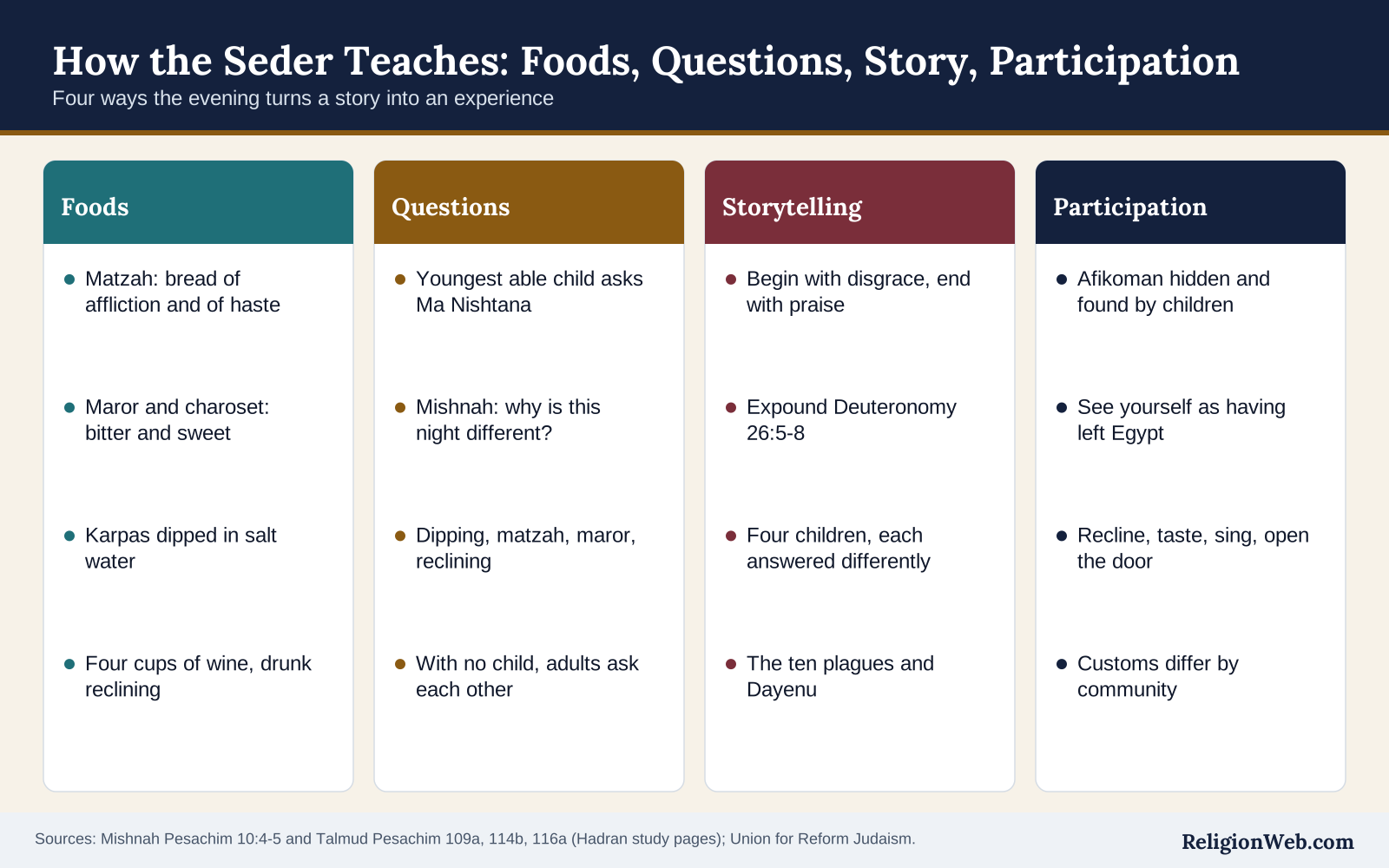
The Seder is designed as a conversation, not a lecture. The Mishnah (Pesachim 10:4) describes the moment when the second cup is poured and the child asks the father why this night is different; if the child lacks the understanding to ask, the father teaches the questions. The Gemara adds a sequence for the case when no child is present: the wise son asks his father, otherwise the wife asks her husband, and a person alone asks himself, so that even two scholars who know the laws of Passover are to ask each other. The father is told to teach according to the child’s understanding, beginning with disgrace and ending with praise, and to expound the biblical passage beginning “A wandering Aramean” from Deuteronomy 26. The Talmud records a disagreement about what “disgrace” means: Rav says it refers to the idolatry of the Israelites’ ancestors, and Shmuel says it refers to their having been slaves.
The passage in Deuteronomy that the Haggadah expounds reads, in the 1917 Jewish Publication Society translation:
A wandering Aramean was my father, and he went down into Egypt, and sojourned there, few in number; and he became there a nation, great, mighty, and populous.
Deuteronomy 26:5, The Holy Scriptures (JPS 1917)
The Haggadah follows the Mishnah’s rabbinic reading, which takes the opening Hebrew words to mean that an Aramean tried to destroy the patriarch Jacob, a reference to his uncle Laban. This is an example of how the Seder joins the biblical text to the rabbis’ commentary: the verses are read phrase by phrase, and each phrase is explained by stories and passages from Midrash. Modern translations, such as the 1917 text above, usually render the verse in its plainer sense, and both readings are part of what students of the Haggadah learn.
Seeing oneself as having left Egypt
The best-known instruction for participants appears in the next paragraph of the Mishnah (Pesachim 10:5). Rabban Gamliel taught that a person who does not mention three things on Passover, the paschal offering, the matzah, and the bitter herbs, has not fulfilled the obligation, and that in every generation a person must regard themselves as though they personally left Egypt, a conclusion the rabbis draw from the first-person wording of Exodus 13:8. The text then draws a consequence: the person is bound to give thanks and praise for the move from slavery to freedom, from mourning to festival, and from darkness to light.
That instruction accounts for much of how the Seder feels in practice. The leader asks participants to taste the bitter herb as if their own lives had been embittered, to recline because they are now free, and to say “we” of the generation that left. Jewish thinkers disagree about how literally to take the instruction. For some it is a call for imaginative identification, for others a statement about the unbroken chain of the Jewish people, and for others an ethical demand to see present oppression clearly. Each understanding finds support within the tradition, and a Haggadah or a leader may stress any of them.

The Haggadah: Text, Questions, and Songs
What the Haggadah Contains
The Four Questions
The best-known section is Ma Nishtana, “What is different?”, usually called the Four Questions. In the Mishnah the questions asked why on this night only matzah is eaten, why bitter herbs, why the meat is only roasted, and why the vegetable is dipped twice. In the form sung today, the question about roasted meat has been replaced by one about reclining, a change that reflects the end of the Temple offering. Writing for My Jewish Learning, Ruth Abusch-Magder notes that the Ashkenazi order is matzah, bitter herbs, dipping, and reclining, while Sephardi, Mizrahi, and Yemenite communities begin with dipping. The now widely used tune was composed by Ephraim Abileah, who was born in Russia in 1881, as part of an effort to create a new Jewish musical culture.
The Talmud reports that Rav Nachman, asked how a freed slave should speak, began his own answer by saying that the family had been slaves in Egypt, and the Haggadah’s answer still opens with that statement. In practice the Haggadah continues with a long series of passages that tell and interpret the story, so the Four Questions serve less as a test than as the opening that the Seder is designed to answer.
The four children, Dayenu, and the plagues
Other well-known passages include the four children, a wise child, a wicked child, a simple child, and one who does not know how to ask, each of whom gets an answer suited to the question. The passage is drawn from the Jerusalem Talmud and from the Mekhilta of Rabbi Ishmael, and it relates to the several places in the Torah where a parent is told how to explain the Exodus. Some modern Haggadot add a fifth child. The Haggadah also recites the ten plagues, and the custom of removing a drop of wine for each is traditionally explained as a sign that joy is diminished by the suffering of others, an idea taken up in the section on misconceptions. The song Dayenu, “it would have been enough,” lists steps of divine kindness from the Exodus to the building of the Temple, and My Jewish Learning notes that it is more than a thousand years old. In some Persian and Afghan communities it is sung while people lightly tap one another with scallions, a vivid sign of how a single text acquires local forms.
Songs at the end
The Seder ends with songs that are later additions to the core text. Chad Gadya, “One Little Goat,” and Echad Mi Yodea, “Who Knows One?”, are cumulative songs that appear in medieval Haggadot. Interpretations of Chad Gadya vary, from a simple children’s song to an allegory of history; the Vilna Gaon read it as a picture of divine justice at the end of days. They are sung at the end of the night, when the more formal obligations have been completed.
A Book with a History
Manuscripts and early printing
The oldest complete Haggadah text appears in a tenth-century prayer book from Babylonia compiled by Saadia Gaon, as noted by the librarian Nanette Stahl. The Haggadah later became a separate book, and illuminated manuscripts from medieval Spain and Germany are among the best-known treasures of Jewish art. The first printed Haggadot date to the late fifteenth century. A Haggadah attributed to Guadalajara in 1482 is probably the first, though it names no place or date and the attribution is uncertain, and the Soncino family printed one bound with a prayer book in 1486. The first complete illustrated printed Haggadah to survive was produced in Prague in 1526 by Gershom ben Solomon Cohen and his brother Gronem, with about sixty woodcuts. Further illustrated editions followed in Mantua in 1560, Venice in 1609, and Amsterdam in 1695, which was the first to use engraved copperplates. Scholars have counted more than 3,500 editions in all, most of them printed in the last century of the roughly six hundred years of publication.
Modern Haggadot
The twentieth and twenty-first centuries have produced an unprecedented variety of Haggadot. The writer Donald Altschiller calls the Maxwell House Haggadah, an edition distributed by a coffee company, probably the most widely used Seder text among American Jews. Alongside such standard editions are Haggadot designed for particular movements, for families with young children, for communities of Sephardi and Mizrahi heritage, and for social concerns. The Freedom Seder, first held by Arthur Waskow in 1969, linked the Exodus to the civil rights movement, and many later Haggadot adapted the format for causes such as feminism, refugees, and environmental concern. Critics within the tradition worry that innovation can crowd out the core texts, while supporters see it as continuing the rabbis’ own practice of making the story speak to a new generation.
The Seder Plate and Symbolic Foods
The Items on the Seder Plate
Six foods and what they recall
The Seder plate holds the foods that the leader points to during the telling. The Reform movement’s educational summary lists the shankbone, the roasted egg, the bitter herb, the charoset, and the greens, while a common sixth item, a second bitter vegetable called chazeret, appears on many plates. Each is linked to part of the story, though the explanations offered are traditions of interpretation and not statements of biblical law. The table gathers them.
| Item | What it is | Traditional meaning |
|---|---|---|
| Zeroa | Roasted shankbone | Recalls the lamb sacrificed in ancient times |
| Beitzah | Roasted or boiled egg | Recalls the festival offering and the cycle of life |
| Maror | Bitter herb, often horseradish or romaine lettuce | Recalls the bitter lives of the enslaved |
| Chazeret | A second bitter vegetable | Used for the Hillel sandwich in many households |
| Charoset | Paste of fruit, nuts, spices, and wine | Recalls the bricks and mortar of forced labor |
| Karpas | Parsley, celery, or another green | Spring; dipped in salt water |
| Salt water | Water with salt | A reminder of the tears of the enslaved |
| Three matzot | Stack of unleavened bread | The bread of affliction and of haste |
The charoset shows how a single symbol takes different forms. According to the Reform movement’s summary, the Ashkenazi version uses apples, nuts, sweet wine, cinnamon, and sugar, while the Sephardic version uses dates, nuts, and sweet wine. Other communities use figs, pomegranates, raisins, or other local fruit, so that the mixture that stands for mortar is sweet, a contrast many teachers point out.
Why the explanations differ
The earliest rabbinic text does not describe a plate. The Mishnah names the lamb, the matzah, and the bitter herbs as the items that must be explained, and the plate as a standard arrangement developed afterward. Interpretations of the egg and the shankbone differ among communities, and some of them connect the egg with mourning for the destroyed Temple. In Yemenite households, as My Jewish Learning’s survey of customs reports, there is no plate and the vegetables are arranged across the whole table. These differences are a reminder that the plate is a teaching aid, not a rubric.
Newer Symbols: Cups and the Orange
Elijah’s cup and Miriam’s cup
Elijah’s cup is the older of the two customs. The Reform summary describes it as a cup poured for the prophet who is expected to herald the Messiah, a symbol of “the hope for a redemptive future.” The door is opened during the grace after the meal. Miriam’s cup is a newer custom, filled with water, in honor of the sister of Moses, who in the biblical narrative watches over the infant Moses and leads the women in song at the sea. A water cup recalls the tradition of a well that accompanied the Israelites for her sake. It is optional, and many communities do not use it.
The orange: history and meaning
The orange on the Seder plate has a well-documented and often misreported history. A Jewish Women’s Archive blog post by Jordan Namerow traces the custom to an episode in Berkeley in 1979, when students placed bread on a Seder plate in solidarity with Jewish lesbians, in response to a remark attributed to a Chabad rebbetzin. A student version of that story appeared in an Oberlin College women’s Haggadah in the mid-1980s, and the scholar Susannah Heschel later told it widely, substituting a fruit as a sign of solidarity with gay and lesbian Jews. As the story spread, the fruit became an orange and the emphasis shifted toward the inclusion of women in leadership, until a version published in a 1996 Haggadah reached a wider audience. The Reform summary reports that many families and congregations now use an orange to symbolize the inclusion of LGBTQ+ people and others who feel marginalized in Jewish life. Not every community uses it, and some leaders object to adding new symbols to the plate. It remains one of the clearest examples of a Seder custom invented within living memory.
Synagogue Worship, Festival Days, and the Rest of the Week
The Opening and Closing Days
The first and last days of Passover are full festival days. Following Leviticus 23, ordinary work is prohibited on them, and the synagogue liturgy includes the festival Torah readings and full Hallel. Observant communities treat the first and last days much as they treat Shabbat, with exceptions for cooking and carrying. The table shows the diaspora schedule for 2027 according to Hebcal.
| Date | Day | Observance |
|---|---|---|
| April 21 (sundown) | Wednesday | Erev Pesach; first Seder; Fast of the Firstborn that morning |
| April 22 | Thursday | First day (15 Nisan); second Seder at night in the diaspora |
| April 23 | Friday | Second day in the diaspora |
| April 24 to 27 | Saturday to Tuesday | Chol HaMoed; Shabbat on April 24 |
| April 28 | Wednesday | Seventh day (21 Nisan) |
| April 29 | Thursday | Eighth day in the diaspora; festival ends at nightfall |
First days: prayers and readings
On the first day the Torah reading is Exodus 12:21-51, the account of the original Passover night, together with the festival offerings of Numbers 28. The reading on the second day in the diaspora is from Leviticus 22 and 23, the chapter that lays out the festival calendar, and its prophetic reading, from 2 Kings 23, tells of Josiah’s Passover. Communities of Ashkenazi origin recite a prayer for dew at the additional service of the first day, a custom that marks the turn of the agricultural seasons. These passages come from the Torah but are chosen for the festival and not for the weekly sequence.
The seventh and last days
The seventh day of Passover is traditionally marked as the day of the crossing of the sea, and its Torah reading, Exodus 13:17 through 15:26, includes the Song at the Sea, which congregations often chant to a special melody. The last day of the festival in the diaspora reads Deuteronomy 15:19 through 16:17, which includes the commandment to keep the pilgrimage festivals, and the Reform movement’s summary notes that Yizkor, the memorial prayer for the dead, is recited on the last day. Hallel is said in a shortened form on the later days, and one reason often given is a rabbinic teaching in the Talmud, discussed in the section on misconceptions, that God did not rejoice at the drowning of the Egyptians.
Chol HaMoed, the Omer, and Related Dates
Chol HaMoed and Shabbat during Passover
Chol HaMoed means the “ordinary days of the festival,” the intermediate days between the opening and closing festival days. Work restrictions are looser than on the festival days themselves, and many people use the time for family outings, though the rules against chametz continue. When Shabbat falls during the festival, as it does in 2027, a special reading from Exodus 33 and 34 is read in the synagogue, and in many communities the biblical Song of Songs is read as well, because rabbinic tradition associates its images of spring and love with Passover and the covenant between God and Israel.
Before and after: the Fast of the Firstborn, Shabbat HaGadol, and the Omer
Several observances belong to the weeks around Passover. The Sabbath before the festival is called Shabbat HaGadol, “the Great Sabbath,” and the rabbi traditionally gives a sermon on the laws of the holiday. On the morning of the Seder, firstborn males traditionally fast in memory of the firstborn who were spared in Egypt, though in practice many firstborn avoid the fast by attending a celebration marking the completion of a Torah text, which exempts them. On the second night of Passover begins the counting of the Omer, forty-nine days that link Passover with the festival of Shavuot, the holiday associated with the giving of the Torah at Sinai. The count is a time of restraint in many communities, with traditions against weddings and haircuts, and it is eased on Lag B’Omer, the thirty-third day. Finally, Pesach Sheni, the Second Passover, falls a month after the first, on 14 Iyar, and is marked in some communities by eating matzah.
How Communities Observe Passover
Customs of Different Jewish Communities
| Community or setting | Distinctive practice | Source or note |
|---|---|---|
| Ashkenazi | Many avoid kitniyot; charoset of apples and nuts | Custom dating from medieval France |
| Sephardi and Mizrahi | Kitniyot often permitted; charoset of dates | Practice varies by family and region |
| Yemenite | No Seder plate; foods arranged on the table | My Jewish Learning survey of customs |
| Persian and Afghan | Tapping with scallions during Dayenu | My Jewish Learning survey of customs |
| Tunisian and Moroccan | Reed basket or Seder plate held over guests’ heads | Accompanied by a dialogue about leaving Egypt |
| Hungarian and Austrian | Seder table decorated with jewelry | Recalls Exodus 3:21-22 |
| Orthodox and Conservative, diaspora | Two Sedarim; eight days | Israel: one Seder; seven days |
| Reform and other liberal communities | One Seder, sometimes two; seven days | Family and congregation practice varies |
Ashkenazi and Sephardi patterns
Differences between Ashkenazi Jews, whose ancestry lies in Central and Eastern Europe, and Sephardi Jews, whose ancestry lies in Spain and Portugal, are among the best-known sources of variation. They touch kitniyot, charoset, the order of the Four Questions, and the foods of the Seder meal. Mizrahi communities from North Africa, the Middle East, and Central Asia contribute their own customs, and regional communities such as Bene Israel in India or the Beta Israel in Ethiopia developed distinct patterns. Abby Seitz, writing for My Jewish Learning, collects a number of them: Kurdish households give their kitchens an extra deep cleaning, Turkish families toss candy and coins for children to gather, and Bene Israel families press handprints in sheep’s blood on paper to hang by the door.
The pattern of acting out the Exodus recurs across continents. Tunisian hosts hold a basket of Seder foods over each guest’s head while a short dialogue about leaving Egypt and reaching freedom is recited, Moroccans use a plate, and in some Romanian families participants carry a bag of heavy objects around the table. All of these customs rest on the rabbinic instruction to see oneself as having left Egypt, rendered in gesture instead of in words.
Mimouna and the end of the festival
The festival has its own ending among Moroccan Jews. Mimouna is the celebration held on the evening and day after Passover, when chametz is again permitted. According to Lesli Koppelman Ross, its origins are unclear and the explanations include a memorial for the father of Maimonides and associations with good fortune. Tables are decorated with flowers and sometimes live fish, a dairy meal features thin pancakes with honey, and neighbors visit one another. The custom spread through North Africa and to Israel, where the community gathers in Jerusalem and elsewhere.
Movements and Individual Choices
Orthodox and Conservative practice
Orthodox communities keep the full body of law about chametz, matzah, kitniyot for Ashkenazim, and the second day outside Israel, and Orthodox Jews are most likely to have taken part in a Seder, according to Pew. Conservative Judaism similarly keeps the rules about chametz and matzah and, as noted above, its law committee permitted kitniyot in 2015. Details of the movements are covered in the articles on Orthodox Judaism and Conservative Judaism. Both traditions regard avoidance of chametz as a binding obligation for the entire week.
Reform, secular, and unaffiliated households
Reform Judaism, described in the article on Reform Judaism, places emphasis on the Seder and on adapting it. The Reform summary states that matzah is obligatory only at the Seder, that the Seder is held on the first night and in some families on the second, and that “both old and new traditions are equally welcome.” Many Jews who do not belong to any movement keep the Seder as a central annual expression of Jewish identity. In Israel, Pew’s 2014 to 2015 survey found that 87 percent of secular Jews said they had hosted or attended a Seder the previous Passover, which shows how widely the evening is observed beyond the religiously observant.
The Samaritan Passover
How the offering is carried out
The Samaritans are a small community whose scripture is their own version of the Torah, and they still sacrifice the paschal animal each year on Mount Gerizim, near Nablus, which they regard as their holiest site. Jewish tradition regards the Samaritans as a distinct community, and the Samaritans do not describe themselves as following rabbinic Judaism. According to an AFP report, carried by UCA News, on the April 2025 sacrifice, every family brings a sheep, men in white garments slaughter the animals, and priests recite prayers in ancient Hebrew. Photographs taken in 1917 by members of the American Colony in Jerusalem, published by the Public Domain Review, show the preparation and the meal eaten after dark with unleavened bread and bitter herbs in keeping with Exodus 12.
A small community and a living practice
The Samaritan population is under a thousand, with about half living near Mount Gerizim and half in Holon, near Tel Aviv, according to the same report, a number that fell below two hundred in the nineteenth century. The ritual is mentioned here because it is one of the few places where a paschal sacrifice is still carried out under priestly direction, and because it shows what the rabbis’ Seder replaced when the festival moved into the home. Mishnah tractate Pesachim discusses the Egyptian Passover and the Passover of later generations as separate cases, and the Samaritan rite retains the sacrifice that the Seder replaced for most Jews.
Passover in Modern Jewish Life
How Widely the Seder Is Kept
Survey evidence from the United States and Israel
The Seder is among the most widely observed Jewish practices, including among people who do not otherwise follow religious law. Pew Research Center’s 2020 Survey of U.S. Jews, conducted mostly before the coronavirus pandemic and published in 2021, found that about six in ten Jewish Americans (60 percent) said they had held or participated in a Seder in the year before the survey. The share was about three-quarters (74 percent) among Jews by religion and 30 percent among Jews of no religion. Orthodox Jews and Jews with Jewish spouses were more likely than others to have taken part. Pew also found that 56 percent of U.S. Jews owned a Seder plate.
In Israel, Pew’s survey of 2014 and 2015 found that 87 percent of Hilonim, the Israeli Jews who identify as secular, said they had hosted or attended a Seder the previous Passover. The two surveys measure different populations at different times and should not be set against each other as a ranking. They do show that the Seder is a point of contact with Jewish tradition for many people who describe themselves as non-religious.
Communal and virtual Sedarim
Beyond the family table, Passover has developed new settings. Synagogues, Jewish community centers, university Hillel houses, and organizations that host meals for young adults offer communal Sedarim, and many congregations hold a community Seder for those who do not have a household to join. During the pandemic of 2020, many families held Sedarim by video connection for the first time, including with relatives on other continents. Because Orthodox law generally restricts the use of electronic devices on festival days, video Sedarim were chiefly a feature of communities whose practice permits them. The experience prompted wider discussion of what the Seder requires in order to be a shared meal.
Memory, Justice, and Reinterpretation
Passover and the memory of persecution
Passover has long been a time when Jewish communities have remembered more recent suffering alongside the Exodus. The Warsaw ghetto uprising began on April 19, 1943, on the eve of Passover, according to the United States Holocaust Memorial Museum and the date is often noted in Holocaust remembrance. Haggadot and Seder customs now often include readings about the Holocaust, and the fifth child added in some editions represents, depending on the edition, those who did not survive to ask or Jews who have drifted from Jewish life. Reflection of this kind sits within the Seder’s general instruction to remember oppression. It does not displace the focus on the Exodus, and communities differ about how much to add.
Freedom, justice, and contemporary questions
Because the Seder is organized around the move from slavery to freedom, it has long been a vehicle for reflection on justice. The Torah repeatedly tells Israelites to treat the stranger with fairness because they themselves were strangers in the land of Egypt, and teachers often draw on that logic when discussing immigration, refugees, and labor. Arthur Waskow’s Freedom Seder in 1969 connected the story to the American civil rights movement, and later Haggadot have addressed hunger, poverty, women’s roles, and the environment. These adaptations are welcomed by some communities and questioned by others, who worry that the core text is overshadowed by present-day causes. The tradition’s own practice of asking questions allows the debate to take place at the table itself.
Common Misconceptions About Passover
Misconception 1: Passover is a single dinner
Where the misunderstanding comes from
Because the Seder is the most visible and widely shared part of the holiday, many people, including many Jews who encounter the festival mainly through a family meal, think of Passover as the evening of the Seder. Popular media often reinforce this by showing only the table.
What the evidence and tradition actually show
The Torah commands a festival of seven days. Leviticus 23 describes the opening and closing days as sacred assemblies, and the period in between is one of unleavened bread. In the Land of Israel the festival lasts seven days, and in most diaspora communities it lasts eight, with Seders on the first two nights in Orthodox and Conservative communities. During that time observant Jews avoid chametz, eat matzah, attend synagogue services with special readings, and read the Song of Songs on the intermediate Shabbat. The counting of the Omer, which begins on the second night, continues for forty-nine days and leads to the festival of Shavuot. The Seder is the heart of the festival, and it is not the whole of it.
Misconception 2: Every symbolic food appears in the same form in every community
Where the misunderstanding comes from
Illustrations of the Seder plate in textbooks, on greeting cards, and in many American Haggadot present a single arrangement of six items, and that familiar image is easily taken as universal. Cookbooks and food marketing add to the impression by presenting a standard menu, which tends to reflect the traditions of Ashkenazi Jews in North America more than those of the Jewish world as a whole.
What the evidence and tradition actually show
The Mishnah requires that the Seder leader explain three things, and the arrangement of the plate developed later and differs from place to place. Reform sources state that the contents vary by tradition. Charoset is made with apples and nuts in the Ashkenazi tradition and with dates in the Sephardic tradition, and other communities use other local fruits. Yemenite households place the symbolic foods directly on the table with no plate, and Tunisian and Moroccan communities use a basket or plate in a dialogue about leaving Egypt. The Beta Israel of Ethiopia, according to My Jewish Learning’s survey, traditionally slaughter a Passover lamb and read the story from the Torah scroll instead of a Haggadah. Even the question of what may be eaten differs, as the discussion of kitniyot shows. The symbolism is shared; the forms are not.
Misconception 3: Matzah is simply a culinary preference
Where the misunderstanding comes from
Matzah is sold year-round in many supermarkets as a cracker and is eaten with spreads, which can make it look like a food that Jewish people happen to like at Passover. Some people also assume that “no bread” is a dietary habit comparable to modern food restrictions chosen for taste or health.
What the evidence and tradition actually show
In Jewish law, matzah is a ritual food whose preparation and consumption are governed by rules. The Torah commands that unleavened bread be eaten during the festival, and the Mishnah names the matzah, with the lamb and the bitter herbs, as one of the three things that must be explained at the Seder for the obligation to be fulfilled. Rabbinic law sets a maximum time for baking, usually given as eighteen minutes from the addition of water, and shmurah matzah is guarded from the harvest to prevent any contact with moisture. Eating matzah at the Seder is an obligation, and Reform sources state that matzah is required at the Seder alone, with chametz avoided for the rest of the week. Beyond the law, the matzah carries a symbolic charge as the bread of affliction and the bread of haste. The same food eaten at another time of year is not the same act.
Misconception 4: Passover celebrates triumph over the Egyptians
Where the misunderstanding comes from
Popular retellings, including films and children’s books, often focus on the plagues and the drowning of Pharaoh’s army and present the story as a victory. The Song at the Sea in Exodus 15 does exult in the defeat of the pursuers, and a reader who encounters only that passage might reasonably conclude that triumph is the festival’s theme.
What the evidence and tradition actually show
Rabbinic tradition also contains a strong counter-current. The Talmud, in tractates Megillah and Sanhedrin, reports a teaching of the sages that when the angels wished to sing as the Egyptians drowned, God rebuked them, saying that the works of his hands were drowning and asking how they could sing. Jewish teachers cite this as the reason that a drop of wine is removed from the cup for each plague, so that joy is lessened by the suffering of others, and for the shortened Hallel on the later days of the festival. Practice varies by community, and not all scholars link the customs to that passage. The Haggadah itself spends far more attention on redemption, memory, and thanksgiving than on the fate of Egypt. The festival is, in the tradition’s own terms, a celebration of liberation and a reminder of the cost of oppression, and it carries a note of restraint about the downfall of any enemy.
Frequently Asked Questions About Passover
Questions about meaning and timing
What does Passover commemorate, and why does it matter to Jewish tradition?
Passover commemorates the liberation of the Israelites from slavery in Egypt as told in the Book of Exodus, including the tenth plague, in which God is said to have passed over the houses marked with blood. The Exodus is the founding event of Israel’s story in the Torah, and the festival is the yearly occasion on which that story is retold and ritually experienced.
Its importance lies as much in the manner of remembering as in the event. The Mishnah instructs each generation to see itself as having left Egypt, and the evening is structured so that children and adults alike ask, taste, and answer.
Why does the date of Passover change every year on the civil calendar?
The festival falls on 15 Nisan in the Jewish calendar, which follows the moon but is adjusted to the sun. A thirteenth month is added seven times in each nineteen-year cycle so that Nisan stays in spring. Because a Jewish year does not match the civil year in length, the date shifts within a window of about a month. In 2027 the festival begins at sundown on April 21.
How long does Passover last, and what happens on each day?
Passover lasts seven days in Israel and eight days in most diaspora communities that follow traditional practice. The first and last days are full festival days with synagogue services and restrictions on work. The days between are Chol HaMoed, when work is partly permitted and the rules about chametz still apply. The Seder takes place on the first night, and on the second night as well in the diaspora.
Questions about food and the home
What foods are not eaten during Passover?
Observant Jews do not eat chametz, meaning products of wheat, barley, spelt, rye, or oats that have risen or fermented, including bread, pasta, beer, and many baked goods. Many Ashkenazi Jews also avoid kitniyot, such as rice, beans, and lentils, while many Sephardi and Mizrahi Jews do not. Products intended for the week often carry a “kosher for Passover” label, a designation that goes beyond ordinary kosher certification, as the article on kosher and kashrut explains.
What is the afikoman?
The afikoman is the piece of the middle matzah that is broken off early in the Seder and set aside to be eaten at the end of the meal as the last food. The word comes from Greek and is commonly explained as referring to something eaten after the meal, a dessert. Many families hide it for children to find, with a reward for its return, though customs vary and some communities have no such game. The practice keeps younger participants engaged through a long meal.
Can guests who are not Jewish attend a Seder?
Seders are held in homes and communities, and many Jewish hosts welcome guests of any background. The Haggadah itself opens its telling with an invitation for the hungry to come and eat. Guests should ask their hosts what to expect, since practice differs by family and community, and they are generally not asked to take on obligations that belong to the Jewish participants. A gift of kosher-for-Passover food or wine, or help with the meal, is usually welcome.
Questions about the Seder itself
Who asks the Four Questions?
The custom is for the youngest participant who is able to do so to ask the Four Questions, usually by singing them. The Talmud sets an order of precedence for when no child is present: the wife asks the husband, or a person asks themselves, so that the questions are never omitted. Children also take on a growing role over time, and the age of religious responsibility described in the article on bar and bat mitzvah is the point at which a young person becomes obligated to keep the commandments, including those of the Seder.
Is wine required, and what if someone cannot drink it?
Jewish law calls for four cups of wine at the Seder, and the Kiddush at the start is said over wine. Many rabbinic authorities allow grape juice for those who cannot or prefer not to drink alcohol, including people for whom alcohol would be unsafe, and a person with a medical condition should follow medical guidance and ask a rabbi about alternatives. Many households use grape juice for children.
What do people say to greet each other on Passover?
The most common greetings are “Chag sameach,” “joyous festival,” and “Chag Pesach sameach,” “a joyous Passover festival.” Some people say “Chag kasher v’sameach,” which wishes the other person a festival that is both kosher and joyful, a nod to the work of preparing the home. In English, “Happy Passover” is widely used and is welcome.
Conclusion: What Passover Teaches and Where to Continue
What the history and practice show
A festival that teaches by participation
Passover is a festival built around a story told at a table. From a biblical rite of sacrifice and unleavened bread, it became after 70 CE a meal in which questions come first, objects prompt memory, and each participant is asked to take part. The long history of the Haggadah, from a tenth-century prayer book to thousands of printed editions, shows a text that has been adapted repeatedly without losing its basic outline. The rules about chametz and matzah give the story a physical form that lasts the whole week.
One festival, many customs
The tradition has always allowed variety within a shared frame. Ashkenazi and Sephardi households, Orthodox and Reform communities, Israelis and diaspora Jews, and the small Samaritan community all keep the festival in ways that are recognizably related and often differ in detail. That variety is part of the evidence for how deeply the festival has been woven into Jewish life, and an accurate description of Passover includes both what is shared and what differs.
How to keep exploring
Related festivals and the Jewish year
Passover is one of the pilgrimage festivals of the Jewish year and is linked to the others through the count of the Omer. Readers who want to see how it fits among the high holy days and the weekly day of rest can continue with Shabbat, Rosh Hashanah, Yom Kippur, and Hanukkah, each of which has its own history and customs.
Texts and law behind the festival
For the sources of the festival, the article on the Talmud explains how tractate Pesachim came to be, and the general article on Judaism places Passover within the larger picture of belief, law, and community. Readers interested in how different movements treat matters such as kitniyot and the second day can read the articles on Orthodox, Conservative, and Reform Judaism noted above, each on its own terms.
Sources
The table below lists the principal external sources behind this article. Facts, dates and figures were checked against these and related primary, institutional and academic materials.
| # | Source | Publisher and type | Used for | Link |
|---|---|---|---|---|
| 1 | The Holy Scriptures: A New Translation (JPS 1917): Exodus 12-13, Leviticus 23, Deuteronomy 16 and 26 | Sefaria (public-domain JPS 1917 text) · Primary text | All scripture quotations; Exodus 12 instructions; Leviticus 23 calendar; Deuteronomy 16 and 26 | sefaria.org |
| 2 | Daf Yomi study pages: Pesachim 109, 114, 116; Megillah 10; Sanhedrin 39 | Hadran · Primary text study aid | Mishnah Pesachim 10:4-5; Talmud on children's questions, Rabbi Akiva, double dipping, Egyptians drowning | hadran.org.il |
| 3 | Passover | Encyclopaedia Britannica · Encyclopedia | Definition; alternative names (Chag HaMatzot, Chag HaAviv, Zman Cheruteinu) | britannica.com |
| 4 | Passover (Encyclopaedia Judaica text) and Four Cups of Wine | Jewish Virtual Library · Academic reference | Biblical terms, Josiah, Second Temple crowds, Samaritans, Seder steps, four cups | jewishvirtuallibrary.org |
| 5 | Passover (Pesach) 2027, Diaspora and Israel schedules | Hebcal · Calendar data | 2026 and 2027 dates; festival readings; Chol HaMoed and Fast of the Firstborn dates | hebcal.com |
| 6 | Jewish Americans in 2020: Jewish practices and customs | Pew Research Center · Demographic data | 60% held or attended a Seder; 74% of Jews by religion; 30% of Jews of no religion; 56% own a Seder plate | pewresearch.org |
| 7 | Israel's Religiously Divided Society | Pew Research Center · Demographic data | 87% of secular Israeli Jews hosted or attended a Seder (survey Oct 2014 to May 2015) | pewresearch.org |
| 8 | Passover Customs and Rituals | Union for Reform Judaism (ReformJudaism.org) · Institutional | Fifteen Seder steps; Seder plate; charoset; Elijah and Miriam cups; orange; Reform practice | reformjudaism.org |
| 9 | The Illustrated Haggadah: Printed Haggadot (paper by Nanette Stahl) | IFLA General Conference, 1998 · Academic reference | Earliest Haggadah text; first printed and illustrated editions (1482?, 1526, 1560, 1609, 1695) | archive.ifla.org |
| 10 | Kitniyot: Not Quite Hametz (Jeffrey Spitzer) | My Jewish Learning · Educational explainer | Kitniyot custom; 13th-century origin; December 2015 Conservative ruling | myjewishlearning.com |
Last fact-check date: 2026-10-21.