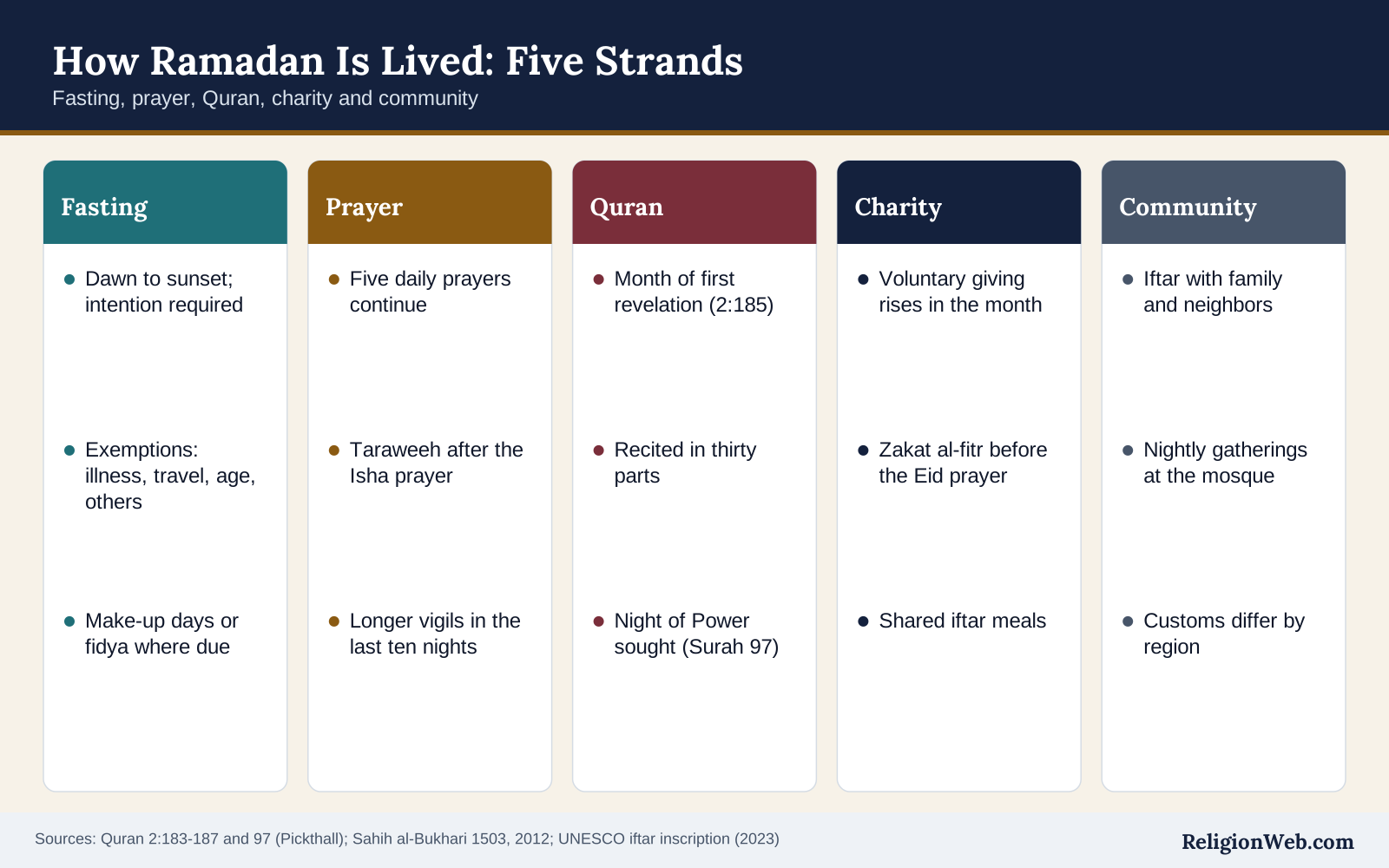
Ramadan is the ninth month of the Islamic lunar calendar and the month in which Muslims fast from dawn until sunset. In that daylight stretch observant adults abstain from food, drink, and marital relations, and they give the month a heavier load of prayer, Quran recitation, charity, and attention to conduct. The Arabic word for the fast is sawm (also siyam), and the Quran names Ramadan as the month in which the fast is to be kept. Muslims regard the fast as an act of obedience and gratitude to God (Allah), a discipline of self-restraint, and a season of mercy and renewal.
The fast of Ramadan is one of the Five Pillars of Islam, the core obligations that the five pillars of Islam chapter treats as a set, alongside the declaration of faith, daily prayer, almsgiving, and pilgrimage. The Quran ties the month to its own origins: according to Surah 2:185, Ramadan is the month in which the Quran was revealed. For that reason many Muslims think of Ramadan less as a time of deprivation than as a time of closeness to scripture, and the month is filled with recitation, study, and long night prayers in mosques.
Ramadan is also a calendar event with practical consequences. Because the Islamic year follows the moon and is about eleven days shorter than the solar year, the month moves earlier through the seasons and begins on a different civil date each year. Its start and end are set by the appearance of the crescent moon or by astronomical calculation, depending on the country and the religious authority, so neighbors in different places may begin the fast a day apart. In 2026 the month began on February 18 or 19, depending on the country, and Eid al-Fitr, the festival that follows it, fell on March 20 in Saudi Arabia and many other countries.
This article explains what Ramadan is and why it matters to Muslims, how it began, how its dates are set, what a fasting day involves, who is exempt and what the exemptions require, how the month is spent in prayer and charity, what the last ten nights and Laylat al-Qadr mean, and how customs differ across Sunni and Shia communities and across regions. For the wider religion, see the chapter on Islam. Where Muslim scholars and communities differ, the article names the school or tradition rather than flattening the differences into one voice.
At a Glance: What Ramadan Is and What Muslims Do
A short definition of the month
Ramadan as the ninth month of the Islamic calendar
The Islamic, or Hijri, calendar has twelve lunar months, and Ramadan is the ninth. Each month begins around the new moon and lasts 29 or 30 days, so Ramadan itself is either 29 or 30 days long, depending on when the next crescent is established. The calendar counts years from the Hijra, the Prophet Muhammad’s migration from Mecca to Medina in 622 CE, and the year of the Ramadan fast that began in 2026 is numbered 1447 AH. Britannica notes that the Hijri year runs 354 or 355 days, which is why Ramadan retreats through the solar year and passes through every season about once every 32.5 years.
The fast during this month is a matter of religious law as well as personal devotion. Islamic jurists classify it as a fard, an obligation, for every adult Muslim who is able to fast and is not traveling or ill. The obligation comes directly from the Quran, in a passage discussed in more detail below, and it is reinforced by a large body of hadith, the reports of the Prophet’s words and actions collected in books such as the hadith collections.
Fasting as one of the Five Pillars
Among the Five Pillars, the fast is the one that is most visibly shared. Prayer happens five times a day in a rhythm that individuals follow in their own settings, almsgiving is usually a private act, and the pilgrimage (Hajj) is required once in a lifetime of those who can afford it. The Ramadan fast, by contrast, brings an entire community into the same schedule at once. Offices adjust their hours, families reorganize meals, and neighborhoods change their rhythm after sunset. A 2013 Pew Research Center summary of surveys in 39 countries and territories found that a median of 93 percent of Muslims said they fast during Ramadan, which makes fasting the second most widely reported pillar after the belief in one God and the prophethood of Muhammad.
Key terms and vocabulary
Ramadan has its own vocabulary, and most of it comes from Arabic. The table below collects the words that appear most often in this article. Spellings vary in English (suhoor, suhur, sahur; taraweeh, tarawih), and Turkish, Persian, Urdu, Indonesian, and Malay speakers often use their own forms for the same practices.
| Term | Meaning | Where it appears in practice |
|---|---|---|
| Sawm / siyam | Fasting; abstaining from food, drink, and marital relations from dawn to sunset | The central obligation of the month |
| Niyya | Intention to fast, formed in the heart | Made before dawn, with timing rules varying by school |
| Suhoor (sahur) | The pre-dawn meal | Eaten before the Fajr prayer begins |
| Iftar | The meal that breaks the fast | At sunset, often with dates and water first |
| Taraweeh | Voluntary night prayers specific to Ramadan | After the Isha prayer, usually in congregation |
| Laylat al-Qadr | The Night of Power or Decree | Sought in the last ten nights |
| I’tikaf | Spiritual retreat in a mosque | Most often the last ten days |
| Zakat al-fitr | Charity due before the end-of-Ramadan festival | Paid before the Eid prayer |
| Fidya | Compensation by feeding a poor person for each missed day | For those who cannot fast and cannot make up the days |
| Qada | Making up missed fasts later | For travelers, the ill who recover, and menstruating women |
| Kaffara | Expiation for deliberately breaking a fast without excuse | Defined in juristic law; see below |
| Hilal | The new crescent | Sighted or calculated to start and end the month |
Words for the fast and its meals
The Arabic word sawm means, at its root, to refrain or hold back. That broader sense matters, because jurists and preachers both stress that the Ramadan fast is a restraint of the whole person and not only of the stomach. Suhoor and iftar are the two meals that frame the fasting day. The first is a recommended act in the Prophet’s example, and the second is the moment when the day’s restraint ends. Neither is a feast in the legal sense, though both are often celebrated in practice.
Words for the prayers and the nights
Ramadan adds several terms to the vocabulary of prayer. Taraweeh is the Ramadan-specific night prayer prayed in sets of two rak’ahs (units of prayer), with short rests between sets, which is the likely source of the name. Laylat al-Qadr and i’tikaf describe the intense final days of the month. The daily ritual prayers themselves remain the five obligatory prayers explained in the chapter on salah, and the Quran is recited, studied, and sometimes completed in full during the month.
How one day in Ramadan is arranged
A day in Ramadan has a recognizable arc. The table below shows the sequence in a generic form; actual clock times depend on latitude, season, and the calculation method a community uses for dawn and sunset.
| Part of the day | What happens | Notes on variation |
|---|---|---|
| Night before / before dawn | Intention to fast; suhoor; Fajr prayer begins the fast | Some families wake neighbors; some skip the meal |
| Morning to afternoon | Work, study, household tasks; Quran reading; Dhuhr and Asr prayers | Several Muslim-majority countries shorten work hours |
| Late afternoon | Cooking, charity distribution, preparing iftar for others | Mosques and charities often prepare shared meals |
| Sunset | Call to prayer; dates and water; Maghrib prayer; the main meal | Shia custom waits a few minutes after sunset |
| Night | Isha prayer, then taraweeh; visits; recitation; supplication | Prayer lengths and rak’ah counts vary by community |
Before dawn: intention and suhoor
The fasting day begins before it starts. A Muslim forms the intention to fast, wakes for the pre-dawn meal if possible, and finishes eating when the first light of dawn appears. The Fajr prayer follows. In reports preserved in Sahih al-Bukhari (1923), the Prophet is quoted as saying that there is blessing in taking suhoor, and jurists treat the meal as recommended and not required. People who miss it may still fast.
After sunset: iftar, prayer, and the evening
When the sun sets, the call to prayer sounds and the fast ends. Most families break it with dates and water, in line with a practice reported in Sunan Abi Dawud (2356), then pray Maghrib and sit down to the main meal of the day. The evening is not only for eating. After the Isha prayer, many Muslims go to the mosque for taraweeh, some stay for Quran recitation, and many visit relatives or host neighbors. The rhythm repeats for 29 or 30 days.

Scale and the people who observe the month
How many Muslims fast
Pew Research Center’s 2025 report on the global religious landscape estimates that Muslims made up 25.6 percent of the world’s population in 2020, an increase of 347 million people since 2010, and that 53 countries and territories had Muslim majorities. Pew’s 2013 summary of fasting levels, drawn from surveys in 39 countries and territories with more than 38,000 respondents, found a global median of 93 percent saying they fast. Those numbers describe different years and different survey questions, and they should not be multiplied into a single headcount of fasters.
Why the numbers vary
Fasting levels vary by country. The same Pew summary reports that fasting is nearly universal in the Southeast and South Asian countries surveyed, while in several Central Asian and European countries fewer than half of Muslims said they fast, for example 44 percent in Albania, 43 percent in Azerbaijan, and 30 percent in Kazakhstan. Pew records the gap without tracing it to a single cause, and the survey says nothing about how those respondents understand the obligation. The figures also remind readers that Muslims who do not fast, whether through illness, age, travel, or choice, still often take part in the social life of the month.
Origins: Revelation, Medina, and the Early History of the Fast
Ramadan in the Quran
The verses that prescribe the fast
Muslims trace the obligation to a short run of verses in the second chapter of the Quran, Surat al-Baqara, which Muslim tradition associates with the Medinan period of the Prophet’s life. The passage opens by addressing the believers directly and by placing the fast in a longer story of religious practice. The translation quoted here is Marmaduke Pickthall’s of 1930, which is in the public domain.
O ye who believe! Fasting is prescribed for you, even as it was prescribed for those before you, that ye may ward off (evil);
Quran 2:183, trans. Marmaduke Pickthall, The Meaning of the Glorious Koran (1930), Internet Sacred Text Archive edition
Classical commentators read the phrase “those before you” as a reference to earlier communities that, in the Muslim understanding, received their own rules of fasting from God. The clause that follows, rendered here “that ye may ward off (evil),” translates the Arabic la’allakum tattaqun. It points to taqwa, a word usually explained as God-consciousness, mindfulness, or protective awareness of one’s obligations to God. Many Muslim writers treat this phrase as the stated purpose of the whole month: the fast is a training in restraint and attentiveness, and the hunger is a means and not the goal.
Revelation, the Criterion, and the month
The next verses name the month and explain why it matters. The central verse links Ramadan to the Quran itself and sets out the rule for the sick and for travelers.
The month of Ramadan in which was revealed the Qur’an, a guidance for mankind, and clear proofs of the guidance, and the Criterion (of right and wrong). And whosoever of you is present, let him fast the month, and whosoever of you is sick or on a journey, (let him fast the same) number of other days. Allah desireth for you ease; He desireth not hardship for you;
Quran 2:185, trans. Marmaduke Pickthall (1930), Internet Sacred Text Archive edition
“The Criterion” renders al-furqan, one of the Quran’s own names for revelation, meaning that which separates right from wrong. Muslim tradition holds that the first revelations to the Prophet Muhammad came during Ramadan, on a night the Quran calls the Night of Power, which a later section of this article explores. The Quran’s wording does not give a calendar day or a year, and the usual date for the first revelation, around 610 CE, is a conclusion drawn from the Prophet’s biography discussed in the chapter on Prophet Muhammad. The structure of the Quran itself, and how its recitation is organized across the month, is covered in the chapter on the Quran.
How the fast took shape in Medina
From Ashura to Ramadan
Traditional Muslim accounts place the prescription of the Ramadan fast in the second year after the Hijra, or 2 AH, which corresponds to 623 to 624 CE. A report in Sahih al-Bukhari (2002), transmitted from the Prophet’s wife Aisha, preserves an important detail about what came before. It says that the Quraysh of Mecca fasted on the day of Ashura (the tenth of Muharram) in the pre-Islamic period, that the Prophet fasted on it as well, and that he continued the practice after moving to Medina and told others to do so. When the fast of Ramadan was prescribed, the report says, Ashura became optional. Muslims still fast on Ashura voluntarily, and for Shia communities the day carries additional meaning in connection with the martyrdom of Husayn, a topic covered in the chapter on Shia Islam.
According to Britannica, the Battle of Badr, the first major military engagement between the early Muslim community and the Quraysh, took place in March 624 CE, which falls in Ramadan of 2 AH on the Hijri calendar. Muslim sources treat that Ramadan as the first in which the community fasted the whole month, and the proximity of the first fast and the first major victory is one reason Ramadan carries historical associations as well as devotional ones. The details of Badr and the dating of the first fast are known from later biographical and historical works, and historians treat them as traditional accounts that were written down after the events.
The name and the older month
The word Ramadan is derived from an Arabic root associated with intense heat and scorched ground. Classical lexicons such as Lisan al-Arab connect the noun to the burning heat of the sun, and some writers have suggested that the month was named at a time when it fell in a hot season. Others point out that in a purely lunar year no month stays in one season, so the explanation has also been read symbolically, as a reference to the fast “burning away” sins. The sources do not settle the question, and the prudent summary is that the name is old, that it was already in use as a month name before Islam, and that Muslim writers have offered several explanations of what it originally evoked.
| Date | Event | How it is known |
|---|---|---|
| About 610 CE | First Quranic revelation to Muhammad, in Ramadan according to Muslim tradition | Quran 2:185 and 97:1; later biographical dating |
| 622 CE | The Hijra to Medina; later the first year of the Hijri calendar | Britannica, Islamic calendar |
| 2 AH (623 to 624 CE) | Ramadan fast prescribed; fast of Ashura becomes optional | Quran 2:183 to 185; Bukhari 2002 |
| March 624 CE | Battle of Badr, in Ramadan of 2 AH | Britannica; traditional accounts |
| About 634 to 644 CE | Caliph Umar gathers the night prayers behind one leader, Ubayy ibn Ka’b | Bukhari 2010 |
| 639 CE | Umar introduces the Hijri era | Britannica, Islamic calendar |
| 2023 CE | UNESCO inscribes iftar traditions on its heritage list | UNESCO decision 18.COM 8.B.19 |
Later development of the Ramadan routine
Taraweeh in congregation
Reports in Sahih al-Bukhari (2012) say that the Prophet once prayed at night in the mosque during Ramadan and that people joined behind him. After several nights he stayed away, explaining that he feared the prayer might be made obligatory and that the community would not be able to sustain it. A second report (2010) says that the caliph Umar ibn al-Khattab later saw people praying in scattered groups in the mosque, gathered them behind a single reciter, Ubayy ibn Ka’b, and remarked on seeing them united that this was an excellent bid’a. Commentators generally explain the word in this report in its literal sense of a new arrangement and not as an endorsement of what jurists would call a blameworthy innovation. These two reports are the usual starting points for discussions of how congregational taraweeh began and why its legal status is described as a confirmed sunna (recommended practice) and not an obligation.
From a rule to a culture
Over the following centuries the legal rule acquired a cultural overlay. Regional customs such as night callers who wake the neighborhood before dawn, lanterns hung in streets, cannons or drums announcing sunset, and special foods developed in different cities and are described in a later section. UNESCO’s 2023 inscription of iftar traditions, nominated by Azerbaijan, Iran, Türkiye, and Uzbekistan, describes the evening meal as a practice with prayers, music, storytelling, and games, shared by people of all ages and backgrounds. Its decision also records that people who do not fast take part in Ramadan gatherings, and it asks states to give weight to the social and cultural functions of the tradition and not only to its religious side.
The Calendar and the Moon: How the Dates of Ramadan Are Set
The lunar calendar and its rule
Twelve lunar months and a moving year
The Hijri calendar is a pure lunar calendar. It has twelve months of 29 or 30 days that follow the moon’s phases, producing a year of 354 or 355 days, against about 365.25 days for the solar year. The Quran itself alludes to this arrangement, describing twelve months with God (9:36), and a different Quranic verse is understood to have ended the pre-Islamic practice of inserting extra months to keep the calendar in step with the seasons (9:37). Since no month is added, each Hijri month moves about ten to eleven days earlier against the solar calendar every year.
The consequence for Ramadan is that it travels through the entire solar year, returning to the same season after about 32.5 years according to Britannica’s calculation. In the Northern Hemisphere, fasting days are long when Ramadan falls in summer and short when it falls in winter, and in the Southern Hemisphere the pattern is reversed. A 2021 Al Jazeera feature on fasting hours reported daytime fasts of 19 to 20 hours in Reykjavik and 17 to 18 hours in Oslo, Stockholm, and Copenhagen, and about 11 to 12 hours in Puerto Montt, Chile and Christchurch, New Zealand, and observed that Northern Hemisphere fasts were shortening each year until about 2032. Ramadan in 2026 fell in late winter, so it came with relatively short days in the north.
Twenty-nine or thirty days
The rule for starting and ending the month is preserved in a report in Sahih al-Bukhari (1906), narrated by Abdullah ibn Umar. The Prophet, it says, spoke of Ramadan and said not to begin fasting until the crescent is seen and not to stop until it is seen again, and that if the sky is overcast one should act on an estimate, counting Sha’ban as 30 days. The Arabic wording of the instruction, faqduru lahu, has been understood in more than one way. Most classical jurists read it as meaning that the month should be completed at thirty days when the crescent cannot be seen, a reading supported by other reports with explicit wording. A minority position, both in early and in modern times, reads “estimate” as permitting astronomical calculation.
Sighting, calculation, and the modern debate
Local and global sighting
In much of the Muslim world the month begins when a trusted observer, or a committee of observers, reports seeing the thin crescent after sunset on the 29th of the preceding month. Authorities such as national fatwa councils, religious ministries, or courts then announce the result. A recurring question is whether a sighting anywhere in the world is binding on everyone or only on people whose horizons are close enough to share the same night, a debate jurists call ikhtilaf al-matali’, the difference of moonrises. Some communities, including many in the Gulf, follow their own national sighting committees. Some follow the announcements of Saudi Arabia, and some immigrant communities follow the country of their families’ origin. Others, such as the Ahmadiyya Muslim Community, have described their own position as giving priority to local sighting, with calculation as an aid and not a replacement, according to an article by Iftekhar Ahmed of the community’s research center published in Al Hakam in 2025.
Calculation and unified calendars
The second approach uses astronomical calculation. Saudi Arabia has for decades used a calculated lunar calendar known as Umm al-Qura, which Bahrain, Qatar, and the United Arab Emirates also follow, according to a survey by R. H. van Gent hosted by Utrecht University. The survey notes that this calendar is generally not based on actual sightings and that it produces date differences around Ramadan and the pilgrimage month. In 2006 the Fiqh Council of North America and the Islamic Society of North America adopted astronomical calculation for the beginning of months, arguing that sighting is a means of timekeeping and not an act of worship in itself. The decision was controversial, according to the account of Waleed Ahmed in MuslimMatters (2014), and the European Council for Fatwa and Research adopted a similar position soon afterward.
The classical position of the four Sunni schools is more cautious. A fiqh summary by Zulfiqar Ali Shah published on IslamOnline reports that Hanafi, Maliki, Shafi’i, and Hanbali jurists have generally held that the month must be established by sighting or by completing thirty days and that calculation cannot establish it, with Ibn Taymiyya among the strongest critics of calculation. Shah’s own conclusion in that article is that the Quranic phrase “whosoever of you is present” does not require eyewitness sighting. In 2016 the Turkish Presidency of Religious Affairs, the European Council for Fatwa and Research, and other bodies convened an Istanbul congress to consider a unified Hijri calendar. The calendar they discussed has not ended regional differences, as the dates of the 2026 month show.
Ramadan in 2026 and 2027
How 2026 began and ended
Reports from the first days of Ramadan in 2026 illustrate the range of methods. Gulf News reported that Saudi Arabia, the United Arab Emirates, Qatar, Kuwait, Bahrain, Iraq, Lebanon, and Palestine began on Wednesday, February 18, while Oman, Egypt, Türkiye, Malaysia, Indonesia, Singapore, Brunei, and several Central Asian countries began on Thursday, February 19. Oman, Türkiye, and Singapore announced their dates by calculation, reasoning that the moon would set before or at sunset and could not be seen. Malaysia, Indonesia, Brunei, and the Central Asian states reported unsuccessful sighting attempts and counted Sha’ban to thirty days. At the end of the month, Saudi Arabia, the United Arab Emirates, Qatar, Kuwait, and Bahrain announced Eid al-Fitr on Friday, March 20, after the Shawwal crescent was not sighted, and so did Türkiye and Australia by calculation. Afghanistan, Niger, and Mali reported a sighting and observed Eid on Thursday, March 19, and Singapore set Eid for Saturday, March 21.
The expected start of 2027
Astronomical forecasts reported by Gulf News in September 2026 give Monday, February 8, 2027, as the expected first day of Ramadan, with the crescent expected to be looked for on the evening of February 7, and Eid al-Fitr forecast for Wednesday, March 10, 2027. These are projections and not announcements, and religious authorities will issue the actual dates after the new moon. Readers who need a date for planning should check their local mosque or national religious authority at the time.
| Event | Date | Where and how it was set |
|---|---|---|
| Ramadan 1447 begins | Wednesday, February 18, 2026 | Saudi Arabia, UAE, Qatar, Kuwait, Bahrain, Iraq, Lebanon, Palestine; sighting reports |
| Ramadan 1447 begins | Thursday, February 19, 2026 | Egypt, Oman, Türkiye, Malaysia, Indonesia, Singapore, others; sighting failed or calculation |
| Eid al-Fitr 1447 | Friday, March 20, 2026 | Saudi Arabia, UAE, Qatar, Kuwait, Bahrain; Türkiye and Australia by calculation |
| Eid al-Fitr 1447 | Thursday, March 19 or Saturday, March 21, 2026 | Afghanistan, Niger, Mali (March 19); Singapore (March 21) |
| Ramadan 1448 expected | Monday, February 8, 2027 | Astronomical forecast reported September 2026; subject to sighting or authority decision |
| Eid al-Fitr 1448 expected | Wednesday, March 10, 2027 | Forecast only; depends on the length of Ramadan (29 or 30 days) |
The Fast Itself: Intention, Dawn to Sunset, and Conduct
Starting and ending the fast
The intention
Islamic law treats the fast as a ritual act, which means it requires an intention (niyya) in the heart. The intention is not a formula that must be spoken; it is a decision to fast for the sake of God, formed before the fasting begins. The schools differ in the details. Some jurists hold that the intention must be formed during the night for each day’s fast, while others have allowed a single intention at the start of the month to cover all of its days, and some allow an intention made during the morning for a Ramadan fast. Because the schools vary and individuals often follow a family or community practice, the standard advice from teachers is to make a general intention at the start of Ramadan and renew it at suhoor.
Dawn and sunset
The Quran defines the fasting day in its own words, in a verse that also lifts a restriction on marital relations during the nights of Ramadan.
and eat and drink until the white thread becometh distinct to you from the black thread of the dawn. Then strictly observe the fast till nightfall
Quran 2:187, trans. Marmaduke Pickthall (1930), Internet Sacred Text Archive edition
Muslim scholars read the “white thread” and the “black thread” as a figure of speech for the first light of dawn showing against the dark of night, and the fasting day therefore begins at true dawn, the time that starts the Fajr prayer, and not at sunrise. Practical timetables use a calculation of the sun’s depth below the horizon to set that time, and organizations choose slightly different angles, which is why two local timetables can differ by several minutes. The fast ends at sunset. Sunni scholars generally hold that sunset itself ends the fast. Many Shia jurists, following their own legal reasoning and reports from the Imams, wait until the red glow has passed from the eastern sky, a few minutes later, explained by the Shia scholars as a precaution that the night has truly begun. A question-and-answer page published by the organization I.M.A.M. adds that this is a difference of juristic reasoning (ijtihad) among jurists and not a rule that divides Sunni from Shia communities as such.
What the fast involves
What breaks the fast
The three basic prohibitions in daylight are eating, drinking, and sexual intercourse, drawn from the language of the verses quoted above. Deliberately swallowing food or drink, smoking, and deliberately inducing vomiting are also generally treated as breaking the fast. Eating or drinking by forgetfulness does not: a report in Sahih al-Bukhari (1933) says the Prophet taught that a person who forgets and eats or drinks should complete the fast, since God provided the food and drink. A fast broken without a valid excuse must be made up, and a deliberately broken fast by intercourse in the day of Ramadan carries an additional expiation, the kaffara. In the report preserved in Sahih al-Bukhari (1936) a man tells the Prophet he is ruined because he had relations with his wife in the daytime in Ramadan. The Prophet lists freeing a slave, fasting two consecutive months, or feeding sixty poor people, and, when the man can do none of these, gives him dates to give as charity, at which the man says no household in Medina is poorer than his own, and the Prophet smiles and tells him to feed his family. Jurists have drawn on this report to define the kaffara and have differed on how it applies to other deliberate breaches.
Questions raised by modern life
Modern daily life raises questions the classical manuals did not address directly: injections, inhalers, eye and ear drops, blood draws, dental work, and the use of medication. Fatwa councils and individual scholars have given different rulings on some of these, usually by asking whether the substance reaches the stomach through the body’s natural passage in a way that counts as nourishment. A Muslim with a specific medical question is generally advised to ask a trusted scholar and, separately, a physician, since religious law and medical safety are distinct questions and one does not substitute for the other.
Conduct and the inner purpose of the fast
Restraint of speech and behavior
Reports in the hadith collections extend the fast to speech and behavior. In Sahih al-Bukhari (1894) the Prophet calls fasting a shield and advises the fasting person to avoid obscene talk and quarreling, and to say “I am fasting” if provoked. Another report (1903) says that God has no need of the fast of a person who does not abandon false speech and acting on it. Jurists distinguish between a fast that is legally valid, in which the basic conditions are met, and a fast that is spiritually full, in which these ethical standards are also met. This distinction underlies the common instruction to avoid gossip, anger, and idle entertainment during Ramadan.
Taqwa as the stated purpose
The Quran states the intended result of the fast in the verse already quoted, and teachers repeat it often: that believers may be mindful of God. Many Muslims describe the fast as training in awareness of those who go hungry, in self-discipline, and in gratitude for ordinary blessings. These are explanations drawn from preaching and devotional writing and not formal legal categories. The law is concerned with the correct performance of the fast. The wider meaning is a matter of interpretation and personal experience, and Muslim writers describe it in different ways.
Who Must Fast: Exemptions, Make-Up Days, and Compensation
Who is obligated
Adults of sound mind and ability
Islamic law makes the Ramadan fast obligatory for a Muslim who has reached legal maturity, is of sound mind, is resident and not traveling, and is physically able. The obligation is personal and is not delegated. It falls away or is deferred where the Quran itself grants ease, and the Quran frames that ease as God’s intention, not as a loophole: “Allah desireth for you ease; He desireth not hardship for you” (2:185). Jurists in every school have treated the principle of ease as a legal reason to relax the obligation in cases of real hardship, and they have debated the details at length, which is why different communities may give slightly different answers to practical questions.
Children and learning to fast
Children are not required to fast before puberty, which classical law generally recognizes by physical signs or by a default age that differs by school. Many Muslim families nevertheless introduce fasting gradually, for example by asking a child to fast for part of a day or on weekends. This is a custom of upbringing and not a legal requirement, and parents are generally advised to watch a child’s health and not to press them.
Valid reasons for not fasting
Illness and travel
The Quran addresses the sick and travelers directly in the same verses that prescribe the fast: they are to fast “the same number of other days” later (2:184 to 185). Jurists have defined the conditions more precisely. A person is considered ill for this purpose if fasting would cause real harm or significantly delay recovery, and many scholars treat a fear of harm that is based on experience or a physician’s advice as sufficient. A traveler’s exemption depends on the length and nature of the journey, and the schools set different minimum distances. Many travelers who are not troubled by the journey choose to fast, and the schools differ on whether fasting or deferring is the preferable course when the journey brings no real difficulty.
Menstruation and postnatal bleeding
Women do not fast during menstruation or postnatal bleeding, and they make up the missed days after Ramadan. A report in Sahih Muslim (335a), transmitted from Aisha, records that in the Prophet’s time women were told to make up missed fasts but not missed prayers, a distinction that is part of the standard legal discussion of menstruation. Women in this situation remain part of the social and charitable life of the month, and rulings on other devotional acts during these days differ by school. The waived ritual prayers are part of the broader subject covered in the chapter on salah.
Pregnancy and breastfeeding
Scholars agree that a pregnant or breastfeeding woman may skip fasts if fasting would harm her, her child, or both. They disagree about what she owes afterward. In an answer published on IslamOnline, the Toronto scholar Ahmad Kutty summarizes three positions. The Hanafi school requires her to make up the days without compensation. The Shafi’i and Hanbali schools require her to make up the days and also pay fidya for each day if she skipped out of concern for the baby alone, while making up the days is enough if her own health, or both hers and the baby’s, was the concern. A third view, attributed to Companions including Ibn Abbas and Ibn Umar, holds that she owes only fidya, comparing her to the elderly. Kutty adds that a woman may follow that view if she cannot make up the days.
Make-up days and compensation
Qada and fidya
Two different mechanisms exist, and they answer different situations. Qada means making up a missed fast on another day when the reason for missing it is temporary. Fidya means giving food, or the cost of it, to a poor person for each day missed when a person cannot practically fast or make up the days, as with advanced age or a long-term illness. The Quran mentions the second in the same passage that prescribes the fast: “for those who can afford it there is a ransom: the feeding of a man in need” (2:184, Pickthall). Commentators have read this verse in more than one way. A widely cited reading, associated with the Companion Ibn Abbas, applies it to people who are too old or too sick to fast.
Kaffara for a deliberate breach
Kaffara is a heavier form of expiation, tied to the report discussed earlier of a man who broke the fast with a marital act in daylight. Charitable organizations commonly summarize it as fasting two consecutive months or feeding sixty people for each such day, along with making up the day, though schools differ on which conditions trigger it and on how the options are ordered. It is not an ordinary penalty for occasional lapses, and teachers generally emphasize repentance, making up the day, and avoiding anxious scrupulosity about uncertain cases.
| Situation | Fast during Ramadan? | What follows |
|---|---|---|
| Healthy adult resident | Required | Fast from dawn to sunset |
| Child before puberty | Not required | Practice varies; gradual training is common |
| Temporary illness | Excused if fasting would harm or delay recovery | Make up the days (qada) |
| Traveler on a qualifying journey | May fast or defer | Make up any missed days; schools set distance limits |
| Menstruation or postnatal bleeding | Not permitted to fast | Make up the days after Ramadan |
| Pregnancy or breastfeeding | May defer if harmful | Make-up, with or without fidya, depending on school and view |
| Elderly or permanently ill | Excused | Fidya for each missed day |
| Deliberate breach without excuse | The day is invalid | Make up the day; kaffara applies in some cases, such as intercourse |
Health, safety, and special circumstances
Medical conditions and the limits of religious guidance
Religious ease and medical safety work together here and do not replace each other. The practical guidelines on diabetes and Ramadan published in Diabetes Research and Clinical Practice in 2017 note that exemptions exist for people with serious medical conditions, including many people with diabetes, but that many fast regardless, often against medical advice, and the guidelines include risk stratification so that clinicians can advise patients. A person with a chronic condition, a medication schedule, a pregnancy, or any symptom that worsens during fasting should speak with a physician as well as a knowledgeable religious teacher. Islamic teaching does not ask anyone to endanger health for the sake of the fast, and a person who becomes seriously unwell during the day is permitted, and in the view of many jurists required, to break the fast and seek care.
Fasting in the far north and south
At high latitudes the sun may rise and set at unusual hours or hardly set at all in the summer, and fasting from dawn to sunset can approach or exceed twenty hours. A report on Muslims in the Arctic published by NBC News, which appears to date from around 2012, described several coping strategies: following the timetable of a Muslim-majority country such as Türkiye, following Mecca’s hours, following the nearest place where dawn and dusk can be distinguished, or following local times. The report quotes the Islamic Association of Sweden favoring the nearest place with distinguishable dawn and dusk and the Islamic Community Center of Anchorage advising Mecca’s hours, and it attributes to the European Council for Fatwa and Research a preference for local times. These are differing positions from different institutions, and individual Muslims in these regions tend to follow their local mosque.

Suhoor, Iftar, and the Food of Ramadan
The meals that frame the day
Suhoor and the blessing of the pre-dawn meal
The pre-dawn meal is recommended and not required. The report in Sahih al-Bukhari (1923) transmitted from Anas ibn Malik quotes the Prophet as saying to take suhoor because there is blessing in it, and jurists have applied that report to a light meal, however modest. The meal is often simple: dates, bread, yogurt, eggs, rice, or leftovers from the night before, depending on the country and the household. Many communities add a custom of waking neighbors, which is part of the regional picture described later. Muslims who are unwell or traveling, and those who work night shifts, adapt the timing to their circumstances.
Iftar, dates, and the first prayer
A report in Sahih al-Bukhari (1957) says that people will remain in good so long as they hasten to break the fast, and many jurists therefore consider it recommended to break the fast promptly at sunset and not to delay without reason. A report in Sunan Abi Dawud (2356), from Anas ibn Malik, says the Prophet used to break his fast with fresh dates before praying, with dry dates if there were none, and with sips of water if there were no dry dates. This is why dates and water are the first things on most iftar tables, from Medina to Manila. After the first dates, many people pray the Maghrib prayer and then eat the full meal, though families vary in whether they eat before or after the prayer.
Sharing food and hospitality
Communal and neighborhood iftars
Iftar is also one of the most visible expressions of community in the month. Mosques often host nightly meals funded by donations, charities set up tables in public squares, and families invite neighbors, colleagues, and people who live alone. The UNESCO text that inscribed iftar traditions in 2023 says the practice is shared among people of all ages, genders, and backgrounds, includes prayers, music, storytelling, and games alongside the meal, and that people who do not fast also take part in the gatherings. In many cities where Muslims are a minority, open iftars to which neighbors and colleagues of other beliefs are invited have become a familiar form of civic hospitality. Hosting is not required by law, but it is widely regarded as a good deed. A report in Sahih al-Bukhari (6), from Ibn Abbas, says the Prophet’s generosity reached its peak in Ramadan, when Gabriel met him each night to review the Quran.
Food, moderation, and health
The dishes eaten in Ramadan vary by region and are discussed in the later section on customs. Teachers often remind believers that the month is meant to teach restraint and not a daily feast. Health professionals who write for Muslim patients commonly advise balanced meals, fluids, and attention to medications. These are practical health points and do not create religious rulings, and anyone with a medical condition should ask their physician how to adjust meals and medication around the dawn and sunset timetable.
Prayer, Quran, and Charity: How the Month Is Filled
Night prayer and the Quran
Taraweeh: the Ramadan night prayer
After the evening Isha prayer, many mosques lead the congregation in taraweeh, a voluntary prayer made of units of two rak’ahs with brief pauses between sets. The prayer takes its legal footing from the reports described earlier in the history of the month: the Prophet’s night prayers in the mosque, his decision to stop leading them in public lest they become obligatory, and Umar’s later gathering of the people behind Ubayy ibn Ka’b. How many rak’ahs are prayed is a point on which traditions differ. Many Sunni communities in the Hanafi, Shafi’i, and Hanbali traditions pray twenty rak’ahs followed by the odd-numbered witr prayer, while others, including many Salafi and Ahl-i Hadith communities, pray eight followed by witr. Both are understood as valid forms of a voluntary prayer, and congregations usually follow the custom of their local mosque. The ritual prayer in general, with its postures and recitations, is explained in the chapter on Muslim prayer.
Reciting and completing the Quran
The Quran is divided into thirty roughly equal parts called juz’, and the arrangement makes it easy to recite one part each night. Many mosques are known for aiming to complete the whole text across the month of taraweeh, often led by a hafiz, a person who has memorized the Quran, and the final night is sometimes marked with a special supplication. Individuals commonly set their own goals as well, such as reading one part a day or finishing the Quran once or more during the month. This custom draws on the report in Sahih al-Bukhari (6) that Gabriel met the Prophet every night of Ramadan to review the Quran with him. For the history of the text and the art of recitation, see the Quran chapter. Muslims who cannot read Arabic often follow with a translation, or listen to recitation in a mosque or online, and these are accepted ways of engaging with the text.
Supplication and remembrance
Prayer of petition in the fasting verses
Between the verse on fasting and the verse on the limits of the fast, the Quran places a short passage about prayer of petition, du’a, which readers have long connected to the spirit of the month.
And when My servants question thee concerning Me, then surely I am nigh. I answer the prayer of the suppliant when he crieth unto Me.
Quran 2:186, trans. Marmaduke Pickthall (1930), Internet Sacred Text Archive edition
Classical and modern commentators have noted the placement of the verse in the middle of the fasting passage and have read it as a reminder that the month is an opportunity for supplication. Muslim tradition particularly values the moments before breaking the fast and the hours before dawn for personal prayer, and many families make a short supplication at iftar. Reports about the exact words of the supplications vary in strength in the hadith literature, which is a reason that scholars encourage believers to pray in their own words as well as in transmitted formulas.
Night supplications in Shia practice
Shia communities have their own devotional texts for the month. According to Wikishia, an online encyclopedia of Shia Islam, the supplication known as Dua Iftitah is recited every night and the Supplication of Abu Hamza al-Thumali is recited in the hours before dawn. The same source lists vigils on the three nights considered candidates for the Night of Power, and Shia congregations typically gather in mosques, shrines, and the community halls known as husayniyyas on those nights. These practices are described further in the chapter on Shia Islam.
Charity and character
Generosity as a mark of the month
Almsgiving has its own pillar in Islam, called zakat, which is a fixed annual obligation calculated on wealth above a threshold. Voluntary charity, sadaqa, has no fixed amount and no fixed season, but many Muslims concentrate both kinds of giving in Ramadan, partly because of the Prophet’s example of generosity in the month and partly because the reward for good deeds is believed to be multiplied. The hospitality of iftar tables, the funding of meals, and gifts to families in need express the same impulse in a communal form.
Zakat al-fitr: charity owed before the festival
A specific form of charity belongs to the end of the month. Zakat al-fitr, also called sadaqat al-fitr, is owed on behalf of every Muslim and paid before the Eid prayer. A report in Sahih al-Bukhari (1503), transmitted from Ibn Umar, says the Prophet ordered it in the amount of one sa’ of dates or one sa’ of barley on every Muslim, free or enslaved, male or female, young or old, and ordered that it be given before people go out to the Eid prayer. The sa’ is an old measure of volume, and today the payment is usually calculated as a sum of money equal to the cost of a set amount of a local staple food, with the amount set by religious authorities in each country. The purpose, as many teachers describe it, is to purify the fasting person from lapses and to make sure that the poor can celebrate the festival. The rules and customs of this payment are explained further in the chapter on Eid al-Fitr.
The Last Ten Nights, Laylat al-Qadr, and the Turn to Eid
The last ten nights
The practice of the Prophet
Muslim tradition gives special weight to the final ten nights of Ramadan. In a report in Sahih al-Bukhari (2024), Aisha says that when the last ten days began, the Prophet tightened his waist-wrapper, kept the night in worship, and woke his family. Another report (2025), from Abdullah ibn Umar, says that he used to practice i’tikaf in the last ten days of Ramadan. Many mosques lengthen their night prayers in these days, hold extra recitation, and see higher attendance. The phrase about the waist-wrapper is commonly understood as an idiom for exceptional effort.
I’tikaf: retreat in the mosque
I’tikaf means staying in a mosque for devotion for a period of time, and the Quran refers to the practice in the fasting verses by instructing believers to be “at your devotions in the mosques” (2:187, Pickthall). Participants spend the days in prayer, recitation, and remembrance, leaving only for needs that cannot be met in the mosque. Many people observe the full ten days if they can, though practice varies, and some observe a shorter period of a few days or nights. Many mosques arrange space and meals for those in i’tikaf. In most communities only some members can manage the full retreat, and others take part through the night prayers.
Laylat al-Qadr, the Night of Power
What the Quran says
The Quran devotes a whole short chapter, Surah 97, to the Night of Power, called Laylat al-Qadr and also translated as the Night of Decree or Destiny. The Pickthall translation, in the edition of the Internet Sacred Text Archive, renders its five verses as follows.
Lo! We revealed it on the Night of Predestination. Ah, what will convey unto thee what the Night of Power is! The Night of Power is better than a thousand months. The angels and the Spirit descend therein, by the permission of their Lord, with all decrees. (The night is) Peace until the rising of the dawn.
Quran 97:1 to 5, trans. Marmaduke Pickthall (1930), Internet Sacred Text Archive edition
Muslim commentators generally understand the “it” in the first verse as the Quran and the night as the night in which its revelation began, in line with the statement of Surah 2:185 that the Quran was revealed in Ramadan. A thousand months is about eighty-three years, and the verse is commonly explained to mean that worship on this night is worth more than a lifetime of ordinary nights. “The Spirit” is identified in the classical commentaries with the angel Gabriel. The Quran does not name the date of the night, which leaves it open to interpretation and is one reason for the practice of seeking it across several nights.
Which night?
A report in Sahih al-Bukhari (2017), from Aisha, tells believers to look for the Night of Qadr on the odd-numbered nights of the last ten nights of Ramadan. Sunni Muslims differ on which night is intended, and many hold that the twenty-seventh is the most likely, an emphasis that grew out of the opinions of certain Companions and of later scholars. Others stress that the night may fall on any of the odd nights, or on a different night each year. Shia sources, by contrast, name the nights of the 19th, 21st, and 23rd and, according to Wikishia, treat the 23rd as the most likely. Al-Islam.org, a Shia library project, publishes a question-and-answer page by Sayyed Mohammad Al-Musawi that calls those three nights the best supported in the narrations of the Imams and describes the 27th as the personal opinion of Ubayy ibn Ka’b, a characterization that Sunni scholars who favor the 27th do not share. These are differing readings of the evidence, and many Muslims simply spend all of the last ten nights in extra worship.
| Night (eve of) | Associations | Common practice |
|---|---|---|
| 19th | One of the three candidate nights in Shia sources; connected in Shia memory to the attack on Imam Ali | Vigil and supplication, especially in Shia communities |
| 21st | Odd night in the Sunni tradition; Shia candidate night; commemoration of Imam Ali’s death | Extended prayer; Shia mourning gatherings and charity |
| 23rd | Shia sources treat it as most likely; also an odd night in the Sunni tradition | Night-long worship with Quran held in supplication in many Shia communities |
| 25th | Odd night in Sunni tradition | Extra prayer and recitation |
| 27th | Widely emphasized in Sunni communities as the likely Night of Power | Crowded mosques, long taraweeh, completion of the Quran in many places |
| 29th and the last night | Final odd night; end of the month approaches | Farewell supplications, final charity, search for the crescent |
Ending the month and turning to Eid
The new crescent and the first of Shawwal
The month ends with the same method that began it. On the evening of the 29th of Ramadan, observers look for the crescent of Shawwal. If it is sighted, or if authorities using calculation accept that it should be, the next day is the first of Shawwal and the festival of Eid al-Fitr. If not, Ramadan completes thirty days. In 2026, as the earlier table shows, this produced Eid on March 19 in a few countries, on March 20 in most, and on March 21 in Singapore. On the morning of Eid, Muslims pray a special congregational prayer, usually outdoors or in large halls, after which families visit and share meals. Fasting on the day of Eid itself is not permitted.
The six days of Shawwal
A report in Sahih Muslim (1164a), from Abu Ayyub al-Ansari, says that whoever fasts Ramadan and follows it with six days of Shawwal is as though he fasted perpetually. Many Muslims observe these six days voluntarily after Eid, either together or at separate times in the month, and the schools differ in how strongly they recommend the practice. They are not obligatory, and a person who has not completed make-up days for Ramadan may handle those first, according to many teachers. The custom carries the rhythm of Ramadan a little way beyond the festival, while the chapter on Eid al-Adha describes the other major festival of the Muslim year.
Customs and Communities: How Ramadan Looks in Different Places
Sounds and lights of the month
Night callers, drummers, and cannons
The law of Ramadan is shared, but its sounds differ from city to city. A 2023 report in The Daily Star describes drummers in Türkiye who walk neighborhoods before dawn to wake people for the pre-dawn meal, wearing Ottoman-style dress, and reports that officials introduced membership cards for drummers to keep the custom alive. The same report describes the nafar of Morocco, a town crier who blows a trumpet for the same purpose, and a custom of cannon fire marking the end of the fast in cities of the Levant and Egypt, with a story that the practice began in Egypt when a cannon was fired accidentally at dusk. These are reported customs with traditional origin stories and not documented histories, and they continue in some places and have given way to alarms and phone apps in others.
Lanterns and lights
In Egypt the fanus, a decorative lantern, is a familiar sign of the month and appears in streets and shop windows. One origin story, repeated in popular accounts, links the custom to the arrival of the Fatimid caliph al-Mu’izz in Cairo in 969 CE, when residents are said to have greeted him with lanterns, a story better read as tradition than as documented history. In Türkiye the Ottoman-era craft of mahya hangs lines of lamps between the minarets of historic mosques to spell out phrases or draw designs. The Associated Press reported in March 2024 that the art is thought to be at least 400 years old, that the lamps first used oil candles, and that only nine mosques still use the traditional craft.
Food, family, and gatherings
Foods at the iftar table
Dates and water begin the meal nearly everywhere, and after that the table reflects the cooking of the place. In Morocco the thick soup harira is a common starter. In South Asia, fried snacks such as samosas and pakoras, fruit chats, and cold sweet drinks are widespread at iftar. In Egypt and the Levant, syrup-soaked and stuffed pastries are made especially for the month. In Indonesia and Malaysia, night markets sell sweet drinks and snacks for the evening. These dishes are customs and not requirements, and what one family serves another may never have seen. The legal point is only that the fast ends at sunset, and the choice of food is left to tradition.
Family gatherings and local rites
Families often arrange the month around shared meals, visits, and the night prayers. The Daily Star report describes children in the Gulf going door to door on the 13th to 15th days of Ramadan, singing and collecting sweets, a custom it traces to Bahrain. It also describes padusan in Java, a ritual bath taken the day before the month begins, which it attributes to early preachers in the region known as the Wali Songo. The customs are local, their stories are traditional, and they are not universal. A Muslim in Dakar, Detroit, or Delhi may follow none of them while keeping the fast, the prayers, and the charity in the manner of their own family and mosque.
| Region | Custom or food | Context and caution |
|---|---|---|
| Türkiye | Drummers waking neighborhoods; mahya lights between minarets | Mahya described by AP (2024) as at least 400 years old; drummers reported by The Daily Star (2023) |
| Egypt | Fanus lanterns; pastries and sweets for the month | Origin story links lanterns to 969 CE; treat as traditional account |
| Morocco | Nafar trumpeter; harira soup | Wake-up custom reported by The Daily Star; foods vary by household |
| Indonesia | Padusan bath before the month; night food markets | Padusan attributed to early Javanese preachers; practices vary by island and community |
| Gulf states | Children collecting sweets on the 13th to 15th days | Reported as a custom traced to Bahrain; not universal in the region |
| Levant and Cairo | Cannon fire at sunset | Traditional story of an accidental origin; practice varies by city |
| South Asia | Fried snacks, fruit chat, cold drinks at iftar | General custom; recipes differ by family and region |
Diversity within Muslim communities
Sunni, Shia, and other communities
The differences within the Muslim community are visible in the month. Sunni and Shia Muslims share the Quranic rule, the dawn-to-sunset fast, the month of Ramadan, and the Night of Power, and they differ in the details described above: Shia jurists tend to break the fast a few minutes after sunset, they emphasize the 19th, 21st, and 23rd nights, and they commemorate the death of Imam Ali on the 21st, according to Wikishia. Traditional Shia accounts describe him as wounded on the 19th and as dying two days later, in 40 AH (661 CE). The chapters on Sunni Islam and Shia Islam set these differences in the wider context of law, history, and devotion. Within Sunni communities, the four legal schools and movements such as Salafi and Ahl-i Hadith communities differ on taraweeh and some legal details, while Sufi orders often add group remembrance, as outlined in the chapter on Sufism.
Ramadan in minority and diaspora settings
For Muslims who live as minorities, the month involves practical arrangements. People adjust work or school hours, ask for prayer space, and rely on mosque or community calendars to know the start of the month. Fasting hours vary with the latitude and the season, and communities in northern Europe and North America have in some years faced long summer days. The question of which calendar to follow is more visible in diaspora communities, where one neighborhood can contain people following the Saudi announcement, the decision of a local council, or the decision of the country their families come from. Many Muslims in these settings treat the shared iftar, open to neighbors, as a way of making the month visible without making it exclusive.
Common Misconceptions About Ramadan
Misconception 1: Muslims do not eat or drink at all for an entire month
Where the misunderstanding comes from
The phrase “month of fasting” invites a literal reading, and headlines about the difficulty of fasting in hot weather can leave the impression of thirty days without food or water. Outsiders also tend to see the daytime, when restaurants may close or office life changes, and miss the night, when most eating and socializing happens. A second source of confusion is that the restriction is real and strict while it lasts: water, too, is forbidden between dawn and sunset, which is the detail people most often remember.
What the evidence and tradition actually show
The Quran limits the fast to daylight. The verse quoted earlier tells believers to eat and drink until the white thread of dawn becomes distinct from the black thread, and then to observe the fast until nightfall (2:187). The nights are for eating, drinking, and, in the same verse, marital relations. Muslim practice organizes the day around two meals, suhoor before dawn and iftar after sunset, and the Prophet is reported to have encouraged both, as the earlier sections describe. The fast is also not a permanent state. Pew’s surveys found that most Muslims in the countries surveyed say they fast, and the people who cannot, such as the ill, the elderly, travelers, and women during menstruation, are excused under rules grounded in the Quran and the Prophet’s example. Ramadan as a whole is better described as a month of altered eating than of no eating.
The length of the daily restriction also changes. A fast of eleven or twelve hours in the winter months of a mid-latitude city is a different experience from one of seventeen or eighteen hours in a northern summer, and in the far north communities follow the rulings described earlier on how to fix dawn and sunset. Health guidance is part of the picture as well: clinicians who advise Muslim patients and religious scholars agree that a person who becomes seriously ill during the day may break the fast. The popular image of a month without food or water leaves out both the nights and the exemptions, and it also leaves out the plain fact that millions of Muslims keep ordinary jobs, school schedules, and household routines throughout the month while following the fast.
Misconception 2: Every Muslim everywhere begins Ramadan on the same civil date
Where the misunderstanding comes from
Printed calendars and news stories often give a single date for Ramadan, usually the date announced in Saudi Arabia or another prominent country. Because the Hijri calendar is also published in tabular form, it can look as fixed as the Gregorian one. People also assume that a global religious community would naturally share a single start, and the existence of proposals for a unified calendar can add to the impression that one already exists. Phone apps and websites that display a single “Ramadan start” for the whole world, and news stories that quote one country’s announcement as if it applied everywhere, reinforce the same expectation.
What the evidence and tradition actually show
The start of Ramadan is decided in each country or community by a method that rests on the Hijri month, and the methods differ. In 2026, reports in Gulf News show some countries beginning on Wednesday, February 18 and others on Thursday, February 19, because they used different sighting reports or calculation. The Prophetic rule of sighting or completing thirty days produces differences of a day because crescents are visible in some regions on a given evening and not in others, and because jurists disagree about whether a sighting in one region binds another. The Istanbul congress of 2016 and the calculation-based decisions of bodies such as the Fiqh Council of North America show that a number of institutions have tried to unify the calendar, and the continuing differences show that the effort has not been adopted everywhere. The differences are usually one day. Most Muslims treat them as a legitimate result of different methods and not as a fracture in the community.
The end of the month can differ as well, and the two ends do not always move together. In 2026, countries that began on February 18 and countries that began on February 19 mostly converged on Friday, March 20 for Eid al-Fitr, while a few announced Thursday, March 19 and Singapore announced Saturday, March 21. Within a single city, communities that follow different authorities can start on different days, which is why mosque calendars in diaspora neighborhoods often state which announcement they follow. The Hijri date and the civil date also differ by design: Ramadan 1447 is a lunar date, and its Gregorian equivalent changes every year.
Misconception 3: Ramadan is primarily a food festival
Where the misunderstanding comes from
Photographs of lavish iftar tables, restaurant promotions, and grocery advertising make food a prominent theme of Ramadan in media and in markets. Eid al-Fitr, which follows the month, is a celebration with feasting, and the two are sometimes blended together in popular descriptions. Greeting cards, seasonal menus, and special retail offers add to the sense that the month is an occasion for consumption, even though these are commercial overlays and not part of the religious rule. Evening television programming, shopping campaigns, and social visits in several countries strengthen the impression of a seasonal festival.
What the evidence and tradition actually show
In Islamic law and teaching, Ramadan is first of all a month of fasting, prayer, recitation of the Quran, and charity, and the festival is Eid al-Fitr on the first of Shawwal, which has its own chapter on Eid al-Fitr. The meals are real and socially important. UNESCO’s 2023 inscription calls iftar a practice of family and community bonds, charity, and solidarity, and also asked that its social and cultural functions be emphasized and not only its religious aspects. Even so, teachers within the tradition repeatedly warn against turning the month into a daily banquet, and they remind believers that the purpose, according to Quran 2:183, is to become mindful of God. Food is the way the day is divided; it is not the point of the month.
The nights of Ramadan show the proportion most clearly. After the meal come the Isha prayer and taraweeh, recitation of the Quran, and in the last ten nights the long vigils and retreats described earlier. Many mosques fill to capacity in the month in a way that they do not at other times of year, and the charities that organize iftars and distribute zakat al-fitr do so as acts of worship and not as hospitality alone. A description of Ramadan that begins with food is accurate about what people see at sunset but incomplete about what the month asks of them.
Misconception 4: Every Muslim must fast, with no exceptions
Where the misunderstanding comes from
The fast is a pillar, and public descriptions often present it as universal. The Pew finding that a median of 93 percent of Muslims in the surveyed countries say they fast can give the impression that the remaining 7 percent are simply neglecting the duty. Social pressure in some communities can also make people reluctant to explain a medical or personal reason for not fasting, which hides the existence of legitimate exemptions from view.
What the evidence and tradition actually show
The same Quranic passage that prescribes the fast sets out exemptions for the sick and for travelers, who are to make up the days later, and states that God desires ease and not hardship (2:184 to 185). Jurists have extended these principles to children, to women who are menstruating or in postnatal bleeding, and, with differences by school, to pregnant and breastfeeding women, and to the elderly and permanently ill, who give fidya in place of fasting. A person with a valid exemption who does not fast is following the law, and not failing it. The fast is also a matter between a believer and God, and teachers commonly advise that a reason for not fasting is a private matter between a person and God. Anyone uncertain whether a medical condition qualifies should consult both a physician and a trusted religious teacher.
It is also worth separating two questions that are often run together: whether a person fasts, and how others regard that person. Jurists treat a deliberate omission of the fast without any excuse as a serious failing that calls for repentance and making up the days, and they differ on the details of expiation. In mainstream Sunni teaching, however, a serious sin does not by itself remove a person from the Muslim community, and Pew’s findings of widely varying fasting levels, from near-universal observance in some countries to well under half in others, describe practice and not the boundary of belonging. Communities and individuals speak about this subject in different tones, and a respectful reader will not assume that a person who is not fasting has no reason.
Frequently Asked Questions About Ramadan
Questions about the fast
What happens if someone eats or drinks by mistake?
Islamic law distinguishes between a mistake and a deliberate act. A report in Sahih al-Bukhari (1933) says that a person who eats or drinks forgetfully should complete the fast, because the food and drink were a provision from God. Most jurists therefore hold that a forgetful meal does not invalidate the fast, and the person continues as soon as they remember. A deliberate act is treated differently and generally requires making up the day, with the further expiation of kaffara reserved for specific cases such as intercourse in the daytime. For borderline cases involving medication or medical procedures, people are usually advised to consult a scholar they trust.
Can people who do not fast still take part in Ramadan?
Yes. Muslims who are excused from fasting remain full members of the community in the month. They attend the night prayers, give charity, host or join iftars, and may make up the days later or pay fidya according to their situation. UNESCO’s description of iftar traditions notes that people who do not fast also take part in the ceremonies, and non-Muslim neighbors and colleagues are commonly invited to iftar tables as guests. A guest is not expected to fast, to pray, or to follow any ritual, and a short question to the host about timing and dress is usually enough preparation.
Questions about dates and timing
When is Ramadan in 2027?
Astronomical forecasts reported by Gulf News in September 2026 give Monday, February 8, 2027, as the expected first day, with the crescent to be looked for on the evening of February 7, and Eid al-Fitr expected on Wednesday, March 10, 2027. These dates are forecasts. The official start will be announced by the relevant religious authority in each country after the new moon, and the announced date can differ by a day from the forecast or from a neighboring country’s decision. The date also depends on whether the previous month, Sha’ban, completes 29 or 30 days.
Why does Ramadan begin on different days in different countries?
The short version is that the month starts when the new crescent is established, and different communities establish it in different ways. Some rely on local sighting, some follow the announcements of another country, and some use astronomical calculation. A crescent that is visible in one region on a given evening may not be visible in another, and jurists disagree about whether one sighting binds the whole world. The result in 2026 was a start on February 18 in some countries and February 19 in others, as the earlier table shows. The difference is usually a single day.
How long is Ramadan, and how long is each day’s fast?
Ramadan lasts 29 or 30 days, depending on when the next crescent is established. The length of the daily fast depends on the latitude and the season. Al Jazeera’s 2021 survey of fasting hours reported fasts of 19 to 20 hours in Reykjavik, 17 to 18 hours in Oslo and Stockholm, and about 11 to 12 hours in Puerto Montt, Chile. Because Ramadan moves earlier by about ten or eleven days each year, a given city passes through long and short fasting days over a cycle of about three decades.
Questions about meaning and etiquette
Why do Muslims fast in Ramadan?
Muslims fast first because they understand the fast as a command of God in the Quran (2:183 to 185) and an act of obedience. The Quran names its purpose as mindfulness of God, and Muslim teachers describe further aims: self-discipline, gratitude, empathy for those who are hungry, and a closer relationship with the Quran. The month is also tied to the revelation of the Quran in Muslim tradition. These are the reasons given within the tradition, and each Muslim describes the meaning of the month in personal terms as well.
What is the difference between Ramadan and Eid al-Fitr?
Ramadan is the month of fasting. Eid al-Fitr, meaning the festival of breaking the fast, is the one-day-or-longer celebration that begins on the first day of Shawwal, the month after Ramadan, with a special congregational prayer and the giving of zakat al-fitr. Fasting is forbidden on the day of Eid. The two are connected in practice, and people often say “Ramadan” when they are referring to the whole season, but in Islamic law and in the calendar they are distinct, and the festival is covered in its own chapter on Eid al-Fitr.
What do people say to greet one another during Ramadan?
Common greetings include “Ramadan Mubarak,” meaning a blessed Ramadan, and “Ramadan Kareem,” often rendered as a generous Ramadan. Both are widely used, and in many communities people simply greet each other in their own language with a wish for a blessed month. A non-Muslim colleague or neighbor who offers a simple greeting is generally welcomed, and there is no required response.
Conclusion: What Ramadan Shows and Where to Read Next
What the practice shows
A shared rule with many local forms
The core of Ramadan is stable: a fast from dawn to sunset based on the Quran, accompanied by prayer, recitation, charity, and attention to conduct, with exemptions that the Quran and the Prophet’s example set out. Around that core, the details differ by legal school, by community, and by region, from the timing of the evening meal to the number of rak’ahs in taraweeh and the night on which the Night of Power is sought. A reader who keeps both facts in mind, the shared rule and the varied practice, can follow most news stories about the month without mistaking one community’s custom for the whole religion.
Calendar, community, and meaning
Ramadan also shows how a lunar calendar shapes religious life. The month cannot be pinned to a season or a fixed date, and its start depends on a method each community chooses. The fast is lived as a discipline of the individual and, just as much, as a rhythm of families, neighborhoods, and mosques that gather every evening for a month. Different Muslims describe its meaning in terms of obedience, gratitude, solidarity, or renewal, and the tradition leaves room for each of these.
How to keep exploring
Related chapters on ReligionWeb.com
To place Ramadan in its wider setting, begin with the chapters on Islam and the five pillars. The chapters on the Quran, salah, and Hajj explain the text, daily prayer, and pilgrimage that sit alongside the fast, and Eid al-Fitr explains the festival that closes the month.
A note on checking dates and rulings
Dates of Ramadan are announced locally each year, and legal rulings on questions of health, travel, and the validity of a fast differ by school and by scholar. For a specific personal question, a local imam or a qualified scholar from one’s own tradition, together with a physician where health is involved, is the appropriate source of guidance.
Sources
The table below lists the principal external sources behind this article. Facts, dates and figures were checked against these and related primary, institutional and academic materials.
| # | Source | Publisher and type | Used for | Link |
|---|---|---|---|---|
| 1 | The Meaning of the Glorious Koran (Pickthall, 1930): Surah 2 and Surah 97 | Internet Sacred Text Archive · Primary text | All Quran quotations (2:183-187; 97:1-5; same edition, Surah 97 page); public-domain translation | sacred-texts.com |
| 2 | Sahih al-Bukhari, Sahih Muslim and Sunan Abi Dawud (hadith reports cited by number; example: Bukhari 1906) | Sunnah.com · Primary text | Hadith reports on sighting, suhoor, iftar, taraweeh, last ten nights, zakat al-fitr (paraphrased) | sunnah.com |
| 3 | Islamic calendar | Encyclopaedia Britannica · Encyclopedia | Month names, 354/355-day year, 622 CE epoch, 639 CE era, 32.5-year seasonal cycle | britannica.com |
| 4 | How the Global Religious Landscape Changed From 2010 to 2020 | Pew Research Center · Demographic data | Muslim share of world population (25.6%, 2020), growth since 2010, 53 Muslim-majority places | pewresearch.org |
| 5 | Global median of 93% of Muslims say they fast during Ramadan | Pew Research Center · Survey data | Fasting median (93%), 39 countries, country examples (survey summary published 2013) | pewresearch.org |
| 6 | Iftar/Eftari/Iftar/Iftor and its socio-cultural traditions (Decision 18.COM 8.B.19) | UNESCO Intangible Cultural Heritage · Institutional | Description of iftar as a communal practice; December 2023 inscription | ich.unesco.org |
| 7 | Ramadan 2026 in UAE: crescent moon sighting and announcements worldwide | Gulf News · News report | Start dates and methods by country for Ramadan 2026 (February 18 and 19) | gulfnews.com |
| 8 | When is Ramadan 2027? The expected date, moon sighting and Eid explained | Gulf News · News report | Forecast start of Ramadan 1448 (February 8, 2027) and Eid (March 10, 2027), published September 2026 | gulfnews.com |
| 9 | Making up for fasting days missed because of pregnancy (Ahmad Kutty) | IslamOnline fiqh · Legal opinion | School positions on make-up and fidya for pregnant and breastfeeding women | fiqh.islamonline.net |
| 10 | Astronomical Calculations: A Fiqhi Discussion, Part 1 (Zulfiqar Ali Shah) | IslamOnline · Legal discussion | Classical schools' positions on sighting versus calculation to begin the month | islamonline.net |
Last fact-check date: 2026-10-21.