
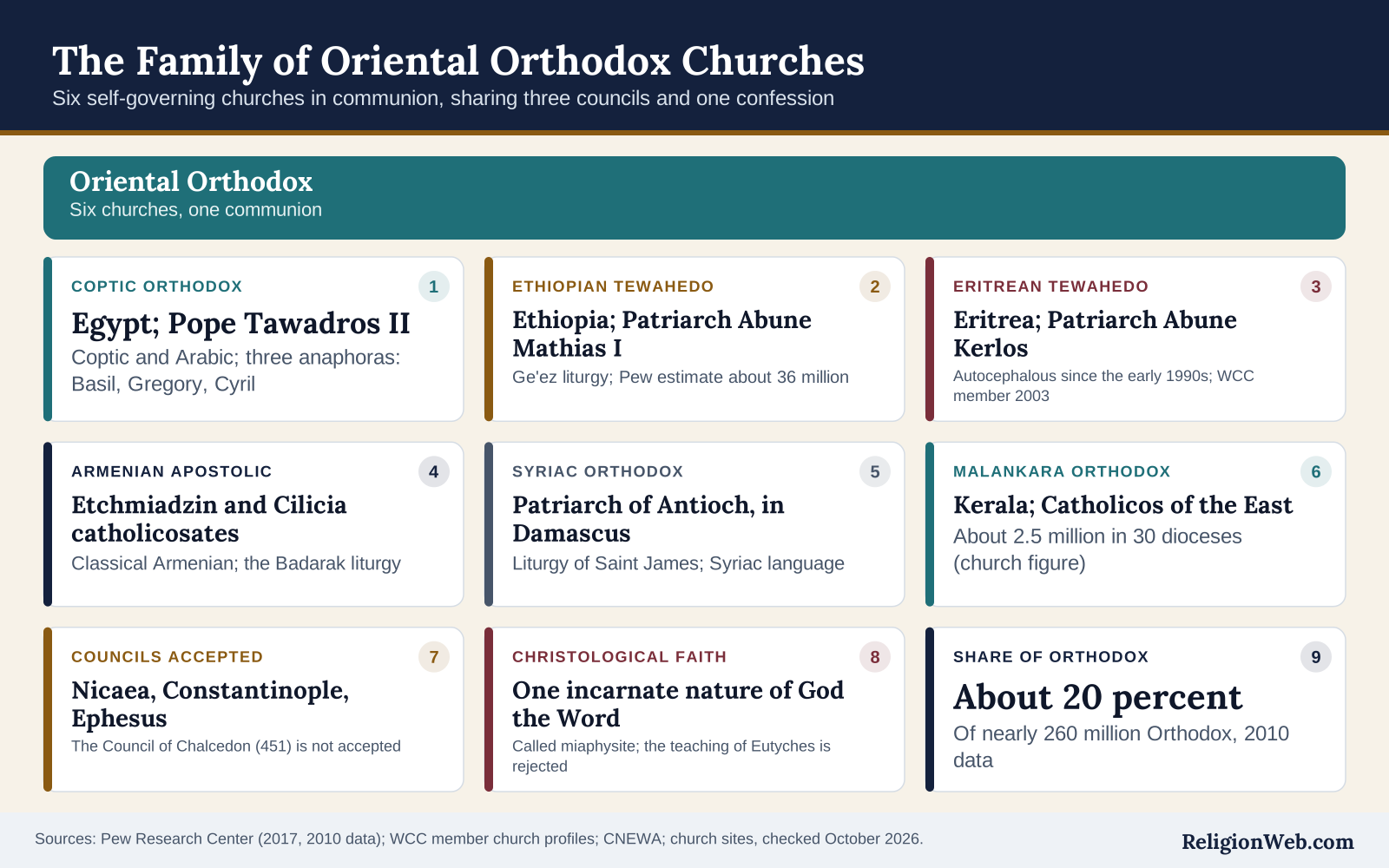
Oriental Orthodox Christianity is the name given to a family of six ancient churches: the Coptic Orthodox Church of Egypt, the Ethiopian Orthodox Tewahedo Church, the Eritrean Orthodox Tewahedo Church, the Syriac Orthodox Church of Antioch, the Armenian Apostolic Church, and the Malankara Orthodox Syrian Church of India. They share one faith and are in full communion with one another, yet each governs itself, worships in its own liturgical language, and keeps its own calendar of fasts and feasts. Each traces its beginnings to the apostolic age or to the first Christian centuries, and together they form some of the oldest continuing Christian communities in Africa, the Middle East, the Caucasus, and South Asia.
What binds these churches theologically is a shared reading of the early councils. They accept the Council of Nicaea (325), the First Council of Constantinople (381), and the Council of Ephesus (431), but they did not accept the Christological definition issued at the Council of Chalcedon in 451. In its place they confess, in the words of Cyril of Alexandria, one incarnate nature of God the Word, fully divine and fully human without mixture or separation. This is often called miaphysitism, from the Greek mia, “one.” The churches themselves say that this teaching is faithful to the apostolic and patristic inheritance, and they reject the labels “Nestorian” and “Eutychian” that were sometimes applied to them or to their opponents. The wider Christian story is told in the article on Christianity; this article follows one branch of it in detail.
The scale is large, though often underestimated. Pew Research Center’s 2017 report on Orthodox Christianity found that Oriental Orthodoxy accounts for roughly 20 percent of the worldwide Orthodox population, which it counted at nearly 260 million people in 2010, and it estimated that the Ethiopian Orthodox Tewahedo Church alone had about 36 million adherents. Members live in the highlands of Ethiopia and Eritrea, along the Nile, in Armenia and its worldwide diaspora, in Syria, Lebanon, Iraq, and Turkey, and in the Indian state of Kerala, with large communities today in North America, Europe, Australia, and the Gulf.
The sections that follow describe these churches on their own terms, beginning with how they name and understand themselves. They then cover history, teaching, Scripture, the six member churches, worship, the sacraments, fasting and feasting, clergy and monastic life, sacred places, and the present-day situation of each community. Wherever a church or a scholar uses a contested term, the text says who uses it and why. Facts about leaders and institutions reflect sources checked in October 2026.
Oriental Orthodox Christianity at a Glance: Definition, Churches, and Vocabulary
What Oriental Orthodox Christianity Is
How these churches describe themselves
Each of the six churches begins its account of itself with an apostolic founder or an early conversion. The Coptic Orthodox Church holds that the evangelist Mark founded the church in Alexandria, and church tradition places his martyrdom there in the year 63. The Syriac Orthodox Church of Antioch describes its see as established by the apostle Peter, and it counts its present patriarch as the 122nd successor in that line. Armenian tradition remembers the apostles Thaddeus and Bartholomew as the first preachers of the gospel in Armenia and honors Gregory the Illuminator as the missionary whose work led King Tiridates III to proclaim Christianity in the early fourth century. The Malankara Orthodox Syrian Church holds that the apostle Thomas arrived in India in the year 52. The Ethiopian church points to the Ethiopian official baptized by Philip in the Acts of the Apostles and to the later mission of Frumentius at Aksum, and the Eritrean church shares that heritage.
These are statements of tradition, and the churches present them as such. Historians treat them with differing degrees of confidence: the fourth-century conversions of Armenia and Aksum are firmly attested in later sources and in material evidence, while the earliest centuries of Egyptian, Syrian, and Indian Christianity are known from fragments and are debated in detail. Later sections return to each case. What all six churches claim in common is that they preserve the faith of the first three ecumenical councils, that their bishops stand in succession from the apostles, and that they are, in their own name for themselves, Orthodox, meaning right in worship and in belief.
The word “Oriental” and other labels
“Oriental” here simply means “of the East,” and it has been the agreed English name for these churches since the twentieth century. A conference of church heads convened in Addis Ababa in January 1965 by Emperor Haile Selassie of Ethiopia brought together the leaders of the Ethiopian, Syriac, Coptic, and Malankara churches and observers from the Armenian church, and the churches have since described themselves collectively as the Oriental Orthodox. The phrase is easily confused with “Eastern Orthodox,” the name of a different communion centered on the Greek, Slavic, and other churches of the Byzantine tradition. The two families share the word “Orthodox” and many practices, but they are separate communions with separate histories, and each has its own article on this site; the Eastern Orthodox family is described in the article on Eastern Orthodox Christianity.
Other labels exist, and some are contested. “Non-Chalcedonian” is a neutral description of the position on the council, though it defines the churches by what they did not accept. “Monophysite,” from the Greek for “one nature,” was used by opponents for centuries and is rejected by the churches, because it is associated with the teaching of Eutyches, which they condemn. The Gorgias Encyclopedic Dictionary of the Syriac Heritage, a scholarly reference, calls “Jacobite” and “Monophysite” misleading as names for the Syriac Orthodox Church and describes “Miaphysite” as acceptable. “Jacobite” derives from Jacob Baradaeus, a sixth-century bishop, and is still used by one Indian faction as a self-designation, as a later section explains. “Tewahedo,” used by the Ethiopian and Eritrean churches, is a Ge’ez word meaning “being made one” or “unified,” an expression of the belief that the divine and the human are united in the one Christ.
The Six Churches and Where They Are
A family of self-governing churches
The six churches are autocephalous, a Greek word meaning “self-headed”: each elects its own leader and synod and answers to no outside authority. They are in communion with one another, which means that their members may receive the sacraments in each other’s churches and their clergy may serve together. The Armenian Apostolic Church has two coequal catholicosates, the Mother See of Holy Etchmiadzin in Armenia and the Holy See of Cilicia based in Antelias, Lebanon, so the family is sometimes counted as seven sees, though it is six churches. There is no single head of the whole communion, and no church claims one. Coordination happens through meetings of the heads of churches, bilateral visits, and common participation in the World Council of Churches.
| Feature | Summary |
|---|---|
| Member churches | Coptic Orthodox Church; Ethiopian Orthodox Tewahedo Church; Eritrean Orthodox Tewahedo Church; Syriac Orthodox Church of Antioch; Armenian Apostolic Church (Holy See of Etchmiadzin and Holy See of Cilicia); Malankara Orthodox Syrian Church |
| Councils accepted | Nicaea (325), Constantinople (381), Ephesus (431) |
| Christological confession | One incarnate nature of God the Word (miaphysite), with the divinity and humanity united without confusion, change, or separation |
| Main regions | Egypt, Ethiopia, Eritrea, Armenia, Syria and neighboring countries, Kerala in India, and diaspora communities worldwide |
| Liturgical languages | Coptic and Arabic; Ge’ez with Amharic; Classical Armenian; Syriac with Arabic, Malayalam, and other local languages |
| Size (Pew, 2010 data) | About 20 percent of roughly 260 million Orthodox Christians; Ethiopian church about 36 million |
| Sacraments | Seven: baptism, chrismation, Eucharist, repentance, anointing of the sick, marriage, and holy orders |
| Clergy | Bishops, priests, and deacons; monastic life central to church leadership |
| Calendars | Coptic and Ethiopian calendars; the Armenian, Syriac, and Malankara churches use Gregorian-based calendars for fixed feasts, with variations noted below |
How many people belong
Counting is difficult, and the figures that circulate differ by tens of millions. Pew’s 2017 report did not publish a separate Oriental total, but applying its 20 percent share to its 2010 figure of nearly 260 million Orthodox Christians implies a population near 50 million. Pew’s separate estimate of about 36 million for Ethiopia is based on survey and census data. Church bodies often report more: the World Council of Churches lists the Ethiopian church at about 60 million, the Coptic church at about 12 million, the Malankara Orthodox Syrian Church at about 2.5 million, and the Armenian Apostolic Church (Etchmiadzin) at about 8 million, figures that come from the churches themselves and are not independently audited. Ethiopia’s 2007 census recorded the Ethiopian Orthodox share of the population at 43.5 percent, down from 54 percent in the 1984 census, according to a 2025 study by the Ethiopian anthropologist Dereje Feyissa.
The sensible way to read these numbers is as a range. Orthodoxy in these countries is often a matter of family and community identity as well as of regular practice, and censuses in Egypt, Syria, and Ethiopia have each been politically sensitive. Pew’s survey of Ethiopia is a useful reminder that membership and observance can coincide: it found that 78 percent of Ethiopian Orthodox respondents attended church weekly or more and 65 percent prayed daily, higher than in most Orthodox populations in Europe.
Key Vocabulary for Reading About These Churches
Words about Christ and the councils
A handful of terms recur in nearly every discussion of these churches. “Chalcedon” names the council held in 451 near Constantinople, attended by about 520 bishops according to the historian Rebecca Denova, which defined Christ as one person in two natures. “Nature” (Greek physis) and “hypostasis” (roughly, a concrete individual existence or “person”) were used with shifting meanings in the fifth century, and much of the dispute turned on how they were defined. “Theotokos,” Greek for “God-bearer,” is the title of Mary affirmed at Ephesus in 431, and all six churches use it. “Miaphysite” is the term for the confession of one united nature of the incarnate Word, in contrast to “dyophysite,” which refers to the confession of two natures after the union.
Words about church life
Church life brings its own vocabulary, which differs by tradition. The glossary below collects the terms used most often in this article, with the church or churches where each is at home.
| Term | Meaning | Where it is used |
|---|---|---|
| Miaphysite | Confessing one united nature of God the Word incarnate | All six churches |
| Autocephalous | Self-governing, with its own synod and head | All six churches |
| Tewahedo | Ge’ez word meaning “being made one,” the union of divinity and humanity in Christ | Ethiopian and Eritrean churches |
| Catholicos | Title of the head of an Armenian catholicosate and of the Malankara church | Armenian and Malankara churches |
| Anaphora | The eucharistic prayer at the center of the liturgy | All six churches |
| Agpeya | Coptic book of the seven hours of daily prayer | Coptic church |
| Shehimo | Syriac book of common prayer arranged for seven daily prayer times | Syriac and Malankara churches |
| Badarak | Armenian name for the Divine Liturgy | Armenian church |
| Tabot | Consecrated altar tablet, understood as a replica of the Ark of the Covenant | Ethiopian and Eritrean churches |
| Synaxarium | Collection of short lives of saints read through the church year | Coptic and Ethiopian churches |
| Khachkar | Carved memorial cross-stone | Armenian church |
Origins and Historical Development: From Apostolic Traditions to the Present
Apostolic Traditions and the First Centuries
Egypt and the Holy Family tradition
Christianity reached Egypt early. Coptic tradition holds that Mark the evangelist preached in Alexandria and was martyred there, and Alexandria became one of the great intellectual centers of the early church, home to the catechetical school and to the bishops Athanasius and Cyril. The word “Coptic” itself comes from the Greek and Arabic words for “Egyptian.” Egypt also gave the church its first monastic pioneers: the desert hermits and the communal monasteries of the fourth century became models for monastic life across the Christian world, a story that returns in the section on monasticism below.
Egyptian Christians have long found their land in Scripture. The prophet Isaiah, in a chapter about the nations around Israel, speaks of Egypt turning to God, and Coptic tradition has traditionally read this passage as pointing to the church in Egypt.
In that day, there will be an altar to Yahweh in the middle of the land of Egypt, and a pillar to Yahweh at its border.
Isaiah 19:19, World English Bible (Classic edition, public domain)
In the Gospel of Matthew, the infant Jesus is taken to Egypt to escape Herod, and the Coptic Church treats that journey as a founding blessing on the land.
He arose and took the young child and his mother by night and departed into Egypt, and was there until the death of Herod, that it might be fulfilled which was spoken by the Lord through the prophet, saying, “Out of Egypt I called my son.”
Gospel of Matthew 2:14-15, World English Bible (Classic edition, public domain)
The Coptic calendar commemorates the flight of the Holy Family to Egypt on 24 Bashans, about June 1 in the Gregorian calendar, and the Ethiopian church also keeps the flight into Egypt among its feasts of Mary. These readings belong to the devotional tradition of the churches. Historians have no independent evidence about the infancy journey, and the Gospel account itself says only that Joseph took the child to Egypt and stayed until Herod’s death.
Antioch, Edessa, and the Syriac world
In Syria, the city of Antioch was the earliest major center of the Gentile mission, and the Syriac Orthodox Church claims its patriarchal see as the apostle Peter’s foundation. East of Antioch, in the region of Edessa (modern Urfa) and across northern Mesopotamia, Christians began writing in Syriac, a dialect of Aramaic, by the second century. The fourth through seventh centuries were a golden age of Syriac literature, producing poetry, biblical commentary, and translations from Greek. Ephrem the Syrian, Aphrahat, and Jacob of Serugh are among the great names, and the Syriac heritage they created belongs, in different ways, to the Syriac Orthodox Church, its Indian daughter churches, and other Eastern churches.
The Roman and Persian empires divided this world politically. The Persian Empire’s state religion was Zoroastrianism, a tradition described in the article on Zoroastrianism, and Syriac-speaking Christians lived on both sides of the frontier, and Christian communities in Persian territory developed along a separate path from those of the Roman Empire. That division is part of the background of the Church of the East, a distinct Christian tradition that is not part of the Oriental Orthodox family. Their shared Syriac language means that the early histories of the two traditions overlap before the fifth century and diverge afterward.
Armenia, Aksum, and India
Armenia, according to the traditional chronology, became the first kingdom to adopt Christianity as its state religion in 301, when Gregory the Illuminator converted King Tiridates III. Some historians place the conversion in the following decade, and the date is better understood as a symbol of a process that took generations. The cathedral of Etchmiadzin, which tradition says was founded at the time of the conversion, still stands near Yerevan and was inscribed on UNESCO’s World Heritage List in 2000. Armenian Christianity gained its written language when, by tradition, Mesrop Mashtots devised the Armenian alphabet in 405 in order to translate the Bible.
The kingdom of Aksum, in the highlands of what are now northern Ethiopia and Eritrea, adopted Christianity in the fourth century under King Ezana, whose coins are among the earliest to bear the cross. The church’s own tradition begins earlier, with the New Testament account of an Ethiopian official baptized by the evangelist Philip.
He arose and went; and behold, there was a man of Ethiopia, a eunuch of great authority under Candace, queen of the Ethiopians, who was over all her treasure, who had come to Jerusalem to worship. He was returning and sitting in his chariot, and was reading the prophet Isaiah.
Acts of the Apostles 8:27-28, World English Bible (Classic edition, public domain)
The Ethiopian Orthodox Tewahedo Church treats this passage as the beginning of Christianity in Ethiopia. Historians note that “Candace” (Kandake) was a title of queens of the Nubian kingdom of Meroe, south of Egypt, so the story is usually connected to that region and not to Aksum. The later history, recorded by the church historians Rufinus and Socrates Scholasticus, tells of Frumentius, a young man from Tyre who came to the Aksumite court as a captive, rose to influence, and was consecrated the first bishop of Aksum by Athanasius of Alexandria. That connection with Alexandria shaped the Ethiopian church for sixteen centuries: until the twentieth century its chief bishop, the abuna, was always an Egyptian Copt appointed by the Coptic patriarch.
In India, the Malankara church holds that the apostle Thomas arrived in 52 and founded seven centers of worship in Kerala. Historians cannot confirm the apostolic visit, but they agree that Kerala had Christian communities with trade ties to Persia and the Mediterranean from the early centuries, and the church’s own account notes close ties with the Persian church from at least the fourth century. Until the seventeenth century the Indian church used East Syriac liturgy.
Ephesus, Chalcedon, and the Years After
The councils of 431 and 451
The controversies that divided Christians in the fifth century were about how to speak of the union of divine and human in Christ. They began in 428 and 429, when Nestorius, the bishop of Constantinople, and Cyril, the patriarch of Alexandria, exchanged letters that sharpened into an empire-wide dispute. At the Council of Ephesus in 431, Nestorius was deposed and the title Theotokos was upheld. Cyril’s central phrase, “one incarnate nature of the Word,” became the Alexandrian watchword. Daniel Keating, in a 2024 article, notes that Cyril believed the phrase came from Athanasius, though it actually derives from Apollinarius, and that scholars still disagree about whether Cyril meant “nature” as a single concrete reality that is both divine and human, or as the divine nature of the Word now embodied.
The Council of Chalcedon met from October 8 to November 1, 451, under Emperor Marcian, with about 520 bishops. Its definition confessed one Christ in two natures, united “without confusion, without change, without division, without separation,” and it approved Cyril’s letters as authoritative. For the bishops who accepted the definition, “two natures” protected the distinct reality of Christ’s humanity and divinity. For the Alexandrians and for many in Syria, “in two natures” sounded like a return to Nestorius’s division of Christ into two subjects, and the Council’s deposition of Dioscorus, Cyril’s successor at Alexandria, appeared to confirm that fear. The Egyptian hierarchy and most of the Egyptian faithful rejected the council, and no Armenian bishop had attended it at all. Both sides appealed to Cyril, and the question of whether the disagreement was about substance or about vocabulary has remained a subject of study ever since, as a later section on dialogue describes.
Rejection, imperial pressure, and consolidation
The century after Chalcedon was turbulent. Byzantine emperors sought unity: Zeno’s Henotikon of 482 tried to set the council aside in the interest of peace, and for a time the churches of Constantinople and Alexandria were in communion again. Under later emperors the policy turned toward enforcing the council. Severus served as patriarch of Antioch from 512 to 518 and is remembered as one of the principal theologians of the Syriac Orthodox tradition. According to the Gorgias Encyclopedic Dictionary of the Syriac Heritage, he fled to Egypt when Justin I’s pro-Chalcedonian policy took effect in 518 and died there in 538. From the fifth to the seventh century, Byzantine patriarchs resided in Alexandria, while the Coptic patriarchs lived in rural Egypt, where most Copts lived.
In Syria, the movement was kept alive by Jacob Baradaeus (Yaʿqub Burdʿoyo), who was secretly consecrated in Constantinople in 542 or 543 and ordained clergy as he traveled, in disguise, across the Near East. His Syriac nickname refers to the saddle-cloth he wore, and the Syriac Orthodox Church was later called “Jacobite” after him. The scholar Sebastian Brock argues in the same reference work that this label reflects a later hostile view and that Jacob is better seen as acting from pastoral concern. In Armenia, a church synod in 506 rejected the Christology of Chalcedon, and in Ethiopia the Nine Saints, who arrived around 480 and are remembered for establishing monasticism and translating Scripture into Ge’ez, are described as opposing the council. By the middle of the sixth century, separate hierarchies existed in Egypt and Syria, and the family of churches now called Oriental Orthodox had taken shape.
Under Islamic Rule and in the Medieval World
After the Arab conquests
The Arab conquest of Egypt, completed in 642, began a long period in which the Coptic Church lived within Islamic states. The details varied by century and by ruler. Periods of persecution, as under Caliph al-Hakim (996-1021), alternated with times of relative freedom in which the church flourished and Christian scholars wrote in Arabic. CNEWA, the Catholic agency for Eastern Christian communities, reports that Arabic replaced Coptic as Egypt’s official language in the eighth century, that Coptic continued to be spoken in the north until the eleventh century and in Upper Egypt until the sixteenth, and that Copts probably became a minority sometime between the ninth and thirteenth centuries. The same pattern of gradual language shift occurred in Syria, where Arabic slowly replaced Syriac, although Syriac enjoyed a renaissance in the twelfth and thirteenth centuries, when authors such as the patriarch Michael the Great and Bar Hebraeus wrote in it. The relationship between the churches and the Islamic states is discussed further in the article on Islam.
The Syriac patriarchs settled in the thirteenth century at the monastery of Mar Hananyo (Dayr al-Zaʿfarān) near Mardin, where the seat remained for centuries. Armenia lost its independent kingdom in the eleventh century, and many Armenians migrated to Cilicia on the Mediterranean coast, where a new Armenian kingdom lasted until the fourteenth century. After that, CNEWA observes, Armenian identity rested chiefly on language and church, and that is a major reason the Armenian Apostolic Church became the central institution of Armenian life.
Highlands, Cilicia, and Kerala
In Ethiopia, the Zagwe dynasty carved the rock-hewn churches of Lalibela in the twelfth and thirteenth centuries, a “New Jerusalem” that UNESCO describes as still a living center of pilgrimage. The Solomonic dynasty took power in 1270, and the church reached a height of influence in the fifteenth century. The sixteenth century brought war with the Adal sultanate, which destroyed many churches and monastic libraries between 1531 and 1543, followed by contact with Portuguese Catholic missionaries that the church remembers as painful and that led to long isolation. The Armenian church, meanwhile, maintained two centers of authority. In 1441 Etchmiadzin elected its own catholicos, and since then there have been two catholicosates, Etchmiadzin and Cilicia, with equal standing.
In Kerala, the arrival of the Portuguese in 1498 brought pressure on the Christian community to adopt Latin practices. On January 3, 1653, thousands of Christians gathered at the Coonan Cross in Mattancherry and swore not to submit to the Portuguese Jesuit authorities, an event known as the Coonan Cross Oath. Part of the community stayed in communion with Rome and is today the Syro-Malabar Catholic Church. The rest first sought help from the Church of the East without success, and in 1665 received a bishop from the Syriac Orthodox Patriarchate of Antioch on condition that they follow the West Syriac liturgy and Christology. That arrangement is the origin of the Malankara church’s connection with Antioch. The Kerala setting, shared with large Hindu and Muslim communities, is part of the background to the article on Hinduism.
The Modern Era
Catastrophe and dispersion
The First World War era brought catastrophe to Armenian and Syriac Christians in the Ottoman Empire. The Syriac memory of this time is called Sayfo, Syriac for “the sword.” According to the Gorgias Encyclopedic Dictionary of the Syriac Heritage, the massacres and deportations of 1915 and the following years destroyed eight of the twenty Syriac Orthodox dioceses in eastern Turkey completely or largely, and losses among Syriac churches in the region were well over half and in some places as much as 90 percent. The entry states that the events were evidently orchestrated by high Ottoman officials, and the patriarchate moved afterward to Homs in the early 1930s and to Damascus in 1957. Armenian communities suffered the same period in the Armenian Genocide, in which, by a widely cited estimate, between one and a half and two million Armenians died. The term “genocide” is accepted by most genocide scholars and many governments and is disputed by the Turkish state. Survivors scattered across the Middle East, Europe, and the Americas, and the Cilician catholicosate relocated to Antelias, Lebanon, in 1930.
Ethiopia faced a different trauma in the Italian invasion and occupation of 1935 to 1940, during which, in the Ethiopian church’s own account relayed by the World Council of Churches, several bishops, many priests, and thousands of faithful died and more than two thousand churches were destroyed. The twentieth century also brought pressure from secular and revolutionary states: Armenia’s church functioned under Soviet rule until the Republic of Armenia declared independence on September 23, 1991, and the Ethiopian revolution of 1974 ended the church’s position as state church and led to the nationalization of most church land.
Independence, autocephaly, and meeting
The same century saw the churches take charge of their own affairs. The Ethiopian church had been led by Egyptian bishops until 1929, when four Ethiopian bishops were ordained. An agreement of 1948 provided for an Ethiopian metropolitan, Basilios was elected in 1951, and the Coptic Patriarchate confirmed him as the first Ethiopian patriarch in 1959. The Eritrean church became autocephalous after Eritrea’s independence in the early 1990s, with the assistance of the Coptic Orthodox Church. The Malankara church in India had already declared its autocephaly in 1912 by restoring the ancient office of Catholicos of the East.
At the same time, the churches began to meet. The Addis Ababa conference of January 1965 gathered their leaders, with Emperor Haile Selassie as host, for the first time in the modern era. Pope Shenouda III led the Coptic Church from 1971 to 2012, and signed a common declaration with Pope Paul VI in 1973. The Syriac patriarch Ignatius Zakka I Iwas signed a declaration with Pope John Paul II in 1984. The Joint Commission between the Orthodox and Oriental Orthodox churches issued its agreed statements in 1989 and 1990. The churches have been active in the World Council of Churches, which several of them joined at its founding in 1948.
A Timeline at a Glance
The long view
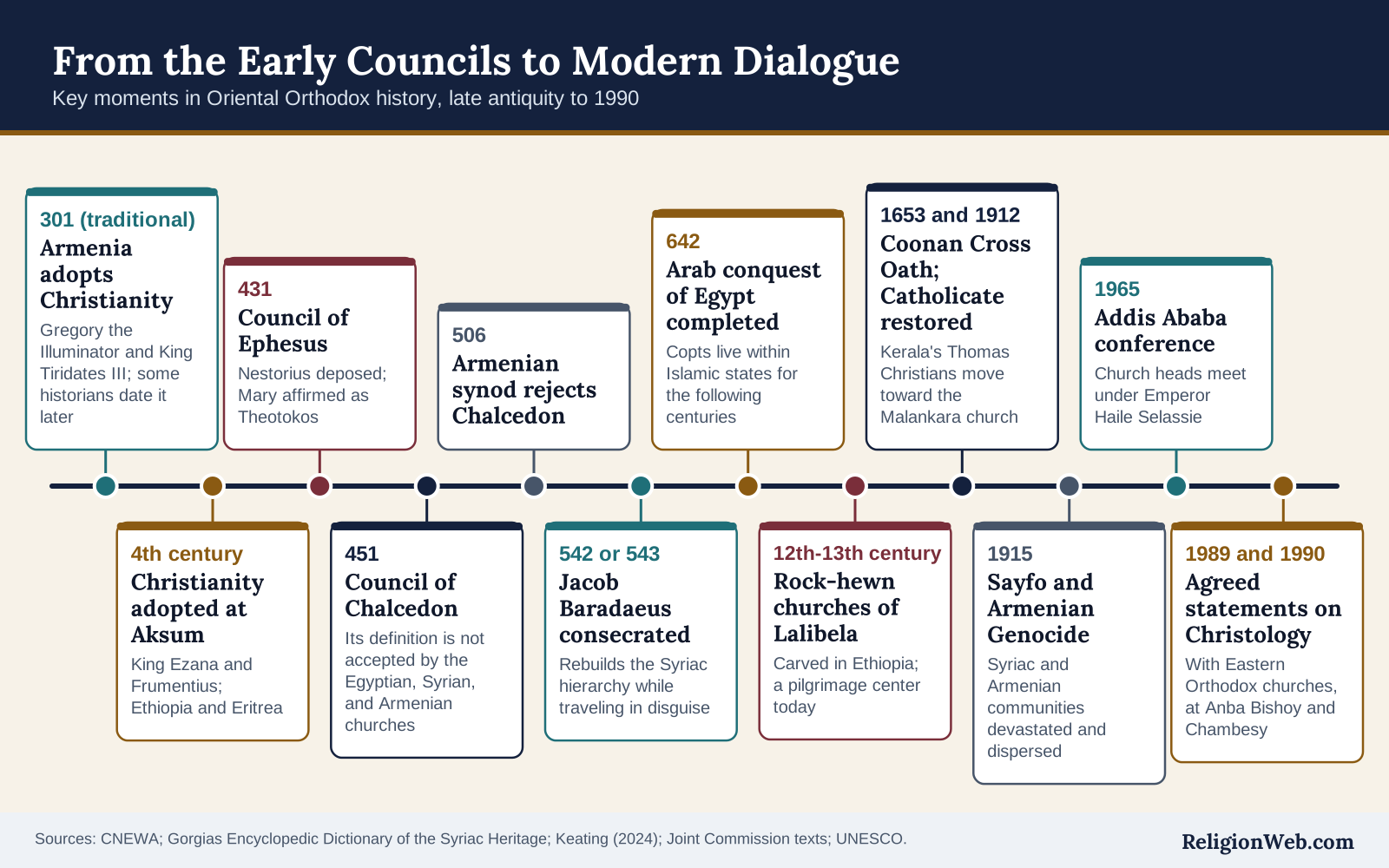
The table below collects the dates mentioned in this section. Dates marked “traditional” come from the churches’ own accounts and are not independently confirmed; the others rest on historical sources of varying strength.
| Date | Event | Church or region |
|---|---|---|
| 1st century (traditional) | Mark preaches in Alexandria; Thomas arrives in India in 52; Thaddeus and Bartholomew preach in Armenia | Egypt, India, Armenia |
| 301 (traditional) | King Tiridates III and Gregory the Illuminator; Christianity proclaimed in Armenia | Armenia |
| 4th century | Ezana and Frumentius; Christianity adopted at Aksum | Ethiopia and Eritrea |
| 325, 381, 431 | Councils of Nicaea, Constantinople, and Ephesus, accepted by all six churches | Whole family |
| 405 (traditional) | Armenian alphabet devised for translating the Bible | Armenia |
| 451 | Council of Chalcedon; Egyptian and other churches do not accept its definition | Egypt, Syria, Armenia |
| c. 480 | Nine Saints arrive in Aksum, establishing monasticism | Ethiopia |
| 506 | Armenian synod rejects Chalcedon | Armenia |
| 512-518 | Severus serves as patriarch of Antioch before exile in Egypt | Syria, Egypt |
| 542 or 543 | Jacob Baradaeus consecrated; underground hierarchy rebuilt | Syria |
| 642 | Arab conquest of Egypt completed | Egypt |
| 12th-13th century | Rock-hewn churches of Lalibela carved | Ethiopia |
| 1441 | Etchmiadzin elects its own catholicos; two catholicosates exist | Armenia and Cilicia |
| 1653 and 1665 | Coonan Cross Oath; bishop received from Antioch | Kerala, India |
| 1912 | Catholicate of the East restored in India | Malankara |
| 1915 and after | Sayfo and Armenian Genocide | Syriac and Armenian communities |
| 1959 | First Ethiopian patriarch confirmed | Ethiopia |
| 1965 | Addis Ababa conference of church heads | Whole family |
| 1973 and 1984 | Common declarations with the Catholic Church | Coptic and Syriac |
| 1989 and 1990 | Agreed statements with Eastern Orthodox churches | Whole family |
| 1991 | Armenia declares independence from the Soviet Union | Armenia |
How to read the dates
Historians distinguish three grades of evidence in this record. Council dates and the careers of figures such as Cyril, Severus, and Jacob Baradaeus rest on contemporary documents. The conversions of Armenia and Aksum are attested in later narratives and, in the Aksumite case, in inscriptions and coins, though exact years remain debated. The apostolic foundations, especially of Egypt, India, and Antioch, are best understood as the churches’ traditions of origin. Treating them in this way does not require anyone to accept or dismiss the traditions; it only keeps the kinds of knowledge separate.
Faith and Teaching: Christ, the Trinity, Salvation, and the Church
Christ: One Incarnate Nature of the Word
What the formula affirms
The center of Oriental Orthodox teaching is the confession that God the Word, the second person of the Trinity, became a human being in Jesus Christ without ceasing to be God. In the language of Cyril of Alexandria, which these churches treat as the standard expression of the faith, there is “one incarnate nature of God the Word.” The Armenian Apostolic Church, for example, describes its teaching as resting on the Bible, holy Tradition, and the first three ecumenical councils, and it states that it accepts the definition of Ephesus, that one is the nature of the incarnate Word. The Ethiopian and Eritrean title Tewahedo, “made one,” expresses the same idea in a single word.
Churches in this family are explicit about what the formula does not mean. It does not teach that Christ’s humanity was absorbed into his divinity or reduced to appearance. The Second Agreed Statement of 1990 between the Orthodox and Oriental Orthodox churches summarizes the shared faith as the commission’s delegates formulated it: the Logos became fully human while remaining fully God, with a human soul, body, and mind, and the two are united in one hypostasis without confusion, change, division, or separation. In worship, the same teaching is spoken at the moment of communion. Before the faithful receive the Eucharist, the Coptic priest recites a confession of belief in Christ.
What the churches reject, and the question of labels
Two teachings are rejected by name. The first is associated with Nestorius, who was understood by his critics to divide Christ into two subjects, one divine and one human. The second is associated with Eutyches, a fifth-century monk who was understood to teach that the humanity of Christ was absorbed into the divinity. The Armenian Apostolic Church, in the profile given by the World Council of Churches, rejects the teachings of both, and the Oriental Orthodox churches generally condemn the teaching of Eutyches as well. This is why the churches object to the label “Monophysite,” which suggests that they teach what Eutyches taught. The Gorgias Encyclopedic Dictionary of the Syriac Heritage calls the term unacceptable for the Syriac Orthodox Church and accepts “Miaphysite” instead.
The disagreement with Chalcedon, as these churches understand it, was never about whether Christ is fully God and fully human. It was about whether the language of “two natures” after the union could be used without implying two subjects. Scholarship on Cyril shows how real this question was: Keating’s 2024 survey notes that Cyril rarely applied “nature” to Christ’s humanity, partly to avoid any suggestion of “two sons,” and that modern scholars read his key phrase in at least two ways. The Chalcedonian churches, for their part, understand their own formula as protecting the full integrity of both natures. Both positions are stated here as their communities state them, and later sections show how dialogue has treated the question.
God, Salvation, and the Church
The Trinity and the creed
All six churches confess the Trinity: one God in three persons, Father, Son, and Holy Spirit. Their liturgies recite the Nicene Creed, which came from the councils of 325 and 381 that they accept, and they treat it as the summary of apostolic faith. The Armenian Divine Liturgy has the whole congregation chant it, and the Syriac and Coptic liturgies place it before the eucharistic prayer. Baptism is performed in the name of the Trinity, and the sign of the cross is made with that invocation. The Trinity is also the frame for the church’s sense of history: the churches see the Father as creator, the Son as redeemer who took flesh, and the Spirit as the one who sanctifies through the sacraments.
Salvation as sharing in the life of God
Oriental Orthodox writers describe salvation less as the settling of a legal debt than as healing and union with God. The theme is classically associated with Athanasius of Alexandria, who taught that the Word became human so that human beings might share in the divine life. Because the Word really took flesh, the churches hold that the body and material creation are included in redemption, which is why water, oil, bread, wine, incense, and fasting are all taken seriously as means of grace. Grace and human response are held together: baptism and the Eucharist are gifts, and repentance, prayer, fasting, almsgiving, and the sacrament of confession are the believer’s cooperation with them. Salvation is understood as a lifelong journey rather than a single moment.
Mary, the saints, and the communion of the living and the dead
Veneration of Mary as Theotokos and ever-virgin is central in all six churches. The Ethiopian church, in particular, has a tradition of Marian devotion that includes a large body of hymns, icons, and the Miracles of Mary, a collection that, according to the Metropolitan Museum of Art, the fifteenth-century emperor Zar’a Ya’eqob required to be read, along with the honoring of Mary on many feast days across the year. The Coptic and Ethiopian calendars give each month a day for Mary, the twenty-first, and the Armenian and Syriac churches have their own Marian seasons and fasts. The churches also understand the Church as one body of the living and the departed, so the faithful ask for the prayers of Mary and the saints and pray in turn for the dead. Icons are venerated in Oriental Orthodox churches as visual proclamations of the faith, and the Joint Commission of 1990 recorded that Orthodox and Oriental Orthodox agree on this practice.
Dialogue and Agreement on Christology
With the Catholic Church
The twentieth century produced a series of formal statements about the Christological split. On May 10, 1973, Pope Paul VI and Pope Shenouda III of Alexandria signed a common declaration in the Vatican confessing the divinity and humanity of Christ as united “without mingling, without commixtion, without confusion, without alteration, without division, without separation,” language that both traditions could affirm. The declaration also named the seven sacraments they hold in common, affirmed devotion to Mary as God-bearer, and established a joint commission. In 1984, Pope John Paul II and Patriarch Ignatius Zakka I Iwas of the Syriac Orthodox Church issued a similar declaration; as CNEWA summarizes it, the two said that the old disputes over the incarnation did not affect the substance of their faith, and they allowed members of each church to receive penance, Eucharist, and anointing of the sick from the other when their own priests were not available.
These steps were followed by dialogues with the Malankara, Armenian, and other churches. In 2017, Pope Francis and Pope Tawadros II, meeting in Cairo, declared that they would seek not to repeat baptisms administered in either church. The Catholic Church and all the Oriental Orthodox churches have held an international theological dialogue since 2003. The Catholic Church is described in the article on Catholic Christianity, which also treats the Eastern Catholic churches that share some of the liturgical traditions found here.
With the Eastern Orthodox churches
A parallel dialogue, between the Eastern Orthodox and Oriental Orthodox families, began with a meeting at Chambésy, Switzerland, in 1985 and reached two agreed statements. The First Agreed Statement was adopted at the Anba Bishoy Monastery in Egypt in June 1989. The Second Agreed Statement was adopted at Chambésy in September 1990. It declared that both families have preserved the same authentic Orthodox faith and apostolic tradition on Christ, though they use the terms differently: the Oriental Orthodox keep the Cyrillian formula of one nature of the incarnate Logos, and the Eastern Orthodox use the two-natures formula, and each accepts the other’s usage as legitimate. The statement also recommended that the mutual condemnations of earlier centuries be lifted, with each church deciding how to do so, and it urged that members of one family not be rebaptized by the other.
A meeting in 1993 took up proposals on lifting the anathemas, and a meeting in Addis Ababa in 1995 produced a memorandum of convergences. Pastoral agreements followed in 2001, and working groups met in 2014 and 2018, according to the Centro Pro Unione’s record of the dialogue. As of 2026, the two families have not restored full communion, and reception of the agreed statements within the member churches has been uneven. The Eastern Orthodox churches are described in the article on Eastern Orthodox Christianity, and readers interested in the theological vocabulary of the councils will find the Christian background in the article on Christianity.
Scripture, Tradition, and Authority in the Oriental Orthodox Churches
The Bible in Oriental Orthodox Churches
The canon and the Ethiopian “broader canon”
The Bible is read in every service and treated as the church’s book, received within the life of the church and interpreted with the help of the Fathers. The Gospel book is carried in procession and honored with incense, and in the Coptic Divine Liturgy the Gospel is the culmination of a sequence of readings from the letters of Paul, the Catholic Epistles, and the Acts of the Apostles. All six churches use an Old Testament that is larger than the Hebrew Bible: they inherited the books of the Greek Septuagint tradition, including books and additions that Protestant churches do not count as canonical.
The Ethiopian Orthodox Tewahedo Church has the largest canon. The World Council of Churches reports the church’s own count as 81 canonical books, a “broader canon” that includes the Jewish and Christian books known elsewhere as deuterocanonical or apocryphal and several writings that survive in full only in Ethiopia, such as Jubilees and the three books of Meqabyan. The Book of Enoch, a Jewish work composed in the last centuries before the Common Era, is preserved complete only in an Ethiopic translation, according to Encyclopaedia Britannica. Counts of the Ethiopian canon vary among sources, because books can be divided or grouped in different ways. The Kebra Nagast, the medieval national epic that links the Solomonic dynasty to the Queen of Sheba, is revered in Ethiopia but is not a canonical book.
Ancient translations and living languages
Each church has a version of Scripture in its own classical language. Syriac Christians have the Peshitta, the standard Syriac version. According to the church’s account relayed by the World Council of Churches, the Bible was translated into Armenian at the beginning of the fifth century, shortly after the Armenian alphabet was created, and a new translation was published in 1994. In Ethiopia, the Nine Saints and their disciples are credited with translating the Bible and other religious books into Ge’ez. The Coptic Church’s service books present Coptic and Arabic text in parallel columns, a sign that Arabic has become the language of understanding even where Coptic remains the language of prayer. In Kerala, most liturgical texts were translated into Malayalam during the twentieth century, according to the Malankara church, though Syriac remains the church’s classical language.
Translation is a recurring theme in the history of these churches. Alphabets and Bible translations helped Armenian and Ethiopian Christians define their national cultures, and the use of local languages in preaching and teaching has been a priority wherever the churches have grown, including in the diaspora, where English and other local languages now appear alongside the classical ones. The relationship between a classical liturgical language and the spoken languages of the faithful is a theme taken up in the section on worship.
Tradition, Councils, and Church Authority
Holy Tradition and the early councils
These churches understand Scripture as part of a wider Holy Tradition that includes the creed, the liturgy, the writings of the Fathers, the canons of the councils, and the lives of the saints. The Armenian Apostolic Church describes its faith as based on the Bible, holy Tradition, and the first three ecumenical councils, a formula that the other churches would accept. The writings of Athanasius, Cyril of Alexandria, and Severus of Antioch carry particular weight, along with the monastic Fathers and the great liturgists of each tradition. Canon law differs by church. The Ethiopian church draws on the Fetha Nagast (“Law of the Kings”), a medieval legal collection that also gives the church’s list of fasts, while the Coptic, Syriac, and Armenian churches each preserve their own collections of canons.
The three councils matter in a particular way. Nicaea established the divinity of the Son, Constantinople the divinity of the Holy Spirit and the final form of the creed, and Ephesus the unity of Christ’s person and the title Theotokos. The Oriental Orthodox churches therefore count three councils as ecumenical, and the question of how to regard the later councils has been central to their dialogue with the Eastern Orthodox churches.
Synods, patriarchs, and catholicoi
Church government is episcopal: each church is led by a bishop, and bishops act together in synod. The head of the Coptic Church is the Pope of Alexandria and Patriarch of the See of Saint Mark, who today is Tawadros II. According to CNEWA, he was selected in November 2012 when a blindfolded child drew his name from three candidates, a custom that combines election by clergy and laypeople with an act of prayerful reliance on God. The Ethiopian patriarch chairs the Holy Synod, which the World Council of Churches describes as the supreme authority for administration and justice. The Armenian Church has two catholicoi of equal standing, the Catholicos of All Armenians at Etchmiadzin and the Catholicos of Cilicia in Antelias, and the Syriac Orthodox Church is led by the Patriarch of Antioch and All the East, with a maphrian or catholicos for India. The Malankara Orthodox Syrian Church is led by the Catholicos of the East, who also holds the title Malankara Metropolitan.
No bishop has authority over the whole communion. The heads meet when they can, as they did in Addis Ababa in 1965, and the churches consult one another on matters of doctrine and ecumenical engagement, but each church decides its own affairs. Questions of leadership can nevertheless become acute when church and state interact, and later sections describe cases from Ethiopia, Eritrea, and Armenia.
The Member Churches: Coptic, Ethiopian, Eritrean, Armenian, Syriac, and Malankara
The six churches share a faith but not a story. Each grew in a different society, speaks a different liturgical language, and faces different pressures today. This section introduces them one at a time, starting with each church’s own account of itself, and the table at the end of the section summarizes the comparison of their basic facts. Head-of-church names and membership figures reflect sources checked in October 2026 and may change.
The Coptic Orthodox Church
Egypt’s native Christian community
The Coptic Orthodox Church is the largest Christian community in the Middle East and the church of most Egyptian Christians. It describes itself as the church founded by Mark in Alexandria and counts its leader, the Pope of Alexandria and Patriarch of the See of Saint Mark, as Mark’s successor. Pope Tawadros II has held the office since 2012, and he follows Pope Shenouda III, who led the church from 1971 until his death in 2012. The pope resides in Cairo, and Tawadros II had been a monk since 1988 and a bishop since 1997 before his selection. The church’s main seminary stands beside St. Mark’s Cathedral in Cairo, and the largest concentration of monasteries is at Wadi Natrun, about sixty miles northwest of the capital.
How many Copts there are is a matter of estimate. Pew’s 2017 report estimated about 4 million Orthodox Christians in Egypt in 2010, or 5 percent of the population. CNEWA gives the church’s membership as 9 million, and the World Council of Churches gives about 12 million, including roughly a million outside Egypt. The sources use different methods, and the church and independent researchers do not count in the same way. Whatever the exact number, Copts are a substantial minority in a country with an overwhelming Muslim majority.
Monasticism, education, and recent history
Monastic life gives the Coptic Church much of its character. CNEWA reports a monastic revival, with young monks working in agriculture and publishing, about thirty-three monasteries in Egypt and abroad with over a thousand monks, and six convents with about three hundred nuns. The church has a large Sunday School movement, Coptic schools, and an Institute of Coptic Studies founded in 1954 in Cairo. Since the 1970s, the church has also faced violence from militants against Christians and, at times, tensions with the state; in 1981 President Sadat placed Pope Shenouda III under house arrest in a desert monastery, where he remained until 1985. More recently, the Egyptian government has allowed Copts to build new churches and has legalized some previously unregistered ones, CNEWA reports.
In 2015, twenty-one Christian men, twenty Egyptians and one Ghanaian, were killed in Libya by militants of the so-called Islamic State. The Coptic Church added the group to its Synaxarium, the collection of lives of saints, with a feast on 8 Amshir, which falls on February 15, and a shrine was built in El-Aour, the hometown of most of the men. In 2023, during Pope Tawadros II’s visit to Rome for the fiftieth anniversary of the 1973 Christological declaration, Pope Francis announced that the men would be added to the Roman Martyrology of the Catholic Church. Martyrdom is a living category in Coptic tradition: the Coptic calendar counts its years from 284 CE, the accession of the emperor Diocletian, in what the church calls the Era of the Martyrs.
The Ethiopian and Eritrean Orthodox Tewahedo Churches
The Ethiopian Orthodox Tewahedo Church
The Ethiopian Orthodox Tewahedo Church is the largest of the six churches by most counts. Pew estimated about 36 million adherents; the church’s own figure, as reported by the World Council of Churches, is 60 million. The 2007 census recorded 43.5 percent of Ethiopians as Orthodox, according to the anthropologist Dereje Feyissa, who notes that the share has declined from 54 percent in 1984 as Protestant churches have grown. The church was Ethiopia’s state church until the revolution of 1974, which separated church and state and nationalized most church land. It has been led since 2013 by Patriarch Abune Mathias I, and its headquarters are in Addis Ababa. The church has its own theological college, Holy Trinity, founded in 1942 and reopened in 1994 after being closed from 1974.
The recent history is turbulent. From 1991 to 2018, the church was divided between a synod in Ethiopia and a synod in exile, a separation the World Council of Churches counts as twenty-seven years, which ended in a 2018 reunification in which Prime Minister Abiy Ahmed took part. Dereje’s 2025 study describes subsequent strains tied to the political and ethnic conflicts of the country. In January 2023, three Oromo archbishops declared a separate synod for Oromia, and the central synod excommunicated them; the excommunication was lifted in July 2023, though the division was not fully resolved. Tigrayan clergy formed their own synod in October 2024 following the war in Tigray. In these disputes the contested questions were language, regional representation, and the relationship between church and state, and not the creed.
The Eritrean Orthodox Tewahedo Church
The Eritrean Orthodox Tewahedo Church was part of the Ethiopian church until Eritrea’s independence. It became autocephalous in the early 1990s with the help of the Coptic Orthodox Church, and the World Council of Churches dates its autocephaly to 1994. The church joined the WCC in 2003 and shares the liturgical heritage, the Ge’ez language, and the Tewahedo name with its mother church. Its patriarch Abune Antonios was removed in 2007 after he called for the release of political prisoners and resisted pressure to excommunicate members, according to the United States Commission on International Religious Freedom, which lists the case as an example of state interference in church affairs. He lived under house arrest until his death on February 9, 2022. In June 2021 the WCC congratulated Abune Kerlos on his election as the church’s fifth patriarch.
The Armenian Apostolic Church
Two catholicosates and two patriarchates
The Armenian Apostolic Church is led by two catholicoi of equal standing. The Catholicos of All Armenians, Karekin II, resides at the Mother See of Holy Etchmiadzin near Yerevan and was elected in 1999. The Catholicos of Cilicia, Aram I, who was elected in 1995, is based at Antelias in Lebanon and presides over communities in the Middle East, Greece, and the Americas that grew after the displacements of the First World War. Two patriarchates, at Jerusalem and Constantinople, have local jurisdiction within the church. The church has about 6 million members by its own count in a CNEWA profile, while the World Council of Churches lists about 8 million, including approximately 3 million in Armenia, 3.7 million across Europe and former Soviet countries, and 1.2 million in North America. In Armenia’s 2011 census, 92 percent of the population identified as Armenian Apostolic.
Church and nation
Armenian Christianity is bound closely to Armenian national identity. After the loss of the kingdom, language and church became the pillars of Armenian life, and the church preserved the alphabet, the liturgy in Classical Armenian, and the memory of the conversion. After the Soviet period, the church experienced a revival, with new dioceses, seminaries, and teaching of church history in public schools. Its relationship with the Armenian state has become sharply contested in recent years. Beginning in June 2025, the government of Prime Minister Nikol Pashinyan pressed for Karekin II’s resignation, and law-enforcement actions were taken against senior clergy, which the World Council of Churches said in a July 2025 statement it viewed with concern. According to reports in August 2026, Karekin II and other clergy were on trial, the government had announced a plan to remove him, and he had said he would not step down. The Mother See has called the effort unlawful. The charges are denied by the clergy, the matter is unresolved, and readers should consult current reporting.
The Syriac Orthodox Church of Antioch
The patriarchate and its history
The Syriac Orthodox Church of Antioch is led by the Patriarch of Antioch and All the East, currently Ignatius Aphrem II, whom the church counts as the 122nd successor of Peter. Patriarchs have taken the name Ignatius since 1293, after the second-century bishop of Antioch. The patriarchal seat stood at the monastery of Mar Hananyo near Mardin from the thirteenth century; after the Sayfo it moved to Homs in the early 1930s and to Damascus in 1957. The church was long called “Jacobite” by outsiders and today uses “Syriac Orthodox.” Its scholarly heritage includes the writers of the golden age and the thirteenth-century polymath Bar Hebraeus, who died in 1286.
Tur Abdin and the diaspora
The ancient heartland of the church is Tur Abdin, a plateau in southeastern Turkey. Mor Gabriel, near Midyat, was founded in 397 by the monks Mor Shmu’el and Mor Shem’un and is described by the Syriac Heritage Project as the oldest surviving Syriac Orthodox monastery in the world; it remains inhabited. The Sayfo gave what the Gorgias dictionary calls a huge impetus to emigration, and a large proportion of Syriac Christians now live in the diaspora. That reference puts the church at 400,000 to 500,000 members in the Middle East, Europe, the Americas, and Australia, plus about a million in India, while the WCC lists 1.43 million, in fifteen countries including Sweden, Germany, the United States, and Lebanon. Although the Syriac language is used in worship, the faithful speak Arabic, Malayalam, Swedish, English, and many other languages.
The Malankara Orthodox Syrian Church
The Thomas Christians and the road to autocephaly
The Malankara Orthodox Syrian Church is the Indian member of the family. It belongs to the ancient community known as the Thomas Christians or Saint Thomas Christians, who trace their faith to the apostle Thomas. After 1665 it gradually adopted the West Syriac liturgy of Antioch, and the Catholicate of the East was established in 1912. The relationship between the Indian church and the Patriarchate of Antioch led to a long dispute, which went through several stages in the twentieth century and was addressed repeatedly by the Indian Supreme Court. In 1958 the court recognized the Catholicos as the lawful head of the church and its parishes, and the two sides were reconciled. In 1975 the dispute broke out again, and a decision of the Supreme Court in 1995 upheld the 1934 constitution of the church. In 2017 the court reaffirmed this ruling and ordered more contested churches transferred to the Orthodox side, according to CNEWA. Today two bodies exist in Kerala: the Malankara Orthodox Syrian Church under its Catholicos, and the Jacobite Syrian Christian Church, which acknowledges the Patriarch of Antioch.
Church life in Kerala and abroad
The Malankara Orthodox Syrian Church reports about 2.5 million members in thirty dioceses, mostly in Kerala, and its headquarters are in Kottayam. Its head, Baselios Marthoma Mathews III, was elected on October 14, 2021, and enthroned the following day at the shrine of Saint Gregorios of Parumala, according to the Dicastery for Promoting Christian Unity, which noted that he had served on the church’s dialogue with the Catholic Church. The church has an extensive record of education and social service, including colleges, hundreds of schools, hospitals, and orphanages, according to CNEWA, and parishes in North America, Europe, Australia, and the Gulf, where many Keralites work. It also takes part in the World Council of Churches, as a member since 1948. The church is rooted in Indian language and culture, with customs of birth, marriage, and funerals blending local and Antiochene practice, as the church’s own site describes.
| Church | Head and seat | Main regions | Liturgical languages | Estimated membership (source varies) |
|---|---|---|---|---|
| Coptic Orthodox Church | Pope Tawadros II (since 2012), Cairo | Egypt; diaspora in North America, Australia, Europe | Coptic and Arabic | Pew est. about 4 million in Egypt (2010); church figures 9 to 12 million |
| Ethiopian Orthodox Tewahedo Church | Patriarch Abune Mathias I (elected 2013), Addis Ababa | Ethiopia; diaspora | Ge’ez, with Amharic | Pew est. about 36 million; church figure about 60 million |
| Eritrean Orthodox Tewahedo Church | Patriarch Abune Kerlos (elected 2021) | Eritrea; diaspora | Ge’ez | No reliable independent estimate |
| Armenian Apostolic Church | Catholicos Karekin II (1999), Etchmiadzin; Catholicos Aram I (1995), Antelias | Armenia, Middle East, Europe, Americas | Classical Armenian | About 6 to 8 million, church figures |
| Syriac Orthodox Church of Antioch | Patriarch Ignatius Aphrem II, Damascus | Syria, Iraq, Turkey, Lebanon, India, Europe, Americas | Syriac with Arabic and local languages | About 1.4 million (WCC); scholarly estimates vary |
| Malankara Orthodox Syrian Church | Catholicos Baselios Marthoma Mathews III (2021), Kottayam | Kerala; Gulf, North America, Europe | Syriac and Malayalam | About 2.5 million (church figure) |
Saints, Teachers, and Central Figures
Founders and Teachers of the Faith
Apostles, missionaries, and monastic pioneers
Each church honors a founding figure. Mark is the patron of Alexandria and the first in the Coptic list of popes; Peter is remembered in the Syriac Orthodox account of Antioch; Thomas is the apostle of the Malankara church; Thaddeus and Bartholomew are the apostles of Armenia, and Gregory the Illuminator is its patron saint and the first head of the Armenian church. In Ethiopia the figure of Frumentius, consecrated by Athanasius, stands beside the Nine Saints of the late fifth century, who are credited with establishing monastic communities and translating Scripture. The monastic founders Antony and Pachomius, who lived in Egypt in the fourth century, are honored across the family as the fathers of desert and communal monasticism. Mesrop Mashtots, the inventor of the Armenian alphabet, is honored as a teacher and saint, and the Ethiopian king Lalibela is remembered as the ruler to whom the rock-hewn churches are attributed.
Theologians and writers
The theological tradition of these churches begins with Athanasius of Alexandria, the defender of the Nicene faith, and Cyril of Alexandria, whose phrase about the incarnate nature of the Word they treat as normative. For the Syriac Orthodox Church, Severus of Antioch and Philoxenos of Mabbug are the main authorities on Christology, according to Sebastian Brock in the Gorgias dictionary. The Syriac heritage also includes Ephrem the Syrian, Aphrahat, and Jacob of Serugh, poets and teachers of the fourth through sixth centuries, and the later chroniclers and scholars Michael the Great and Bar Hebraeus. In Ethiopia, the hymnary called the Deggua is attributed to Saint Yared, a sixth-century scholar of Aksum, and Ethiopian tradition credits him with the foundations of the church’s chant.
Saints in Living Devotion
Martyrs and new saints
Martyrdom has shaped the memory of every church in this family, from the persecutions of the Roman Empire to the twentieth century. The Armenian church remembers Vartan and his companions, who died in battle at Avarayr in 451, and the Coptic Church counts the years of its calendar from the Era of the Martyrs. Modern saints and martyrs are added to the calendar from time to time. The Coptic Synaxarium now includes the twenty-one men killed in Libya in 2015, and the Malankara church honors Saint Gregorios of Parumala, whose shrine in Kerala was the site of the enthronement of the church’s Catholicos in 2021.
How the saints are remembered
Saints are remembered through the calendar, the liturgy, and the home. The Coptic Church reads from its Synaxarium in the liturgy, and the Ethiopian church assigns monthly observances: the seventh of each month to the Trinity, the twelfth to the archangel Michael, and the twenty-first to Mary. Icons, relics, and pilgrimage sites keep the saints present in the life of the faithful, and the faithful ask for their prayers without regarding them as rivals to Christ. In the churches’ understanding, the saints are members of the same body as the living and are honored as friends of God and examples of faith.
Worship and the Divine Liturgy: How the Churches Pray
The Eucharistic Liturgy
The shape of the liturgy
The central act of worship in all six churches is the Divine Liturgy, called the Holy Qurbana in Syriac and Malayalam, the Badarak in Armenian, and simply the Divine Liturgy in Coptic and Ethiopian usage. Its structure follows an ancient pattern shared by many Christians: preparation of the bread and wine, a service of readings and preaching, the Nicene Creed, the great eucharistic prayer called the anaphora, communion, and a blessing. The Coptic Church, as its own diocesan guides explain, divides the liturgy into the offering of the oblation, the Liturgy of the Catechumens, and the Liturgy of the Faithful. It uses three anaphoras: that of Saint Basil, used most of the year, that of Saint Gregory, used on major feasts such as Christmas, Epiphany, and Easter, and that of Saint Cyril, now used in part during Lent. Readings come from the letters of Paul, the Catholic Epistles, and the Acts of the Apostles, followed by the Synaxarium and the Gospel. Before communion, the priest recites the church’s confession of faith, and Psalm 150 and hymns are sung while the faithful receive.
The Syriac Orthodox Church and the Malankara church use the Liturgy of Saint James, the anaphora of Jerusalem, which was adopted at Antioch in the early fifth century according to the Malankara church’s own account. About eighty anaphoras are known in the Syriac tradition, and a dozen or so are used in India. The liturgy begins with preparation rites, moves through a procession and the Trisagion to the readings, and includes the creed, the kiss of peace, the lifting of the veil over the gifts, the epiclesis, or invocation of the Holy Spirit, and the Lord’s Prayer before communion. The Armenian Badarak has four parts: preparation, the Synaxis or teaching, the Eucharist, and the last blessing. It uses unleavened bread and unmixed wine, and a curtain is drawn at several moments, including the preparation and the priest’s private prayers. The Ethiopian church retains fourteen anaphoras, each used on particular occasions, and the service is celebrated in Ge’ez with parts now in Amharic.
What the liturgy means
For these churches, the liturgy is both a remembrance and a participation. Coptic diocesan teaching states that the bread and wine are the true body and blood of Christ, and the Syriac liturgy invokes the Holy Spirit upon the gifts in a prayer called the epiclesis. Participation is expected to be prepared: the Coptic faithful confess their sins to a priest and fast from food and drink for several hours, nine according to one account, before communion, and Armenians confess and make the sign of the cross when approaching the priest. The Armenian practice of placing a small piece of bread dipped in wine into the communicant’s mouth, and the distribution of blessed bread to those not communing, show how each tradition has its own form of the common act. Hymns, incense, standing, and processions make the liturgy a service in which the whole congregation takes part. Children are present throughout, and the sacraments section describes how infants are included.
Languages, Rites, and Music
Liturgical families and languages
The churches fall into three liturgical families. The Alexandrian family includes the Coptic and the Ethiopian and Eritrean churches, whose liturgies are in Coptic or Ge’ez. The Antiochene or West Syriac family includes the Syriac Orthodox Church and, since the seventeenth through nineteenth centuries, the Malankara church. The Armenian rite is a distinct tradition formed in the fifth to seventh centuries under strong Syrian and Jerusalem influence, with later Byzantine and Latin influences, according to CNEWA.
| Church | Liturgical tradition | Liturgical languages | Notable features |
|---|---|---|---|
| Coptic Orthodox Church | Alexandrian | Coptic and Arabic, with local languages in the diaspora | Three anaphoras (Basil, Gregory, Cyril); Agpeya prayer book of seven hours; service books in parallel columns of Coptic and Arabic |
| Ethiopian Orthodox Tewahedo Church | Alexandrian, with Ethiopian development | Ge’ez, with Amharic | Fourteen anaphoras; chant attributed to Saint Yared; tabot present at every liturgy |
| Eritrean Orthodox Tewahedo Church | Alexandrian, shared with Ethiopia | Ge’ez | Shares liturgy, calendar, and fasting rules with its mother church |
| Syriac Orthodox Church | Antiochene (West Syriac) | Syriac, with Arabic and other local languages | Liturgy of Saint James; Shehimo prayer book; chant in eight modes |
| Malankara Orthodox Syrian Church | Antiochene (West Syriac), adopted from 1665 | Syriac and Malayalam | Liturgy of Saint James; most texts in Malayalam since the twentieth century |
| Armenian Apostolic Church | Armenian rite | Classical Armenian | Badarak in four parts; unleavened bread and unmixed wine; curtain at points in the service |
Why language matters to identity
Language is more than a vehicle of worship in these churches. For the Armenians, the alphabet and the Bible gave Christianity a written voice in Armenian and, after the loss of the kingdom, helped sustain a national identity, and the Classical Armenian of the liturgy remains the sound of that continuity. For many Copts, the Coptic language is the last stage of ancient Egyptian, and its place in the liturgy ties the community to its Egyptian past. For the Ethiopians and Eritreans, Ge’ez is the language of the Aksumite kingdom and of the church’s scholarship, even though it is no longer a native language. For Syriac Christians, Syriac connects them with the Aramaic world of the New Testament. The Gospel of Mark preserves a phrase of Aramaic spoken by Jesus, which the Greek text translates for its readers.
Taking the child by the hand, he said to her, “Talitha cumi!” which means, being interpreted, “Girl, I tell you, get up!”
Gospel of Mark 5:41, World English Bible (Classic edition, public domain)
Syriac is not identical to the Aramaic of first-century Galilee. It is a later dialect from Edessa and northern Mesopotamia, but it belongs to the same language family, and a CNEWA magazine article describes it as closely related to the Aramaic of Christ. Choices about language are continually negotiated. The Coptic and Ethiopian churches use Arabic and Amharic so that worshipers can follow the service, parishes abroad use English and other local languages, and the Malankara church has translated most of its texts into Malayalam. The balance between the classical language and the language of understanding varies by parish and generation, and each church treats it as a pastoral question.
Music, instruments, and movement
Chant is the normal voice of liturgy. The Syriac tradition chants its prayers in eight musical modes, with hymns sung back and forth between two choirs. The Armenian liturgy has original Armenian chants that give it what the St. John Armenian Church describes as a national character. The Ethiopian tradition is the most elaborate in its use of instruments and movement: cantors called debteras chant with drums and prayer sticks, with hand-clapping on joyful occasions, while mourning chants are slow and unaccompanied, and drums are not used during Lent except on Palm Sunday, according to the Ethiopian church’s own description of its worship. Both men and women join in the singing there, in contrast to the Western choir. The common thread is that music is part of the prayer, not an accompaniment to it.
Daily Prayer and the Manner of Worship
The hours of prayer
Oriental Orthodox Christians are expected to pray at fixed hours through the day, a practice that comes from the Psalms and the monastic tradition. Coptic Christians use the Agpeya, a book of seven hours. Each hour includes an introductory prayer, the Lord’s Prayer, Psalm 51 and other psalms, a Gospel passage, and a series of petitions, along with the repetition of “Lord have mercy” forty-one times. The Syriac and Malankara tradition uses the Shehimo, in which seven prayers mark the evening, bedtime, midnight, morning, and the third, sixth, and ninth hours, with the ecclesiastical day beginning at sunset. In practice, many lay people pray twice a day outside fasting seasons, and monasteries often combine the hours. The Ethiopian church prescribes seven times of prayer: on rising, at the third, sixth, and ninth hours, in the evening, before sleep, and at midnight, with a prayer book, the Se’atat, composed in the fifteenth century.
Posture, dress, and conduct in church
Worship is bodily as well as verbal. The faithful stand for most of the liturgy, cross themselves, bow, and in some traditions prostrate. In Ethiopian churches worshipers remove their shoes before entering, sit or stand on rush mats where there are no pews, and traditionally gather in separate areas for men and women. Visitors to any of these churches are generally expected to dress modestly and to follow the lead of the congregation, and photography during services is often restricted. Non-members are welcome as observers, but communion is ordinarily reserved for baptized members who have prepared, in keeping with the churches’ understanding of the Eucharist as the sign of their communion, with narrow exceptions such as those in the 1984 declaration with the Catholic Church.
The Seven Sacraments and the Passages of Life
Entering the Church: Baptism, Chrismation, and Communion
Baptism of infants and adults
The churches count seven sacraments, which they call mysteries: baptism, chrismation, the Eucharist, repentance, the anointing of the sick, marriage, and holy orders. Entry into the church is a single movement in which three of them, baptism, chrismation, and communion, are given together. In the Coptic Church, as a parish guide explains, infants are the usual candidates, with boys baptized after forty days and girls after eighty, following the purification period in the book of Leviticus, though adults and converts are also baptized. The priest immerses the person three times in the name of the Father, the Son, and the Holy Spirit, and the immersion is understood as sharing in the death and resurrection of Christ. The Armenian Church likewise baptizes by threefold immersion, recommends baptism between the eighth and fortieth day after birth, and instructs adults before baptism. Each Armenian child has godparents, one of whom must be a baptized and chrismated member of the Armenian Church.
Chrismation with Holy Myron and first communion
Immediately after baptism the newly baptized person is anointed with Holy Myron, a consecrated oil understood as the seal of the Holy Spirit. In the Coptic rite, the Myron is added to the baptismal water and the child is then anointed with it in the same service. The Armenian Church consecrates its Myron at Etchmiadzin: according to a CNEWA report from 1997, the Catholicos of All Armenians presides over a ceremony roughly every seven years in which a vat of olive oil mixed with more than forty herbs, spices, and flowers is blessed and then distributed to the bishops of the church. The same oil is used to anoint at ordinations and to consecrate churches and altars. After chrismation the newly baptized receive communion, so that even infants are included in the Eucharist, a practice reported for both the Coptic and Armenian churches; in the Coptic case the child commonly receives communion at the liturgy that follows the baptism.
Repentance, Healing, and the Last Rites
Confession and the anointing of the sick
Repentance is the sacrament in which a believer confesses sins to God in the presence of a priest and receives forgiveness through the church. Coptic teaching holds that all the sacraments should be preceded by it, which is why confession is expected before communion. The anointing of the sick is administered by a priest with blessed oil, with prayers for healing understood as the work of God. This is a religious rite, and the churches do not present it as a substitute for medical treatment.
Funerals and prayer for the departed
The churches pray for the dead and for the saints, and the funeral is a service of hope in resurrection as well as of mourning. Memorial prayers recur on days after the death, and families commonly observe an anniversary, with the specific days and food customs differing by church and region. In Ethiopian churches mourning chants are slow and unaccompanied, as noted above. The details vary enough that families often take guidance from their own priest.
Marriage and Ordination
Marriage in the church
Marriage is a sacrament in which the couple is joined before God by a priest’s blessing. Coptic teaching describes it as a union of the man, the woman, and God. The churches avoid weddings during fasting seasons; a Coptic guide to the Nativity Fast, for example, notes that no marriages or parties are held during it. Marriage customs also carry the marks of local culture, as in Kerala, where the Malankara church notes that its customs of birth, marriage, and funerals blend local and Antiochene practice. Divorce and remarriage are governed by each church’s canons.
Holy orders
Ordination takes place by the laying on of hands of a bishop, with the descent of the Holy Spirit invoked on the candidate. The churches ordain deacons, priests, and bishops, and only men are ordained to the priesthood. Parish priests in these churches may be married if they marry before ordination, while bishops are drawn from celibate clergy, usually monks. Women serve in other recognized forms of church life, including monastic communities of nuns and church education.
| Sacrament | What takes place | Notes from the churches |
|---|---|---|
| Baptism | Threefold immersion in the name of the Trinity | Coptic infants at 40 or 80 days; Armenian between the 8th and 40th day |
| Chrismation | Anointing with Holy Myron immediately after baptism | Armenian Myron consecrated at Etchmiadzin about every seven years |
| Eucharist | Communion in the bread and wine as the Body and Blood of Christ | Newly baptized infants receive communion in Coptic and Armenian practice; preparation by confession and fasting |
| Repentance | Confession to a priest and absolution | Coptic teaching says all sacraments should be preceded by repentance |
| Anointing of the sick | Anointing with blessed oil and prayer for healing | A religious rite, not a substitute for medical care |
| Marriage | Blessing of the union by a priest | Not celebrated during fasting seasons in Coptic practice |
| Holy orders | Laying on of hands by a bishop | Deacons, priests, and bishops; priests may be married before ordination |
Fasting, Feasts, and the Church Year
Calendars and the Date of Easter
Calendars in use across the family
The churches do not share a single calendar, and that fact explains many apparent contradictions in dates. The Coptic Church uses the Coptic calendar, which counts its years from 284 CE, the Era of the Martyrs, and its fixed feasts fall on set days of Coptic months: the Nativity on 29 Kiahk, about January 7; Epiphany on 11 Tobah, about January 19; and the new year festival of Nayrouz on 1 Tout, about September 11. The Ethiopian calendar has twelve months of thirty days followed by five extra days (six in a leap year), and it runs seven or eight years behind the Gregorian count; Ethiopian Christmas is on 29 Tahsas and Epiphany on 11 Ter, usually January 7 and January 19. The Armenian Church primarily uses the Gregorian calendar and celebrates the Nativity together with Theophany on January 6, while the Armenian Patriarchate of Jerusalem, following the Julian calendar, observes January 19. According to a Syriac Orthodox reference site, the Syriac Orthodox Church moved its fixed feasts to the Gregorian calendar in 1955, celebrating Christmas on December 25 except in the Holy Land, while the Malankara church has used the Gregorian calendar entirely since 1953; Great Lent and Passion Week in the Syriac Orthodox Church are still reckoned by the Julian calendar.
The date of Easter
All the churches use the rule laid down at Nicaea: Easter falls on the Sunday after the first full moon following the spring equinox. The difference lies in how the equinox and the moon are calculated. The Coptic and Ethiopian churches use the traditional reckoning of Alexandria, and the Julian calendar’s equinox, so that their Easter usually falls on the same day as the Julian-based Easter of many Eastern Orthodox churches; in 2026 that date was April 12, one week after the Western date of April 5. The World Council of Churches notes that in some years, including 2025, the Western and Julian-based dates coincide. The Armenian Church’s diaspora calendars follow the Gregorian date of Easter. The Joint Declaration signed by Pope Francis and Pope Tawadros II in 2017 lists a common date for Easter as something to be sought, not as something already agreed.
The Discipline of Fasting
Why and how the churches fast
Fasting is among the most visible features of Oriental Orthodox life. The churches teach that fasting prepares the body and soul for prayer, expresses repentance, and unites the believer with Christ’s own fasting. Ethiopian guidance puts it in broad terms: fasting is abstinence from all things the body needs, and it also concerns the eyes, the mouth, and the ears. The weekly fast on Wednesday and Friday, which recalls the betrayal and crucifixion of Jesus in the traditional reading, is kept by the Coptic, Ethiopian, and Armenian churches, and it is suspended during the Easter season. The ordinary rule is to abstain from meat, dairy products, and eggs, and in some fasts also from fish, often with a period of complete abstention until a set hour. One account of Coptic practice puts the total at roughly 210 days in the year, and an Ethiopian church guide estimates about 250 fasting days, of which about 180 are binding on all.
Fasting rules are adjusted for those who cannot keep them. The Coptic tradition exempts children, the elderly, pregnant and nursing mothers, and those with medical conditions, and the Ethiopian guidance applies the obligation to the Orthodox above the age of seven. Anyone with a medical condition should follow a physician’s advice. The rules also differ with local custom, so that a parish priest is the usual authority for the particulars.
The seasons of fasting
The principal fasting seasons recur in similar form across the churches, with differences of length and date. The table summarizes what church sources describe.
| Fast | Coptic | Ethiopian and Eritrean | Armenian |
|---|---|---|---|
| Weekly fast | Wednesday and Friday, except the 50 days after Easter | Wednesday and Friday, except the 50 days after Easter | Wednesday and Friday, suspended after Easter until Ascension and during the Theophany octave |
| Great Lent | 55 days, including Holy Week | About 55 days; Passion Week is stricter | Seven weeks before Easter |
| Nineveh (Jonah) | 3 days before Lent | 3 days, Monday to Wednesday, in January or February | No equivalent in the sources reviewed |
| Apostles | From the day after Pentecost to the feast of Peter and Paul on 5 Abib, about July 12 | From the day after Pentecost; length varies from year to year | Week-long fasts precede many feasts |
| Virgin Mary | August 7 to 21 | Filseta, August 7 to 22 | A week-long fast before the Assumption |
| Nativity | 43 days, about November 25 to January 6 | The fast of the Prophets, about November 24 to January 7 | A six-day fast before Nativity and Theophany |
The Syriac Orthodox Church keeps comparable fasts. A Syriac Orthodox reference site lists the Three Days of Nineveh beginning on the Monday three weeks before Great Lent, Great Lent beginning on the Monday seven weeks before the Resurrection, a Nativity fast that begins December 1 and is obligatory from December 15, a short fast of the Apostles ending on June 29, and a fast of the Mother of God from August 10 to 15. The Coptic Nativity and Apostles’ fasts permit fish, as does the fast of the Virgin Mary, though many Copts keep the latter as a vegan fast, and most other Coptic fasts, including Great Lent, are vegan.
Principal Feasts through the Year
New Year, the Cross, and the autumn feasts
The Coptic year opens at Nayrouz, on 1 Tout, and the celebration continues for seventeen days until the Feast of the Cross, as the Coptic Orthodox Diocese of Los Angeles describes the season. A second feast of the Cross falls in March. The Ethiopian year begins in early September, and on 17 Meskerem, about September 27, the Ethiopian and Eritrean churches celebrate Meskel, the finding of the True Cross, with a bonfire on the previous evening and large public gatherings. UNESCO’s description of Lalibela notes that both Meskel and the Ethiopian Epiphany are listed under its 2003 convention on intangible cultural heritage. The cross, in many forms, is the central symbol of all six churches, and these feasts show how a symbol shared across the Christian world takes local shape.
Nativity, Epiphany, and Timkat
The Nativity is celebrated on January 7 in the Coptic and Ethiopian churches, on January 6 together with Theophany in the Armenian Church, and on December 25 in the Syriac and Malankara churches. Epiphany, the feast of the baptism of Jesus in the Jordan, falls on January 19 in the Coptic and Ethiopian calendars and includes the blessing of water. In Ethiopia and Eritrea it is called Timkat, and the replicas of the Ark of the Covenant, the tabots, are carried in procession from the churches to a pool or river for a ceremony that renews baptismal commitment; UNESCO lists the Ethiopian Epiphany among the practices connected to Lalibela and Aksum.
Holy Week, Easter, and the fifty days
Great Lent leads to Palm Sunday, called Hosanna in the Ethiopian tradition, followed by Maundy Thursday, Good Friday, and Holy Saturday. The Ethiopian church calls Easter the feast of feasts. In the Coptic Church the fifty days from Easter to Pentecost are a season of joy in which the weekly fasts are lifted; the Ascension falls on the fortieth day, a Thursday, and Pentecost, which the Coptic Church treats as the birthday of the church, on the fiftieth. The Armenian Church counts forty days from Easter to the Ascension and ten more to Pentecost, and the Syriac Orthodox Church observes Pentecost on the Sunday ten days after the Ascension. Because the date of Easter moves, so do these feasts, and the Easter dates described above determine the dates of Lent and of the Pentecost season each year.
Mary, the saints, and local feasts
Marian feasts mark the year in every church. The Ethiopian and Coptic churches observe the Assumption, or falling asleep, of Mary in August after the fast of the Virgin, with the Ethiopian feast on 16 Nehase, about August 22. The Armenian Church celebrates the Assumption on the Sunday nearest to August 15, and the Syriac Orthodox Church on August 15. Each church also has its own commemorations, such as the Armenian feast of Holy Etchmiadzin and the memorial of the martyrs of Avarayr, the Coptic feast of the New Martyrs of Libya on February 15, and patron saints’ days in every town and village. The table collects the principal feasts.
| Feast | Date or rule | Customs and notes |
|---|---|---|
| Nayrouz (Coptic new year) | 1 Tout, about September 11 | Opens the Coptic year; continues to the Feast of the Cross on 17 Tout |
| Meskel (Finding of the Cross) | 17 Meskerem, about September 27 | Bonfire the evening before; public gatherings in Ethiopia and Eritrea |
| Nativity | January 7 (Coptic, Ethiopian); January 6 (Armenian); December 25 (Syriac, Malankara) | Follows the Nativity fast; midnight or early-morning liturgy |
| Epiphany or Timkat | January 19 (Coptic, Ethiopian); January 6 (Armenian) | Blessing of water; in Ethiopia, tabots carried in procession to water |
| Palm Sunday and Holy Week | The week before Easter | Hosanna Sunday, Maundy Thursday, Good Friday, Holy Saturday |
| Easter | Sunday after the first full moon after the spring equinox | Called the feast of feasts in Ethiopia; fifty days of joy follow in the Coptic Church |
| Ascension and Pentecost | 40th and 50th days of the Easter season (Armenian: Pentecost 10 days after Ascension) | Pentecost seen as the birthday of the church in the Coptic tradition |
| Assumption of Mary | August 22 (Ethiopian); August 15 (Syriac); Sunday nearest August 15 (Armenian) | Follows the Marian fast in the Coptic, Ethiopian, Syriac, and Armenian churches |
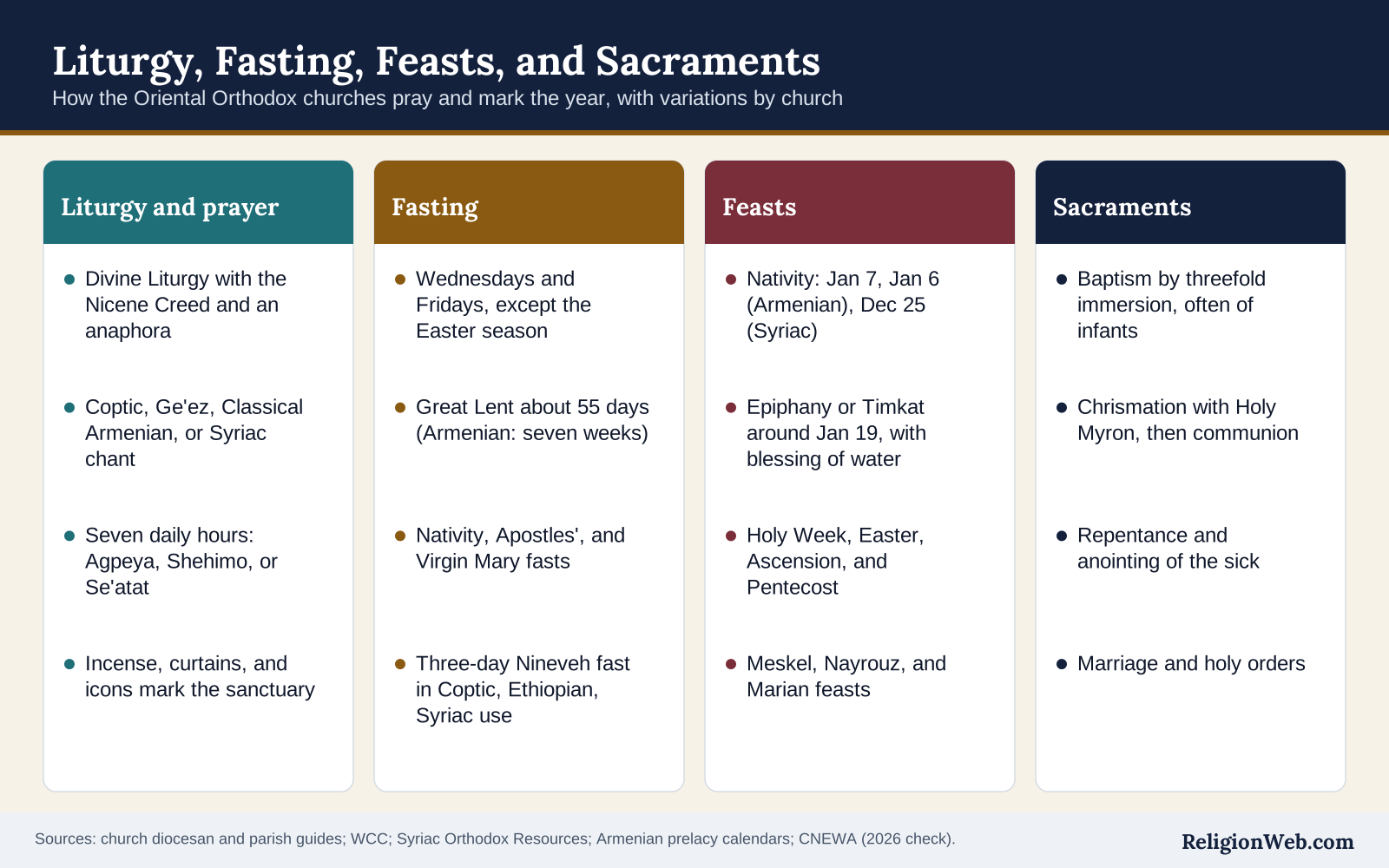
Clergy, Monasticism, Sacred Places, and Material Culture
Clergy and Monastic Life
Bishops, priests, deacons, and monks
The ministry of the six churches is threefold: bishops, who lead dioceses and meet in synod; priests, who celebrate the sacraments in parishes; and deacons, who serve at the altar and chant. Deacons, and in Ethiopia the cantors, carry much of the singing of the liturgy. In Ethiopia, the debteras are trained cantors and scholars who are not ordained but preserve the church’s chant, poetry, and learning. Priests may be married, provided they marry before ordination, while bishops are chosen from celibate clergy, usually monks. Seminaries train clergy: the main Coptic seminary stands beside Saint Mark’s Cathedral in Cairo, the Armenian church has seminaries at Etchmiadzin, Sevan, Bikfaya in Lebanon, Jerusalem, and Armonk, New York, and the Malankara church’s Orthodox Theological Seminary in Kottayam was founded in 1815, according to CNEWA. Sunday school programs, which the Coptic and Ethiopian churches have developed energetically, train lay teachers who carry much of the church’s education.
Monasteries across the family
Egypt is the birthplace of Christian monasticism, and CNEWA describes the desert monks of the fourth century as the first models of the Christian monastic tradition. Today the largest concentration of Coptic monasteries is at Wadi Natrun, and the church counts about thirty-three monasteries and six convents in Egypt and abroad. Ethiopian monasteries were centers of learning and manuscript production from the time of the Nine Saints, and the Metropolitan Museum of Art notes that monasteries such as Dabra Hayq Estifanos had scriptoria producing illuminated manuscripts, very few of which survive. In the Syriac world, Mor Gabriel in Tur Abdin, founded in 397, is described by the Syriac Heritage Project as the oldest surviving Syriac Orthodox monastery in the world, and the Malankara church reports about thirty monasteries and fifteen convents. Monasteries are also pilgrimage destinations, retreat centers, and sources of bishops and patriarchs. The Coptic pope Tawadros II, for example, became a monk at the monastery of Saint Bishoy in 1988.
Sacred Spaces and Material Culture
Churches, shrines, and pilgrimage
The cathedral of Etchmiadzin in Armenia, which tradition dates to 301 to 303, has a cruciform plan with four apses and a central dome; UNESCO describes it as the earliest domed church and as influential on later architecture. The rock-hewn churches of Lalibela in Ethiopia, eleven monolithic churches carved from living rock and inscribed by UNESCO in 1978, remain a living center of pilgrimage with a resident community of priests and monks. At Aksum, the Church of Saint Mary of Zion, rebuilt in the seventeenth century, is believed in Ethiopian tradition to house the Ark of the Covenant, according to UNESCO. In Kerala, the shrine of Saint Gregorios of Parumala draws pilgrims, and in Egypt the monasteries of Wadi Natrun attract pilgrims and visitors.
Church interiors reflect the theology of the sanctuary. Traditional Ethiopian churches are round or octagonal and divided into three concentric zones: the innermost sanctuary, the maqdas, where the tabot rests and only priests and deacons may enter; a middle ring for communicants; and an outer ambulatory where cantors sing. A church cannot hold services without a tabot, and the bishop’s blessing of the tabot consecrates it. The Armenian Divine Liturgy uses a curtain that opens and closes at key moments, and the Syriac liturgy uses a veil over the gifts that is lifted after the kiss of peace.
Crosses, icons, manuscripts, and stones
The cross takes distinct regional shapes. The Armenian khachkar, a carved stone cross set on a sun or “wheel of eternity” motif with geometric and vegetal ornament, was added to UNESCO’s Representative List of the Intangible Cultural Heritage of Humanity in 2010. UNESCO reports more than 50,000 khachkars in Armenia, no two alike, and notes that each is blessed and anointed when erected. In Ethiopia, processional crosses of metal and elaborate painted manuscripts preserve the church’s artistic tradition; the Metropolitan Museum of Art credits the Lake Tana monastic artist Fre Seyon with developing the devotional style of Marian icons that Gondar painters produced in large numbers. Ezana’s coins, which bear the cross, are among the earliest Christian material culture in Ethiopia. Icons are venerated across the family, and the Orthodox and Oriental Orthodox churches agree on the veneration of images, as the 1990 agreed statement records.
Community, Daily Life, and the Churches Today
Community, Ethics, and Daily Life
Family, charity, and education
For many members, the parish is the center of social life as well as worship. Churches run schools, clinics, orphanages, and relief programs. The Malankara church, for example, reports colleges, hundreds of schools, hospitals, and homes for orphans and for people living with leprosy and HIV/AIDS, and the Ethiopian church runs relief efforts and orphanages and expects every parish to maintain a Sunday school, according to CNEWA. In Armenia, the government agreed in 2002 to add Armenian Church history to the public school curriculum. The ethical teaching of the churches centers on love of God and neighbor, almsgiving, the dignity of marriage and family, and the discipline of fasting and prayer as training in self-restraint. Faith and national identity are closely linked in several communities, and clergy are often called upon to speak for their communities in public life.
Distinctive customs of particular churches
The churches keep customs that are not shared by all. The Ethiopian church, according to CNEWA, retains practices such as circumcision, dietary laws, and the observance of both Saturday and Sunday as days of rest, which Ethiopian tradition connects with the Old Testament heritage of its Scripture; the relationship between the Hebrew Bible and Christian practice is a broader subject treated in the article on Judaism. The Coptic churches commemorate their saints by the Coptic calendar, the Armenians raise khachkars to remember the dead, the Syriac and Malankara churches pray seven times a day from the Shehimo, and the Ethiopians remove their shoes on entering a church. Diaspora parishes adapt these customs to new countries: Coptic communities number about two hundred in the United States and over forty in Canada, according to CNEWA, and Syriac Orthodox Christians worship in more than thirty churches in Sweden alone, as of a 1998 count. Language classes, youth groups, and festivals keep the traditions alive among families who have moved far from the original homelands.
Present-Day Presence and Relations with Other Churches
Numbers, regions, and pressures
The six churches exist in very different conditions. The Ethiopian church is the majority church in a large and diverse country, and it faces internal strains tied to ethnic politics and conflict. The Coptic Church is a large minority in Egypt and continues to face sporadic violence while also benefiting from a recent easing of church-building restrictions. The Armenian Apostolic Church is the church of about 92 percent of Armenia’s citizens, according to the 2011 census, and in 2026 is in an open dispute with the government. The Eritrean church’s leadership has been shaped by state intervention, as the case of Abune Antonios shows. Syriac Orthodox communities in Syria, Iraq, and Turkey have shrunk through emigration, and the Malankara church is an Indian church with extensive educational and social institutions whose property disputes have gone through the courts. Pew’s 2017 report found Ethiopian Orthodox Christians to be among the most observant of the world’s Orthodox populations, a reminder that the Oriental Orthodox churches are not only historical institutions but living communities.
Ecumenical engagement and dialogue
The Oriental Orthodox churches have been active in the modern ecumenical movement. The Coptic, Ethiopian, and Malankara churches have been members of the World Council of Churches since 1948, the Armenian Church since 1962, the Syriac Orthodox Church since the early 1960s, and the Eritrean church since 2003. In addition to the dialogues with the Catholic and Eastern Orthodox churches described above, the Malankara church holds official dialogues with the Catholic and Lutheran churches, according to the WCC. The relationship with Protestant and Anglican churches is shaped by local history: in Kerala the Mar Thoma Church, a reformed church that emerged from the same Thomas Christian community, has been in communion with Anglican provinces since 1974, according to CNEWA. The broader Protestant tradition is described in the article on Protestant Christianity, and the Anglican Communion in the article on Anglicanism. The churches continue to meet in the Joint Commission with the Eastern Orthodox and the international dialogue with the Catholic Church.
Common Misconceptions About Oriental Orthodox Christianity
Misconception 1: Oriental Orthodoxy is one ethnic church
Where the misunderstanding comes from
The impression is understandable. Several of the churches carry the name of a nation in their titles, such as Coptic (from a word for “Egyptian”), Armenian, and Ethiopian, and their histories are interwoven with the histories of those peoples. In Armenia the church has been a pillar of national identity since the loss of the medieval kingdom, and in Egypt the Copts are often spoken of as a single community. News coverage tends to discuss one church at a time, and the single label “Oriental” can make a family of six sound like a single body with a single culture.
What the evidence and tradition actually show
The Oriental Orthodox communion is a family of six self-governing churches in several countries and cultures. Each has its own leader, synod, liturgical language, and calendar. Their members speak Arabic, Amharic, Armenian, Syriac, Malayalam, and many other languages, and the communion includes Africans, Armenians, Arabs, Syriac-speaking communities, and South Asians. The Syriac Orthodox Church alone includes Arabic-speaking Syrians, Syriac-speaking communities in Turkey, and, by one reference estimate, roughly a million members in India. The Ethiopian church is itself multiethnic; recent disputes over language and regional representation, described above, show how many peoples worship within it. The Ethiopian and Eritrean churches share the Tewahedo name and liturgical heritage, but they are separate churches in separate countries.
National identity and church life are connected in several communities, and the churches speak of their long histories with pride. That is different from being ethnic churches in the sense of excluding others. The churches teach that baptism and the faith, not descent, make a person a member, and Coptic guidance, for example, provides for the baptism of adults, including converts from other denominations. The churches also exist as minorities in Egypt, Syria, Turkey, India, and Iraq, where their identity is bound up with questions of citizenship that are separate from ethnicity.
Misconception 2: Its theology can be reduced to a single polemical label
Where the misunderstanding comes from
For fifteen centuries, outsiders summed up these churches with a single word, “Monophysite,” meaning “one nature.” The word appears in older encyclopedias and textbooks and still turns up in popular writing. It sounds precise, and it was easy to attach to a church that rejected Chalcedon. But it carried a charge: it implied that these Christians taught what Eutyches had taught, that Christ’s humanity was absorbed into his divinity. Debates about vocabulary in the fifth and sixth centuries took place amid imperial politics, and accusations hardened on both sides.
What the evidence and tradition actually show
The churches reject the teaching of Eutyches and describe their own faith as that of Cyril of Alexandria: one incarnate nature of God the Word, truly divine and truly human. The Gorgias Encyclopedic Dictionary of the Syriac Heritage states that “Monophysite” is misleading and unacceptable for the Syriac Orthodox Church and that “Miaphysite” is acceptable. Scholarship on Cyril shows that his formula can be read in more than one way, so that the question was never as simple as the label suggests, and the formal dialogues since 1973 have produced statements in which the Oriental Orthodox, the Catholic Church, and the Eastern Orthodox churches describe the Christological difference as one of terminology while professing a common faith in Christ’s full divinity and humanity.
The picture is still nuanced. The agreed statements have not ended the separation, and some theologians in every tradition hold that the differences are more than verbal. The accurate course for a reader is to describe the churches’ teaching in the churches’ own words, to name the label they reject, and to note that the history of the dispute was real and painful even where later dialogue found common ground.
Misconception 3: All member churches use the same liturgical language and customs
Where the misunderstanding comes from
Outward similarities suggest uniformity. The six churches share the Nicene Creed, the three councils, the seven sacraments, a liturgical year, a rich use of incense and chant, a pattern of long fasts, and a conviction that worship is the heart of church life. Visitors to one Oriental Orthodox church may reasonably expect to find the same service in another, and reference works often describe the family in general terms, as an introduction like this one must do at the start.
What the evidence and tradition actually show
Detailed practice varies greatly. The liturgies belong to three families, Alexandrian, West Syriac, and Armenian, and are celebrated in Coptic and Arabic, in Ge’ez with Amharic, in Syriac with Malayalam and Arabic, and in Classical Armenian. The Coptic Church has three principal anaphoras and the Ethiopian church fourteen; the Armenian Badarak uses unleavened bread, and the Ethiopian service uses drums and prayer sticks, which are unknown in the Armenian or Syriac tradition. Christmas falls on December 25 in the Syriac and Malankara churches, on January 6 in the Armenian Church, and on January 7 in the Coptic and Ethiopian churches. Fasting seasons differ in length and in dates, and the cycle of local saints’ days differs from one nation to another.
What the churches share is deeper than a single liturgical form. They are in communion, which means that a member of one may receive the sacraments in another, and they hold the same faith in Christ. The diversity of language and rite is a feature of their history, and each church regards its own tradition as a legitimate expression of the common faith.
Misconception 4: The Oriental Orthodox churches are the Eastern Orthodox churches under another name
Where the misunderstanding comes from
The two names differ by one word in English, and both families call themselves Orthodox. They share much: icons, incense, a threefold ministry, a rich liturgical year, married parish clergy, and devotion to Mary and the saints. Journalists often refer to “Orthodox Christians” in Egypt, Ethiopia, or Armenia without distinguishing the families, and Pew Research Center’s 2017 report treats both families under the heading of Orthodox Christianity, counting about 80 percent as Eastern and about 20 percent as Oriental.
What the evidence and tradition actually show
The two families are separate communions with separate leadership and separate histories. The Eastern Orthodox family, which includes the Greek, Russian, Serbian, Romanian, and other churches, accepts Chalcedon and the councils that followed it, while the Oriental Orthodox churches accept the first three councils. The two families are not in full communion, although the dialogue begun in 1985 and the agreed statements of 1989 and 1990 describe them as having preserved the same apostolic faith in different vocabularies. Reading the two as one church would erase both the distinct histories of the Coptic, Armenian, Syriac, Ethiopian, Eritrean, and Malankara churches and the careful work of dialogue between the two families. The Eastern Orthodox family is described in its own article, Eastern Orthodox Christianity, which follows the same principle of describing each church on its own terms.
Misconception 5: The Oriental Orthodox churches have lived in isolation from the rest of Christianity
Where the misunderstanding comes from
Part of the idea comes from the churches themselves. After the fifth century they lived outside the Roman and Byzantine state church, mostly under rulers of another faith, and Ethiopia in particular experienced long stretches of seclusion after the sixteenth century. The 1965 Addis Ababa conference was convened, as its published proceedings put it, to reconnect the churches after centuries of isolation. Western accounts of Christian history, which follow the story through Rome, Constantinople, and the Reformation, often leave these churches out of the narrative after Chalcedon, so readers meet them only as a footnote.
What the evidence and tradition actually show
The picture is more connected than the word “isolation” suggests. The Ethiopian church received its chief bishop from Alexandria for some sixteen centuries. The Armenian church maintains patriarchates in Jerusalem and Constantinople, and the Syriac and Malankara churches have been linked since 1665. Scholars of the Syriac heritage point out that Greek influenced Syriac vocabulary and syntax more than any other language, especially during the fifth-to-seventh-century translation movement, and Ethiopian scribes preserved works, such as the Book of Enoch, whose complete text survives only in Ethiopic. Egyptian monks gave Christianity its first monastic models, a debt acknowledged across the Christian world.
In the modern period the churches have been participants in ecumenical life, not observers. Several joined the World Council of Churches in 1948, the Joint Commission with the Eastern Orthodox has met since 1985, and the international dialogue with the Catholic Church has been active since 2003. Isolation is better understood as a pattern of political separation and of limited contact, varying from church to church and century to century, than as a permanent condition.
Frequently Asked Questions About Oriental Orthodox Christianity
Questions About Names and Identity
Are Oriental Orthodox and Eastern Orthodox the same church?
No. They are two families of churches that each call themselves Orthodox. The Eastern Orthodox churches accept the Council of Chalcedon (451), and the Oriental Orthodox churches accept the first three ecumenical councils but not Chalcedon’s Christological definition.
The families are not in full communion today, though they have held a theological dialogue since 1985 and in 1990 issued an agreed statement that both have preserved the same faith in Christ.
Do Oriental Orthodox Christians believe that Jesus had only one nature?
They confess one incarnate nature of God the Word, in which divinity and humanity are united without confusion, change, or separation. They reject the teaching of Eutyches, who was understood to dissolve Christ’s humanity into his divinity, and they prefer the word miaphysite to Monophysite.
In other words, they affirm that Jesus is fully God and fully human; what differs from the Chalcedonian churches is the vocabulary for describing the union.
Which churches belong to the Oriental Orthodox communion?
There are six: the Coptic Orthodox Church, the Ethiopian Orthodox Tewahedo Church, the Eritrean Orthodox Tewahedo Church, the Syriac Orthodox Church of Antioch, the Armenian Apostolic Church, and the Malankara Orthodox Syrian Church.
The Armenian church has two catholicosates, Etchmiadzin and Cilicia, so the family can also be counted as seven sees. The Assyrian Church of the East is a separate church and not a member.
Questions About Belief and Practice
Do Oriental Orthodox churches have a pope?
The Coptic Church does: its leader is the Pope of Alexandria and Patriarch of the See of Saint Mark, currently Tawadros II. The other churches use different titles: patriarch for the Ethiopian, Eritrean, and Syriac churches, and catholicos for the Armenian and Malankara churches.
None of these offices governs the whole family, and none is the same as the papacy of the Catholic Church, which is described in the article on Catholic Christianity.
When do Oriental Orthodox Christians celebrate Christmas and Easter?
Christmas is on January 7 for the Coptic and Ethiopian churches, January 6 for the Armenian Church, and December 25 for the Syriac and Malankara churches. These differences come from calendars, not from different beliefs about the event.
Easter follows the Nicene rule of the first Sunday after the full moon following the spring equinox, but churches calculate it differently. In 2026 the Julian-based date was April 12 and the Western date April 5.
How long and how strictly do they fast?
Some fasting seasons are very long. Great Lent lasts about fifty-five days in the Coptic and Ethiopian churches, the Nativity fast is about forty-three days, and Wednesday and Friday fasts continue most of the year. One account puts total Coptic fasting at roughly 210 days a year.
The usual rule is to abstain from meat, dairy products, and eggs, and the old, the young, the pregnant, and the sick are exempt from strict fasting. Anyone with a medical condition should follow medical advice.
Questions About the Churches Today
How many Oriental Orthodox Christians are there?
Pew Research Center found that Oriental Orthodoxy accounts for roughly 20 percent of the world’s Orthodox population, which implies a figure near 50 million in 2010, and it estimated the Ethiopian church at about 36 million. Church-reported totals are higher.
The total depends on the counting method and the year, so it is best read as a range of tens of millions across several continents.
Can a visitor attend an Oriental Orthodox service?
Yes. These churches generally welcome visitors to the liturgy as observers. Visitors should dress modestly, follow the congregation’s lead, and, in Ethiopian churches, expect to remove their shoes. Services can be long, and parts of them are in classical languages.
Communion is ordinarily reserved for baptized members who have prepared by confession and fasting, so visitors are asked to refrain from it, and a parish priest can explain local custom.
Conclusion: What the Oriental Orthodox Churches Show
What the History Shows
Continuity across empires
The Oriental Orthodox churches have lived under Roman, Persian, Byzantine, Islamic, Ottoman, colonial, Soviet, and modern national states, and in most of those settings they were minorities or subject to powers that did not share their faith. Their endurance owes much to liturgy, language, monasticism, and strong local communities, and to a conviction that the faith received from the apostles was worth preserving at great cost. The history includes councils and controversies, and also centuries of ordinary parish life.
Unity and diversity within one family
The family is united by a shared confession and by communion, and diversified by language, calendar, rite, and culture. That combination is why generalizations about “the Oriental Orthodox” need to be checked against the particular church, and why this article has named each tradition. Present-day challenges, from emigration to disputes over church and state, continue to shape the six communities, and readers who want current information should consult the churches’ own announcements and recent reporting.
How to Keep Exploring
Related articles on ReligionWeb.com
The wider picture of the Christian family is set out in the article on Christianity. Readers can continue with Eastern Orthodox Christianity, Catholic Christianity, and Protestant Christianity.
Reading and visiting with care
The most useful sources for any of the six churches are their own publications and the scholarly reference works cited in the table at the end of this article. A visit to a local parish, where possible, adds what no description can: the sound of Coptic, Ge’ez, Armenian, or Syriac chanted by a living congregation.
Sources
The table below lists the principal external sources behind this article. Facts, dates and figures were checked against these and related primary, institutional and academic materials.
| # | Source | Publisher and type | Used for | Link |
|---|---|---|---|---|
| 1 | World English Bible (Classic edition): Isaiah 19, Psalm 68, Matthew 2, Mark 5, Acts 8 | eBible.org · Primary text | Public-domain Bible text for the five quotations (Isaiah 19:19; Matthew 2:14-15; Acts 8:27-28; Mark 5:41) | ebible.org |
| 2 | Orthodox Christianity in the 21st Century | Pew Research Center · Demographic data | Oriental share of Orthodox (about 20%); Ethiopian church size; Egypt estimate; Ethiopian observance | pewresearch.org |
| 3 | Second Agreed Statement (1990), Joint Commission of the Theological Dialogue between the Orthodox Church and the Oriental Orthodox Churches | Syriac Orthodox Patriarchate of Antioch (Department of Syriac Studies site) · Primary text | 1990 Chambesy statement on Christology and anathemas; shared faith, differing terms | dss-syriacpatriarchate.org |
| 4 | The Christology of Cyril of Alexandria (Daniel A. Keating, Religions 15(6), 688, 2024) | MDPI Religions · Academic reference | Cyril’s formula, Ephesus, Chalcedon’s approval of Cyril’s letters, scholarly disagreement on ‘nature’ | mdpi.com |
| 5 | Syriac Orthodox Church (George A. Kiraz), Gorgias Encyclopedic Dictionary of the Syriac Heritage | Beth Mardutho / Gorgias Press · Academic reference | Terminology (Miaphysite, Jacobite); councils accepted; patriarchal seats; membership estimates | gedsh.bethmardutho.org |
| 6 | The Coptic Orthodox Church | CNEWA (Catholic Near East Welfare Association) · Institutional | Coptic history, Arab conquest and language shift, Pope Tawadros II, monasticism, ecumenical declarations | cnewa.org |
| 7 | The Armenian Apostolic Church | CNEWA (Catholic Near East Welfare Association) · Institutional | Armenian history, 506 synod, catholicosates and patriarchates, 2011 census share, seminaries, liturgy | cnewa.org |
| 8 | The Ethiopian Orthodox Tewahedo Church | CNEWA (Catholic Near East Welfare Association) · Institutional | Meaning of Tewahedo; Frumentius and Ezana; Nine Saints; 1929-1959 autocephaly; 1974 revolution | cnewa.org |
| 9 | The Malankara Orthodox Syrian Church | Malankara Orthodox Syrian Church (official site) · Institutional | Thomas tradition, 1653, 1665, 1912 Catholicate, membership and dioceses, current Catholicos | mosc.in |
| 10 | The Ethiopian Orthodox Tewahedo Church in Post-2018 Ethiopia (Dereje Feyissa) | Rift Valley Institute, Peace Research Facility · Academic reference | Ethiopian census shares; 2018 reunification; 2023 Oromia synod episode; Tigray synod 2024 | riftvalley.net |
Last fact-check date: 2026-10-21.
