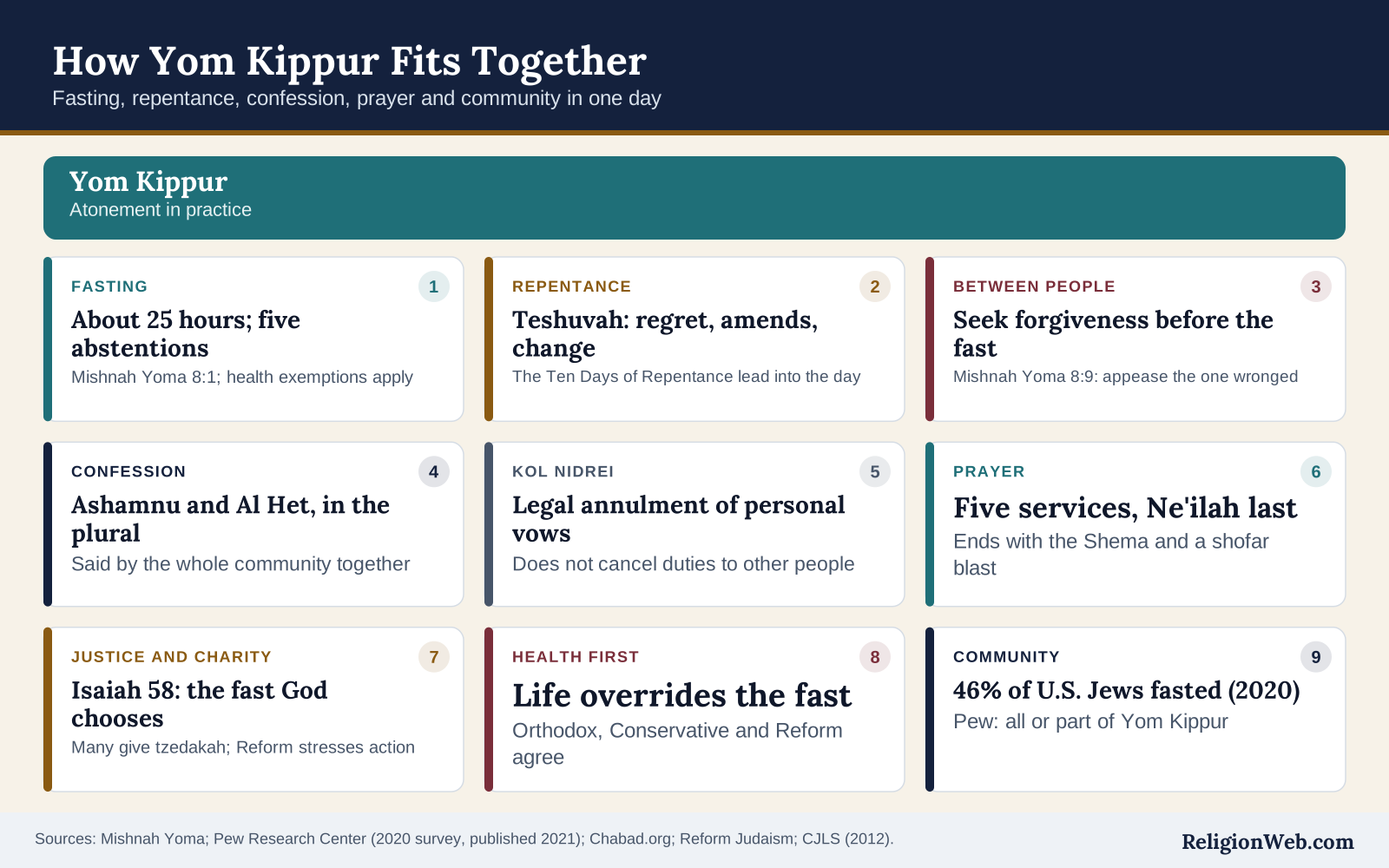
Yom Kippur, the Day of Atonement, is the day Jewish tradition sets apart for repentance, forgiveness and reconciliation with God. It falls on the tenth day of the Hebrew month of Tishrei, nine days after Rosh Hashanah, and in communities that follow traditional rules it is marked by a fast of roughly 25 hours, by abstaining from washing, anointing, leather footwear and marital relations, and by a long cycle of services in the synagogue. Most of the day is spent in prayer, much of it in the first person plural: “we have sinned” rather than “I have sinned.”
The holiday rests on the Torah. Leviticus describes it as a day on which atonement is made, a “sabbath of solemn rest” on which the people are to “afflict” themselves, and Leviticus 16 sets out an elaborate ritual performed by the high priest in the Temple in Jerusalem. After the Second Temple was destroyed in 70 CE, the rabbis kept the day but moved its center of gravity. Repentance (teshuvah), prayer and acts of charity took the place of sacrifice, and the synagogue liturgy, including the Kol Nidrei declaration on the opening evening and the Ne’ilah service at the close, took the shapes recognized today.
Two ideas explain much of what happens on the day. The first is that Yom Kippur is the culmination of a season of judgment and return that begins with Rosh Hashanah and runs through the Ten Days of Repentance. The second, stated plainly in the Mishnah, is that the day atones for wrongs between a person and God, while wrongs between people require the injured party’s forgiveness first. That is why the days before Yom Kippur are traditionally spent asking forgiveness of family, friends and colleagues.
This article explains the day as the Jewish tradition itself understands it, in historical context, and with attention to the real differences among Orthodox, Conservative (Masorti), Reform and other communities. It covers the calendar rule, the biblical and Temple background, the meaning of atonement, the fast and its health exemptions, Kol Nidrei, each service of the day, customs of clothing and food, and the questions people most often ask.
Yom Kippur at a Glance
What Yom Kippur Is and When It Falls
A definition in one paragraph
Yom Kippur (Hebrew Yom ha-Kippurim, “Day of Atonement”) is a full day of fasting, prayer and repentance observed annually on 10 Tishrei. Jewish tradition regards it as the most solemn day of the year and, in the Torah’s phrase, a shabbat shabbaton, a “sabbath of solemn rest.” Work forbidden on Shabbat is forbidden on Yom Kippur as well. The word kippur comes from a Hebrew root meaning to cover, wipe clean or atone, and the same root gives the biblical word kapporet for the cover of the ark in the Tabernacle, which the high priest approached on this day.
The calendar rule behind the date
The Hebrew calendar is lunisolar: months follow the moon, and leap months keep the year aligned with the seasons. Because Jewish days run from nightfall to nightfall, Yom Kippur begins at sundown on 9 Tishrei and ends after nightfall on 10 Tishrei. The date on the civil calendar therefore moves from year to year within a window of several weeks in September and October. For example, the 2026 observance began at sundown on Sunday, September 20, and ended after nightfall on Monday, September 21, according to the Hebcal calendar and the Chabad.org reference guide for that year. The next observances begin at sundown on October 10, 2027, and September 29, 2028. Because of how the calendar’s rules fix the weekday of Rosh Hashanah, Yom Kippur never falls on a Sunday, Tuesday or Friday.
Names, Vocabulary and the Season
The names of the day
Beyond “Day of Atonement,” the tradition uses several names. The Mishnah and Talmud often call it simply Yoma, “the Day,” and the Mishnaic tractate devoted to it carries that name. Folk usage speaks of the “Fast” (ha-tzom), and in the liturgy it is the “Day of Forgiveness” (Yom ha-Selichah). Together with Rosh Hashanah it forms the High Holy Days, or Yamim Nora’im, the “Days of Awe.” These names reflect different emphases: the Temple background, the physical discipline, and the hope for pardon.
Key Hebrew terms
A short working vocabulary helps with everything that follows. Several terms recur throughout the article, and the table below defines them in plain English with a note on where each appears in the observance.
| Term | Meaning | Where it appears |
|---|---|---|
| Teshuvah | “Return”; repentance, the turning back toward right conduct and toward God | The central theme of the Ten Days and of the day itself |
| Kapparah / kippur | Atonement, expiation, “covering” or wiping clean of wrongdoing | The name of the day; the purpose of the Temple rites |
| Vidui | Confession of sins, recited in the plural in every service | The Ashamnu and Al Het prayers |
| Selichot | Penitential poems and petitions for pardon | Before Rosh Hashanah, through the Ten Days, and within the services of the day |
| Kol Nidrei | “All vows”; an Aramaic legal declaration annulling certain personal vows | Opens the evening service |
| Avodah | “Service”; the poetic retelling of the high priest’s Temple rites | The Musaf service |
| Yizkor | “May [God] remember”; the memorial prayer for the dead | The morning service, in many communities |
| Ne’ilah | “Closing”; the final service of the day | Ends at nightfall with the Shema and a shofar blast |
| Kittel | A plain white linen robe worn by some worshipers | Worn in many Ashkenazi communities |
| Pikuach nefesh | The saving of life, which overrides most religious prohibitions | The legal basis for eating when health requires |
Who Observes Yom Kippur Today
Observance across the Jewish population
Yom Kippur is among the most widely observed days in Jewish life, including among people who otherwise describe themselves as secular or who rarely attend services. Reliable measurements are partial and differ by place. In the Pew Research Center’s 2020 survey of U.S. Jewish adults, published in May 2021, 46 percent said they fasted for all or part of Yom Kippur, and Orthodox Jews were more likely than others to have done so. In a survey released in September 2026 by the Israel Democracy Institute, 74 percent of Jewish Israelis surveyed said they would fast, 63 percent fully and 11 percent partially, and 57 percent said they planned to attend prayer services.
Reading these numbers carefully
The two figures measure different things. Pew asked American Jews what they had done, and the Israeli survey asked about intentions in the weeks before the holiday. Both count partial fasting. Neither says anything about the many people who observe the day in other ways, such as attending only Kol Nidrei or Ne’ilah, volunteering, or simply staying home from work. Observance also varies sharply by movement and by family background. The Israeli survey, for example, found higher intended fasting among Jews of Mizrahi background than among those of Ashkenazi background, a reminder that practice reflects family and communal tradition as well as theology.
Biblical Foundations and the Temple Day
What the Torah Commands
The commandments in Leviticus and Numbers
The Torah mentions the day in three places. Leviticus 16 gives the long account of the high priest’s rites. Leviticus 23 lists it among the appointed times of the year and commands rest and self-denial. Numbers 29 lists the additional offerings for the tenth day of the seventh month. Where the text commands the people to “afflict your souls,” the Hebrew idiom te’anu et nafshoteichem does not say how. The rabbinic tradition understood the phrase to include abstaining from food and drink, and derived the other four abstentions from the same command. The Torah also calls the day a statute forever.
The central statement of purpose
The clearest statement of what the day is for comes in Leviticus 16:30. In the Jewish Publication Society translation of 1917, the verse reads:
For on this day shall atonement be made for you, to cleanse you; from all your sins shall ye be clean before the LORD.
Leviticus 16:30, The Holy Scriptures: A New Translation (JPS 1917)
Rabbinic tradition reads this verse as promising both a purifying act and a result: sin is not merely overlooked but cleansed. As later sections show, the Mishnah draws a careful boundary around that promise. Modern critical scholars generally assign Leviticus 16 to the Priestly stratum of the Torah and discuss how its rites developed, while the traditional Jewish understanding holds that the commandments were given to Moses. This article reports each reading as what it is.
The High Priest’s Ritual in the Temple
The sequence of the rites
The Mishnah’s tractate Yoma, chapters 1 to 7, describes the Temple procedure as it was remembered in the rabbinic period. According to the Encyclopaedia Judaica’s account, the high priest spent the preceding week in a special chamber studying the rites with the elders, and a deputy was designated in case he became unable to serve. On the day he offered the regular sacrifice and incense, offered a bull as an offering for himself and his household, and confessed his own sins, those of his family and the priests, and those of all Israel. He alone entered the Holy of Holies, and only on this day. Each time he pronounced the divine name in the confession, the people prostrated themselves.
The two goats and Azazel
Lots were drawn for two goats. One was offered as a sin offering, and the other, in the Torah’s wording, was sent “to Azazel” in the wilderness after the high priest confessed the people’s wrongdoing over it. The meaning of the name Azazel has been disputed since antiquity. Interpretations include a place in the desert, a demonic or supernatural figure, and a descriptive phrase for the goat that “goes away.” Rabbinic tradition and modern scholars do not agree, and the text itself does not resolve the question. The image of a goat carrying away sin gave English the word “scapegoat,” which has since taken on meanings far from the biblical rite.
A Day of Joy as Well as Awe
The Mishnah on the happiest days
The same Mishnah that records the solemnity of the day also records a striking counterweight. In tractate Ta’anit (4:8), Rabban Shimon ben Gamliel says that Israel had no happier days than the fifteenth of Av and Yom Kippur. On those days, the young women of Jerusalem went out in white garments that they borrowed from one another, so that no woman would be embarrassed for lacking her own, and the garments were immersed to ensure ritual purity. They danced in the vineyards, according to the text, and called out to the young men to consider whom they might marry.
Why joy belongs to atonement
The Mishnah reads a verse of the Song of Songs about “the day of his wedding” as an allusion to Yom Kippur, the day on which, in rabbinic tradition, the second set of tablets was given to Moses after the incident of the golden calf. On this reading, the day is joyful because it represents forgiveness granted and a relationship restored. The theme matters for later practice. White clothing, the sense of lightness after the final shofar, and the custom of eating a festive meal at the end of the day all draw, in different ways, on the idea that atonement is a gift as well as a discipline.
After the Temple: The Rabbinic Reshaping
From sacrifice to the synagogue
After the Second Temple was destroyed in 70 CE, there was no high priest, no altar and no goat sent to the wilderness. The rabbis of the Mishnah and Talmud, working in the Land of Israel and in Babylonia, treated the loss as a challenge to be answered through the means that remained: repentance, prayer, study and charity. The Avodah, the poetic recitation of the Temple service, entered the Musaf prayer, so that worshipers could retell the rites that could no longer be performed. According to the Encyclopaedia Judaica, the core of that text was composed by the fourth century CE at the latest and was later expanded with medieval acrostic poems by writers including Solomon ibn Gabirol and Judah Halevi.
A timeline of the development
The table below places the main stages in order. Dates for the earliest layers of biblical and Temple history are approximate or debated, and the table says so where relevant.
| Period | Development | Note on evidence |
|---|---|---|
| Biblical period | Leviticus 16 and 23 and Numbers 29 set out the day, its fast, its rest and its offerings | Traditional view: given at Sinai; critical scholars: Priestly tradition, dated variously |
| Second Temple period (to 70 CE) | The high priest performs the rites in Jerusalem, as later described in the Mishnah | Detailed account is rabbinic, written down after the Temple fell |
| 70 CE onward | Without the Temple, repentance, prayer and charity become the means of atonement | Reflected in the Mishnah (c. 200 CE) and Talmuds |
| By the fourth century CE | The Avodah text is in place for recital in the liturgy | Encyclopaedia Judaica’s dating, “at the latest” |
| 8th century onward | Kol Nidrei is first mentioned in responsa of the Babylonian geonim, who note it came from “other lands” | Its earlier origins are unknown |
| c. 1000 CE | A geonic version of Kol Nidrei gains general acceptance | Associated with the time of Hai Gaon |
| 12th century | Rabbenu Tam’s wording applies Kol Nidrei to the coming year; it becomes standard for Ashkenazim | Sephardi rites retain their own versions |
| 1844 | A Reform rabbinical conference in Brunswick calls for removing the Kol Nidrei text | Many Reform congregations later restored it, in whole or in part |
| 2026 | Observed September 20 to 21 (evening to nightfall) | Hebcal; Chabad.org |
The Meaning of Yom Kippur: Atonement, Repentance and Forgiveness
Teshuvah, Kapparah and What Atonement Means
Repentance as turning
The central idea of the day is teshuvah, a Hebrew word that means “return.” In the classical rabbinic understanding, repentance has recognizable parts: acknowledging a wrong, feeling regret, giving it up, making amends where possible, and resolving not to repeat it. The medieval legal writer Maimonides, in his code the Mishneh Torah, set out these stages in a section on repentance, and his framework shaped how later communities speak about the day. Teshuvah is available all year, but the tradition treats the season from Rosh Hashanah to Yom Kippur as a time when it is especially urgent and especially welcome.
Atonement as cleansing, not punishment alone
The word kapparah, “atonement,” carries the sense of covering or wiping clean. Jewish tradition does not generally treat the day as a payment demanded by an angry God. Its liturgy emphasizes divine mercy, and it repeatedly cites the “thirteen attributes” of God from Exodus 34, a passage that describes God as compassionate, gracious and slow to anger. Atonement in this frame is the restoration of a relationship that wrongdoing has strained. The concern is both ethical, the repair of harm done, and spiritual, the return of the person to a state of closeness with God.
Wrongs Between People and Wrongs Against God
The principle in the Mishnah
Tractate Yoma closes with a passage that is among the most influential in the entire tradition. Mishnah Yoma 8:9, in the William Davidson English edition on Sefaria, states in paraphrase that Yom Kippur atones for sins between a person and God, but not for sins against another person until the injured party has been appeased. The Mishnah adds that someone who sins on the assumption that Yom Kippur will atone gets no atonement from it. It then ends on a note of reassurance: Rabbi Akiva praises Israel, saying that just as a ritual bath purifies the impure, God purifies Israel.
How the principle shapes practice
This passage explains why Jewish ethical practice around the holiday is so concrete. Before the fast begins, many people telephone, write or speak to those they have hurt, ask forgiveness directly, and make restitution for money or property wrongly taken. The tradition adds a counterweight: a person who is asked sincerely for forgiveness is expected to grant it, and after repeated sincere attempts, not to hold a grudge. Rabbinic literature does not claim that every wrong can be repaired by an apology, and it recognizes that serious harms may require more. The point is that the day cannot be used as a shortcut around the people one has wronged.
Judgment, Mercy and the Book of Life
The imagery of judgment
Rosh Hashanah and Yom Kippur are traditionally understood as days of judgment, with Rosh Hashanah the day on which decrees for the year are written and Yom Kippur the day they are sealed. The Unetaneh Tokef prayer, recited on both holidays, gives this idea its most memorable language. In Rabbi Reuven Hammer’s description, it depicts a day when “On Rosh Hashanah it is inscribed” and the decree is sealed on Yom Kippur, and it lists the ways that life may end or be disrupted. The common greeting gmar chatimah tovah, “may you be sealed for good,” draws on the same image of a book in which each person is inscribed.
Hope inside the imagery
The image of judgment is balanced by a statement of hope in the same prayer, that “repentance, prayer and righteousness avert the severe decree.” Hammer notes that the prayer does not describe a fixed fate. Its subject, he writes, is human responsibility and the possibility of change, not martyrdom or fear for its own sake. Many modern liberal communities read the imagery of books and seals more metaphorically, as a way of speaking about moral accountability. More traditional communities take the language of divine judgment more literally. Both groups recite the same prayer, and both describe it as a call to take one’s own conduct seriously.
What Kind of Fast? The Prophets on Sincerity
The haftarah reading from Isaiah
On the morning of Yom Kippur the traditional haftarah, the prophetic reading that follows the Torah portion, is Isaiah 57:14 to 58:14. Its message is that outward observance is empty without justice. In the JPS 1917 translation, the prophet speaks in God’s voice and asks:
Is not this the fast that I have chosen? To loose the fetters of wickedness, To undo the bands of the yoke, And to let the oppressed go free, And that ye break every yoke?
Isaiah 58:6, The Holy Scriptures: A New Translation (JPS 1917)
How communities read it
The passage is read aloud on the very day when many in the congregation are fasting, and its placement is deliberate. Traditional interpreters take it as a reminder that the fast is a means and not an end: it prepares a person to act more justly, share food with the hungry and release those who are bound by oppression. Reform communities, which often emphasize the prophetic tradition, frequently build sermons, social-action projects and food donations around the passage. In more traditional settings, the same reading stands beside strict observance of the fast. The two emphases are not opposites, and the haftarah supports both.
The Ten Days and Erev Yom Kippur
The Ten Days of Repentance
From Rosh Hashanah to Yom Kippur
The ten days that begin with Rosh Hashanah and end with Yom Kippur are known as Aseret Yemei Teshuvah, the Ten Days of Repentance. The first of Tishrei, the day the shofar is sounded, opens the period, and the tenth closes it. The Rosh Hashanah article describes the New Year observance in detail. In the days between, many communities add penitential prayers to the daily services, recite the litany Avinu Malkeinu (“Our Father, Our King”), and hold special selichot services before dawn. The Shabbat that falls in this period is called Shabbat Shuvah, “the Shabbat of Return,” after the opening words of its prophetic reading.
Seeking forgiveness before the day
The ten days are also the traditional time for the interpersonal work the Mishnah requires. Rabbinic custom treats the time before Yom Kippur as a deadline for reconciliation: those who have wronged someone are expected to approach that person, and those who have been wronged are expected to be open to hearing the request. Congregations sometimes make this explicit, and many ask for forgiveness for anything said or done during the year in the course of communal life. For people with strained family relationships, the task is rarely simple, and rabbinic teaching acknowledges that the effort counts even when reconciliation does not succeed.
The Day Before: Preparations on Erev Yom Kippur
Kapparot, charity and immersion
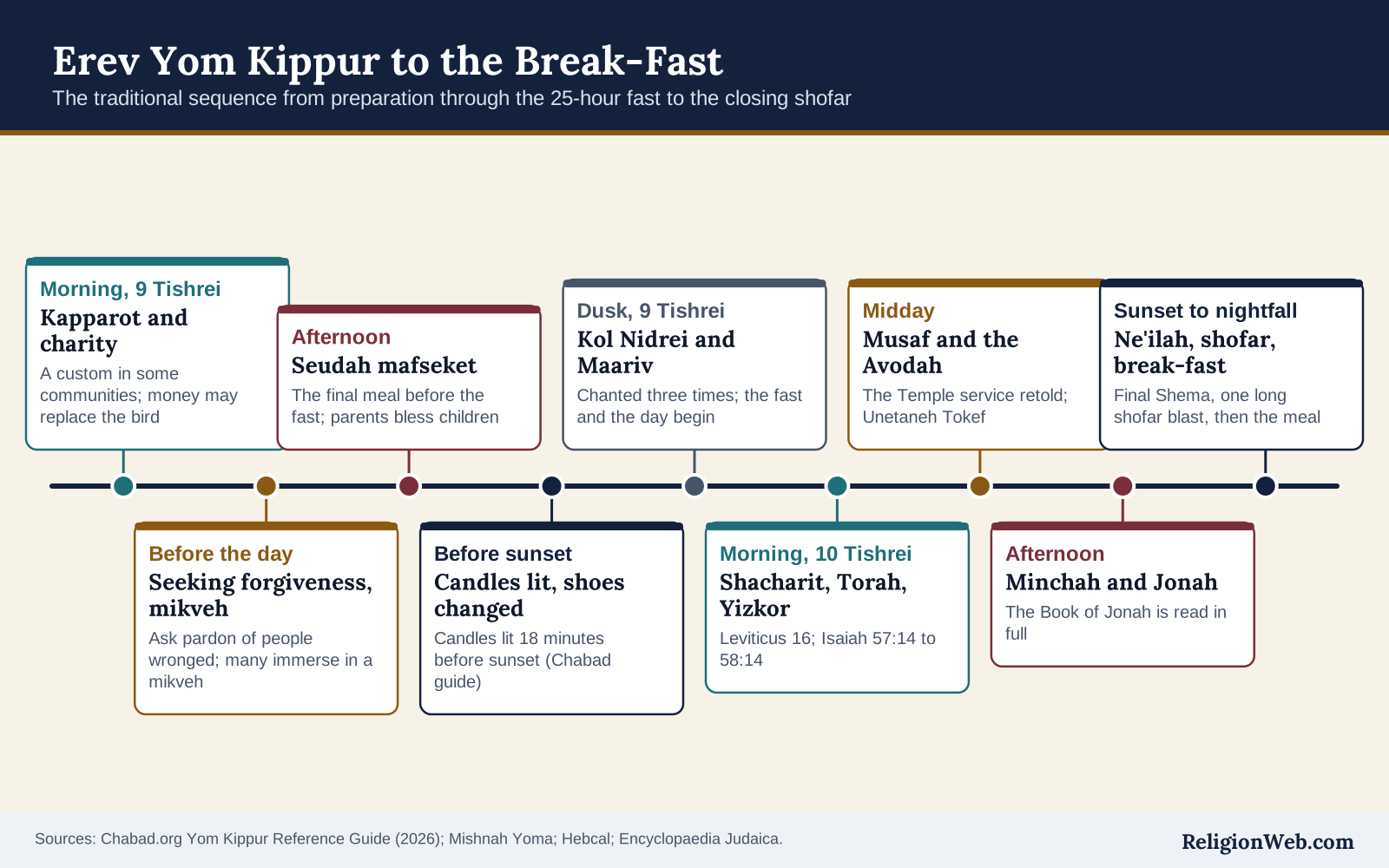
Several customs fall on the day before the fast. Some Orthodox and Hasidic Jews perform kapparot on the morning before Yom Kippur: a chicken, or in a common alternative, money, is swung over the head while a short formula is recited, and the bird is then given to the poor for food or, in the case of money, the equivalent is given to charity. The custom is not found in the Torah or the Talmud. It was discussed by authorities from about the ninth century, and some leading medieval figures, including Nachmanides and Joseph Karo, opposed it, while the kabbalistic tradition supported it. Today many rabbis, including some who respect the custom, endorse the money substitute and raise concerns about the welfare of the birds. Many people also immerse in a mikveh, a ritual bath, and give extra charity.
The last meal, candles and blessings
Tradition treats the meal before the fast as itself a religious act, since Yom Kippur is preceded by a commandment to eat. The Talmud, in tractate Yoma, teaches that eating on the ninth is counted as though one had fasted on both the ninth and the tenth. Families share a festive meal called the seudah mafseket, “the meal that separates,” typically early in the afternoon and without strong spices or heavy salt, which can cause thirst. Parents customarily bless their children before leaving for the synagogue. Women and girls light holiday candles before sunset, which the Chabad reference guide gives as 18 minutes before sunset, and many households also light a 24-hour candle in memory of the dead or as a source of light for the night. In some communities, notably Chabad, it is also customary to ask others for a piece of sweet cake, lekach, before the fast begins.
Entering the Day Before Sunset
Taking on the holiness early
Jewish law requires adding time from the ordinary day to the holy one, so the fast begins a little before sunset on the ninth and ends a little after nightfall on the tenth. The resulting span is a little over 25 hours, depending on the latitude and season. Worshipers arrive at the synagogue before sundown. Leather shoes are exchanged for canvas or other non-leather footwear, and white garments are put on. The mood in many congregations on this first evening is one of quiet seriousness, mixed with a sense of anticipation, since many people attend the opening service even if they will not return the next day.
The structure of the 25 hours
The day’s cycle of prayer runs in an unbroken pattern: an evening service with Kol Nidrei, a long morning service with Torah reading and memorial prayers, an extended additional service, an afternoon service with the Book of Jonah, and the closing Ne’ilah. Between services, people rest, study or walk, and some stay in the sanctuary for most of the day. The sections that follow take each stage in turn, beginning with the rules of the fast.
The Fast: Five Prohibitions, Exemptions and Health
What Is Forbidden and Why
The five abstentions
The Torah’s command to “afflict your souls” is understood in rabbinic law to include five abstentions, listed in Mishnah Yoma 8:1: no eating or drinking, no washing, no anointing with oils or lotions, no wearing of leather shoes, and no marital relations. Alongside these, all work forbidden on Shabbat is forbidden on Yom Kippur. The first abstention is the one most people mean when they say “the fast,” and the tradition counts it as the primary obligation. The other four extend the discipline to comfort and pleasure more broadly. The Shabbat rules about work, including lighting fires and handling money, apply in full, which is why Yom Kippur is called a Sabbath of Sabbaths.
Why these abstentions
Interpreters give several reasons. One is that stripping away ordinary comforts turns attention from the body to the soul, a view the Reform movement’s guide to the fast expresses by quoting Rabbi Mordecai Kaplan on the importance of “putting them in their place,” meaning physical appetites. Another is that a day without food, work or ordinary social activity makes it easier to reflect on one’s conduct. A third reading, found especially in classical sources, sees the day as a rehearsal for a different kind of existence, one in which human beings stand before God without the usual concerns of the body. Interpretations differ, and the tradition itself usually presents them as complements rather than rivals. The law is clear even where the reasons are debated.
The fasting framework at a glance
The following table summarizes the framework in its traditional form and notes where communities differ. It describes what each movement’s own materials say, not a ranking of approaches.
| Element | Traditional rule | Variations and notes |
|---|---|---|
| Duration | From shortly before sunset on 9 Tishrei until after nightfall on 10 Tishrei, a little over 25 hours | Exact times depend on location and local custom |
| Eating and drinking | None, including water | Exempt categories described below; partial fasting is common among those not fully obligated |
| Washing | No bathing for pleasure; minimal washing for cleanliness after using the toilet or to remove dirt | Practice on washing the hands in the morning differs in detail by community |
| Anointing | No lotions, creams or perfumes | Medicinal use is permitted when needed |
| Footwear | No leather shoes | Canvas, rubber or cloth footwear is customary |
| Marital relations | Forbidden for the duration of the day | Part of the Mishnah’s list |
| Work | Same prohibitions as Shabbat | The Reform movement interprets Sabbath rules differently from Orthodox and Conservative communities |
| Children | Not obligated before bar or bat mitzvah age | Chabad guidance has healthy children begin short fasts around age nine; the Reform guide says under 13 are not required |
Who Fasts and Who Does Not
Obligation and age
Traditionally the obligation to fast begins at the age of religious majority, which is the age marked by a bar or bat mitzvah. Children below that age are not required to fast, though many Orthodox families gradually train children to fast for short periods. The Chabad reference guide, for example, says that healthy children are taught to fast for short periods starting around age nine. The Reform movement’s guide says that children under 13 are not required to fast. These accounts are consistent: the full obligation begins later, and what happens before it is a matter of education and family custom.
Illness, pregnancy and the priority of life
All major movements agree that preserving life and health takes precedence over the fast. The principle is called pikuach nefesh, and the Mishnah itself applies it. Mishnah Yoma 8:5, in the William Davidson English edition on Sefaria, describes a pregnant woman who smells food and craves it: she is fed until she recovers. It also says that a sick person is fed on the instruction of medical experts and, if there are none, according to the person’s own request. Later legal codes developed these cases. A person who must eat or drink for health reasons is not considered a sinner, and in the Orthodox view, as Chabad’s guidance puts it, eating on a rabbi’s direction on medical advice is still a mitzvah.
How the movements differ in emphasis
The movements agree on the principle but differ on defaults and on who decides. The Chabad guide says that all adults fast, including pregnant and nursing women, and that anyone who is ill, takes medication, is elderly or finds fasting difficult should consult a rabbi. A 2012 Conservative responsum by Rabbi Gail Labovitz, approved by the Committee on Jewish Law and Standards, says that fasting is a Torah obligation but that a person whose health would be seriously endangered is exempt and may be required to eat, citing diabetes, weakness from illness or treatment such as chemotherapy, medications that must be taken with food, and eating disorders under treatment. It adds that pregnancy and nursing are not automatic exemptions and that women should follow a physician’s advice. The Reform guide states that children under 13, pregnant or nursing people, and those who are ill are not required to fast, and that “Fasting is not supposed to endanger your life or your health.”
Fasting Safely and Breaking the Fast
Practical and health considerations
The traditions agree that a religious fast is not a substitute for medical care. People with diabetes, kidney disease, a history of eating disorders, pregnancy, or conditions that require regular medication should speak with their doctor, and where relevant their rabbi, well before the holiday. The Reform guide recommends preparing in advance, staying hydrated beforehand and continuing to take daily medications, and the Conservative responsum advises that anyone who becomes ill during the fast should receive medical treatment first and, if they must eat, do so discreetly and only as much as health requires. Alternatives for those who cannot fast, including donating the money one would have spent on food or doing volunteer work, are offered in Reform materials.
Ending the fast
The fast ends after Ne’ilah with the sounding of a single long shofar blast, called tekiah gedolah, which in many congregations is followed by the evening service. In most traditional communities, the evening prayer is followed by Havdalah, the ceremony that marks the end of a holy day, and the congregation then goes home to eat. Chabad’s guide describes the blast as the formal end of the holy day. The meal, known in English as the “break-fast,” varies by culture: in many Ashkenazi homes it centers on dairy dishes, bagels, smoked fish and cake, while Sephardi and Mizrahi families may begin with dates, sweet drinks or regional dishes. Some communities, according to a widespread custom, begin building the sukkah for the harvest festival immediately afterward, a reminder that the calendar moves quickly from solemnity to celebration.
Kol Nidrei and the Evening Service
The Opening of the Day
The setting before sundown
The synagogue fills before sunset on the evening of 9 Tishrei. Many congregations use white covers for the ark and the Torah scrolls on this day. Before the service proper begins, the ark is opened and two respected members of the community, or two rabbis, take scrolls of the Torah from it and stand on either side of the cantor, as the Jewish Encyclopedia describes the ceremony. The number of scrolls taken out varied by community. Many commentators see in the three standing figures an image of a court of three, which would fit the legal character of what follows. The tallit, the prayer shawl normally worn only in the morning, is put on before sunset for this evening service, an exception to the usual rule.
Permission to pray with those who have transgressed
Before the declaration of vows, the congregation recites a short preliminary formula, traced by the Jewish Encyclopedia to Rabbi Meir of Rothenburg (died 1293), that permits “transgressors” to join in prayer. Its effect is inclusive: it states, in effect, that no one is excluded from the day’s worship because of past wrongdoing, including people under communal discipline. In many communities this formula is understood as an expression of the idea that the community prays for sinners and with them. The cantor then chants Kol Nidrei three times, beginning softly and rising in volume, so that those who arrived late could hear it.
What the Declaration Says and Does
An Aramaic legal formula about vows
Kol Nidrei, whose Aramaic title means “All Vows,” is a formula by which worshipers declare void the personal vows and oaths they made unwittingly, rashly or by mistake. In the Jewish tradition, a spoken vow has real legal force, and failing to keep it is a serious matter. The Encyclopaedia Judaica notes that the text eased worry about unkept pledges, a worry that was especially strong in the Rosh Hashanah season. The language is Aramaic, the legal register of much of the Talmud, which is characteristic of a document with the force of a court procedure. The wording that is standard among Ashkenazim today is the version of Rabbenu Tam, the twelfth-century French scholar.
What it does not do
Kol Nidrei has narrow boundaries. Jewish teachers, as the Jewish Encyclopedia records, have long emphasized that it applies only to personal vows made before God, and not to obligations toward other people, court judgments or contracts. A person who borrowed money, promised to meet a friend, or took an oath in court is not released from those obligations by the declaration. Within the legal tradition even the annulment of personal vows requires conditions: in rabbinic law, vows are annulled by a court of three or an expert scholar after review, and the Kol Nidrei text works as a general, advance declaration, in line with a Talmudic teaching in tractate Nedarim that a person can declare future vows void. Kol Nidrei is also not a confession of sin; that comes later.
Debate, Reform and Misunderstanding
Origins and resistance among the geonim
The first mention of Kol Nidrei as a collective declaration appears in responsa of the Babylonian geonim, beginning in the eighth century, who said they knew it from “other lands,” which the Encyclopaedia Judaica does not identify. Its origins remain unknown. The geonim of Sura condemned it sharply for generations, while those of Pumbedita were more lenient, probably in response to popular demand. By about 1000 CE, in the time of Hai Gaon, a geonic formula covering the previous year’s vows had been generally accepted. In the twelfth century Rabbi Meir ben Samuel and his son Rabbenu Tam reworded it to refer to vows that might be made from this Yom Kippur until the next, shifting the focus from the past to the future. Their Aramaic version became standard for Ashkenazi communities.
Reform changes and false accusations
In 1844 a rabbinical conference in Brunswick, Germany, urged removing the text, and many Reform congregations in western Europe and America dropped it, often keeping the melody and substituting hymns, psalms or revised wording. The 1961 edition of the Reform movement’s Union Prayer Book in the United States restored the full Aramaic text. Kol Nidrei was also used for centuries against Jews: some opponents, including Jewish converts to Christianity, claimed that it showed that Jewish oaths were unreliable, and in some European jurisdictions a special “Jew’s oath” was required in court. Jewish authorities rejected the charge from the thirteenth century on, noting, as Jehiel of Paris did in 1240, that the formula concerns private vows before God and not oaths made in legal settings.
The Rest of the Opening Service
Maariv, the Shema and penitential poetry
After Kol Nidrei, the community recites the evening service, Maariv, which includes the Shema and its blessings, with additions for the day. In many congregations the cantor and worshipers also chant selichot, penitential poems, and recite the first confession. The congregation says the prayer Baruch shem kevod malchuto aloud, in a break from the quiet in which it is usually spoken, a custom tied to the day’s closeness to the angels in rabbinic imagery. The tone is one of intensity without elaboration.
The night itself
Some people stay in the synagogue late into the night reciting psalms or studying, and others go home to rest before returning for the morning service, which in many communities begins early. Customs of staying up, reading Psalms, or sleeping in the synagogue vary by community. For many congregants the opening evening is the emotional high point, with Kol Nidrei as its symbol, and for others, who attend only one service, it is the only part of Yom Kippur they hear in person.
The Day’s Services: From Shacharit to Ne’ilah
The Cycle of Services at a Glance
Five services in one day
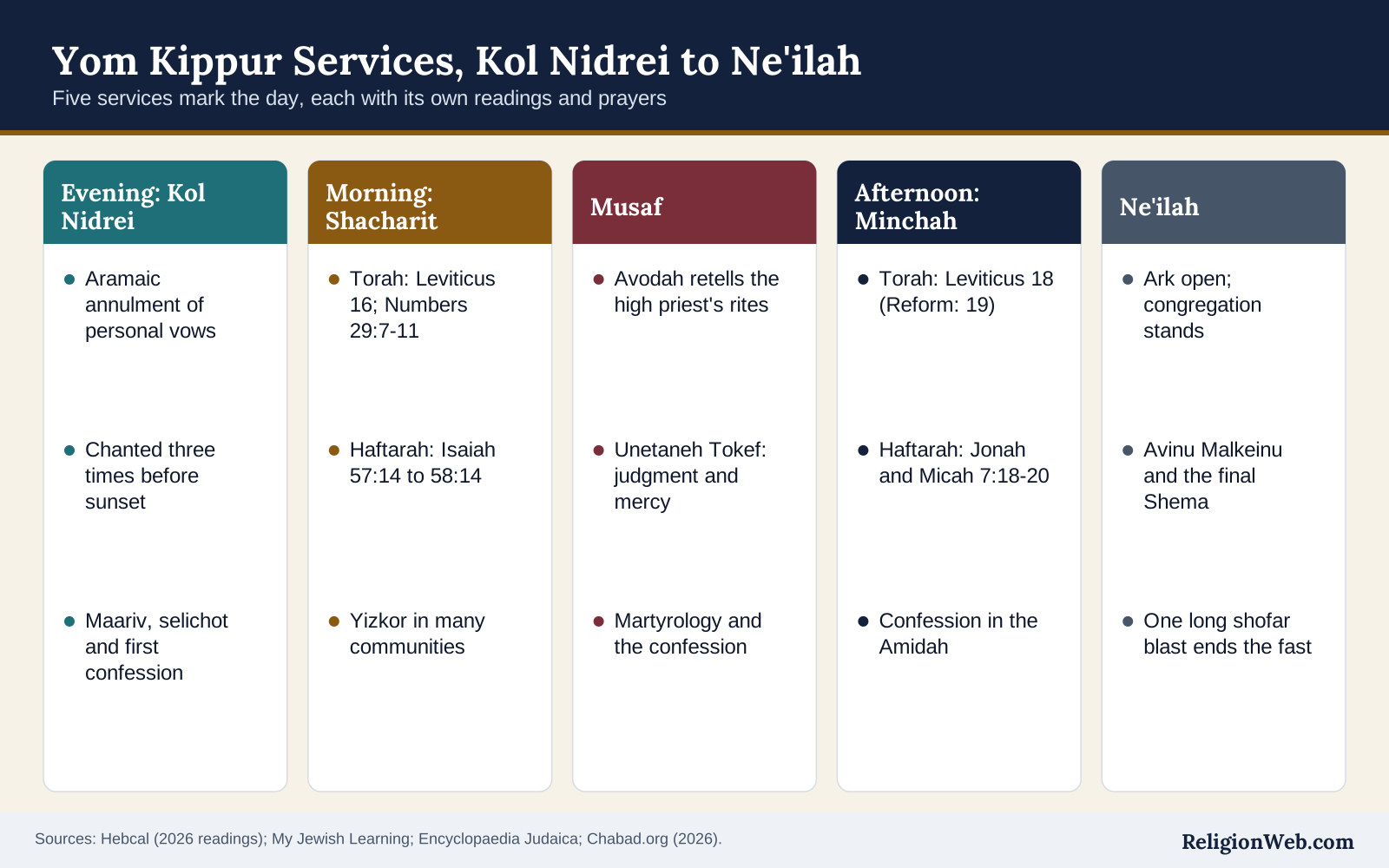
On most days of the year Jewish tradition prescribes three services: morning, afternoon and evening. On Shabbat and festivals it adds a fourth, the additional service called Musaf. Yom Kippur is distinguished in Ashkenazi usage by a fifth, Ne’ilah, which closes the day. The sequence is therefore the opening evening service, Shacharit (morning), Musaf (additional), Minchah (afternoon) and Ne’ilah. In traditional synagogues these services last most of the daylight hours, with breaks between them, and in some communities the congregation stays in the sanctuary almost without interruption.
Services, readings and main elements
The table below follows the traditional Ashkenazi order and the readings listed by the Hebcal calendar, and it notes where other communities differ. Sephardi and Mizrahi rites follow their own prayer books, with different melodies and some different poems, but the framework is the same.
| Service | Time | Main elements | Readings |
|---|---|---|---|
| Kol Nidrei and Maariv | Opens before sunset on 9 Tishrei | Kol Nidrei chanted three times; evening prayers; selichot and first confession | None; the Shema and its blessings |
| Shacharit | Morning | Extended Amidah with confession; Torah and haftarah readings; Yizkor in many communities | Leviticus 16:1 to 34; Numbers 29:7 to 11; Isaiah 57:14 to 58:14 |
| Musaf | Late morning to early afternoon | Avodah retelling the Temple service; Unetaneh Tokef; martyrology; confession | None in the service itself |
| Minchah | Afternoon | Torah reading; Book of Jonah as haftarah; confession | Leviticus 18 (Reform: Leviticus 19); Jonah 1:1 to 4:11 and Micah 7:18 to 20 |
| Ne’ilah | Late afternoon into nightfall | Ark open; Avinu Malkeinu; final Shema; shofar blast | None |
Morning: Shacharit, the Torah and Yizkor
The Torah and haftarah readings
The morning service is the longest regular service of the year in most synagogues. Two scrolls are read from the Torah. The first reading, Leviticus 16, recounts the high priest’s rites, so that the congregation hears again the account the day is built on. A shorter second reading from Numbers 29:7 to 11 gives the additional offerings of the day. The Torah reading is followed by the haftarah from Isaiah 57:14 to 58:14, the passage on what true fasting means. Together the readings tie the observance in the present to both the Temple tradition and the prophetic critique of empty ritual.
Yizkor, remembering the dead
Yizkor, the memorial prayer, is recited in many communities after the Torah reading. In the Ashkenazi tradition it is said four times a year, including Yom Kippur, and Chabad’s guide places it in the morning service. Worshipers recall parents and relatives who have died, often pledge charity in their memory, and in many congregations those whose parents are living leave the room during the prayer, a custom that some communities keep and others do not. Sephardi and Mizrahi communities have corresponding memorial customs, called hazkarat neshamot, whose timing and form differ from the Ashkenazi Yizkor. The prayer connects the day of atonement to the idea that the living and the dead remain part of one community.
Musaf: The Avodah, Unetaneh Tokef and the Martyrology
Retelling the Temple service
Musaf is the climax of the daytime liturgy for many worshipers. Its central element, the Avodah, retells the Temple service in poetry, beginning in many rites with a review of history from creation and moving to the high priest’s preparations, his confession, the lots, and his entry into the Holy of Holies. At the points where the high priest pronounced the divine name and the people fell on their faces, Orthodox Ashkenazi worshipers and some Sephardi communities still prostrate themselves fully on the floor, according to the Encyclopaedia Judaica. The Reform liturgy keeps only the high priest’s confession, in Hebrew and in the vernacular, and omits the sacrificial detail while adding moral themes. Conservative prayer books keep most of the traditional text with modern meditations. The best-known melody, the Ve-ha-kohanim, is treated as a cantorial showpiece in Ashkenazi synagogues.
Unetaneh Tokef and the martyrology
Within the repetition of the Musaf Amidah, before the Kedushah, the cantor recites Unetaneh Tokef, the poem of judgment discussed above. Rabbi Reuven Hammer writes that no one knows who composed it, that the popular legend ties it to Rabbi Amnon of Mainz, a martyr said to have recited it before dying, and that the poem’s structure and language suggest it was composed in the Byzantine period. Many communities then recite the martyrology, a medieval poem that recalls rabbis killed by the Roman authorities, and in many rites additional memorials are added for later victims of persecution. The prayers are somber by design, and they remind worshipers that the day’s theme of faithfulness has a history.
Confession: Vidui, Ashamnu and Al Het
The confessions in the plural
The confession, or vidui, is the heart of the day’s penitential prayer. It appears in every Amidah of Yom Kippur in a form that is said first silently by each worshiper and then, in the cantor’s repetition, aloud. Two texts dominate. Ashamnu (“We have been guilty”) is a short list of wrongs arranged alphabetically in Hebrew. Al Het (“For the sin”) is a longer litany, also alphabetical, whose lines begin with the phrase “for the sin we have sinned before You” and then name particular failings: hardening of the heart, harmful speech and deceit are among those listed. Both are written in the first person plural.
Why “we” and why the breast is beaten
The plural has a purpose. Many commentators explain that every member of the community answers for the failings of the group, including wrongs one has not personally committed, and that the plural prevents a worshiper from claiming moral superiority or from feeling alone in his or her own failings. As My Jewish Learning’s account puts it, the confession is an alphabet of transgressions “from A to Z,” recited while the congregation gently beats its breast, a gesture of regret that is a matter of custom and not a legal requirement. In Jewish practice each person addresses God directly in these prayers, with the cantor leading the congregation but not pronouncing absolution.
Afternoon: Minchah and the Book of Jonah
Why Jonah is read
The afternoon service is marked by the reading of the entire Book of Jonah as the haftarah, followed by the three verses of Micah 7:18 to 20. Jonah tells of a prophet who tried to flee from a divine command and was eventually sent to the city of Nineveh to announce its coming destruction. The people of Nineveh repent, and God relents. The story is read, traditional commentators say, because it shows that repentance is possible even for a people with a grave record and that divine mercy is greater than the prophet himself expected. Micah’s closing verses speak of God pardoning iniquity and casting sins into the depths of the sea.
The Torah reading on Leviticus 18
The Torah reading for Minchah in traditional communities is Leviticus 18, which sets out rules about sexual conduct and other prohibited relationships. The choice is old, and one traditional explanation is that it serves as a reminder of moral boundaries on a day concerned with moral responsibility. Reform communities generally read Leviticus 19 instead, according to My Jewish Learning, a chapter that includes the command to love one’s neighbor as oneself and a series of ethical laws. The difference reflects each movement’s view of which passages best serve the day’s themes. Both choices are made in the context of the same liturgical frame.
Ne’ilah: The Closing Service
The meaning of “closing”
Ne’ilah means “closing.” My Jewish Learning notes that the name refers to the closing of the gates of heaven, an image of the last opportunity to be heard before the day ends. The ark remains open throughout the service, and the congregation traditionally stands. Many worshipers say that the energy of the room changes: people who have been tired and hungry for hours stand together, and the prayers pick up intensity. The central litany is Avinu Malkeinu, and in many communities the cantor and the congregation chant it to melodies that rise toward the end of the service.
The final Shema and the shofar
The service ends at nightfall. In the traditional order the congregation recites the Shema once aloud, repeats a verse in praise of God’s name three times, and repeats “The LORD, He is God” seven times, and the shofar is then sounded in one long blast, the tekiah gedolah, which marks the formal end of the holy day. In many communities the congregation then sings or calls “Next year in Jerusalem,” a phrase that Chabad’s guide places at the close of the service. The sound of the shofar here echoes the Rosh Hashanah shofar, and many people hear it as the closing of a single long season of reflection that began on the first of Tishrei.
White Clothing, Customs and the Synagogue Setting
Dress, Footwear and Simplicity
White garments and the kittel
White is the color of the day. Many worshipers wear white clothing, and in many Ashkenazi communities married men wear a plain white linen garment called a kittel, the same robe in which some are buried. The Chabad reference guide notes that wearing white is a custom and not a requirement for either men or women. Traditional explanations include purity, the image of angels, and a reminder of mortality. The connection to purity goes back to Mishnah Ta’anit, where the daughters of Jerusalem wore white garments on the day. Many synagogues also use white covers for the ark and the Torah scrolls, and some cantors and rabbis wear white as well.
Leather shoes and jewelry
The prohibition on leather footwear leads many worshipers to wear canvas shoes, sneakers or socks on the sanctuary floor. A common explanation is that leather footwear is associated with comfort and status, which are out of place on a day of self-denial. Many people also avoid gold jewelry, according to Chabad’s guide. Some explain this by reference to the golden calf, the episode that preceded the second tablets in rabbinic tradition. The overall effect is a plain congregation: simple clothing, no ornament, and a lowered sense of social hierarchy.
Posture, Music and the Prayer Book
Standing, bowing and prostration
Many congregants stand through much of the service, and the prayers include several moments of full prostration in traditional Ashkenazi synagogues. The practice appears at the Avodah, as noted above, and in some communities at the Aleinu prayer, where worshipers fall on their faces on the synagogue floor, which in a crowded sanctuary sometimes requires a cleared space and a cloth. It is among the few moments when Orthodox Jewish liturgy includes full prostration, and it is a vivid sign of the seriousness of the day. Many Reform and Conservative communities have adapted or omitted prostration.
The machzor and the music of the day
Yom Kippur services use a special prayer book called a machzor, which is much larger than the weekday siddur and contains the poetry added in medieval centuries. The music of the day is distinctive: the Kol Nidrei melody, the Ve-ha-kohanim melody of the Avodah, and the rising chant of Ne’ilah are among the best-known of all synagogue melodies. Communities have their own settings, and cantors often prepare for months. The Jewish Encyclopedia observes that the Kol Nidrei melody varies considerably between communities and that its opening resembles plainchant, while its close appears to borrow from the Aleinu prayer. Max Bruch’s arrangement for cello brought the melody to concert audiences.
Community, Children and the Break Between Services
Children and families in the synagogue
Many synagogues hold special programs for children, with shorter services, stories and music, and some arrange for separate services for teenagers. Children who do not fast are often taught about the day through the Book of Jonah and discussion of apology and forgiveness. Families often attend together, though practices on seating differ by community: Orthodox synagogues seat men and women separately, while Conservative, Reform and Reconstructionist ones generally have mixed seating.
Using the intermission
Between the Musaf and Minchah services, many people rest, read or take a quiet walk. Some study Torah or Jewish ethics, and in some communities there are lectures, text study sessions or music. Some Reform and other liberal congregations schedule a study session or meditation in the afternoon alongside the services. The break is part of the rhythm of the day, and its purpose is to preserve strength for the final service.
Movements, Communities and Regional Variation
Orthodox, Hasidic and Haredi Communities
The halakhic framework in full
In Orthodox Judaism, Yom Kippur is observed according to the full rabbinic framework: the five abstentions, the Sabbath restrictions on work, and the complete traditional liturgy, including the Avodah and the martyrology. Orthodox authorities treat the fast as a biblical obligation, and they treat the exemptions for health as part of the same law and not a departure from it. When someone is unsure whether illness or pregnancy affects the obligation, the standard advice is to consult a rabbi who can weigh the medical facts, a practice the Chabad guide describes. Congregations are typically segregated by sex in the sanctuary, and services run from early morning to nightfall.
Hasidic customs
Hasidic communities, including Chabad, preserve a number of additional customs, many of them shaped by kabbalistic tradition. Kapparot is more widely observed in Hasidic and some other Orthodox circles than elsewhere, and, as noted earlier, the figures who supported it include the kabbalist Isaac Luria. Chabad’s guide also describes the practice of asking for a piece of sweet cake before the fast, avoiding gold and wearing a kittel for married men. Within Hasidic life, the closing hour of Ne’ilah is often sung with particular intensity. These customs should not be read as the practice of all Orthodox Jews, since Orthodox communities with other histories, such as many Sephardi and Mizrahi ones, have their own distinct traditions.
Conservative, Reform and Other Liberal Communities
Conservative (Masorti) Judaism
Conservative Judaism, called Masorti outside North America, holds that the Torah’s commandments, including the fast, are binding and that Jewish law develops through the work of its rabbis. The movement’s Committee on Jewish Law and Standards has issued rulings on matters such as the Yom Kippur fast for people with medical conditions, including the 2012 responsum on a non-fasting cantor discussed above. Conservative prayer books keep most of the traditional text of the Avodah and the confessions, with added readings and meditations, according to the Encyclopaedia Judaica, and most Conservative synagogues have mixed seating and men and women reading from the Torah.
Reform and Reconstructionist communities
Reform Judaism treats the fast as a meaningful practice that individuals approach with informed choice. Its guide presents fasting as something many Jews observe, encourages doing it safely, and invites each person to consider what it means to them. Reform services are often shorter than Orthodox ones, are conducted partly in English, and, as noted earlier, shorten the Avodah to the high priest’s confession and add moral themes. Reform congregations read Leviticus 19 at Minchah, and many incorporate the Isaiah reading and social-action projects, such as collections for hunger relief, into the day. Reconstructionist and other liberal congregations also use their own prayer books and approaches. Each movement’s own materials remain the best guide to its current practice.
Ashkenazi, Sephardi and Mizrahi Traditions
Different rites for the same day
Beyond the movements, geography and ancestry shape how the day sounds and feels. Ashkenazi communities, descended from Jews of central and eastern Europe, use the Ashkenazi rite, with the Kol Nidrei text associated with Rabbenu Tam and the Ve-ha-kohanim melody. Sephardi and Mizrahi communities, whose roots lie in Iberia, North Africa, the Middle East and Central Asia, use rites with their own poems and melodies. The Encyclopaedia Judaica notes that Sephardi, Italian (Piedmont), Yemenite and Ashkenazi rites each open the Avodah differently, a small example of the larger diversity. Within a single city, adjacent synagogues may therefore pray the same day in recognizably different ways.
Customs of food and welcome
The break-fast meal is one of the clearest signs of cultural difference. Ashkenazi families in North America often serve bagels, fish and dairy dishes, and many Sephardi and Mizrahi families begin with dates, juices or regional pastries and soups. The Israeli survey cited earlier found higher intended fasting among Jews of Mizrahi background (88 percent, 81 percent fully) than among Ashkenazi respondents (64 percent), though the survey’s authors and any reader should be cautious about general conclusions from a single poll. What the numbers do show is that fasting is deeply embedded in family traditions of many kinds.
A Summary of Community Practice
Practice at a glance
The following table summarizes the main patterns described by each community’s own materials. It is a simplification, since individual congregations vary within every movement.
| Community | Fast | Liturgy and readings | Distinctive notes |
|---|---|---|---|
| Orthodox | Binding biblical obligation; health exemptions on rabbinic and medical advice | Full traditional machzor, including the Avodah and martyrology | Separate seating; prostration at the Avodah in Ashkenazi and some Sephardi rites |
| Hasidic and Chabad | Pregnant and nursing women fast unless a rabbi directs otherwise | Traditional liturgy; Yizkor in the morning | Kapparot, kittel, asking for sweet cake, shofar after Ne’ilah preceded by joyful song |
| Conservative (Masorti) | Torah obligation; serious health risk exempts and may require eating | Most of the traditional text, with modern additions | Mixed seating; CJLS responsum permits a medically exempt person to lead services |
| Reform | A practice many observe; not required for those under 13, pregnant, nursing or ill | Shortened Avodah; Leviticus 19 at Minchah; English alongside Hebrew | Emphasis on social action and the prophetic reading; alternatives for non-fasters |
| Sephardi and Mizrahi traditions | Widely observed; strong family tradition | Sephardi rites with different poems and melodies | Different openings to the Avodah; memorial customs differ from Yizkor |
What the table cannot show
The table cannot show the individuals who move among these categories. Many Jews belong to a synagogue of one movement while following family customs from another tradition. Others attend Kol Nidrei in a Conservative or Reform synagogue and Ne’ilah in an Orthodox one, or join independent communities that do not fit any label. Readers should treat the movement labels as a map of patterns and not a description of every person.
Yom Kippur in the Modern World
Israel and the Land
A day of quiet
In Israel, where Jews are the majority of the population, Yom Kippur is a public holiday with a distinct national character. Public life largely stops: broadcasts are off, the main roads are widely reported to be nearly empty of cars, and commerce and public transport stand still. Many secular Israelis who do not attend services still fast or stay at home, and the intended-fasting figure of 74 percent in the Israel Democracy Institute’s September 2026 survey reflects how widely the day is kept. Details such as broadcasting hours and transport are set by law and by custom, and they differ in some respects from one place to another.
The Yom Kippur War
The day also carries a historical association. On 6 October 1973, which was Yom Kippur that year, Egyptian and Syrian forces launched coordinated attacks on Israeli positions in the Sinai Peninsula and the Golan Heights, beginning the conflict known in Israel as the Yom Kippur War and elsewhere as the October War. The war had political, military and human consequences that are the subject of a large historical literature. For many Israelis, the date continues to link the religious day with national memory.
Diaspora Communities and Everyday Life
Attendance and accommodation
Outside Israel, Jewish communities arrange the observance around school and work calendars. Many Jewish students and employees ask for the day off, and many schools and institutions in areas with large Jewish populations take account of Yom Kippur in scheduling. Synagogues often add extra seating or hold services in rented halls to accommodate large attendance, since the High Holy Days draw many people who attend rarely at other times. The Pew survey found that 46 percent of U.S. Jewish adults had fasted all or part of Yom Kippur, with Orthodox Jews more likely than others to have fasted.
Reflection beyond the synagogue
For many people, the day’s meaning extends outside formal worship. Some spend part of it in quiet reflection, reading, walking or volunteering, and some combine a partial fast with participation in a service. The Reform guide, for example, offers alternatives for those who cannot fast, including a meditation for non-fasters and the suggestion of donating the money one would have spent on food to a hunger organization. Congregations have also made services available online. These forms of observance do not replace the traditional ones for those who follow them, and they show how widely the day is felt.
Teaching, Ethics and Public Understanding
Forgiveness as a social practice
One enduring emphasis of the day is the ethic of apology and forgiveness, which has reached beyond Jewish communities in the form of general interest in what it means to ask forgiveness. Rabbis and educators often use the Mishnah’s principle that offenses against others must be put right with those others to teach practical skills, such as how to apologize clearly, how to offer restitution and how to accept an apology. The tradition’s insistence that forgiveness cannot be skipped over, and that no ritual replaces the work of repair, remains an organizing idea of the observance.
Learning more
Readers who want to place Yom Kippur within the wider Jewish year may find it helpful to read about the Passover Seder, which marks the spring festival of freedom, and Hanukkah, the winter festival of lights. Each has its own history and customs. Yom Kippur stands out for its abstention and its focus on conscience, and the others show how the same calendar also gives space to celebration.
Common Misconceptions About Yom Kippur
Misconception 1: Yom Kippur is only about feeling guilty
Where the misunderstanding comes from
It is easy to see why the day is described this way. The liturgy is full of confession, the mood in synagogue is solemn, and the English phrase “Day of Atonement” suggests payment for wrongdoing. Popular accounts often compress the day into one idea: a day when Jews feel bad about their sins. Outside observers who see only the fast and the confessional lists may reasonably conclude that guilt is the point.
The confusion also comes from translation. “Afflict your souls” sounds punitive in English, and the long lists of sins in the Al Het prayer can suggest an exercise in self-reproach to a reader who does not know the context in which they are recited, in the plural, with the congregation standing together.
What the evidence and tradition actually show
Jewish sources treat regret as one element of a larger process. In rabbinic teaching, teshuvah means acknowledging a wrong, making amends, and changing, and the aim is a restored relationship with God and with other people. Leviticus 16:30 speaks of being cleansed, and the Mishnah ends the discussion with Rabbi Akiva’s words of encouragement, comparing God to a ritual bath that purifies Israel. The same Mishnah tradition that records the solemnity of the day also records, in tractate Ta’anit, that Israel had no happier days than the fifteenth of Av and Yom Kippur.
The Reform guide to the fast describes its purpose as setting aside physical appetites so that people can focus on spiritual priorities and deep self-reflection, and many rabbis across movements teach that the day is a gift of a fresh start. Guilt as a feeling does appear in the confessions, but the day’s design aims at repair, renewal and relief. Individual experiences vary, and some people do find the day heavy.
The structure of the services supports this reading. The day begins with a legal declaration about vows, moves through confession and the memorial prayers, and ends with Ne’ilah, which closes with the sound of the shofar and a call to sing. Many congregants describe the end of the fast as a release, and the shared meal afterward is a festive one. A day designed only to produce guilt would be unlikely to end this way.
Misconception 2: Fasting overrides health concerns in every circumstance
Where the misunderstanding comes from
The fast is a biblical commandment, widely observed, and stories of people who fasted through illness or hardship circulate in many communities. Because the day is so closely associated with the discipline of going without food and water, some people assume that the law demands the fast whatever the cost, and some families feel pressure to fast despite medical risk. Observers outside the Jewish community may also assume that strict religious law leaves no room for exemptions.
What the evidence and tradition actually show
The tradition has recognized the priority of life since the Mishnah. Yoma 8:5 describes feeding a pregnant woman who craves food and a sick person on expert advice, and later law developed the principle of pikuach nefesh, under which the saving of life overrides almost all commandments. Chabad’s Orthodox guide says that eating on a rabbi’s instruction, on medical advice, is still a mitzvah. The Conservative responsum of 2012 states that a person whose health would be seriously endangered is exempt and that someone who eats in such circumstances is not a sinner. The Reform guide says that fasting is not supposed to endanger life or health.
Differences remain about defaults. The Chabad guide expects pregnant and nursing women to fast unless a rabbi directs otherwise, the Conservative responsum says pregnancy is not an automatic exemption and urges consulting a physician, and the Reform guide lists pregnant and nursing people among those not required to fast. Everyone agrees that where medical need is real, health comes first. Anyone with a medical condition should speak with a doctor and, if they wish, a rabbi in advance.
Misconception 3: Kol Nidrei cancels all ethical obligations or promises to other people
Where the misunderstanding comes from
The idea is old and has a painful history. From the medieval period onward, some opponents of Jews, including Jewish apostates, cited Kol Nidrei as evidence that Jewish oaths could not be trusted, and in some European jurisdictions a special “Jew’s oath” was imposed in legal settings. The Jewish Encyclopedia records that some judges refused to accept supplementary oaths for this reason. A text whose opening words are in Aramaic, and which declares vows void, can sound alarming to readers who do not know its legal setting.
Misunderstanding also arises inside Jewish communities. Because the declaration is chanted in a language many worshipers do not read, and because the melody is so moving, some people take the moment for a prayer of repentance or for a ritual cancellation of the year’s wrongdoing. Neither description fits the text, which is a legal formula about a specific category of private commitments.
What the evidence and tradition actually show
Jewish authorities have rejected this reading since at least the thirteenth century. Jehiel of Paris defended the text in 1240, and later teachers repeated that the formula concerns personal vows made before God and has no effect on obligations toward other people, such as debts, contracts, promises to friends and oaths in court. The Jewish Virtual Library’s entry on Kol Nidrei states that the text covers only vows affecting oneself and that vows between persons are not covered.
Within Jewish debate, the text has itself been questioned, including by the geonim of Sura and by 19th-century Reform leaders, and some communities have altered its wording. The criticism within the tradition was about the status of the text and whether annulling vows in advance was desirable. It was not a claim that it releases anyone from duties to others. The accusation, in short, attributes to a liturgical formula a meaning that Jewish law has never given it.
Misconception 4: Fasting on Yom Kippur automatically erases all sins
Where the misunderstanding comes from
The phrase “Day of Forgiveness” and the language of being “cleansed” can suggest that the holiday works like a reset button: fast for 25 hours, and the slate is clean. Popular summaries sometimes present the day this way, and the idea that one ritual can resolve a year of conduct is an easy one to hold, particularly for people who observe the day mainly through fasting.
What the evidence and tradition actually show
The Mishnah itself rules out the automatic reading. In Yoma 8:9, as paraphrased from the William Davidson edition, someone who sins on the assumption that Yom Kippur will atone gets no atonement, and the day atones for sins between a person and God but not for sins against another person until the injured party is appeased. The prophet Isaiah, read on the morning of the day, asks whether the fast that God wants is only a day of self-denial, and answers with a call to release the oppressed.
The tradition therefore treats the fast as a means to repentance and not a replacement for it. The confession, apology, restitution and a resolution to change are all part of what the day asks. Many teachers add that atonement is a hope and a possibility and not a mechanical guarantee, and that this is why the Ten Days of Repentance come first.
Frequently Asked Questions About Yom Kippur
Questions About the Date and the Meaning
When is Yom Kippur, and why does the date change?
Yom Kippur is on the tenth day of the Hebrew month of Tishrei, and because the Hebrew calendar is lunisolar, that day lands on a different civil date each year. According to Hebcal, the 2026 observance began at sundown on Sunday, September 20, and ended after nightfall on Monday, September 21. The 2027 observance begins at sundown on Sunday, October 10, and ends on Monday, October 11, and the 2028 observance begins on Friday, September 29, and ends on Saturday, September 30. Because every Jewish day starts at nightfall, the holiday always starts on the evening before the date given for the day itself.
How does Yom Kippur relate to Rosh Hashanah?
The two holidays are the High Holy Days, and they are linked as the beginning and end of the Ten Days of Repentance. Rosh Hashanah, the first of Tishrei, is the Jewish New Year and a day of judgment and of the shofar. Yom Kippur is the day on which, in the traditional imagery, the decree is sealed, and it is marked with more severity of discipline. The article on Rosh Hashanah covers the first holiday, including its foods and customs of a sweet new year.
Why is it called the Day of Atonement?
The name comes from the Hebrew Yom ha-Kippurim in Leviticus 23, and “atonement” translates the Hebrew root associated with covering or wiping clean. The English phrase is a good rendering of the biblical focus on the high priest’s rites and on cleansing, as in Leviticus 16:30. In everyday Jewish speech, the day is usually called simply Yom Kippur.
Questions About Fasting and Practice
How long is the fast, and is water allowed?
In communities that follow traditional rules, the fast lasts a little over 25 hours, from shortly before sunset on the ninth of Tishrei until after nightfall on the tenth, and it includes water. Those who are exempt for health reasons follow the guidance of their doctors and rabbis, and the movements’ own materials describe how to eat or drink in measured ways when necessary. Anyone with a medical condition should consult a physician before the holiday, since religious practice does not replace medical advice.
What foods break the fast?
There is no single rule. The meal after Ne’ilah is a custom and not a commandment, and it is shaped by family and regional tradition. Ashkenazi families in North America often serve dairy dishes, fish, bagels and cake, while Sephardi and Mizrahi families may begin with dates, juices or local dishes. Households that keep a kosher kitchen follow the same dietary rules as on any other day.
What do people say to each other on the holiday?
Greetings vary. Before and during the holiday many Jews say gmar chatimah tovah, “may you be sealed [in the book of life] for good,” and many also say “have an easy fast,” in English or Hebrew. After the fast, people often wish each other a good year. None of these phrases is required, and sincere good wishes in any form are welcome.
Why do people wear white and avoid leather shoes?
White clothing is a custom, not a legal requirement, and it is often explained as a symbol of purity and of the angels, with some linking it to burial garments as a reminder of mortality. The avoidance of leather footwear is one of the five abstentions in Mishnah Yoma 8:1. Together they create a congregation that looks plain and equal, in keeping with the day’s emphasis on humility.
Questions About Services, Texts and Visitors
Is Kol Nidrei a prayer, and must one attend?
Kol Nidrei is a legal declaration in Aramaic, not a prayer in the usual sense, and the Encyclopaedia Judaica’s entry describes it as not formally a prayer. Attendance is not a separate legal requirement apart from the evening service, though it has become among the best-attended services in the Jewish year, and many people who attend rarely at other times come for Kol Nidrei. The text is repeated three times, partly so that latecomers can still hear it.
Which texts are read, and where does the Talmud come in?
The readings are drawn from the Hebrew Bible, from Leviticus, Numbers, Isaiah, Jonah and Micah, and the liturgy is built from biblical verses and medieval poetry. The legal framework of the fast comes from rabbinic literature, notably the Mishnah, tractate Yoma, and the Gemara that accompanies it in the Talmud. The Torah supplies the commandment and the account of the Temple service, and the rabbinic tradition shapes how both are applied today.
Can someone outside the Jewish community attend a Yom Kippur service?
Many synagogues welcome respectful visitors, and some hold open services for guests, though policies differ from one congregation to another and large High Holy Day services often require tickets or advance registration. The best approach is to contact the congregation ahead of time, ask about dress, seating and expectations, and be prepared for a long service. Visitors are not expected to fast, though they may wish to be mindful of those who do. Because the day is also a Sabbath, photography and electronic devices are generally not used in Orthodox and many Conservative synagogues.
Conclusion: What Yom Kippur Asks and Where to Read Next
What the History Shows
Continuity through change
Yom Kippur has changed more than its prayers suggest. It began as a Temple day centered on the high priest and the sacrificial rites described in Leviticus 16, and it became, after 70 CE, a day of prayer, fasting and repentance that any community could keep wherever it lived. The Avodah preserved the memory of the Temple, Kol Nidrei entered the evening service by a route that remains partly unknown, and Ne’ilah and Unetaneh Tokef gave the day its present emotional shape. The continuity is real, but it is the continuity of a tradition that kept reinterpreting itself.
A day with several voices
The Orthodox, Conservative, Reform and other communities do not observe the day identically, and they do not always agree on questions such as the status of the fast, the form of the Avodah, or the readings. They share a common core: the tenth of Tishrei, the call to repentance, the confession in the plural, the reading of Isaiah and Jonah, and the closing of the gates at Ne’ilah. They also share the Mishnah’s principle that atonement for wrongs between people cannot bypass the people involved. A careful reading recognizes both the shared structure and the real differences.
How to Keep Exploring
Related articles
For the wider tradition, begin with the overview of Judaism, then read about the weekly day of rest in the article on Shabbat, whose rules of work and rest Yom Kippur shares, and the account of Rosh Hashanah that opens the season. The Orthodox, Conservative and Reform movements discussed above each have their own articles, which describe their history and structure more fully.
Reading and observing respectfully
The most reliable way to learn what the day means is to read the primary texts, in a good translation, alongside a movement’s own explanation, and, where possible, to talk with people who observe it. Readers who plan to visit a synagogue, to support a friend or colleague who is fasting, or to reflect on their own relationships, will find that the day’s central questions are ordinary ones: what have I done, whom have I harmed, and what can I change?
Sources
The table below lists the principal external sources behind this article. Facts, dates and figures were checked against these and related primary, institutional and academic materials.
| # | Source | Publisher and type | Used for | Link |
|---|---|---|---|---|
| 1 | The Holy Scriptures: A New Translation (JPS 1917), Leviticus 16:30 and Isaiah 58:6 | Sefaria (public-domain JPS 1917 text) · Primary text | Quoted verses Leviticus 16:30 and Isaiah 58:6; the 'afflict your souls' command | sefaria.org |
| 2 | Mishnah Yoma 8 and Mishnah Ta'anit 4:8 (William Davidson Edition) | Sefaria · Primary text | Five abstentions, feeding the ill, sins between people, the joy of Yom Kippur | sefaria.org |
| 3 | Kol Nidrei (Encyclopaedia Judaica) | Jewish Virtual Library · Academic reference | Geonic history, Rabbenu Tam's wording, vows between persons not covered, Reform changes | jewishvirtuallibrary.org |
| 4 | Kol Nidre | Jewish Encyclopedia (1906) · Encyclopedia | Ceremony, Meir of Rothenburg's formula, accusations against Jews and responses, the melody | jewishencyclopedia.com |
| 5 | Avodah (Encyclopaedia Judaica) | Jewish Virtual Library · Academic reference | The Temple ritual, the Avodah liturgy, differences among Ashkenazi, Sephardi, Reform and Conservative rites | jewishvirtuallibrary.org |
| 6 | Yom Kippur Reference Guide 2026 | Chabad.org · Institutional | Orthodox (Chabad) practice: dates, fast rules, customs, services, ending the fast | chabad.org |
| 7 | Your Guide to Fasting (or Not) on Yom Kippur | Reform Judaism (Union for Reform Judaism) · Institutional | Reform guidance on who fasts, health, alternatives, and the purpose of the fast | reformjudaism.org |
| 8 | The Non-Fasting Shaliah Tzibbur on Yom Kippur (CJLS responsum, Rabbi Gail Labovitz, 2012) | Rabbinical Assembly · Institutional | Conservative position on health exemptions, pregnancy and a non-fasting prayer leader | rabbinicalassembly.org |
| 9 | Yom Kippur 2026 / 5787 | Hebcal · Calendar data | Dates for 2026 to 2028; Torah and haftarah readings | hebcal.com |
| 10 | Jewish Practices and Customs (Jewish Americans in 2020) | Pew Research Center · Demographic data | 46% of U.S. Jewish adults fasted all or part of Yom Kippur (2020 survey, published May 2021) | pewresearch.org |
Last fact-check date: 2026-10-21.