The Dao De Jing (道德經, also written Daodejing and, in the older Wade-Giles spelling, Tao Te Ching) is a short Chinese classic of about five thousand characters, traditionally attributed to a teacher called Laozi, “Old Master.” Its title is usually rendered “Classic of the Way and Its Power” or “Classic of the Way and Virtue.” The book is built from eighty-one brief chapters of rhymed verse, aphorism and paradox that speak of the Dao (the “Way,” the source and pattern of all things), of de (the “power” or “virtue” that things draw from the Way), and of a manner of acting and ruling called wu wei, often translated “non-action.” It is among the most widely translated books to come out of China, and it sits at the root of both philosophical writing and organized religion in the tradition now called Daoism (Taoism).
The short version of its history is that a text of uncertain authorship, composed in stages during the Warring States period (roughly 475 to 221 BCE), was copied, rearranged and edited for many centuries before it reached the eighty-one-chapter form that most readers know. That picture changed sharply in the late twentieth century, when tomb discoveries at Mawangdui (1973) and Guodian (1993), and a set of bamboo slips donated to Peking University (2009), put copies in scholars’ hands that are centuries older than any medieval manuscript. They show that early readers met the book in different arrangements and with different wording, and they have made the old question of “who was Laozi?” harder to answer in a single sentence.
The Dao De Jing has been read in many ways within the Chinese world. Han dynasty courts studied it as a guide to restrained government, the third-century philosopher Wang Bi read it as a treatise on the relation of “non-being” to the things of the world, and Celestial Masters communities used the commentary known as Xiang’er to teach conduct and the cultivation of long life. Later Daoist priests recited it, Tang emperors sponsored commentaries on it, and Buddhist, Confucian and alchemical writers each found their own questions in it. This article follows those layers in order: what the text is, what is known and debated about Laozi, how the book is built and how its text was transmitted, what its key terms mean, how commentators and Daoist communities have used it, and why translation is so difficult.
One principle runs through the whole discussion. The Dao De Jing is a compressed, poetic and often deliberately ambiguous work, and its readers have never agreed on a single reading. Where a view belongs to a particular commentator, school or period, this article says so, and it separates what the text says on its face from what a tradition has understood it to mean. Quotations from the book are given in James Legge’s public-domain English translation of 1891, which spells the title and the key terms in the older Wade-Giles style (“Tao” for “Dao”), and each is identified by chapter.
The Dao De Jing at a Glance
What the Dao De Jing Is
A short classic with several names
The book has been known by more than one title, and the variation is itself a clue to its history. Britannica notes that the title “Tao-te ching” came into use during the Han dynasty (206 BCE to 220 CE) and that the work had previously been called the Laozi, after its traditional author. Both titles remain in use today. Scholars of early Chinese thought often call the book the Laozi when they are discussing its early history, and Dao De Jing or Daodejing when they mean the received eighty-one-chapter classic. Popular English usage has favored “Tao Te Ching,” the Wade-Giles spelling that dominated Western writing for most of the twentieth century. Pinyin, the romanization standard in mainland China since the late 1950s, gives “Dao De Jing,” and this article uses it except inside quotations and titles that use the older form.
The word jing in the title is the Chinese term for a “classic” or “scripture”: a text that is treated as authoritative and worth transmitting. Reading the three syllables in order, dao is the “way,” de is “virtue” or “power,” and jing is “classic.” Daoist tradition has also called the work Daode zhenjing, “True Classic of the Way and Its Power,” and Wuqian wen, the “Text in Five Thousand Words.” The round figure is old. In his biography of Laozi, the Han historian Sima Qian says the teacher wrote a book in two parts of a little over five thousand characters, and the actual character count of surviving copies sits close to that number.
Two parts, eighty-one chapters, about five thousand characters
In its received form the Dao De Jing falls into two halves. The first, the Daojing or “Classic of the Way,” contains chapters 1 to 37; the second, the Dejing or “Classic of Virtue,” contains chapters 38 to 81. The names come from the first word of the opening chapter of each half, and they should not be taken to mean that the first half speaks only of the Dao and the second only of de, since the two ideas recur throughout. Most chapters are short, often no more than a few lines, and a reader can finish the whole text in an afternoon. Short does not mean simple. A great deal of the work done on the text over two thousand years has been the work of explaining what a single compressed line is saying.
The eighty-one-chapter division is less ancient than it looks. Isabelle Robinet, writing in The Encyclopedia of Taoism, notes that it first appears in the version associated with the commentator Heshang gong and was not universally accepted until perhaps the Tang period (618 to 907). Some versions have 64, 66 or 72 sections, and the oldest manuscripts have no chapter divisions at all. The chapter numbers that readers use today are therefore a convenience of the received text, and the later sections of this article explain how they came to be fixed.
How the Text Reads
Verse, aphorism and paradox
The Dao De Jing does not read like a treatise, a law code or a narrative. Robinet describes its contents as a mixture of rhymed general statements, aphorisms that may preserve older oral sayings, and advice on self-cultivation and on social and political life. The style is paradoxical and lyrical. It uses wordplay, deliberate contradiction and enigmatic images: a valley, a wheel hub, a newborn child, a river that overcomes stone. The effect is to unsettle ordinary assumptions about strength and weakness, speech and silence, knowledge and ignorance, rather than to lay out a system of doctrines in order.
Because the book proceeds by images and reversals, it invites different readers to find different books inside it. Some find a manual of statecraft addressed to a ruler. Others find a guide to a calm and uncluttered personal life, or a cosmological account of how the world arises from an undivided source, or a set of instructions for breath and body practices. Robinet notes that scholars still debate whether the work teaches statecraft, self-cultivation, or both, and whether it contains mystical elements. These debates are not signs of weak scholarship. They follow from the form of the book, which supports several readings at once.
Why the language is so compressed
Classical Chinese, the written language of the Dao De Jing, marks little of what English grammar requires. It generally does not mark tense, number or person in the way English does, its sentences often leave subjects and objects unstated, and the original manuscripts used little or no punctuation. A line that looks to an English reader like a statement may be a command, a general truth or a conditional, and the same string of characters can be broken into clauses in more than one way. The next chapter of this article returns to one famous case, the opening line of chapter 1, where the placement of a pause alters the sense.
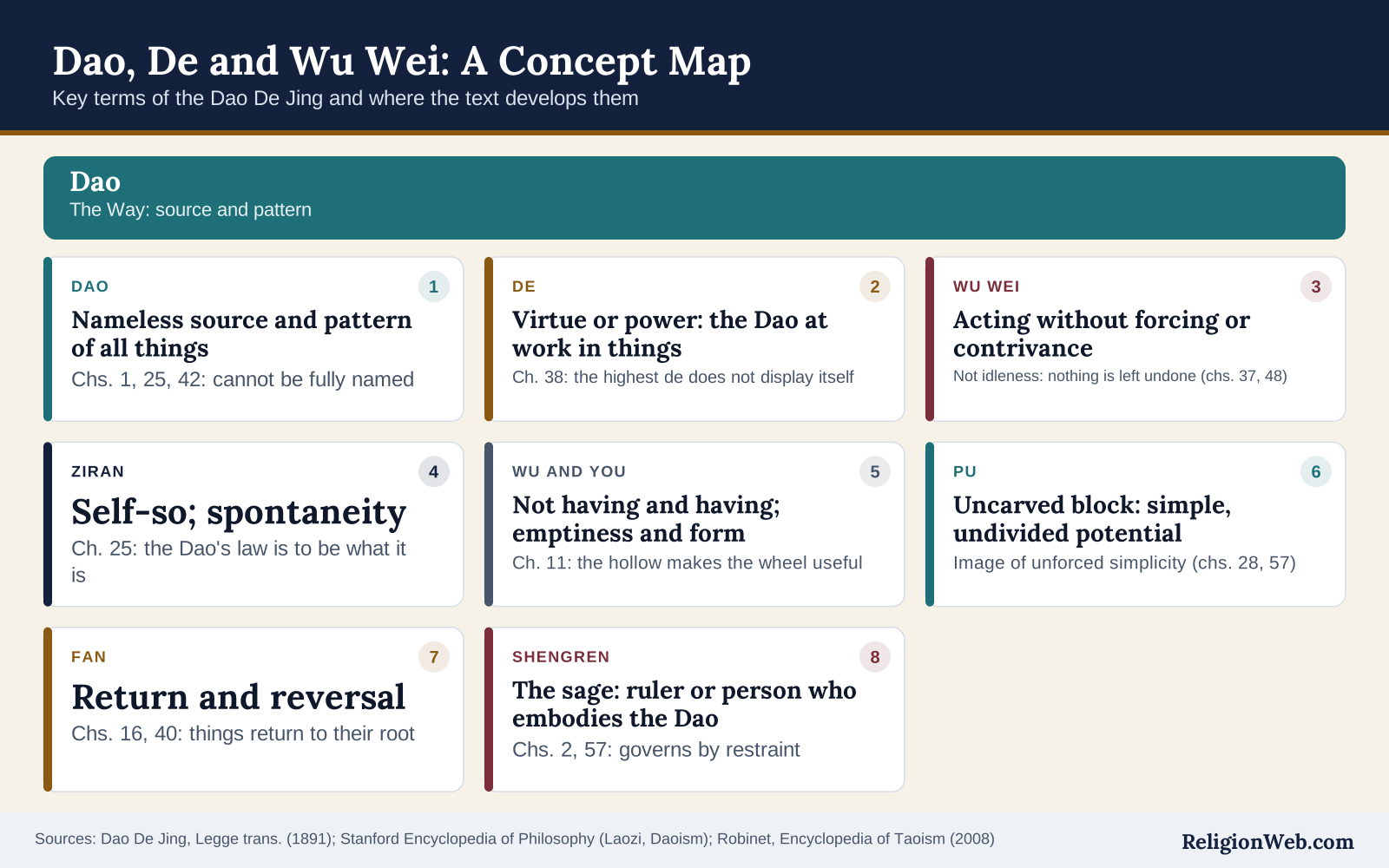
The book also uses ordinary words in demanding ways. Dao is an everyday word for a road or a method, and the Dao De Jing turns it into something close to a name for the unnameable source of things. De is a common term for moral character or virtue, and the text treats it more as an inner potency than as a list of correct behaviors. A reader who meets these words as technical vocabulary misses the pressure the book puts on their ordinary senses, which is part of its argument.
Where the Text Fits
In Chinese thought
The Dao De Jing belongs to the Warring States period, an age of competing states and competing teachers, when thinkers argued about how to restore order to a fragmented world. Britannica describes the book as proposing a way to restore harmony to a kingdom in disorder and as criticizing self-serving rulers as well as the moralism and ritual propriety associated with Confucian ethics. That description is a useful starting point, but it should not be pushed too far. The text names no rival school, and it was later read in many ways, including by readers who combined it with Confucian, Legalist and Buddhist ideas. Han bibliographers later grouped the book with a “Daoist” lineage of thinkers (daojia), and the Stanford Encyclopedia of Philosophy notes that the Han-era Huang-Lao movement, which honored the Yellow Emperor together with Laozi, dominated officialdom for a time.
In Daoist religious life
For organized Daoism the Dao De Jing is both a founding text and a scripture. Robinet writes that it has been treated as sacred, recited with meditation and ritual, including for healing and protective purposes. Livia Kohn, in her study The Daode Jing: A Guide (2019), notes that it was recited at court by the second century BCE and that by the second century CE it appears among early Daoist communities, where the Celestial Masters used the Xiang’er commentary as a kind of catechism. Laozi himself became a deity in religious Daoism, honored under the title Taishang Laojun, “Most High Lord Lao.” How the text functions in these settings, and how it relates to the larger world of Daoist scriptures, ritual and priesthood, is covered at length in the hub article on Daoism; this article concentrates on the book itself.
Beyond China
The book traveled early. Britannica reports that more than 350 commentaries on it have been preserved in Chinese and about 250 in Japanese, which gives some idea of its reach in East Asia, and that more than forty English translations have appeared since 1900. Translators and commentators have approached it as philosophy, as religious scripture and as poetry, and the ways they have rendered its key terms are discussed in the translation section below. The summary table collects the main facts about the text in one place.
| Feature | What is known | Notes |
|---|---|---|
| Chinese title | Dao De Jing (道德經), “Classic of the Way and Its Power” | Earlier called the Laozi; Wade-Giles spelling Tao Te Ching |
| Traditional author | Laozi, “Old Master,” later called Li Er or Lao Dan | Biography reported by Sima Qian; historicity debated |
| Date of composition | Gradual, within the Warring States period (about 5th to 3rd centuries BCE) | Oldest copy: Guodian slips, about 300 BCE |
| Length | About 5,000 characters; the two scribal totals recorded on Mawangdui copy B add up to 5,467 | Often called the “Text in Five Thousand Words” |
| Structure | Daojing (chapters 1 to 37) and Dejing (chapters 38 to 81) | Mawangdui copies put the Dejing first; Peking University slips have 77 chapters |
| Language and form | Classical Chinese; rhymed verse, aphorism and paradox | Sparse grammatical marking; no original punctuation |
| Main themes | Dao, de, wu wei, ziran, emptiness, softness, restrained rule | Read as philosophy, statecraft, self-cultivation and religious scripture |
| Major commentaries | Heshang gong, Xiang’er, Wang Bi, and hundreds more | More than 350 preserved in Chinese, about 250 in Japanese (Britannica) |
| Principal religious role | Foundational and recited text in Daoism | Laozi honored as Taishang Laojun |
Laozi: The Traditional Author and the Historical Questions
The Biography Told by Sima Qian
Li Er, called Dan, the Zhou archivist
Almost everything that tradition says about Laozi’s life goes back to a single passage, the biography of Laozi in the Shiji (Records of the Grand Historian), compiled by Sima Qian in the decades around 100 BCE. According to the Stanford Encyclopedia of Philosophy entry by Alan Chan, Sima Qian describes Laozi as a native of the southern state of Chu, with the family name Li and the personal name Er, also called Dan. He is said to have served as a keeper of archives at the Zhou royal court. The biography adds that Laozi lived a very long time and offers two numbers, around 160 and around 200 years, apparently without choosing between them.
The text of the biography is short, and its tone is not that of a confident chronicler. Sima Qian reports what is said and then, remarkably, tells the reader that the facts are uncertain. The result is an account that later generations treated as a life story, even though its author presented it as a bundle of traditions. Taking that caution seriously is the first step in discussing Laozi without claiming more than the sources allow.
The meeting with Confucius
One of the best-known episodes in the biography is a meeting between Laozi and Confucius, in which the older archivist is said to have advised the younger man to drop pride, many desires and a show of ambition. Stories of an encounter of this sort were already circulating by the fourth century BCE, and A. C. Graham, as summarized in the Stanford entry, argued that the Laozi legend was built from several layers beginning with a Confucius and Lao Dan story. Within the Chinese tradition the meeting is often invoked to give Laozi the standing of a senior contemporary and teacher; it also dramatizes, as a literary scene, the contrast between the ritual learning of the Confucian circle and the unadorned outlook ascribed to Laozi. For the historical Confucius and his own teachings, see the article on Confucius.
Departure west and the keeper of the pass
In Sima Qian’s account, Laozi saw the Zhou decline, left the court and traveled toward the northwest border. At the pass, the gatekeeper (named Yin Xi in later versions) asked him to write down his teaching before departing, and Laozi composed a book of a little over five thousand characters in two parts, then went out and was not seen again. This is the origin story of the Dao De Jing as a book. Later tradition elaborated it: in some versions Yin Xi became a disciple and traveled with Laozi, and in a seventh-century Daoist compendium he became the model of the ideal student, who advances through stages of preparation, testing, training and attainment.
As narrative, the departure has a striking logic. The book’s own preference for withdrawal, for not displaying one’s gifts, and for leaving without claiming credit is acted out in the figure of its supposed author, who writes only because he is stopped at a barrier. Historians treat this story as a literary account of origins and not as testimony, but it shows how early readers understood the work: as the parting words of a sage who had stepped away from a failing order.
Why Historians Hesitate
Sima Qian’s own uncertainty
Sima Qian does not offer one Laozi but several candidates. Besides Li Er (Lao Dan), the Shiji mentions a figure named Lao Laizi, also from Chu and also a contemporary of Confucius, who is said to have written a book of fifteen parts, and a Grand Historian Dan of Zhou who is supposed to have met Duke Xian of Qin more than a century after Confucius’s death. Sima Qian does not settle which of these, if any, wrote the book that bears the name. The Stanford entry lists the modern responses. The surname reading proposes that “Lao” is a family name and the title “Laozi” simply means “Master Lao,” parallel to “Master Kong” for Confucius. Fung Yu-lan argued that Sima Qian had confused the legendary Lao Dan with Li Er, a figure of the Warring States period. Graham proposed that the Laozi story is a composite of several strands. Alan Chan himself finds little reason to reject Laozi as a senior contemporary of Confucius, while admitting that this position is conjecture.
Modern arguments about date
The traditional dating of Laozi to the sixth or early fifth century BCE was challenged seriously in the twentieth century. Britannica notes that in the nineteenth century the attribution to a Zhou archivist came under strong attack, that some scholars questioned whether Laozi existed at all, and that the text itself contains no references to persons, events or places that would help date it. Through much of the twentieth century many scholars, in China and the West, doubted that a single historical Laozi had written the book as a unified work. The scholarly positions are more varied than a simple yes or no. In Chan’s reading of the evidence, a single author in the sixth or early fifth century BCE is unlikely; sayings attributed to Laozi were probably first written down from the second half of the fifth century BCE, were consolidated during the fourth, and had largely stabilized by the middle of the third century. Liu Xiaogan, using patterns of rhyme, places the language of the text closer to the Shijing (Book of Odes) and so supports a traditional, early dating, while William Baxter dates the bulk of the text to the early or middle fourth century BCE.
These dates matter because they affect interpretation. A book written by a single archivist in the late Spring and Autumn period would be answering the decay of the Zhou order, while a book compiled during the competitive and militarized Warring States would be speaking to rulers of large, aggressive states. Chan emphasizes that the political conditions of the Warring States shaped the book’s concerns, which is one reason the dating question is more than an antiquarian puzzle.
A text that grew by stages
The manuscript discoveries of the last fifty years have tilted most specialists toward a developmental model. The oldest surviving copy, from Guodian, contains only part of the later text (roughly two thousand characters), in an order that differs from the received chapters; the oldest complete copies, from Mawangdui, arrange the two halves in the opposite order. According to Robinet, scholars disagree on whether the book has one author, whether it began as oral tradition in the Warring States period, and whether it reached final form in the late third or early second century BCE. For readers, the practical consequence is modest but important. “Laozi” can be used safely as the name the tradition gave to the voice of the book, and as the name of the sage in religious devotion, without implying that the identity or the dates of a single writer have been established.
Laozi in Later Tradition
From teacher to deity
Whatever the historical facts, the figure of Laozi took on a life of its own. In the Stanford entry, Chan notes that in religious Daoism Laozi became a supreme deity, and Daoist devotion honors him as Taishang Laojun, sometimes in the form of Daode Tianzun, “Celestial Worthy of the Way and Its Power.” The early Celestial Masters movement, which emerged in the second century CE, taught that Laozi had revealed the Way to its founder Zhang Daoling, and the movement used the Dao De Jing as its central text. Daoist hagiography accumulated miraculous traits around him: a prolonged gestation, an extraordinary old age and repeated returns to the world in different eras. Such stories belong to devotional literature, and they should be read as expressions of how Daoist communities understood Laozi’s role, not as biography.
Ancestor of the Tang ruling house
Laozi’s family name also had political consequences. The surname Li was borne by the Tang imperial house, which ruled from 618 to 907, and the dynasty claimed descent from him. The Stanford entry notes this Tang claim, and it fits the dynasty’s interest in the book: Chan holds that the chapter division of the Dao De Jing was probably standardized in the Tang period under Emperor Xuanzong (reigned 712 to 756). Claims of descent from a revered ancestor are a theme in Chinese public life more broadly, and the connection between Laozi and the Li lineage is one example of how ancestral status and cultural authority could reinforce each other. For the wider practice of honoring ancestors in Chinese society, see the article on Chinese ancestor veneration.
Structure, Style and a Guided Reading of the Text
The Architecture of the Received Text
The Daojing and the Dejing
The received Dao De Jing, the form that appears in most printed editions and translations, runs through eighty-one chapters in one fixed order. Chapters 1 to 37 make up the Daojing, and chapters 38 to 81 make up the Dejing, a split that leaves the second half longer by seven chapters. Reading straight through, a modern reader first meets the Dao in its most abstract guise (the nameless source, the emptiness that makes use possible, the return of all things) and later meets the conduct and character associated with de. The break between the two parts falls where chapter 37 closes with the hope that the world will settle of itself once desire is stilled and chapter 38 opens with a statement about the highest virtue. That boundary is a feature of the received arrangement, and the next section of this article shows that early copies place it differently.
Within each half, the chapters are not arranged as a continuous argument. Neighboring chapters sometimes share an image or a keyword, and some clusters seem to circle a single theme, but the book does not build its case in a sequence that a reader must follow to the end. Many readers dip into it at random and find that a single chapter stands alone. This feature is part of why the book lends itself to quotation and also part of why translators and commentators have organized it under thematic headings that do not exist in the Chinese. Where a printed edition supplies a chapter title, as many English versions do, the title is the editor’s or translator’s and not the text’s.
Why chapter numbers are a convenience, not a given
The numbering used in this article is the standard one, but it is a later layer on the text. The oldest known copies have no numbered chapters, and the scheme that became universal was established over centuries. In practice, the chapter breaks often fall at natural pauses in rhyme or subject, which suggests that whoever introduced them followed the text’s own structure, but disagreement about where one saying ends and another begins is common in the commentarial tradition. A few chapters read as if two or three separate sayings had been joined, and some commentators and modern translators have rearranged lines on the grounds that the traditional order seems to have been disturbed in copying. Such rearrangements are always conjectural, because there is no single authoritative original against which to check them.
A Guided Tour of Chapters 1 to 37
The Dao that cannot be named
The opening chapter announces the book’s central puzzle. In the received wording, the first line runs, in transliteration, dao ke dao, fei chang dao: roughly, a “way” that can be spoken as a way is not the constant way. The next lines make the same move with names, and then pair “having” and “not having” as two aspects of one mystery. Chapter 1 does not define the Dao. It tells the reader at once that the term will resist definition, and it asks them to hold two ideas together: that the Dao is the unnamed origin of the world, and that naming and distinguishing, which make up the business of human life, are how the many things come to be known. Brook Ziporyn, in a note on this chapter, observes that the received text has no sentence-ending particles and so its first lines can be read as a conditional, as a topic and comment, or as two flat statements, while the Mawangdui copy adds particles that point to the last. Which reading the translator chooses affects the character of the whole opening.
Chapters 2 to 4 follow with the first of many reversals. Beauty and ugliness, long and short, high and low give rise to each other, and the sage therefore “manages affairs without doing anything, and conveys his instructions without the use of speech,” in Legge’s rendering of chapter 2. Chapter 4 describes the Dao as an empty vessel that is never filled, and chapter 6 speaks of a “valley spirit” that never dies, an image of the generative void as feminine and receptive. These early chapters teach the reader how the book thinks: by pairing opposites and by treating the lower, quieter or emptier term as the more basic.
Emptiness, the valley and the wheel
No image in the Daojing is more discussed than the wheel of chapter 11. The chapter observes that the usefulness of a wheel, a pot and a room each depends on a space that the maker leaves empty. In Legge’s translation:
The thirty spokes unite in the one nave; but it is on the empty space (for the axle), that the use of the wheel depends. Clay is fashioned into vessels; but it is on their empty hollowness, that their use depends.
Tao Te Ching, trans. James Legge, Sacred Books of the East vol. 39 (1891), ch. 11
The chapter goes on to apply the same pattern to the door and windows of a house and concludes that what has positive existence provides benefit while what lacks it provides usefulness. Robinet notes that the void appears here first as a functional space, the hollow of a vessel, and that elsewhere in the book it takes on a cosmic meaning as the matrix from which primal breath arises and a human meaning as a mind free of desire and bias. The argument works at all three levels at once. It is a remark about carpentry and pottery, a claim about how the world is organized, and an invitation to cultivate a mind that is open rather than crowded.
Chapters 25 and 42 supply the nearest thing in the Daojing to a cosmology. Chapter 25 speaks of “something undefined and complete, coming into existence before Heaven and Earth,” and chapter 42 describes a process in which the Dao yields one, then two, then three and then the ten thousand things, the traditional phrase for everything that exists. Commentators have read these lines as accounts of the origin of the world, as descriptions of the structure of reality at any moment, or as accounts of the stages of a person’s inward cultivation. The text does not say which, and the religious and philosophical traditions that grew around it have used all three.
Stillness and return
A second cluster of chapters turns to movement and rest. Chapter 16 urges the reader to bring emptiness to its utmost and to keep stillness, and observes, in Legge’s words, that “all things alike go through their processes of activity, and (then) we see them return (to their original state).” The word usually translated “return” (fan or fu) becomes a key term. The general idea, found also in chapter 40, is that things move in cycles and that the strong tend to turn into the weak, so that clinging to strength and fullness is a poor way to last. This is the root of the book’s well-known preference for the soft, the low and the unassuming. The text presents it as an observation about how the world works and a guide to acting well within it, not as a program of passivity.
Chapters 17 to 20 pair a picture of rulership with a sharp critique of conventional learning and morality. Chapter 17 remarks that in the highest antiquity the people hardly knew that they had rulers, and chapter 18 says that when the Great Dao ceased to be observed, benevolence and righteousness came into vogue, and that wisdom and shrewdness then appeared along with great hypocrisy. Chapter 19 recommends giving up sageness, benevolence and artful contrivance, and chapter 20 begins by saying that when learning is renounced, troubles end. These lines are among those that readers have taken as attacks on Confucian values, and they are also among the lines most affected by the new manuscripts, as the fun fact in the next section explains.
A Guided Tour of Chapters 38 to 81
Virtue without display
The Dejing opens by turning to de. Chapter 38 states a paradox about virtue, which Alan Chan reads in the Stanford Encyclopedia of Philosophy as a deliberate jolt intended to pull the reader out of conventional moral thinking. Legge renders the first sentence:
(Those who) possessed in highest degree the attributes (of the Tao) did not (seek) to show them, and therefore they possessed them (in fullest measure).
Tao Te Ching, trans. James Legge, Sacred Books of the East vol. 39 (1891), ch. 38
The chapter continues down a descending ladder: after the highest virtue come benevolence, righteousness and ritual propriety, each a step further from the original simplicity and each a sign of a world in which something has already gone wrong. As Britannica notes, the text criticizes the moralism and the ritual propriety associated with Confucian ethics, and chapter 38 is the place where that criticism is most explicit. A fair reading adds that the chapter is a claim about spontaneity in virtue, about the difference between goodness that has to be performed and goodness that flows without self-consciousness, and not a call to abandon kindness.
Water, softness and weakness
Water becomes the book’s most characteristic image. Chapter 8 introduces the highest good as being like water, which benefits all things without contending, and chapter 78 gives the sharpest statement of the image. Legge’s version reads:
There is nothing in the world more soft and weak than water, and yet for attacking things that are firm and strong there is nothing that can take precedence of it; for there is nothing (so effectual) for which it can be changed.
Tao Te Ching, trans. James Legge, Sacred Books of the East vol. 39 (1891), ch. 78
The point is not that softness is pleasant but that it is effective. Water wears away stone, finds the lowest places and yields to every obstacle without being destroyed. Chapter 76 makes a parallel observation about the living and the dead: the living body is supple, the corpse stiff, the young plant tender and the dead one brittle. Taken together, these chapters give the book’s practical wisdom a physical grounding. Readers who find the praise of weakness paradoxical are being asked to notice what endures, which is often not what looks strong.
The small state and the closing chapters
The last third of the book has a somewhat different character. Chapters 57 to 66 develop the political teaching discussed later in this article, chapters 67 to 69 speak of compassion, frugality and the dangers of military pride, and chapter 80 sketches a small state with a small population whose people have boats and carriages but no occasion to ride in them and weapons they have no occasion to use. The final chapter, 81, closes the book on a note of restraint: sincere words, it says, are not beautiful and beautiful words are not sincere, and the way of the sage is to act without contending. Many commentators have noticed that the book ends where it began, with a warning about the limits of language and display.
The table below sets out a selection of chapters, with the themes for which they are best known. The chapter numbers are those of the standard 81-chapter text. The descriptions are summaries in the author’s words and not quotations, apart from the Legge phrases already given above.
| Chapter | Main theme | Image or phrase for which it is known |
|---|---|---|
| 1 | The Dao that cannot be fully named | A “constant” way and constant names; “having” and “not having” as two aspects of one mystery |
| 2 | Mutual dependence of opposites; action without forcing | The sage who manages affairs without doing anything |
| 11 | The usefulness of emptiness | Wheel hub, clay vessel, doors and windows |
| 16 | Stillness and return | All things flourish and then return to their root |
| 19 | Giving up contrived learning and virtues | Renouncing sageness, benevolence and artful contrivance (wording differs in the Guodian slips) |
| 25 | The Dao as source; the law of the Dao is to be what it is | “Something undefined and complete” before Heaven and Earth |
| 38 | Highest virtue and its decline | Virtue that does not display itself |
| 48 | Learning increases, the Dao decreases | Diminishing doing until one “does nothing” on purpose |
| 57 | Government by restraint | “I will do nothing, and the people will be transformed” |
| 60 | Careful rule | Governing a great state is like cooking small fish |
| 78 | The strength of the soft | Water against the firm and strong |
| 80 | The small state | People who have boats and weapons but no occasion to use them |
Manuscripts and Text History
Before the Excavated Copies
Traces in Warring States and early Han writing
For most of Chinese history, readers knew the Dao De Jing only through copies made centuries after the text first took shape. The earliest evidence for how the book was understood comes from other writings. The Han Feizi, a late Warring States collection associated with the Legalist thinker Han Fei, is generally described as containing the earliest surviving commentary on passages from the Laozi, in the chapters often called “Explaining Laozi” (Jie Lao) and “Illustrating Laozi” (Yu Lao). The author or authors of those chapters read the book as political advice for a ruler, an approach that fits the Legalist interest in method and control. Whether these chapters were written by Han Fei himself is debated, but their existence shows that the Laozi was being quoted and glossed before the Qin unification of 221 BCE.
A second early witness is the Huainanzi, a large synthesizing work completed in 139 BCE under Liu An, the king of Huainan. Its authors quote and discuss the Laozi extensively, and their quotations, studied by Li Ruohui in a 2021 article, are one of the clues scholars use to work out what form of the text circulated in the early Han. Taken together, the Han Feizi and the Huainanzi show that the book existed by the third and second centuries BCE as an authority that political and cosmological writers wished to cite, although neither proves that it had the form or the chapter order that readers now know.
The Laozi becomes a jing
The word “classic” was attached to the Laozi only gradually. Britannica notes that the title Tao-te ching came into use during the Han and that the work was previously called Laozi. During the Han, the book was studied at court, and the movement known as Huang-Lao, which paired the legendary Yellow Emperor with Laozi, drew on its ideas about governing without interference. Kohn describes the text as a sacred work recited at court by the second century BCE. In the second century CE it became the central scripture of the Celestial Masters, and from that point forward its status as a jing was secure in Daoist circles. The label and the standing it implies were therefore products of Han and post-Han history, not features of the book’s earliest circulation.
Three Ancient Discoveries
Guodian, about 300 BCE
In October 1993, archaeologists excavating a tomb at Guodian near Jingmen in Hubei province found a cache of about 800 bamboo slips, of which about 730 bear writing, totaling more than 13,000 characters, according to the Stanford Encyclopedia entry. The tomb dates to around 300 BCE, and the slips contain, among other works, about 2,000 characters that parallel passages in the Laozi, making them the oldest known witnesses to the text. The Laozi material is divided into three bundles, conventionally labeled A, B and C. The slips carry no chapter divisions and arrange the passages in an order that often differs from the later text; they correspond to roughly thirty chapters of the received book and omit the rest. According to Robinet, the Guodian date, which she places between 350 and 300 BCE, suggests the text already existed in a form very close to the received version.
How to interpret the omissions is the central debate. One possibility is that the Guodian slips preserve an early and shorter stage of the book, before other sayings were added. Another is that the slips are an excerpt: a selection made for a specific purpose from a longer text already in existence. The evidence does not force a choice, and scholars have defended both. What the slips make clear is that the sayings were circulating in written form by about 300 BCE, that they could be grouped and ordered in different ways, and that at least some of their wording differs from what later readers took for granted.
Mawangdui, sealed in 168 BCE
In 1973, excavators opening a tomb at Mawangdui near Changsha in Hunan province recovered two silk manuscripts of the Laozi, conventionally called A and B, from a tomb sealed in 168 BCE. According to the Stanford entry, copy A was probably made before 195 BCE. Copy B, which is usually described as written in a later and more regular script, records scribal character counts at the ends of the two parts: 3,041 characters for the “Virtue” part and 2,426 for the “Dao” part, a total of 5,467, which is close to the traditional “five thousand words.” Both silk copies put the Dejing, beginning with what is chapter 38 in the received order, before the Daojing. Neither copy numbers its chapters in the later eighty-one-part scheme.
Much of the wording is the same as the received text, but there are many differences, some trivial and some interpretively important. Ziporyn points out that in the opening lines of chapter 1, the Mawangdui copy uses the character heng (“constant”) where the received version has chang (“constant”), both meaning much the same, and adds sentence-ending particles that help to fix the grammar. Wayne Alt, reviewing three translations in Philosophy East and West, notes that a variant character in chapter 33 changes a key word from “perish” to “forget.” These examples show why some translators began working from the manuscripts rather than from the received text. They also show that the changes are rarely dramatic: Robert Henricks, whose 1989 translation (Lao-tzu Te-Tao Ching) is based on Mawangdui, found, in Alt’s summary, that the manuscripts do not differ from the received text “in any radical way,” though they are more grammatical.
The Peking University bamboo text
The third discovery came to scholars by a different route. In January 2009, a nearly complete Western Han bamboo text of the Laozi was donated to Peking University. Unlike the Guodian and Mawangdui copies, it did not come from a documented excavation, so its find-spot and tomb context are not known. Chan reports that specialists agree on a date in the second half of the reign of Emperor Wu (141 to 87 BCE), and that the text is divided into two parts and 77 chapters, with the Dao part first as in the received text. The slips were published in 2012. As the Stanford entry notes, a scholar named Xing Wen has argued that the Peking University text is a forgery, but this position is not widely shared, and most specialists treat the manuscript as authentic. The 77-chapter text helps to fill the gap between the Guodian and Mawangdui discoveries and the eighty-one-chapter classic, since it shows an ordering close to the later one at a time when the division into chapters had not yet been standardized.
What the Discoveries Change and What They Leave Alone
Order, chapters and wording
The new manuscripts alter three features that earlier readers took for granted. The first is the order of the two halves: at Mawangdui the Dejing comes first, while the Peking University text and the received text put the Daojing first. The second is the chapter division: the oldest copy has none, the Peking University text has 77, and the received text has 81. The third is the wording of particular lines, where small substitutions and the presence or absence of grammatical particles can affect the sense. The variety shows that the text circulated in several recensions during the Han, that scribes and teachers did not consider a single arrangement canonical, and that the version now treated as standard is one stage in a long process of editing.
Debates about “earlier” and “selected”
A further question is how to weigh these manuscripts against later copies. It is tempting to prefer the older witness whenever the two differ, but the oldest does not necessarily preserve the better or the original reading. The Mawangdui copies are roughly a century younger than the Guodian slips, and each represents a particular line of copying. Scholars working on the text now generally compare all the witnesses, assess each variant individually, and avoid assuming that any one manuscript is the original. The received text, edited and commented on by figures such as Wang Bi and Heshang gong, remains the form in which the book was read in Daoist and scholarly practice for nearly two millennia, and its interpretive history cannot be reconstructed from the manuscripts alone.
Continuity of ideas
It matters just as much what the discoveries do not change. The central themes, including the unnameable Dao, the value of emptiness, the restraint of rulers and the preference for the soft over the hard, appear in all the early copies. Robinet states that the main versions of the text, among them those of Yan Zun, Heshang gong and Wang Bi, do not differ notably in meaning, and Henricks’s assessment of Mawangdui points in the same direction. The manuscripts have corrected details, forced a revision of the story of the text’s growth and opened new lines of inquiry, but they have not turned up a different book. The Dao De Jing the early readers knew and the one readers know today are recognizably the same work.
From Han Copies to the Received Text
Four lines of transmission
Robinet explains that most printed editions descend from four main versions of the text. The Yan Zun version is attributed to Yan Zun, active between about 83 BCE and 10 CE, and survives only in part, covering what are now chapters 38 to 81. The Heshang gong version is associated with a commentary titled Laozi zhangju (Laozi in Chapters and Sentences), traditionally dated to the early Han but placed by the Stanford entry in the second century CE. The Wang Bi version comes from the commentary of the third-century philosopher Wang Bi. The fourth, called the “ancient version” (guben), is said to derive from a tomb dated to 202 BCE and survives in two redactions, one edited by Fu Yi (554 to 639) and one by Fan Yingyuan in the Song period.
The Heshang gong and Wang Bi lines became the most influential. According to the daoinfo.org entry on the book, Heshang gong is credited with the division into chapters, and the Stanford entry notes that more than thirty versions of the Heshang gong text survive. Wang Bi’s edition came to be treated as the standard philosophical text; the Stanford entry on Daoism describes him as the figure who curated the received Daode jing. The long transmission also depended on the choices of later editors and copyists, and each line of copying introduced small variants of its own.
The eighty-one-chapter division
Scholars date the emergence of the eighty-one-chapter form differently. Robinet states that the division first appears in the version associated with Heshang gong and was not universally accepted until perhaps the Tang. Li Ruohui argues, in a 2021 article in the Journal of Zhejiang University, that the eighty-one-chapter edition took shape in the Western Han by way of a stage like the Peking University text’s 77 chapters, and was complete between the reigns of Emperors Wu and Cheng. Chan’s view is that the division was probably standardized under the Tang emperor Xuanzong. These accounts are not entirely incompatible, since one may be describing the first appearance of the scheme and another its triumph, but together they leave the exact sequence open. It is sometimes pointed out that 81 is nine times nine, and Chan describes the division as numerologically motivated, but none of the sources consulted for this article documents the reasoning behind the choice.
Dunhuang and the early religious copies
A last group of early witnesses comes from the sealed library cave at Dunhuang, in northwest China, opened in 1900 and found to contain thousands of manuscripts. Among them Robinet identifies a copy of the Heshang gong text made by a scribe named Suo Dan and dated to 270 CE, and the Stanford entry identifies the Xiang’er commentary, a religious reading connected with the Celestial Masters and dated to around 200 CE. The Xiang’er manuscript is incomplete, covering the text only from the middle of chapter 3 to chapter 37, and it is not divided into the later chapters. These finds are valuable because they show how the text was read and used in early Daoist communities, not only how it was copied.
| Date | Witness or event | What it shows |
|---|---|---|
| Fifth to fourth centuries BCE | Sayings attributed to Laozi first written down (Chan’s reconstruction) | Gradual composition, not a single act of writing |
| About 300 BCE | Guodian bamboo slips (found 1993) | About 2,000 characters in three bundles; no chapter divisions; different order |
| Late Warring States | Han Feizi chapters explaining the Laozi | Early political commentary on passages of the text |
| 139 BCE | Huainanzi completed | Extensive quotation of the Laozi at the Han court of Liu An |
| Before 195 BCE | Mawangdui silk copy A made | Early Han copy; Dejing part first |
| 168 BCE | Mawangdui tomb sealed (found 1973) | Two silk copies; copy B records counts of 3,041 and 2,426 characters |
| 141 to 87 BCE | Peking University bamboo text (acquired 2009) | Nearly complete text in 77 chapters, Dao part first |
| About 83 BCE to 10 CE | Yan Zun, Laozi zhigui | Commentary and text for what are now chapters 38 to 81 |
| About 200 CE | Xiang’er commentary (Dunhuang copy) | Celestial Masters reading; covers chapters 3 to 37 |
| Second to third centuries CE | Heshang gong commentary; Suo Dan manuscript, 270 CE | Eighty-one-chapter scheme associated with this line |
| 226 to 249 CE | Wang Bi’s commentary | Philosophical edition that later became widely standard |
| 712 to 756 CE | Reign of Tang Emperor Xuanzong | Probable standardization of the 81-chapter division (Chan) |

Core Ideas: Dao, De, Wu Wei and Ziran
Dao: The Way and Its Mystery
A word with ordinary meanings
Dao (道) is an everyday Chinese word. As a noun it means a road, a path or a method, and as a verb it means “to speak” or “to guide.” Teachers of the Warring States period used it for the right course of conduct or of government, so that every school had its own dao. The Dao De Jing takes this common word and presses on it until it becomes something close to the name of the ultimate. The Stanford Encyclopedia of Philosophy entry by Alan Chan notes that the word is “way” in both the literal and the verbal sense, and that the text stresses its ineffability. In chapter 25 the speaker says, in Chan’s paraphrase of the line, that he does not know its name and “styles” it Dao. The word is thus presented as a makeshift label for something that no label fits.
That self-undermining quality is the reason the first chapter is so often discussed. A teaching about a “way” that cannot be fully put into words invites the question of what the book itself is doing. Readers within the tradition have given several answers. Some say that the text points beyond itself, as a finger points at the moon. Others say that its paradoxes are meant to loosen the habit of treating words as exact copies of reality. Still others, especially in religious Daoism, say that the Dao can be known through cultivation and meditation even though it cannot be fully described.
Source, pattern and the unnameable
The book uses the Dao in at least two senses that scholars try to keep apart. In one, the Dao is the origin of things: Robinet describes it as the source of all life and the only reliable reference point in a world of transient, named things, invisible, inaudible and imperceptible, yet inexhaustible. Chapter 42 gives the process in outline, with the Dao producing one, one producing two, two producing three, and three producing the ten thousand things. In the other sense the Dao is the pattern or course that things follow, the regular way in which the seasons turn and the living grow and decline. Chad Hansen’s article on Daoism in the Stanford Encyclopedia of Philosophy stresses this second sense, describing the dao as a kind of map of natural possibility and not as a law or command.
Within the commentarial tradition the two senses are often fused. Wang Bi, as Chan describes him, treats the Dao as the ontological ground of the world and reads the Dao De Jing’s talk of wu (“nothing” or “non-being”) as a way of pointing to what grounds all particular things without being one of them. The Heshang gong commentary, by contrast, reads the Dao in terms of qi, the vital breath of cosmology, and treats “guarding the One” as a practice of self-cultivation. Scholars also disagree about the nature of the Dao in the text itself. Wayne Alt notes that translators have argued over whether it should be read as transcendent or as immanent in nature, and over whether the book is fundamentally religious. Those questions remain open, and the text can bear more than one answer.
Dao and the order of the cosmos
Chapter 25 brings the cosmic and the practical together in a short chain. In Legge’s translation:
Man takes his law from the Earth; the Earth takes its law from Heaven; Heaven takes its law from the Tao. The law of the Tao is its being what it is.
Tao Te Ching, trans. James Legge, Sacred Books of the East vol. 39 (1891), ch. 25
The structure of the passage is a ladder of models. Human beings follow the earth, the earth follows heaven, heaven follows the Dao, and the Dao follows what is so of itself, which is the meaning of the Chinese term ziran discussed below. For commentators in the Wang Bi tradition, the last step shows that the Dao has no further source and no external pattern. For the Celestial Masters and later Daoist communities, the ladder helped to justify practices aimed at aligning the human body and society with cosmic rhythms. For modern readers interested in ecology, the chain has seemed to say that human conduct should answer to the order of the natural world. These are interpretations of a four-line text, and each one rests on the reader’s wider commitments.
De: Virtue, Power and Integrity
What de means
De (德) is usually translated “virtue,” “power,” “potency” or “integrity.” In ordinary Warring States usage it referred to the moral qualities of a ruler or gentleman, the character that attracted loyalty and made authority legitimate. In the Dao De Jing the word is closer to the effective presence of the Dao in a person or thing. Chan describes it as what beings obtain from the Dao, a reading supported by a long tradition of glossing de as “to obtain,” and Hansen describes it as the internal capacity to find and follow the paths of the world. On this view, a person with de is one in whom the Dao works without obstruction, and the text’s second half, the Dejing, is in part a description of how such a person looks and acts.
The choice of English word matters. “Virtue” captures the moral side but can suggest the effortful, rule-based goodness that the book criticizes. “Power” captures its effectiveness, as in Arthur Waley’s title The Way and Its Power, but can suggest force. Translators who choose “integrity” or “potency” are attempting to hold the two aspects together. Legge’s rendering of the first line of chapter 38 uses neither word, speaking instead of “the attributes (of the Tao),” which shows how a cautious translator can avoid the choice.
Why the highest de does not display itself
The most puzzling statement about de is the paradox that opens the Dejing: the highest de is not “de-like,” and therefore it has de. Chan reads this as a deliberate shock to conventional thinking. The point seems to be that virtue that announces itself or calculates its own rewards has already moved away from spontaneity. The person who works at being good, in this reading, is farther from goodness than the person who acts well without noticing. The chapter then lays out a descending order of qualities (benevolence, righteousness and ritual propriety) in which each step marks a further loss of the original ease.
Readers have not agreed about how severe this criticism is meant to be. A common view in Chinese intellectual history takes it as an attack on Confucian ethics, and Britannica describes the book as critical of the moralism and ritual propriety associated with Confucian ethics. A more cautious view, found in many commentaries, treats the target as hollow display and not as ethical concern itself, and points to the text’s own praise of gentleness, thrift and kindness elsewhere. The article on Confucianism describes how that tradition understood ritual and virtue on its own terms, which is the necessary background for understanding what the Dao De Jing was reacting to.
Wu Wei and Ziran
What wu wei does not mean
Wu wei (無為) is probably the most misunderstood term in the book. The two characters mean literally “not doing” or “no acting,” and English translations often give “non-action” or “non-doing.” A reader meeting the phrase cold might infer that the text advises idleness. The Stanford entry denies this directly: Chan explains that wu wei is not total inactivity but action free from self-serving desire, and he adds that it does not by itself prescribe particular moral conduct. Britannica says that it means avoiding unnatural action, not total passivity, and associates it with spontaneity, noninterference and letting things take their natural course. The word wei, “to do” or “to act,” can also mean “to make” or “to contrive,” and a good deal of the meaning of wu wei lies in the contrast with artificial contrivance.
The book itself supplies evidence against the idle reading. In chapter 2 the sage “manages affairs” even while doing nothing. Chapter 63 recommends, in Legge’s rendering, “to act without (thinking of) acting,” and it goes on to advise dealing with difficulties while they are still small. In chapter 64 the proverb that a journey of a thousand li begins with a single step is part of an argument for beginning and sustaining effort at the right time. The text’s own formula, repeated in several places, is that the Dao does nothing and yet nothing is left undone. An agent who does nothing and leaves nothing undone is not lazy. The text is describing a manner of acting that achieves results without strain, display or interference.
Acting without forcing
Chapter 48 is the clearest statement of the practical side of the idea. Legge’s translation reads:
He who devotes himself to learning (seeks) from day to day to increase (his knowledge); he who devotes himself to the Tao (seeks) from day to day to diminish (his doing). He diminishes it and again diminishes it, till he arrives at doing nothing (on purpose). Having arrived at this point of non-action, there is nothing which he does not do.
Tao Te Ching, trans. James Legge, Sacred Books of the East vol. 39 (1891), ch. 48
The parenthetical “(on purpose)” in Legge’s version is an interpretive addition, and it tells the reader what he took the point to be: not the abolition of action but the removal of calculated, goal-driven effort. The progressive diminishing recalls the practices of simplification and quiet found in later Daoist cultivation, and also the political teaching that a ruler should reduce commands and projects. The passage can be read as an account of skill, in which practice leads to a stage where action is no longer deliberate, though the Dao De Jing does not develop this theme at length. Later writers, notably in the Zhuangzi, expanded it through stories of craftsmen and swimmers whose work flows without strain; the stories belong to a separate book and are discussed in the article on Daoism.
Ziran: things being so of themselves
Closely tied to wu wei is the term ziran (自然), literally “self so,” usually translated “naturalness” or “spontaneity.” It describes both how the Dao operates, which is without outside compulsion, and an ideal way for things and people to be. Chapter 25, in the quotation above, closes with the statement that the law of the Dao is its “being what it is,” which is Legge’s way of rendering the idea. Chapter 17 draws a political implication: when the best rulers finish their work, the people say that they did it themselves. In the commentary tradition the word acquired high importance. Chan notes that Yan Zun made ziran central and warned that any effort against naturalness is self-defeating, and he reports that Wang Bi described ziran as an expression of the ultimate.
The modern word “nature” is a tempting translation but can mislead. In the Dao De Jing, ziran does not refer in the first place to the wilderness or the environment, although later readers have often connected it to them. It refers to a mode of being that arises of itself, without being made or forced. A craftsman’s skilled movement, a child’s candor and a field’s growth can all be ziran. The distinction becomes important when interpreters draw ecological or ethical conclusions from the text, because the Chinese term does not by itself carry them.
Emptiness, Softness and Return
You and wu: having and not having
The book repeatedly turns on the pair you (“having,” “being,” “something”) and wu (“not having,” “non-being,” “nothing”). Chapter 40 makes the relation explicit in Legge’s version: “All things under heaven sprang from It as existing (and named); that existence sprang from It as non-existent (and not named).” The ordering looks counterintuitive, since it makes the nameless emptiness prior to the named things, and it is the root of what the later commentarial tradition, especially Wang Bi, developed into a philosophy of non-being as ground. Chapter 11, discussed above, supplies the practical counterpart in the image of the hub, the pot and the room. Robinet observes that opposites in the book imply each other and belong to a single whole, which is also how the pair you and wu should be read: not as rivals but as aspects of one reality.
The infant, water and the uncarved block
A set of recurring images carries the book’s picture of a person in harmony with the Dao. The infant, as Robinet notes, serves as a model of the return to an undifferentiated origin: supple, undivided and unselfconscious. Water, treated above, represents effectiveness through yielding. The “uncarved block” (pu), a piece of wood not yet shaped into a tool, stands for simplicity and unspecialized potential. Legge’s chapter 57 renders the corresponding word as “primitive simplicity,” while many later translators prefer “uncarved block,” and the difference shows how an image can be turned into an abstraction or kept concrete. Whichever rendering is used, the idea is that raw potential is more valuable than any particular shape it might take.
Reversal and return
Finally, the book teaches that things return to their source and that extremes tend to turn into their opposites. The idea occurs in chapter 16, where all things go through their activity and then return to their original state, and in chapter 40, which in its traditional form says that reversal is the movement of the Dao and weakness its function. This principle underlies the book’s advice to avoid excess: the vessel filled to the brim spills, the sharpened blade dulls, and the person who clings to success invites ruin. It also explains why a text that speaks so often of the Dao as an origin can sound practical and even prudent. Return is a feature of the world, and a person who understands it can act with less strain.
| Term | Basic meaning | Role in the text | Translation notes |
|---|---|---|---|
| Dao (道) | Road, way, method; to speak or guide | Nameless source and pattern of all things (chs. 1, 25, 42) | “Way,” “path,” “course,” or left as Dao/Tao |
| De (德) | Virtue, power; what is obtained from the Dao | The Dao’s effective presence in a person or thing (ch. 38) | “Virtue,” “power,” “potency,” “integrity” |
| Wu wei (無為) | Not acting; action without contrivance | Manner of acting and ruling (chs. 2, 37, 48, 57, 63) | “Non-action,” “non-doing,” “effortless action” |
| Ziran (自然) | Self-so, spontaneous | How the Dao works and how things flourish (chs. 17, 25) | “Naturalness,” “spontaneity”; not simply “nature” |
| You and wu (有, 無) | Having and not having; being and non-being | Paired aspects of the origin and of usefulness (chs. 1, 11, 40) | Punctuation of ch. 1 affects the reading |
| Pu (樸) | Uncut wood, uncarved block | Image of simplicity and undivided potential | “Uncarved block,” “simplicity” (Legge: “primitive simplicity”) |
| Fan and fu (反, 復) | Reversal, return | Things return to their root; extremes reverse (chs. 16, 40) | “Return,” “reversal”; also “going back” |
| Shengren (聖人) | Sage, wise person | Exemplary ruler or person who embodies the Dao | “Sage,” “wise man,” sometimes “saint” |
Government, Ethics and War in the Dao De Jing
The Sage Ruler
Governing by not interfering
A large part of the Dao De Jing is addressed, openly or by implication, to rulers. Robinet summarizes the political teaching as follows: the sage ruler governs without interfering and is barely known to the people, and the text idealizes a remote primordial age. Chapter 17 gives the ranking: the best ruler is one whose subjects hardly know that he exists. Chapter 57 turns this into a statement of method, in which the sage describes his own policy of restraint. Legge renders it as follows:
‘I will do nothing (of purpose), and the people will be transformed of themselves; I will be fond of keeping still, and the people will of themselves become correct. I will take no trouble about it, and the people will of themselves become rich; I will manifest no ambition, and the people will of themselves attain to the primitive simplicity.’
Tao Te Ching, trans. James Legge, Sacred Books of the East vol. 39 (1891), ch. 57
The passage proposes that rulers can achieve more by reducing their commands, projects and displays of ambition than by increasing them. It is addressed to a reader who might be inclined to read effective government as the multiplication of rules and rewards. In the political climate of the Warring States, when states competed through conscription, taxation and public works, such advice was countercultural. Scholars disagree about whether the book gives real counsel to rulers or presents an ideal with little hope of adoption. Robinet notes that scholars still debate whether the work teaches statecraft, self-cultivation, or both.
A great state and small fish
The text also contains practical images of administration. Chapter 60 says that governing a great state is like cooking small fish, in Legge’s words, an image generally understood to mean that over-handling spoils the result. Both the Heshang gong commentary and later imperial commentators took such lines as dual in application: advice on how to rule the state and on how to govern the self. Robinet says that Heshang gong reads the text on these two levels, and the political thought of Emperor Song Huizong’s imperial commentary, as analyzed in a 2012 article in Taiwanese Journal of Political Science, presents a sage ruler who first cultivates his own moral character and then governs the realm. The notion that care for the self and care for the state follow the same principle is a common thread in the commentarial reception of the book.
Interpreters have also drawn very different conclusions about what restraint requires. The Legalist reading in the Han Feizi is generally described as treating the Dao as a technique by which a ruler conceals his intentions and lets rules do the work, while the Huang-Lao reading of the early Han is usually associated with economy and the avoidance of costly projects. A third reading, favored in some religious contexts, understands the ideal ruler as an adept whose inner cultivation brings harmony to the realm almost automatically. The text does not choose among them, and the differences show how closely the book’s political reception was tied to the circumstances of its readers.
Ethics and Convention
Criticism of contrived virtues
The ethical teaching of the Dao De Jing is largely a critique of the conventional virtues and the learning that supports them. Chapter 18, in Legge’s translation, states that when the Great Tao ceased to be observed, benevolence and righteousness came into vogue, and that wisdom and shrewdness appeared, followed by great hypocrisy. Chapter 19 proposes renouncing sageness, benevolence and artful contrivance, and chapter 20 begins with the line that when learning is renounced there are no troubles. Read in isolation, such lines sound like a rejection of ethics. Read against the Warring States background, they are better understood as a critique of moral and educational programs that, in the author’s view, had become instruments of display and competition.
The manuscripts complicate the picture. The Guodian version of the passage in chapter 19, as the Stanford entry shows, does not read as an attack on benevolence and righteousness, and Chan treats the contrast as evidence of possible polemical shifts in transmission, that is, a sharper anti-Confucian edge that may have developed later. Even so, the received book consistently regards ethics as something that should arise from the Dao and not from rules. Chan makes a related point about wu wei: it does not by itself specify what moral conduct is, which leaves the text open to a wide range of ethical elaborations in later traditions.
Kindness, thrift and humility
Positive ethical teaching is not absent. Chapter 67 names three precious things which the speaker says he holds and keeps. In Legge’s translation: “The first is gentleness; the second is economy; and the third is shrinking from taking precedence of others.” In chapter 63, among a series of instructions on acting without thinking of acting, the text commends repaying injury with kindness, a line that Legge renders as “to recompense injury with kindness.” Chapter 8, as noted, praises the person who, like water, benefits others without contending. These qualities of compassion, restraint and humility are not presented as rules but as natural expressions of a life lived in accord with the Dao.
The tradition developed these themes into explicit moral codes. The Xiang’er commentary, according to the Stanford entry, stresses longevity, qi cultivation and moral precepts, including a list of nine and a list of twenty-seven precepts, and it was used by the Celestial Masters to teach conduct to members. What began as a set of observations about gentleness and restraint thus became, in a community setting, a structured discipline. The movement from aphorism to rule is typical of the way scriptures function within religious traditions, and in this case it also marks the point at which the book’s philosophical reception and its religious reception begin to diverge.
War and the Small State
Weapons as instruments of ill omen
The Dao De Jing has a distinctive attitude toward war, expressed most directly in chapter 31 and reflected in chapters 68 and 69. Chapter 31 opens, in Legge’s version, with the statement that “arms, however beautiful, are instruments of evil omen, hateful, it may be said, to all creatures.” The chapter goes on to say that weapons are used only when there is no alternative and that even a victory should be received with mourning, in the manner of a funeral. This is not the language of a general giving tactical advice. It treats armed force as a grievous necessity to be restrained by sorrow and moderation.
It would nonetheless be a mistake to describe the book as simply pacifist. In the Stanford entry, Chan cautions that wu wei is not a blanket rejection of military engagement, and some chapters give counsel about conduct in war, such as avoiding arrogance and underestimating an opponent. Later readers drew on these passages in different ways, some stressing the compassion and the mourning and others the practical counsel about restraint. The text itself holds both attitudes: reluctance about force and a recognition that it is sometimes unavoidable.
The small-state vision
The picture of social life in chapter 80 is one of the book’s most memorable. Legge’s version of the passage begins: “In a little state with a small population, I would so order it, that, though there were individuals with the abilities of ten or a hundred men, there should be no employment of them.” The people, the chapter says, would have boats and carriages with no occasion to ride in them and weapons with no occasion to use them, and they would be content with their food, clothing and homes. Neighboring states would be close enough to hear one another’s dogs and roosters, yet the people would grow old and die without visiting.
Interpreters differ on how to take this. Some read it as nostalgia for an imagined simple past, an idea consistent with Robinet’s observation that the text idealizes a remote primordial age. Others read it as a critique of the large, expansionist states of the Warring States period, in which the small village is a deliberate counter-image to militarized empire. Still others take it as a concrete political program, a view that has had little support among historians because it would be impossible to apply to the larger territories of the Han and later dynasties. In whichever sense it is read, the chapter shows that the book’s reflections on government rest on a distinctive picture of human flourishing: a community that has what it needs, wants little more, and has no occasion for ambition.
Commentary Traditions: How the Text Has Been Read
The Earliest Readers
Political readings in the Han Feizi
The commentary tradition on the Dao De Jing begins before the book has a settled title. The Han Feizi, a late Warring States collection, includes two chapters that explain and illustrate sayings from the Laozi, and they are generally described as the earliest surviving commentary on the text. Their authors are usually understood to have read the book as practical advice for a ruler, one who should keep his intentions hidden, avoid personal display and let impersonal procedures do the work of government. Scholars debate whether Han Fei himself wrote the chapters, but the reading they offer has an important place in the history of interpretation because it shows the book being pressed into the service of a specific theory of statecraft at a very early date.
This early political reading had a long afterlife. It established the pattern, visible again in Huang-Lao thought and in imperial commentaries many centuries later, in which the Dao De Jing was read as a handbook for rulers whose real power rests on appearing to do little. At the same time it was only one of several early approaches, and the Huainanzi of 139 BCE shows a more cosmological reading that places the Laozi alongside the Zhuangzi in a large synthesis of nature, politics and conduct.
Yan Zun and the Han court
Another early witness is Yan Zun, who was active between about 83 BCE and 10 CE. According to the Stanford entry, his Laozi zhigui survives only in part, covering chapters 38 to 81, and it makes ziran central, warning that any effort against naturalness defeats itself. Yan Zun belongs to a period in which, as Kohn notes, the book was recited at the Han court, and in which the Huang-Lao movement, joining the Yellow Emperor with Laozi, dominated officialdom for a time, as the Stanford article on Daoism explains. His surviving text is also one of the four main versions of the Dao De Jing that Robinet identifies as the sources of later printed editions.
Cosmology, Body and Community: Heshang gong and Xiang’er
The Heshang gong commentary
The Heshang gong commentary, known as Laozi zhangju, is traditionally attributed to a figure who lived in the time of Emperor Wen (reigned 180 to 157 BCE). The best-known story about him appears in a preface attributed to Ge Xuan, a Daoist of the third century CE. In it Emperor Wen, a student of the Laozi, summons a hermit called Heshang gong (“Elder by the River”) for instruction; the hermit refuses to come, rises into the air to show that he is beholden to no one, and then, when the emperor apologizes, hands over his commentary. Historians read this as a legend of the text’s authority and not as evidence of its date. The Stanford entry judges that the commentary is probably of the second century CE, and the Heshang gong tradition is the one in which, as Robinet notes, the eighty-one-chapter division first appears.
Chan describes its approach: it reads the book through qi and yin-yang cosmology, treats “guarding the One” as a method of self-cultivation, and stresses the reduction of desire. Robinet adds that it reads the text on two levels, as advice for governing oneself and as advice for governing the state. Livia Kohn and others have drawn attention to its place in the history of Daoist meditation, and its emphasis on breath and the body made it a natural source for later physical and contemplative practice. In the Stanford entry, Chan counts more than thirty surviving versions of the Heshang gong text, which gives some idea of how widely it circulated.
The Xiang’er commentary of the Celestial Masters
The Xiang’er commentary, preserved in a Dunhuang manuscript that covers the text from the middle of chapter 3 to chapter 37, belongs to the early Celestial Masters (Way of the Celestial Masters). The Stanford entry dates it to around 200 CE and links it to that movement, and Robinet calls it a catechism for members. Its concerns are practical and communal. It emphasizes longevity, the cultivation of qi and obedience to moral precepts, including a set of nine and a set of twenty-seven precepts, and it interprets the book’s language about the Dao as a call to a disciplined life within a religious community. The commentary also reads Laozi himself as a divine figure, in line with the movement’s belief that Laozi had revealed the Way. The text thus shows an early moment in the transformation of the Dao De Jing from a book of sayings into a scripture of an organized religion.
Wang Bi and the Dark Learning
Reading wu as the ground
Wang Bi (226 to 249 CE) died in his early twenties, yet his commentary became the most influential philosophical interpretation of the book. He belonged to the Xuanxue, “Dark Learning” or “Learning of the Mysterious,” a movement of third-century intellectuals who turned to the Dao De Jing and the Yijing for questions about the relation between the origin of the world and the things in it. In the Stanford account, Wang Bi’s commentary is philosophical rather than cosmological: it treats the Dao as the ontological ground, reads wu as non-being or the absence of determinate features that makes all determinate things possible, and gives special weight to li, “pattern” or “principle.” For him ziran is an expression of the ultimate. His way of reading allowed readers to understand the Dao De Jing as an argument about the conditions of existence, not just as a collection of advice.
The Stanford article on Daoism adds that the Dark Learning reached a working accommodation with Han Confucianism, summed up in the formula “sage within, king without,” in which the sage is inwardly detached but outwardly conforms to the prevailing order. Whether Wang Bi himself intended that synthesis is a matter of scholarly discussion. What can be said is that his commentary offered a way for educated readers, including officials, to take the book seriously without leaving public life.
Why Wang Bi’s text became standard
Wang Bi’s text is one of the four main lines of transmission that Robinet lists, and it is the one that most modern translators treat as the base text for the received Dao De Jing. Its dominance owes partly to the intellectual force of his commentary and partly to the later scholarly and printing history that made it the usual starting point for study. The Stanford article on Daoism describes the Dark Learning as having “curated” the received text of the Dao De Jing, just as Guo Xiang curated the Zhuangzi. Translations and studies of the commentary, including Rudolf Wagner’s A Chinese Reading of the Daodejing (2003), have made it an important entry point for modern readers who want to see how an early commentator understood the work.
Tang to Qing: Religious, Imperial and Scholarly Commentaries
Twofold Mystery and the Tang imperial interest
Under the Tang, whose ruling family claimed descent from Laozi, interpretation of the Dao De Jing flourished in the Chongxuan, or Twofold Mystery, school. Robinet describes its approach as a Buddhist-influenced and dialectical reading, and Kohn describes Tang interpretation as centered in the Twofold Mystery. The school’s characteristic move, as in the commentary of Cheng Xuanying (active 631 to 655), was to use the “mystery” (xuan) to go beyond both being and non-being, and then to go beyond the mystery itself. Accounts of Tang court life, summarized in modern studies, report that Cheng Xuanying helped the Buddhist translator Xuanzang to render the Dao De Jing into Sanskrit in 647, and that the two men disagreed over how to translate dao, with Cheng favoring a term close to “awakening” (bodhi) and Xuanzang choosing mārga, “road.” The episode is a reminder that the difficulty of translating the book is as old as its contact with other languages.
The daoinfo.org entry on the book observes that Du Guangting (850 to 933) compiled the Daode zhenjing guangsheng yi, which surveyed more than sixty explanations of the book, over half of them by Daoist priests. Imperial sponsorship supplemented this scholarship. Emperor Xuanzong, in whose reign Chan believes the chapter division was standardized, is credited with a commentary of his own, preserved in the Daoist canon, and Tang rulers treated the text as a work of dynastic importance. Such imperial interest had a double effect: it raised the book’s public standing, and it tied its interpretation to the aims of the court.
Song collections and imperial commentary
By the Song dynasty (960 to 1279), interpretation had spread across scholarly and religious circles. The daoinfo.org entry notes Peng Si’s Daode zhenjing jizhu, a collection that preserves more than twenty Song commentaries, and it observes that after the Song, Daoist interpretations tended to rely on collected commentaries. The Northern Song emperor Huizong (reigned 1100 to 1126) produced his own commentary, which a study in the Taiwanese Journal of Political Science presents as a portrait of a sage ruler who cultivates his moral character before governing the realm. Educated readers outside the Daoist priesthood also wrote on the text; the Song statesman and writer Su Zhe (1039 to 1112) is among the best known, and his commentary reflects the interest of Confucian-educated scholars in reading the book alongside their own tradition.
Alchemical, Buddhist, Confucian and Japanese readings
The range of later interpretation was very wide. According to daoinfo.org, many commentaries preserved in the Zhengtong Daoist Canon of 1445 read the text through inner alchemy (neidan), outer alchemy (waidan) or the numerology of the Yijing, taking its images of the valley, the infant and the uncarved block as encoded descriptions of practice. Robinet notes that Legalist, Buddhist, Confucian and Daoist physiological or alchemical readings all exist. In the late Ming, the Buddhist monk Hanshan Deqing (1546 to 1623) wrote on the text from his own vantage, and the Neo-Confucian philosopher Wang Fuzhi (1619 to 1692) wrote critically about it, an indication of how seriously scholars of other traditions engaged with the book. Beyond China, Britannica reports that about 250 commentaries have been preserved in Japanese in addition to more than 350 in Chinese, a measure of the text’s reach across East Asia. The article on Mahayana Buddhism describes the Buddhist world in which many of these readers lived.
| Tradition or commentator | Period | Approach | Notable features |
|---|---|---|---|
| Han Feizi chapters (“Explaining Laozi,” “Illustrating Laozi”) | Late Warring States | Political, Legalist-oriented | Generally described as the earliest surviving commentary |
| Yan Zun, Laozi zhigui | About 83 BCE to 10 CE | Centered on ziran, naturalness | Survives in part, for chapters 38 to 81 |
| Heshang gong, Laozi zhangju | Probably 2nd century CE | Cosmological, breath and body cultivation; also governance | Eighty-one-chapter division; more than thirty versions survive |
| Xiang’er | About 200 CE | Religious and communal; precepts and long life | Celestial Masters catechism; Dunhuang copy covers chapters 3 to 37 |
| Wang Bi | 226 to 249 CE | Philosophical; wu as ground, li as principle | Dark Learning; basis of the usual received text |
| Twofold Mystery (Chongxuan), including Cheng Xuanying | Tang, 7th century onward | Dialectical, Buddhist-influenced | Moves beyond both being and non-being |
| Du Guangting and Tang imperial commentary | 9th to 10th century; Xuanzong, 712 to 756 | Compendium and court-sponsored reading | Survey of over sixty explanations; Daoist canon preserves imperial commentary |
| Song collections and Emperor Huizong | Song, 960 to 1279 | Anthologies; imperial reading of the sage ruler | Peng Si collects more than twenty Song commentaries |
| Alchemical and later readings | Song to Qing | Inner and outer alchemy, Yijing numerology, Buddhist and Confucian views | Many included in the 1445 Daoist canon |
Reception: Philosophical and Religious Daoism
In the Philosophical Tradition
Huang-Lao and the early Daojia
It is an old convention to speak of two Daoisms, one philosophical (daojia, the “lineage of the Way”) and one religious (daojiao, the “teaching of the Way”), and the distinction is partly useful and partly misleading. Many scholars, including the authors of Britannica’s entry on Taoism, now regard the distinction as outdated. In the Han, the earliest recognizable “Daoist” philosophy was Huang-Lao, which joined the Yellow Emperor and Laozi and which the Stanford article on Daoism says dominated the court for a time. Huang-Lao thinkers are usually understood to have drawn from the Dao De Jing a set of ideas about restrained, low-cost and non-interfering government, ideas associated with the early Han court’s policies after the Qin collapse. The book’s later philosophical reception, through Wang Bi and the Dark Learning, then shifted the emphasis from government to ontology and from the court to the circle of educated conversation.
The Zhuangzi and the Dao De Jing
The Dao De Jing is usually read together with the Zhuangzi, the other classic of the early tradition, and the two books complement each other. The Zhuangzi, the Stanford entry on Zhuangzi explains, is a larger and more varied book whose seven Inner chapters are associated with Zhuangzi himself and which mixes parables, dialogues and argument. Hansen describes its author as accepting human language as part of nature’s music, in contrast to what he calls the early Laozi-style suspicion of language, and as criticizing the quietism associated with the earlier teacher. Not every scholar reads the two books this way, and many see them as sharing an outlook on spontaneity and perspective. What is clear is that the Zhuangzi’s stories gave the Dao De Jing’s abstract language a narrative and imaginative counterpart. The Huainanzi and later writers quote both, and the pairing “Lao-Zhuang” became a standard label for the philosophical side of the tradition.
In Daoist Religion
Scripture for recitation
For the Daoist religious tradition, the Dao De Jing is a scripture and not only a philosophy. Robinet reports that it has been recited with meditation and ritual, including for exorcist and healing purposes. In many Daoist settings, to recite a scripture is understood as more than reading it: recitation can be part of an offering, a rite of purification or a personal discipline. The Dao De Jing was, from early on, among the texts that communities studied and chanted, and Kohn’s study of the book’s devotional use dates its recitation at court to the second century BCE and its appearance among Daoist communities to the second century CE.
It is important not to overstate how this recitation looks in contemporary practice. Daoist communities differ widely in their liturgies, and the book is only one of many scriptures, alongside the revealed texts of Shangqing and Lingbao and the ritual manuals of the priesthood. The details of how the Dao De Jing is used in particular liturgies, ordination ceremonies or monastic routines vary by lineage, region and period, and the hub article on Daoism places those practices in their wider setting.
Laozi as deity and the Celestial Masters
The second feature of the religious reception is the deification of Laozi. Chan’s Stanford entry notes that in religious Daoism he became a supreme deity. In Daoist devotion he is honored as Taishang Laojun and, in some schemes, as Daode Tianzun, one of the highest divine figures of the pantheon. The Celestial Masters taught that Laozi had revealed the Way to Zhang Daoling in the second century CE, and the Dao De Jing, read through the Xiang’er commentary, became the movement’s teaching text. For believers in this tradition the book is the voice of a deity, not just the legacy of a sage, which gives its sayings a different authority from that of a philosophical treatise. Popular temples in the broader landscape of Chinese folk religion often honor Laozi among many other deities, and the question of how the figure of Laozi is understood varies from one setting to another.
Inner alchemy and later movements
As Daoist traditions developed, they continued to find resources in the book. Daoinfo.org notes that many commentaries preserved in the Daoist canon read the book through the lens of inner alchemy. In such readings, images like the valley spirit, the infant and the return to the root are typically taken as references to stages in refining body, breath and spirit. The text served as a reference point for ethical and monastic discipline, as in the Xiang’er precepts, and for the priestly claim to continue the teaching of Laozi. Throughout this history the book remained a shared text across many otherwise distinct Daoist movements, which helps explain why it is so often described as a common foundation of the tradition.
Reading and Honoring Laozi Today
Study, memorization and devotion
Today the Dao De Jing is read in at least three settings. In schools and universities it is studied as a classic of Chinese philosophy, alongside the Analects and the Zhuangzi, in both Chinese and translation. In Daoist temples and among Daoist practitioners it is honored as a scripture of the tradition, and priests and devotees may chant or study it as part of their discipline. And in the wider public it is read as a work of general wisdom, often in a translation chosen for its poetic quality. The relation between these settings is not one of competition. A person can study the text as philosophy and honor it as scripture at the same time.
The birthday of Laozi
Daoist communities mark the birthday of Laozi as Daode Tianzun on the fifteenth day of the second month of the Chinese lunar calendar, according to the festival calendar of the Singapore Taoist Federation and a guide published by the Chinese Culture Center of San Francisco. Because the date is set by the lunisolar calendar, it falls on a different Gregorian date each year, somewhere between early March and early April, and the exact practice varies by temple and region. Observances commonly center on temple services and offerings before the image of Laozi, and the day offers an occasion for devotees to reflect on the teaching associated with him. The festival is a reminder that the book is embedded in a living ritual life, not only in a library.
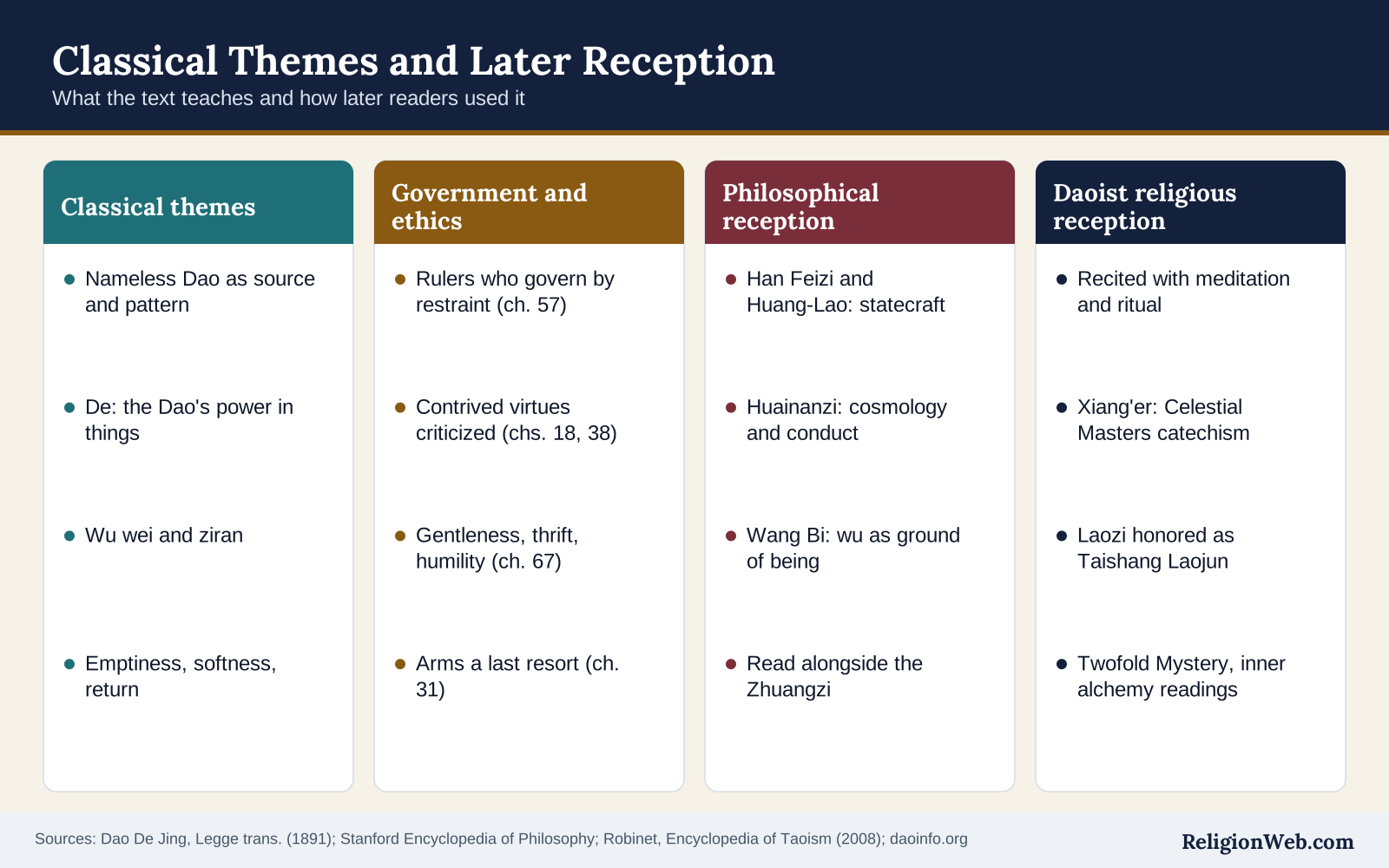
Translating and Interpreting the Dao De Jing
Why Translation Is Hard
Classical Chinese and the limits of English grammar
Any translator of the Dao De Jing begins with a text that is shorter and less explicit than the language it must be turned into. Classical Chinese lets the reader supply many things that English demands. Subjects and objects are often unstated, tense and number are generally not marked, and the same character can serve as a noun, a verb or a modifier depending on its place in the sentence. The original manuscripts carried little or no punctuation, which means that the division of a passage into sentences and clauses is already an act of interpretation. A translator who writes “the sage does not act” has decided that the line is a statement about a particular kind of person, when the Chinese might equally be read as a general principle, as advice or as a conditional.
Poetry adds another layer. Many chapters are rhymed, and rhyme, rhythm and the repetition of key words do part of the work of persuasion. Mair, as Wayne Alt summarizes him, sees the text as having oral origins and many authors, and his versions aim to preserve its poetic quality, whereas Henricks, translating from the Mawangdui manuscripts, concentrates on textual accuracy and an extensive critical apparatus. Neither aim is wrong, but they produce different books. The same lines may read as plain statements in one version and as incantation in another.
Chapter 1 as a test case
The first chapter shows how many decisions lie inside a few characters. Brook Ziporyn’s note on it points out that the received text reads dao ke dao, fei chang dao without any grammatical particles, so that it can be taken as a conditional (roughly, “if a way can be told as a way, it is not the constant way”), as a topic followed by a comment, or as two flat assertions. The Mawangdui copy, by contrast, inserts the particle ye after each clause, which favors the flat reading, and writes heng where the received text has chang for “constant.” The verb dao itself can mean “to speak” or “to guide,” so the opening line can be about the limits of language, about the unreliability of any prescribed course of action, or both.
A second set of choices concerns lines 5 and 6 of the chapter, where the received text can be broken after the words for “desire” or after the words for “being” and “non-being.” Ziporyn finds good support for both parsings. One makes the passage a statement about having desires and being without desires; the other makes it a statement about being and non-being as the constant names of the Dao. A translator must choose, and the choice affects the whole reading of the book’s opening. The commentarial tradition went both ways, and English versions do as well.
A Short History of Translation
Nineteenth-century beginnings
European translation of the Dao De Jing began in the nineteenth century. The French sinologist Stanislas Julien published Le Livre de la Voie et de la Vertu in 1842, and the missionary John Chalmers produced what is generally regarded as the first English translation in 1868, heavily indebted to Julien. The most influential nineteenth-century English version was James Legge’s, published in 1891 as volume 39 of the Sacred Books of the East under the title The Tao Teh King. Legge was a Scottish scholar who held the first professorship of Chinese at Oxford, and his translation is widely available in the public domain. It adds many words in parentheses to mark what the Chinese leaves unstated, and its choices, such as “attributes (of the Tao)” for de and “primitive simplicity” for pu, show the care and the limitations of an early scholarly rendering.
Twentieth-century expansion
The twentieth century multiplied the versions. Arthur Waley’s The Way and Its Power (1934) became one of the most widely read English versions and helped shape later literary translation. D. C. Lau and Wing-tsit Chan each published scholarly versions in 1963, and others followed from translators with different aims, some stressing poetry, some textual accuracy and some a particular spiritual outlook. Britannica notes that more than forty English translations have appeared since 1900, and the real total, counting poetic versions, adaptations and renderings in other languages, is considerably higher. Debates among specialists about the more free-form popular versions are long-standing: critics argue that some depart widely from the Chinese, while others maintain that they meet a real wish among readers for accessible contemplative literature.
Mawangdui-based translations
The discovery of the Mawangdui manuscripts in 1973 created a new category: translations made from the excavated texts rather than from the Wang Bi or Heshang gong editions. Robert Henricks’s Lao-tzu Te-Tao Ching (1989) was an early example, and Victor Mair’s Tao Te Ching (1990) also worked from the manuscripts. Reviewing these along with a translation based on the received text, Wayne Alt noted that the new versions bring a gain in grammatical clarity and sometimes change a reading, as in chapter 33, where a variant character shifts the sense from “perish” to “forget.” After the Guodian and Peking University discoveries, a translator may now work from a received text, from one of several excavated witnesses, or from an eclectic edition that compares them.
Choosing and Using a Translation
What different aims produce
It helps to know what a translator was trying to do. A version meant for students of Chinese philosophy will usually stay close to the wording and explain the choices in notes. A literary version may give up some literal accuracy to achieve rhythm and imagery. A devotional or practice-oriented version may emphasize the text’s use in meditation or daily conduct. A version based on an excavated manuscript may differ noticeably from familiar wording in particular lines. None of these categories is the single correct approach, and comparing two or three versions of the same chapter is one of the best ways to see how much interpretation every translation contains.
Questions worth asking of any version
Several practical questions help a reader judge a translation. Which Chinese text does it follow: Wang Bi, Heshang gong, a Mawangdui manuscript or a composite? Does it say where it departs from that base? Does it add chapter titles or rearrange lines, and if so, on what grounds? How does it render dao, de and wu wei, and does it use the same English words consistently? Does the introduction describe the text’s history honestly, including the uncertainty over Laozi and the manuscript discoveries? A translation that answers these questions openly is easier to use, even for readers who cannot check the Chinese themselves.
| Term or passage | Range of renderings | Why the choices differ |
|---|---|---|
| Title (Dao De Jing) | “Classic of the Way and Its Power”; “Book of the Tao and Its Virtue”; The Way and Its Power (Waley) | De can be moral virtue or effective power; jing can be “classic” or “scripture” |
| Dao (道) | “Way,” “path,” “course,” or untranslated; Tang translators weighed bodhi against mārga | The word is both a noun and a verb, and both senses are active in chapter 1 |
| De (德) | “Virtue,” “power,” “potency,” “integrity”; Legge: “attributes (of the Tao)” | Ordinary Chinese usage is moral; the text’s use is closer to effective presence |
| Wu wei (無為) | “Non-action,” “non-doing,” “effortless action”; Legge: “doing nothing (on purpose)” | Literal “no acting” risks suggesting inertia; wei can also mean “contrive” |
| Ziran (自然) | “Naturalness,” “spontaneity,” “self-so”; Legge: “its being what it is” | The modern word for “nature” is a later sense; the older sense is “of itself” |
| Pu (樸) | “Uncarved block,” “simplicity”; Legge: “primitive simplicity” | A concrete image or an abstract quality |
| Chapter 1, opening line | Conditional (“if a way can be told…”), topic-comment, or two plain statements | No particles in the received text; Mawangdui adds particles |
| Chapter 1, lines 5 and 6 | Break after “desire” or after “being” and “non-being” | Both parsings are well supported (Ziporyn) |
| Chapters 19 and 33 | Different readings in Guodian, Mawangdui and the received text | The base text chosen by the translator alters the sense of a line |
Common Misconceptions About the Dao De Jing
Misconception 1: Laozi’s historical biography is fully certain
Where the misunderstanding comes from
Popular accounts often begin with a short, tidy story: Laozi was an archivist at the Zhou court, a senior contemporary of Confucius, who left China through a western pass and wrote the book at the request of a gatekeeper. The story is vivid, it comes from a respected ancient historian, and it appears in introductions to the book in many languages. Because the Dao De Jing carries its author’s name in its title, readers also tend to assume that a single named person lies behind the text, in the way that a modern book has an author.
Another source of confidence is the institutional weight of the tradition. In religious Daoism, Laozi is a venerated figure, honored as a deity, and devotional literature speaks of him in detail. The line between a historian’s report, a religious tradition and modern scholarly reconstruction is not always drawn in popular writing, so the account that is told with the most assurance may be the one that is most distant from the evidence.
What the evidence and tradition actually show
The earliest biography is in Sima Qian’s Shiji, written several centuries after the period it describes, and it does not offer a single confident life. As the Stanford Encyclopedia of Philosophy notes, the account is questioned, and it lists several alternative identifications for the figure behind the name, including a possible confusion of the legendary Lao Dan with a Warring States figure called Li Er. Sima Qian himself reports different candidates and does not choose among them. Britannica adds that the book contains no references to people, events or places that would help to date it. Alan Chan finds a single author in the sixth or early fifth century BCE unlikely, and Robinet notes that scholars disagree about whether the work has one author at all.
None of this means that Laozi is a pure invention, and the evidence does not require such a conclusion. Some scholars, including Chan, see no strong reason to deny that a teacher of that name existed in the generations around Confucius, while recognizing that the text is a product of later accretion. The responsible position is to treat Laozi as the traditional author and as a figure of devotion, to treat the text’s composition as a process over several generations, and to leave open the question of how much of the Sima Qian biography reflects a real person.
Misconception 2: Wu wei means doing nothing at all
Where the misunderstanding comes from
The most common English renderings, “non-action” and “doing nothing,” sound like instructions to be passive. When the phrase is also met in a self-help or lifestyle setting, it is easy to picture a person who declines to make an effort, avoids responsibility or lets events take their course. A quotation that stops at the sage “doing nothing” and omits the clause that follows it strengthens the impression.
The ordinary meaning of the two characters also contributes. Wu means “not having” and wei means “doing” or “acting,” so a literal reading is natural. In addition, the text praises stillness, softness and withdrawal, and a reader who skims these chapters can be forgiven for concluding that the book discourages activity of any kind.
What the evidence and tradition actually show
The Stanford entry states that wu wei is not total inactivity but action free from self-serving desire. Britannica describes it as avoiding unnatural action and acting spontaneously, without interference, rather than as passivity. The text supports this reading in its own words. In Legge’s translation, chapter 48 describes a person who diminishes his doing until he arrives at “doing nothing (on purpose)” and then “there is nothing which he does not do.” Chapter 63 speaks of acting without thinking of acting, and chapters 63 and 64 advise dealing with difficulty while it is small and beginning even great undertakings with a single step. The sage of chapter 2 “manages affairs,” even while doing nothing. A figure who manages affairs and leaves nothing undone is not idle.
Traditions of commentary elaborated the point in different ways. Wang Bi and the Dark Learning tied it to their reading of the Dao as the ground of all things. Heshang gong and later religious readers linked it to calming desire and guarding the breath. Legalist and Huang-Lao readers took it as a method of governing through restraint. Chan adds that wu wei does not by itself prescribe any particular moral conduct, and that it should not be read as a blanket rejection of every kind of effort or even of military action. What unites these readings is that the term describes a quality of acting, not an absence of it.
Misconception 3: The Dao De Jing is a simple self-help manual detached from ancient Chinese religious and political contexts
Where the misunderstanding comes from
The book’s brevity, its quotable phrases and its calm tone make it easy to read as a collection of mindfulness advice. Many translations strip away the historical setting, give the chapters inviting titles and present the text as timeless wisdom for personal peace. Popular versions have reached very large audiences in this form, and readers who meet the book through them can reasonably come to think that this is all it is. Some modern reading has also separated “Taoism the philosophy” from “Taoism the religion” and treated the first as the real teaching, a division that the hub article on Daoism discusses.
A related assumption is that religion and politics are sidelines for a book about inner life. Because the text does not discuss specific rulers, battles or rituals by name, it is easy to suppose that it is not about them.
What the evidence and tradition actually show
The Dao De Jing belongs to a world of competing states and competing teachers. Britannica describes it as proposing a way to restore harmony to a disordered kingdom and as criticizing self-serving rulers, and Robinet notes that a large part of its content concerns the sage ruler who governs without interfering. Chapters such as 57, 60 and 80 deal directly with government, and chapter 31 deals with war. The Han Feizi read it as advice for a ruler, the Huang-Lao movement drew on it for government, and emperors of the Tang and Song sponsored or wrote commentaries on it. Chan stresses that the political conditions of the Warring States shaped its concerns.
It has also always been a religious text. Robinet states that it has been treated as a sacred scripture, recited with meditation and ritual; the Celestial Masters used a commentary on it as a catechism; and Laozi became a deity. Reading it for personal calm is a legitimate use, and many Chinese readers over the centuries have done so, but it is one use among several, and an account that leaves out the political and religious ones is incomplete. Comparing a few translations, and reading some of the commentaries, restores the sense of how much historical context the book carries.
Misconception 4: The Dao De Jing has always had eighty-one chapters in one fixed wording
Where the misunderstanding comes from
Every modern edition prints the same eighty-one numbered chapters in the same order, so it is natural to assume that this is how the book was always arranged. The title page often names a single author, and the chapter numbers are cited so routinely that they seem to belong to the text itself. The fact that the number eighty-one resembles a tidy pattern encourages the impression that it was designed from the start.
What the evidence and tradition actually show
The earliest known copies tell a different story. The Guodian slips from about 300 BCE have no chapter divisions and an order that differs from the received text. The Mawangdui copies of the second century BCE put the Dejing before the Daojing, and the Peking University bamboo text has 77 chapters. Robinet notes that the eighty-one-section division first appears with Heshang gong and was probably not universally accepted until the Tang, and other versions had 64, 66 or 72 sections. Wording varied as well, as the difference between the Guodian and received readings of chapter 19 shows. The received text is therefore best understood as one stage, a very successful one, in a long process of editing and standardization. Knowing this does not diminish the classic. It explains why scholars speak of the Laozi as a text that grew and why translators must say which version they follow.
Misconception 5: The Dao De Jing is the whole of Daoist scripture, and Laozi founded the Daoist religion
Where the misunderstanding comes from
Introductions to Daoism often present the Dao De Jing as the foundation of the tradition and Laozi as its founder, and Britannica itself calls him the reputed founder of Daoism. For a reader meeting the subject for the first time, the shorthand is convenient: one book, one teacher, one movement. Because the Dao De Jing is short and widely translated, it is also the Daoist text that most outsiders actually read, which makes it easy to assume that it is the main body of Daoist writing.
What the evidence and tradition actually show
The Dao De Jing is the most widely shared text of the tradition, but it stands within a much larger literature. The Zhuangzi, the Huainanzi, the Liezi, the alchemical writings of Ge Hong, the Shangqing revelations received in the 360s CE and the Lingbao scriptures of the late fourth and early fifth centuries all became part of Daoist learning, and the Ming-era Daoist canon of 1445 gathers a very large collection of scriptures, ritual manuals and commentaries. The Dao De Jing is a central text within that library and not the whole of it.
Likewise, organized religious Daoism is usually traced to the Celestial Masters of the second century CE, who honored Laozi as the source of a revelation and used the Dao De Jing in their teaching. Whether a historical Laozi founded anything is uncertain, and the text itself describes no church, rites or priesthood. It is more accurate to say that the book became a foundation of the religious tradition through the work of later communities than to say that its author established a religion.
Frequently Asked Questions About the Dao De Jing
Questions about the Name and the Author
What does Dao De Jing mean?
The title joins three Chinese words. Dao means “way,” de means “virtue” or “power,” and jing means “classic” or “scripture,” so the usual English rendering is “Classic of the Way and Its Power” or “Classic of the Way and Virtue.” Britannica notes that the title came into use during the Han dynasty and that the book had previously been called the Laozi, after its traditional author.
The two halves of the received text take their names from the same pair of words. The Daojing, chapters 1 to 37, is the “Classic of the Way,” and the Dejing, chapters 38 to 81, is the “Classic of Virtue.” The names do not mean that each half treats only one of the two ideas, since both run through the whole book.
Is the Tao Te Ching the same book as the Dao De Jing?
Yes. Tao Te Ching is the older Wade-Giles romanization of the same three words, and Dao De Jing (or Daodejing) is the pinyin spelling now standard in mainland China and in most scholarly writing. The different spellings reflect different systems for writing Chinese sounds in the Latin alphabet, not different texts. Legge’s 1891 translation, quoted in this article, uses a still earlier spelling, “Tao Teh King.”
The same applies to the author’s name: Lao Tzu, Lao-tzu and Laozi are alternate romanizations of the same Chinese words meaning “Old Master.” Differences in wording between books titled Tao Te Ching come from translators and from the underlying Chinese text they used, and not from the spelling of the title.
Did Laozi really write the Dao De Jing?
The tradition says so, and the tradition’s account goes back to Sima Qian’s biography. Historians are more cautious. The Stanford Encyclopedia of Philosophy entry argues that a single author in the sixth or early fifth century BCE is unlikely and that the sayings were gathered over the fifth, fourth and early third centuries BCE. The manuscripts found at Guodian, Mawangdui and Peking University show the text in different forms, which supports the view that it grew over time.
A fair summary is that Laozi is the traditional author and the name attached to the book, that a historical teacher of that name may have existed, and that the text as we have it is the work of several hands. Within Daoist religion, Laozi is also a deity, and devotional belief about him is a separate matter from historical reconstruction.
Questions about Meaning
What is the Dao in the Dao De Jing?
The text uses Dao for the nameless source of all things and for the pattern that things follow. Chapter 25 speaks of “something undefined and complete, coming into existence before Heaven and Earth” in Legge’s rendering, and chapter 42 describes the Dao as producing one, then two, then three, then the ten thousand things. The opening chapter says the constant Dao cannot be fully named.
Commentators have understood this in more than one way. Wang Bi read the Dao as the ground of being, Heshang gong related it to the primal breath of cosmology, and scholars today debate whether it should be read as transcendent or as immanent in the world. The text itself does not settle the question.
Is the Dao De Jing a religious scripture or a philosophy book?
It has been both, and the two uses have not been strictly separate. Philosophers have studied it as a classic of Chinese thought from the Han dynasty onward, and Wang Bi’s commentary treated it as a work of ontology. Religious Daoists treat it as a scripture. Isabelle Robinet writes that it was recited with meditation and ritual, and the Celestial Masters used the Xiang’er commentary to teach members.
Many scholars now regard the old division between “philosophical Daoism” and “religious Daoism” as too sharp, since the same text and often the same commentators moved between the two settings. A reader can approach the book as literature, philosophy or scripture, and each approach has a long history behind it.
Questions about Reading and Use
Which translation should a beginner read?
There is no single best version, but it helps to match a translation to a purpose. A student of Chinese philosophy may want one with notes that explain the Chinese terms and the choices made, such as D. C. Lau’s or Robert Henricks’s. Legge’s 1891 version is free to read online and shows the older scholarly style, with added words in parentheses. Readers who want poetry may prefer one of the literary translations, with the understanding that these depart further from the wording.
Whichever version is chosen, comparing two or three renderings of the same chapter reveals the choices every translator makes. It is also worth checking which Chinese text the translator followed, since versions based on the Mawangdui manuscripts differ from those based on Wang Bi in places.
How long is the Dao De Jing and how should it be read?
The book is about five thousand characters, and an English version usually fills fewer than a hundred printed pages. A first reading can be completed in an afternoon. Most readers find it more rewarding to take a few chapters at a time and to return to them, since the text is compressed and repays slow rereading.
The chapter reading guide earlier in this article can help in choosing where to begin, and a commentary will help with difficult lines. The commentary tradition shows that readers over two thousand years have returned to the same short chapters and found new things in them.
How did the Dao De Jing relate to Buddhism when Buddhism reached China?
The relationship was one of historical contact and exchange. Tang accounts, summarized in modern studies, report that in 647 the Daoist scholar Cheng Xuanying helped the Buddhist translator Xuanzang to render the book into Sanskrit and that the two discussed how to translate dao. The Twofold Mystery commentators of the Tang used a dialectical style that Robinet describes as Buddhist in character. The Stanford article on Daoism notes that the worship of Laozi took on institutional forms such as monks, nuns and monasteries that resemble those of Buddhism, and it describes the later convergence of the two traditions in Chan (Zen).
The mutual influence is a subject of ongoing scholarly study and should be described carefully, since each tradition has its own self-understanding and its own sources. For the Chan school’s practices, the article on Buddhist meditation gives a Buddhist account of meditation on its own terms.
Conclusion: The Dao De Jing as a Text That Grew and a Text That Is Still Read
What the History Shows
A short book with a long life
The Dao De Jing is a short, poetic work attributed to Laozi, whose identity remains uncertain, and its form was shaped over several centuries. The Guodian, Mawangdui and Peking University manuscripts show that early readers met it in different orders and with different wording, and that the eighty-one-chapter classic is the product of editing, commentary and standardization. Its central ideas, however, are stable across the early copies: a nameless Dao that is the source and pattern of things, a power or virtue that arises from it, and a manner of acting and ruling that avoids force and display.
Many readings, one text
Its commentary tradition, from the Han Feizi chapters to Heshang gong, Xiang’er, Wang Bi, the Tang Twofold Mystery writers and the Song and later collections, shows how one text can serve a ruler’s handbook, a philosophy of non-being, a communal catechism and a guide to cultivation. For the wider setting of the religion that treats the book as scripture, the hub article on Daoism provides the context.
How to Keep Exploring
Reading the text itself
The best way to understand the Dao De Jing is to read it, preferably in more than one translation and with the manuscript history in mind. The reading guide, the key-concept table and the list of translation pitfalls in this article are designed to help with that. Readers may also wish to turn to the Zhuangzi, which develops many of the same themes in narrative form.
Learning about the contexts
Understanding the Warring States background helps to explain the book’s concerns. The article on Confucius describes the teacher whom Sima Qian’s story places in conversation with Laozi, and the article on Confucianism covers the tradition against which the Dao De Jing is often read. Both are best approached on their own terms and without ranking.
Sources
The table below lists the principal external sources behind this article. Facts, dates and figures were checked against these and related primary, institutional and academic materials.
| # | Source | Publisher and type | Used for | Link |
|---|---|---|---|---|
| 1 | Tao Te Ching (Tao Teh King), translated by James Legge, Sacred Books of the East vol. 39 (1891) | Internet Sacred Text Archive · Primary text | All block quotations and inline quotations from the Dao De Jing (chs. 2, 11, 16-20, 25, 31, 38, 40, 48, 57, 60, 63, 64, 67, 78, 80) | sacred-texts.com |
| 2 | Laozi (Alan Chan), Stanford Encyclopedia of Philosophy | Stanford Encyclopedia of Philosophy · Academic reference | Sima Qian biography, dating debates, Guodian, Mawangdui and Peking University texts, commentaries, key terms | plato.stanford.edu |
| 3 | Daoism (Chad Hansen), Stanford Encyclopedia of Philosophy | Stanford Encyclopedia of Philosophy · Academic reference | Dao, de and ziran; Huang-Lao; Wang Bi and the Dark Learning; Laozi worship and Chan | plato.stanford.edu |
| 4 | Daode jing (Isabelle Robinet), The Encyclopedia of Taoism, ed. Fabrizio Pregadio (Routledge, 2008) | Golden Elixir Press (reproducing the Routledge entry) · Academic reference | Text structure, 81-section division, four main versions, doctrines, recitation as scripture | goldenelixir.com |
| 5 | Tao-te Ching, Encyclopaedia Britannica | Encyclopaedia Britannica · Encyclopedia | Title history, purpose, wuwei, commentary and English translation counts | britannica.com |
| 6 | The Book of Dao and its Virtue (Laozi), Daoist Studies Wiki | daoinfo.org · Academic reference | Commentators: Du Guangting, Chongxuan school, Peng Si, alchemical readings, Zhengtong Daozang | en.daoinfo.org |
| 7 | New Translations of the Old Master(s) (Wayne Alt), review of Henricks, Chen and Mair, Philosophy East and West | University of Hawai'i Press (hosted by Terebess Asia Online) · Academic reference | Mawangdui-based translations, base-text choices, chapter 33 variant, translation debates | terebess.hu |
| 8 | About Chapter One of the Daodejing (Brook Ziporyn), supplement to the Liveright edition (2023) | University of Chicago · Academic reference | Chapter 1 wording in Mawangdui and received texts; punctuation, particles and parsing options | voices.uchicago.edu |
| 9 | The Daode Jing: A Guide (Livia Kohn), Oxford University Press, 2019: chapters 'Devotional Activation' and 'Later Developments' (abstracts) | Oxford University Press · Academic reference | Recitation at court from the 2nd century BCE; Daoist communities by the 2nd century CE; Twofold Mystery in the Tang | academic.oup.com |
| 10 | The Political Thought of Emperor Song Huizong's Imperial Commentary on Dao De Zhen Jing, Taiwanese Journal of Political Science no. 53 (2012) | National Taiwan University, Department of Political Science · Academic reference | Song Huizong's imperial commentary and its picture of the sage ruler | politics.ntu.edu.tw |
Last fact-check date: 2026-10-21.