Paryushana (also spelled Paryushan or Paryusan) is the annual season of fasting, study, confession, and forgiveness at the center of the Jain year. It falls in the Indian lunisolar month of Bhadrapada, usually in late August or September. Most Shvetambara Jains observe it for eight days, and Digambara Jains observe a ten-day parallel called Das Lakshana, so the season as a whole stretches across more than two weeks. In 2026, for example, the Shvetambara days ran from September 8 to September 15, according to published Jain calendars.
The short version is that Paryushana is a period of turning inward. Laypeople attend daily sermons, keep fasts of many kinds and lengths, spend more time in temples and prayer halls, and give to charity. Monks and nuns, who already live under strict discipline, use the days to teach and to hear scripture. The season closes with a ritual review of the year’s faults, called pratikraman, and with a request for forgiveness that Jains address to relatives, friends, rivals, and every living being. The best-known words of that request are Michchhami Dukkadam, a Prakrit phrase usually understood to mean that any harm done may be undone or be without effect.
This article explains how the season works and why. It follows the Shvetambara eight-day pattern and the Digambara ten-day pattern separately, because they share a purpose but differ in structure, texts, and timing. It then looks at fasting, scripture study, pratikraman, and the culture of forgiveness, and ends with the misunderstandings that most often surround the festival. Readers who want the wider background will find it in the articles on Jainism, on Mahavira, whose example the season recalls, and on ahimsa in Jainism, the ethic of non-harm that gives the whole festival its logic.
At a Glance: What Paryushana Is
The Short Answer
A season, not a single day
Paryushana is best understood as a season of intensified religious life rather than a single holiday. Jains speak of it as the “king of festivals” or the greatest of Jain observances, and Jainpedia, the academic Jain reference site, calls it the most important Shvetambara festival. Nothing in it commemorates a historical event in the way that a birthday or an anniversary does. Its theme is the believer’s own conduct: how much harm one has done in the past year, how to loosen the hold of anger and craving, and how to restore broken relationships before the next year begins.
Within that theme the season combines several strands that are often treated separately in other festivals. Fasting trains the body and weakens appetite. Hearing scripture and sermons trains the mind. Worship and charity turn attention outward. Confession and forgiveness, which come at the end, are meant to settle accounts. The Jain tradition ranks all of these under tapas, the austerity or discipline that is believed to burn away karma, and it insists that none of them is valuable if performed with pride or resentment.
The two names and the two calendars
The festival has two principal names because Jainism has two principal historic communities, the Shvetambaras and the Digambaras. Among Shvetambaras the season is Paryushana (or Paryushan Parva), eight days long, and its last day is Samvatsari, the day of the annual pratikraman. Among Digambaras it is Das Lakshana (Dashlakshana) Parva, ten days long, with each day dedicated to one of ten virtues. The two festivals are neighbors in the calendar and are sometimes loosely called by one name, which is why many English-language sources speak of “Paryushana” for both. The relationship between them is more careful than that, and it is taken up in a later section on the Digambara observance.
Both festivals follow the lunar calendar, so their Gregorian dates move from year to year. The detail that matters for planning is the lunar rule, not a fixed date: they belong to the bright half of Bhadrapada, and the Shvetambara festival ends on the fourth or fifth day of that fortnight depending on the lineage. The calendar section below explains the rule and why even Shvetambara communities sometimes differ by a day.
Core Vocabulary
Words you will meet
Jain vocabulary is mostly Sanskrit and Prakrit, and the same word often appears in several spellings in English. The table lists the terms used most often in this article, with the plain-English sense in which Jain sources use them. Spellings follow common English usage; where a Prakrit form differs from the Sanskrit one, both are given.
| Term | Meaning | Where it appears |
|---|---|---|
| Paryushana (Paryushan, Paryusan; Prakrit pajjosavana) | The Shvetambara eight-day festival; commonly explained as “abiding” or “coming together” | Late Bhadrapada; ends with Samvatsari |
| Das Lakshana (Dashlakshana) | The Digambara ten-day festival of “ten marks” (virtues) of dharma | Usually the fifth to the fourteenth day of the bright half of Bhadrapada |
| Chaturmas (varshavas, chaturmasa) | The four-month rainy-season stay of monks and nuns in one place | Roughly July to November; Paryushana falls inside it |
| Samvatsari | The last day of Shvetambara Paryushana; the day of the annual pratikraman and of the main request for forgiveness | Fourth or fifth day of the bright half of Bhadrapada, by lineage |
| Pratikraman (pratikramana) | A ritual of reviewing, repenting, and turning back from faults, performed by monastics and laypeople | Daily in its short forms; yearly as Samvatsari pratikraman |
| Michchhami Dukkadam | Prakrit phrase of forgiveness, said when asking another person to pardon wrongs | Samvatsari and the days after; also in daily pratikraman |
| Kshamavani (kshamapana) | “Day of forgiveness” or the act of begging forgiveness; the Digambara closing day | The day after Das Lakshana ends |
| Tapas (tapasya) | Austerity or discipline, above all fasting; also study, service, and meditation | Throughout the season |
| Kalpa Sutra | A Shvetambara scripture about Mahavira and the other Jinas, recited during Paryushana | Days four and five in many communities |
| Shravaka and shravika | Lay Jain man and woman; literally “hearers” | The lay majority who observe the season |
| Upashraya, sthanak | Hall where monastics stay and sermons are given | Venue for daily lectures |
| Tithi | A lunar day, reckoned from sunrise, used to fix festival dates | Calendar rule for Samvatsari and Das Lakshana |
Why the Prakrit and Sanskrit forms both appear
Jain scripture was composed in Prakrit (Ardhamagadhi for the Shvetambara canon, Shauraseni for much of the Digambara one) before Sanskrit became the main language of Jain philosophy. That is why the festival’s name appears in older sources as pajjosavana, and why the forgiveness phrase is the Prakrit micchami dukkadam rather than a Sanskrit form. The translator Hermann Jacobi, whose nineteenth-century rendering of the Kalpa Sutra is still the standard public-domain English version, rendered the word as Paggusan in his English text. When this article uses Sanskritized spellings such as Paryushana, it does so because those are what readers will meet in contemporary English.
The word itself is explained in more than one way. The usual scholarly gloss, repeated on reference pages, is “abiding” or “coming together,” a reference to monks and nuns remaining in one place during the rains. A second, devotional etymology popular in sermons reads the word as “burning away on all sides,” meaning that the season is meant to burn away karma. The two explanations are not rivals so much as the monastic origin and the lay interpretation of the same festival.
Who Observes Paryushana and Where
Communities and numbers
Jains are a small religious minority in India, where the 2011 census counted about 4.45 million, roughly 0.37 percent of the population, with the largest numbers in Maharashtra, Rajasthan, Gujarat, Madhya Pradesh, and Karnataka. The Pew Research Center’s 2019 to 2020 survey of Indian adults, which included only 109 Jain respondents, found that about 92 percent of them said they were vegetarian, a figure that gives some sense of how strongly non-harm shapes ordinary life. These figures describe the years 2011 and 2019 to 2020, and they are the most recent that this article cites.
Paryushana in the strict sense belongs to the Shvetambara communities, whose three main strands are the image-venerating Murtipujaka (also called Deravasi), and the two groups that do not venerate images, known as Sthanakavasi and Terapanthi. Digambara communities keep Das Lakshana. The differences among these groups, treated at length in the Jainism article, affect details such as whether a procession carries a sacred image, which text is read from the pulpit, and which day is counted as the start of the season.
Beyond India
Jain communities in East Africa, the United Kingdom, and North America observe Paryushana too, with fewer than 250,000 Jains estimated outside India by Pew in 2012. In these settings the season often has to fit around workdays and school calendars, and temples or rented halls take the place of the upashraya. Sermons may be delivered in English or livestreamed, and visiting monastics are replaced in many places by laypeople who give the daily talks or by samanis, members of a Terapanth order of religious women who are permitted to travel. Because the festival is the principal time when Jains of the diaspora gather, Paryushana is often the largest event of the year at Jain centers.
The practices described in this article are drawn from the way Jain communities describe themselves. They vary by region, lineage, and family, and no single account describes every Jain household. Where a detail is typical rather than universal, the text says so.
Origins: From a Monastic Retreat to a Community Festival
The Rainy-Season Retreat
Why monastics stop traveling
The root of Paryushana is a rule for monks and nuns, not a festival for laypeople. Jain ascetics ordinarily keep moving on foot from village to village, staying nowhere for long, as a way of limiting attachment to any one place. The monsoon changes the calculation. When the rains arrive, the ground fills with insects, worms, frogs, and new growth, and a person walking on a wet path cannot avoid crushing life underfoot. Jain teaching on non-harm, discussed in the article on ahimsa in Jainism, therefore asks monastics to settle in one place for the four months of the rains, a period known as chaturmas or varshavas. During that time they stay in a hall or lodging provided by the lay community, limit their movements, and spend their days in study, meditation, and instruction.
The retreat is also a reminder that the Jain community has always been a fourfold one. Monks, nuns, laymen, and laywomen depend on each other. Householders supply food and lodging; monastics supply teaching and example. The four months in which the two halves of the community live close together shaped the way that the season’s religious life grew, and they explain why so much of Paryushana is public and communal.
Mahavira’s example in the Kalpa Sutra
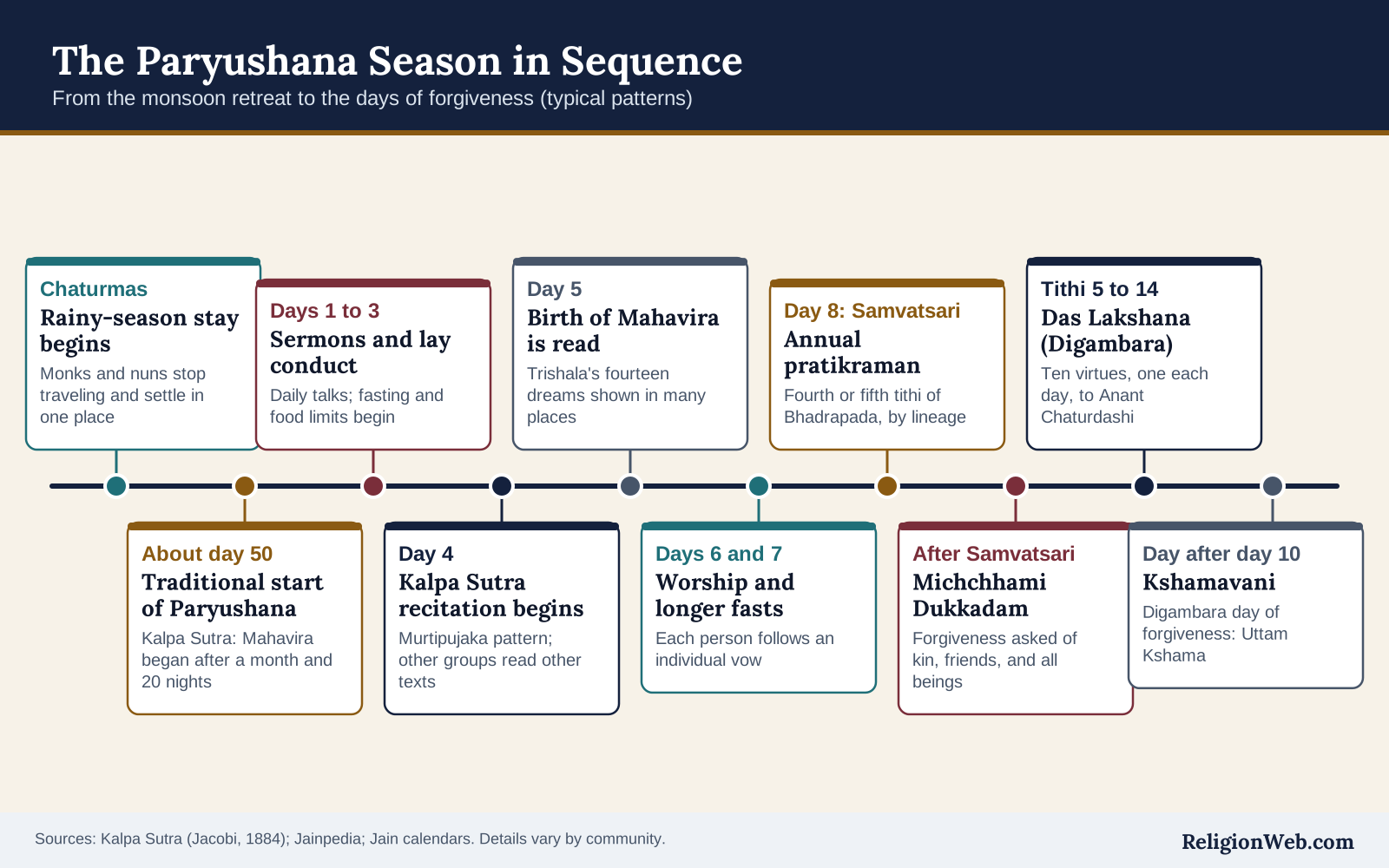
The Shvetambara canon places the origin of the rule with Mahavira himself. The final part of the Kalpa Sutra is a set of rules for monastics, known as the Samachari (Samakari), and its first rule, in Hermann Jacobi’s 1884 English translation, says that the Venerable Ascetic Mahavira began the Paryushana when a month and twenty nights of the rainy season had elapsed. A month and twenty nights is about fifty days. That reckoning is the traditional reason why the festival does not open at the start of the rains but well inside them, and it is one source of the idea that Paryushana is a time to follow the Tirthankara’s own example.
Two cautions are needed. First, the Kalpa Sutra is a Shvetambara text; Digambara tradition does not accept the Shvetambara canon, so this particular proof text is not shared across the whole Jain community. Second, the Samachari is a rulebook for ascetics, and it says little about the festival life of laypeople as it is practiced today. The step from a rule about where monks stay to a festival of lay fasting and forgiveness is one that the sources describe only indirectly.
How a Monastic Rule Became a Lay Festival
The fourfold community
The sources that reveal how the season developed are mostly later than the period of the early canon, and a clear historical account of each step is not possible. What the surviving texts and manuscripts show is that by the medieval period the recitation of the Kalpa Sutra at Paryushana had become a public event. Jainpedia notes that kings in western India funded the copying and decoration of Kalpa Sutra manuscripts, and that illustrated pages, with their paintings of Mahavira’s birth, dreams, and previous lives, were shown to lay audiences so that seeing the text and hearing it would earn merit. Museum collections hold many such manuscripts, some of them illustrated in gold, and their survival is itself evidence of how central the recitation became.
Jain tradition links some of the key changes in the festival’s form to named teachers. One well-known account credits the monk Kalakacharya with moving the final day of the season from the fifth to the fourth day of the bright half of Bhadrapada, which is one explanation for the “fourth or fifth” variation that survives in the calendars. Details of that account come from later Jain narrative literature and have not been checked here against the sources, so it is better read as the community’s own memory than as settled history.
What historians can and cannot say
Historians of Jainism generally distinguish between the age of the rainy-season rule, which fits the broader culture of wandering ascetics in the Ganges plain in the centuries around Mahavira’s lifetime, and the age of the lay festival, which seems to have grown in the later first millennium CE and the medieval period as the Shvetambara community in Gujarat and Rajasthan became prosperous and settled. The Valabhi council of the fifth century CE, which tradition associates with the writing down of the Shvetambara canon, is often cited in this context, though its dates are commonly given as 454 or 466 CE and are themselves traditional.
The picture that emerges is one of gradual layering. A monastic stay in one place turned into a season of sermons; sermons gathered around a particular text; and laypeople, who heard the text read, took up fasts and vows of their own and began to treat the end of the season as a time for reconciliation. None of this implies that the lay practices are less authentic than the monastic rule. In Jain understanding, it shows the community living out the same principles at different levels of strictness.
The Digambara Ten-Day Form
Digambara tradition and the Tattvartha Sutra
Digambaras do not use the Shvetambara Kalpa Sutra. Their festival is organized around a list of ten virtues, or “marks” (lakshana) of dharma, drawn from the ninth chapter of the Tattvartha Sutra, a Sanskrit treatise attributed to Umasvati (also called Umasvami) that both major Jain communities accept as authoritative, though they read and number it somewhat differently. The festival is thus not a recitation of a biography but a ten-day course in conduct: each day takes up one virtue, starting with supreme forgiveness and ending with celibacy.
Digambara teachers also link the festival to the rainy-season retreat, since Digambara monks keep the same four-month residence. The two communities, in other words, share the root of the festival and diverge in how they have developed it.
What is uncertain
The sources consulted for this article do not give a firm date for when the Digambara ten-day form took its present shape, and it would be misleading to claim one. The use of the word Parva (festival) for a ten-day course of this kind appears in modern Digambara practice, and published community materials describe it as an ancient observance. Scholars who study the Digambara tradition have not, as far as these sources show, settled how much of the present format is medieval and how much belongs to the past two centuries. Readers should treat the claim of unbroken antiquity as a traditional position and not as a documented chronology.
The Calendar: When Paryushana Falls and Why Dates Differ
The Lunar Rule
Bhadrapada and the bright half
Paryushana is fixed by the lunar calendar. Each Jain month is divided into a bright fortnight (shukla paksha), from new moon to full moon, and a dark fortnight (krishna paksha), and each fortnight into fifteen lunar days, or tithis. A tithi is not a calendar day; it can begin at any hour and is counted from sunrise, so a single tithi may cover parts of two civil days or, rarely, be skipped. The Shvetambara festival ends on the Samvatsari tithi, the fourth or fifth of the bright half of Bhadrapada, and the eight-day festival is counted back from it; the Digambara festival normally begins on the fifth tithi of the same fortnight and runs for ten days to the fourteenth.
The month names themselves differ by region. In the system used in northern India, a month ends at the full moon, while in Gujarat and Maharashtra it ends at the new moon, so the same fortnight can be called by different month names. Jain sources, whether scriptural or modern, generally agree on the sequence of festival days and differ only in the label for the month. Because the lunar year is about eleven days shorter than the solar year, an intercalary month is added roughly every three years, and the Gregorian date of Paryushana shifts accordingly. It can fall as early as late August or as late as mid-September or beyond.
2026 as an illustration
In 2026, published Jain calendars gave September 8 to September 15 for the Shvetambara festival, with Samvatsari on September 15, and about September 16 to 25 for Das Lakshana. Those dates are given here as examples of the rule at work and not as a prediction for later years; each year’s dates should be taken from the calendar of one’s own temple, community, or monastic order. Observers who live far from India may see a day’s difference from published Indian calendars, because tithi boundaries depend on the sunrise at the observer’s location.
Why Communities Differ by a Day
Fourth or fifth: the Samvatsari question
The most noticeable calendar difference among Shvetambaras is the day of Samvatsari. Murtipujaka lineages commonly observe it on the fourth tithi of Bhadrapada, while some other lineages observe it on the fifth, and reference accounts of the ritual say the annual pratikraman is performed on the fourth or fifth day of that fortnight. Because tithis can be doubled or dropped in a given year, even two groups that follow the same rule may not agree on the day, and a large city may find different temples observing Samvatsari on successive days. These differences are known to the participants and are generally treated as matters of lineage custom, not as disagreement on doctrine.
The Digambara festival, which begins on the fifth tithi, can therefore begin on the same day that some Shvetambara groups observe Samvatsari or on the day after. Published Wikipedia and community summaries describe the relationship in both ways, and the 2026 calendars cited above placed the Digambara start on the day after Shvetambara Samvatsari.
Cities, diaspora, and the practical calendar
In practice, most Jains rely on the printed Jain calendar, called a panchang, of their own sect and region, and on the announcement of the senior monk or the temple trust. Diaspora communities often follow the dates of the home community in Gujarat or Rajasthan, or adopt a local compromise so that families can gather on one weekend. Where a community has no resident monk, the lay executive may set the dates and arrange a visiting scholar to give the sermons.
The calendar also places Paryushana in sequence with the other great Jain days: it comes well inside the monsoon months, about two months before the new moon of Kartika, when Jains observe Mahavira’s liberation on the night that coincides with Diwali. The same lunisolar reckoning is used across much of India, which is why Jain festivals share a calendar logic with those described in the article on Hinduism even though their meanings differ.
Shvetambara Paryushana: The Eight Days
The Annual Duties and the First Days
The five annual duties
Shvetambara teachers often summarize the purpose of Paryushana as a set of five duties that every lay Jain is encouraged to carry out each year. Reference summaries list them as amari pravartan (refraining from killing and working for the protection of life), sadharmik bhakti (affection and practical support for fellow Jains), kshamapana (confessing and asking forgiveness for faults of the past year), attham tapa (a three-day fast), and chaitya paripati (a round of visits to temples). The list is a teaching device and not a rigid checklist, and different communities place the emphasis differently, but it shows the shape of the festival: protect life, care for the community, repair relationships, practice austerity, and worship.
| Duty | What it asks | How communities often carry it out |
|---|---|---|
| Amari pravartan | Do not kill; work for the protection of living beings | Donations to animal shelters, support for requests to close slaughterhouses during the festival |
| Sadharmik bhakti | Honor and help fellow Jains | Community meals, help for families in need |
| Kshamapana | Confess faults and ask forgiveness | Samvatsari pratikraman; personal visits, messages, and calls |
| Attham tapa | Keep a three-day fast | Three consecutive fasts, often during the last days; shorter or lighter fasts for those unable |
| Chaitya paripati | Visit the local temples in turn | Group visits to temples and prayer halls, often with hymns |
Sermons and stories of the first days
The opening days of Paryushana are given over largely to sermons. In a typical Shvetambara community a monk, nun, or visiting lay scholar speaks every morning in the upashraya, and many families rearrange their schedules so that at least one member can attend. Reference accounts say that the early talks draw on sermon literature and on exemplary stories from Jain history, which means that for the first three days the audience hears about the conduct expected of a layperson before the Kalpa Sutra itself is opened.
A particular story that is performed or recounted in many places is that of Chandanabala, a princess who, in the traditional account, was sold into slavery and who later offered food to the fasting Mahavira. Jainpedia’s article on the festival notes that the story is re-enacted in connection with Paryushana, and it describes the story as a lesson on giving alms rightly. For laypeople who are not fasting at all, listening to the daily talk is the principal form of participation.
The Kalpa Sutra Days
Recitation, procession, and the fourteen dreams
In Murtipujaka communities, the recitation of the Kalpa Sutra begins on the fourth day. The text, which tradition attributes to the monk Bhadrabahu, is read aloud in the presence of the gathered congregation, and in some places a procession carries the manuscript or a printed copy from the temple to the hall in a decorated palanquin or on an elephant. Sources describe the procession as occurring on the third day in some communities and on other days elsewhere, so the timing of this event varies. What is constant is the intention: to honor the text as a sacred object and to bring the life of Mahavira, as the Shvetambara tradition tells it, before the congregation.
The central episode is the story of Mahavira’s conception and birth, which in the Shvetambara version includes fourteen auspicious dreams seen by his mother Trishala. On the fifth day, in many communities, the dreams are displayed as symbols, among them a white elephant, a bull, a lion, the goddess Lakshmi, and a full moon, and the congregation celebrates the birth of Mahavira with a lamp ceremony (arati) and songs. Families sometimes take turns bidding for the honor of receiving the dreams or of holding the cradle. Digambara tradition counts sixteen dreams, not fourteen, which is one reason this part of the program is distinctive to the Shvetambara festival.
Auctions, honors, and how the program is paid for
One of the features that sometimes surprises outsiders is the use of auctions. Jainpedia notes that fundraising auctions tied to religious objects and activities are a feature of the festival. In Shvetambara practice, the right to perform a ritual role (such as lighting the lamp, carrying the text, or being the first to see the dreams) may be bid for by families, and the proceeds go to the temple trust or to charitable work. Communities describe this as a form of giving (dana) in which a family acknowledges its good fortune by supporting the community. Critics inside the community sometimes comment on the competitive element of high bids, and the practice varies widely, but it is common enough that readers who attend a festival hall in Gujarat or in a diaspora center are likely to see it.
Some Shvetambara communities, particularly those that do not worship images, have a different emphasis. Reference summaries mention that certain Shvetambara groups also recite the Antagada Sutra, a canonical text containing narratives of people who attained liberation in the time of Mahavira and of Neminatha, and Sthanakavasi and Terapanthi gatherings in prayer halls place their weight on sermon, scripture reading, and the vow-taking that surrounds them, without the temple procession or the display of dreams that are characteristic of the Murtipujaka program.
Samvatsari: The Eighth Day
A day of pratikraman
Samvatsari is the culminating day. In Shvetambara communities it typically begins early, with prayers and a visit to the temple or hall, and many laypeople observe a full fast. The center of the day is the annual pratikraman, a communal recitation in which participants review their conduct over the past year, express regret for any harm they have done by thought, word, or deed, and renew their resolve. After it, they turn to one another and say Michchhami Dukkadam. Both parts, the ritual and the face-to-face forgiveness, are explained in the sections that follow.
A day-by-day outline
The table gives a common pattern for a Murtipujaka community. It should be read as a typical schedule, not a universal one: temples set their own program, and in some places the days are counted differently or the events fall on other days.
| Day | Typical focus | Notes on variation |
|---|---|---|
| Before the first day | Preparation: vows taken, kitchens simplified, travel and work arranged around the days | Many families decide their fast in advance with advice from a monastic |
| Days 1 to 3 | Daily sermons on lay conduct and exemplary stories; fasting and restriction of foods begins | Some communities hold a Kalpa Sutra procession on day 3 |
| Day 4 | Public recitation of the Kalpa Sutra begins | Sthanakavasi and Terapanthi gatherings may read other texts |
| Day 5 | Birth of Mahavira read; dreams of Trishala displayed; lamp ceremony | Digambara tradition counts sixteen dreams |
| Days 6 and 7 | Continuing recitation and worship; many keep longer fasts | Pattern of fasts depends on each person’s vow |
| Day 8: Samvatsari | Annual pratikraman; request for forgiveness; many keep a full fast | Fourth or fifth tithi of Bhadrapada by lineage |
| After Samvatsari | Visits, messages, and calls asking forgiveness; ending of long fasts with a community meal | Fast-breaking celebrated by family and temple |
This sequence is easier to follow when it is read with the shape of a Jain year in mind. The first half of the festival is about hearing and absorbing; the second half is about doing; and the last day is about letting go. That arc, from attention to action to release, is the reason many Jains describe Paryushana less as a series of events than as a single movement.
Das Lakshana: The Digambara Ten Days
How Das Lakshana Relates to Paryushana
Same purpose, different structure
Das Lakshana (also Dashlakshana or Dash Lakshan Parva) is the Digambara counterpart of Paryushana. It is a separate festival with its own name and its own program, not simply a different name for the Shvetambara days, although both fall in Bhadrapada and share the aims of austerity, study, and forgiveness. The most visible difference is the structure: where the Shvetambara festival centers on the narrative of the Kalpa Sutra and ends with the day of the annual pratikraman, the Digambara festival is organized as a course on ten virtues, with a different theme on each of ten days.
The timing also differs. Das Lakshana normally begins on the fifth tithi of the bright half of Bhadrapada and ends on the fourteenth. In 2026 the Digambara festival was listed as starting on September 16, the day after Shvetambara Samvatsari, though calendars differ and summaries sometimes say that the first day of Das Lakshana coincides with the last day of Paryushana. Digambaras observe the closing day of forgiveness after the ten days, so their season of reconciliation comes about ten days after the Shvetambara one.
Why the names should not be treated as synonyms
It is common for general reference works to say that Das Lakshana “is” Paryushana, and for lay speakers in mixed settings to call the whole season by a single name. That is a reasonable shorthand, but it hides real differences in text, program, and day count. A Digambara family will say it is observing Das Lakshana; a Shvetambara family will say it is observing Paryushana; and each would object to being told that its festival is simply the other’s under a new label. The difference also affects practical questions: which sermon to attend, which text is read, which day to visit the temple, and which day to say Michchhami Dukkadam or Uttam Kshama.
The Ten Virtues
The list from the Tattvartha Sutra
The ten “marks” of dharma are named in the Tattvartha Sutra and are the organizing principle of the Digambara festival. They are listed below in the order in which they are usually taken up, with a short gloss of the sense in which Jain teachers use each word. The first virtue, supreme forgiveness (uttama kshama), is the first day’s theme, which is why forgiveness is the keynote of the beginning of the festival as well as its ending.
| Day | Virtue (Sanskrit) | Common English gloss |
|---|---|---|
| 1 | Uttama kshama | Supreme forgiveness; letting go of anger |
| 2 | Mardava | Humility; gentleness; freedom from pride |
| 3 | Arjava | Straightforwardness; freedom from deceit |
| 4 | Shauca | Purity; freedom from greed |
| 5 | Satya | Truthfulness |
| 6 | Samyama | Self-restraint, including care for living beings |
| 7 | Tapa | Austerity; penance |
| 8 | Tyaga | Renunciation; giving up |
| 9 | Akinchanya | Non-possessiveness; non-attachment |
| 10 | Brahmacharya | Celibacy for monastics; sexual restraint and fidelity for laypeople |
How the virtues connect to the passions
Jain thought identifies four basic passions, the kashayas: anger, pride, deceit, and greed. They are said to bind karma to the soul, and the opening virtues answer them directly. Forgiveness answers anger, humility answers pride, straightforwardness answers deceit, and purity answers greed. The remaining six virtues widen the field to truth, restraint, austerity, renunciation, non-possessiveness, and sexual discipline, which are the territory of the five great vows described in the article on ahimsa in Jainism. A Digambara teacher might say, in other words, that the first four days address the sources of harm in the heart and the final six days build the habits that keep those sources from returning.
The Observance and Its Close
Daily study, worship, and fasting
Each day of Das Lakshana usually includes temple worship, including the ritual bathing (abhisheka) of the Jina image and the offering of water, rice, and other articles; a reading and explanation of the day’s virtue by a monastic or a learned layperson; and fasting at whatever level the individual has chosen. Digambara laypeople who keep strict observance may eat a single meal a day or fast, and many do so for all ten days, while others undertake individual days or the first and last. The community organizes lectures, devotional singing, and children’s programs, and many temples hold a cultural evening on one of the days.
A reference summary notes that the tenth day (Anant Chaturdashi, the fourteenth tithi) is also associated in Digambara practice with the attainment of liberation by the twelfth Tirthankara, Vasupujya, and that the day is often marked with a procession. That detail comes from a reference summary of community practice, and it reflects the way Digambara tradition itself describes the day.
Kshamavani: the closing day of forgiveness
Das Lakshana ends with Kshamavani, the “day of forgiveness,” observed on the day after Anant Chaturdashi. Digambara Jains greet one another with the phrase Uttam Kshama (“supreme forgiveness”) and ask pardon of relatives, neighbors, and friends, in person or by message, for any hurt of the previous year. Because the first day of the festival is devoted to the virtue of forgiveness and the last day to the act of asking for it, the festival is framed by forgiveness at both ends.

Fasting During Paryushana: Forms, Reasons, and Limits
Why Jains Fast
Fasting as one form of austerity among twelve
Fasting is the most visible practice of Paryushana, and for outsiders it is often the only one they hear about. Jain teaching, however, places fasting inside a larger frame. The Tattvartha Sutra, which both major communities accept, divides tapas (austerity) into six external and six internal kinds. The external ones are fasting itself, eating less than one’s fill, restricting the kinds of food one will accept, giving up tasty or rich foods, choosing a secluded place to sit or sleep, and bodily endurance. The internal ones are atonement (prayashchitta), reverence, service, study, letting go of attachment, and meditation. In the order of the list, confession comes first among the inner disciplines, and study and meditation follow, so that the Paryushana program of fasting, sermons, and pratikraman is a near-complete walk through the twelve.
The purpose of the external austerities is stated in the same teaching: they are valuable to the extent that they support the inner ones. A fast that leaves a person irritable, boastful, or resentful has, in this view, missed its point. The Jain community has long cautioned against fasting for display or competition, and the best-known teachers in the tradition describe the aim as a quiet reduction of craving.
Fasting and non-harm
The link to non-harm is practical as well as moral. Jain teaching holds that every act of eating involves some injury to living beings, from the plant killed to make a meal to the microscopic life disturbed in preparing it, as described in the article on ahimsa in Jainism. A fast reduces that injury for the day. It also weakens the habit of treating one’s appetites as commands. The spiritual claim is that someone who has gone a day or more without food has a clearer view of how much of daily life is driven by wanting, and is therefore better placed to look at the anger and pride that wanting feeds.
Forms of Fasting
A ladder of fasts
Jain practice offers a graded set of fasts, from a gentle limit on eating to the complete abstention of many days. The terms below are widely used among Shvetambaras, especially in Gujarat, and the exact rules vary by community and teacher. Digambara practice has parallel fasts under Sanskrit names, and each family receives guidance from its own monastic or elders.
| Form | What it generally involves | Notes |
|---|---|---|
| Navkarshi, porsi | No food or drink for a set period after sunrise: about 48 minutes (navkarshi) or about one watch of the day, roughly three hours (porsi) | Lightest form; often a daily habit |
| Ekasana | One meal a day, taken at a single sitting | Water usually boiled; no eating after sunset |
| Biyasana | Two meals a day, each at a single sitting | A gentler step toward ekasana |
| Ayambil | One simple meal of boiled or plain grains and pulses, without oil, spices, sugar, or milk products in the strict form | Practiced especially during the Oli periods; also taken up by some during Paryushana |
| Upavasa | A full day without food; in the strict form chauvihar, without water; in tivihar, boiled water is allowed | Common on Samvatsari for those who are able |
| Attham | Three consecutive days of fasting, the annual duty named in the festival’s five duties | Usually taken in the last days of the festival; lighter forms for those unable |
| Athai | Eight consecutive days of fasting, the length of the Shvetambara festival | Demanding; undertaken after preparation and with monastic advice; usage of the two terms varies by community |
| Masakhaman | A fast of about a month, usually with boiled water | Rare; taken up under monastic guidance |
| Restricted diet | Giving up green vegetables or certain foods for the days of the festival | Widely practiced by those who do not fast |
Names and definitions in this table come from the way Jain communities commonly describe their practices; teachers sometimes use the same word for slightly different fasts, and the periods and rules are adjusted for locality. The table should therefore be read as a guide to the vocabulary and not as a rulebook.
Rules that shape a fast
Reference summaries note that Shvetambara laypeople drink only boiled water between sunrise and sunset on fasting days, since boiling is understood to remove tiny living beings from the water, and that fasts during the festival range from a single day to a month or more. They also note that many Jains give up vegetables during the festival and live on grains, pulses, and dairy products, and that vows to fast fully or partly on the first and last days are common. Jain dietary rules that hold throughout the year, including avoidance of eating after sunset, of root vegetables, and of certain fermented foods, are explained in the article on ahimsa and apply during the festival with additional strictness.
Fasts are normally taken up by a vow (pratyakhyana) made in front of a monastic or, in the absence of one, before an image or in the presence of elders, and the vow specifies the period and the conditions. The vow matters because it turns an ordinary skipped meal into a religious act of intention, and it is the reason a person who has taken a vow will not simply relax it when hungry. The tradition also provides for a fast to be ended in a formal way, and in many communities the completion of a long fast is celebrated by relatives, who gather to share a meal and honor the one who has fasted.
Fasting Without Competition
Voluntary and measured
Public discussion of Jain fasting sometimes treats it as an endurance sport. In the tradition’s own terms, fasting is voluntary, graded, and personal. A person chooses a form that fits health, age, and temperament, and teachers often advise beginners to start with a day or a short sequence. The honor given to those who complete very long fasts is real, and in many communities the families of fasters hold processions or public celebrations. At the same time, Jain writers and teachers themselves caution against turning the festival into a contest of numbers, and against feeling superior to those who fast less. In doctrine, the quality of the fast is measured by calm, not by length.
Health, age, and the limits of fasting
Jain teaching expects older people, pregnant women, children, and people with medical conditions to take lighter fasts or none at all, and lay teachers commonly say so in sermons. Religious practice does not replace medical advice. Anyone with a medical condition, especially diabetes, kidney or heart disease, or a pregnancy, should consult a doctor before fasting, and a doctor’s advice does not conflict with the tradition’s own priorities, which give great weight to preserving life. Fasting while taking medication can carry real risks, and Jain teachers themselves advise adjusting a vow when health requires it. A person who cannot fast can take part in the season through study, charity, worship, and forgiveness, and Jain communities regard that participation as complete.
Scripture, Sermons, and Study
The Texts of the Season
The Kalpa Sutra
The Kalpa Sutra is the text most closely associated with Shvetambara Paryushana. It is a composite work, traditionally credited to the sage Bhadrabahu, with three parts: lives of the Jinas, led by Mahavira; a list of the succession of teachers; and the rules for monastics during the rainy season, the Samachari, quoted in the discussion above. The scholarly translation by Hermann Jacobi, published in 1884 in the Sacred Books of the East, has long served English readers and is in the public domain. For Murtipujaka Jains, the reading of the text’s account of Mahavira’s life during Paryushana turns an ancient biography into a communal ceremony, and the manuscript itself is treated as an object of reverence.
It is useful to remember that the Kalpa Sutra’s account of Mahavira’s life is a devotional narrative, not a modern biography, and it includes miraculous elements, such as the transfer of the embryo from one womb to another, that are matters of Shvetambara belief and are not accepted by Digambara tradition. Historians of Jainism approach the text as a witness to how the Shvetambara community understood and honored its founder, and they treat the evidence it provides about the historical Mahavira with care, a subject covered in the article on Mahavira.
The Tattvartha Sutra and the Digambara course
For Digambaras, the guiding text of Das Lakshana is the Tattvartha Sutra, a short Sanskrit work in ten chapters that sets out Jain doctrine in aphorisms. The list of ten virtues comes from its ninth chapter, which also covers the stopping of the inflow of karma and the twelve austerities. Digambara teachers and scholars give a talk on one virtue each day, and some communities read through the whole text over the ten days, often with a commentary. The sutra is also respected by Shvetambaras, although their editions and commentary differ in details of wording and numbering.
Study as Austerity
Why listening counts as practice
It may seem odd to include listening to a lecture among the austerities, but in Jain thought study (svadhyaya) is one of the six internal disciplines. The tradition holds that correct knowledge is one of the three jewels, along with right faith and right conduct, and that right conduct without right knowledge easily becomes mechanical. Hearing the scripture explained is therefore part of the discipline. It is one reason the festival is organized around daily sermons, and why laypeople, who may have limited time during the rest of the year, set aside several days to listen without distraction.
Sermons, children’s programs, and learning today
In contemporary practice, sermons often combine scripture with commentary on modern life, and they may deal with questions of business ethics, family tension, and the environment as well as with traditional topics. Many temples run programs for children, including story sessions, quizzes on Jain concepts, and craft activities, because Paryushana is the time when the generations are most likely to be in the same place. Diaspora centers frequently provide English-language lectures and translation, and an increasing number of communities record or stream the talks for those who cannot attend.
Pratikraman: The Ritual of Repentance
What Pratikraman Is
Meaning and purpose
Pratikraman (Sanskrit pratikramana) is the Jain ritual of reviewing and repenting of one’s faults. The word combines prati (“back”) and atikramana (“transgression”), and is usually explained as “returning from violations,” meaning that the person steps back from a path of wrongdoing and returns to the path of restraint. Jain teachers say that harm can occur without ill will: a careless step, a sharp word, a moment of greed. Pratikraman addresses harm done knowingly or unknowingly, through thought, speech, or action. Reference sources note that devout Jains often perform it at least twice a day, and that for monks of both Shvetambara and Digambara traditions it is one of the 28 primary attributes of monastic life.
The ritual is not an act of seeking absolution from another being. Jain doctrine has no creator god who forgives sins, and karma is understood as a consequence that the soul itself must work through. What pratikraman offers is a way to prevent faults from deepening into habit, to weaken the passions that bind karma, and to recommit to the vows. In that sense it is both a moral accounting and a form of meditation.
The six essential duties
Pratikraman is one of the six avashyakas, the essential duties that structure the daily religious life of monastics and, in a modified form, of laypeople. They are samayika (a period of equanimity, traditionally 48 minutes), chaturvimshati-stava (praise of the twenty-four Tirthankaras), vandana (salutation to monks and nuns), pratikramana (introspection and repentance), kayotsarga (standing or sitting meditation in which the body is held still), and pratyakhyana (a renunciation or resolve for the coming period). The full ritual, as performed on Samvatsari, brings all six together in sequence, so the congregation praises the Jinas, honors the teachers, repents, meditates, and takes a vow in one connected rite.
The Five Pratikramans of the Jain Year
From daily to yearly
Jain tradition describes five regular forms of pratikraman, which differ in frequency and length. The devasi is done in the evening, the rayi early in the morning, the pakhi every fortnight, the chaumasi every four months at the full moon of Kartika, Phalguna, and Ashadha, and the samvatsari once a year, on the last day of Paryushana. The tradition holds that a person should perform at least the twice-daily forms if possible; failing that, the fortnightly one; failing that, the four-monthly one; and, at the very least, the annual one. The structure reflects a practical logic: a lay Jain who cannot keep up the daily practice is not thereby cut off from the community’s cycle of self-examination, because the yearly rite is the minimum that holds the rest in place.
How the Samvatsari pratikraman is performed
The Samvatsari pratikraman is a long congregational service, often lasting two hours or more, held in the afternoon or evening in a temple, upashraya, or hall. Participants commonly wear simple white or unstitched clothing and sit in rows facing the leader, a monastic if one is present, or a layperson who knows the ritual. Many carry a small woolen whisk (charavalo) and use a square cloth (muhpatti), which they hold before the mouth during recitation. The service is recited in Prakrit and includes hymns of praise, a recitation of the faults one may have committed, a period of silent meditation in the posture of kayotsarga, and the taking of a vow. Participants who do not know the Prakrit text often follow a printed book with a translation in Gujarati, Hindi, or English.
The details, including the order of recitation, the clothing worn, and the precise texts, vary among Murtipujaka, Sthanakavasi, and Terapanthi communities, and the Digambara pratikraman has its own text and form. The common structure is the same: acknowledge, regret, and resolve. The congregation then turns to the forgiveness exchange that is the best-known feature of the day.
Confession, Repentance, and Penance
Confession before a teacher
Alongside the communal rite, Jain practice includes private confession (alochana) before a monastic teacher, who may then assign a penance (prayashchitta). For monks and nuns the practice is regular and structured; for laypeople it is less routine but is often taken up during Paryushana, when monastic guidance is more readily available. The teacher’s task is not to condemn but to help the person understand the fault, choose a remedy, and avoid repeating it. Penances can range from a fast or extra study to repair of the harm caused, and the Tattvartha Sutra counts them as the first of the internal austerities.
A map of repentance and forgiveness practices
The practices of the season fall into a pattern in which each step answers a different part of the problem: seeing the fault, regretting it, resolving to avoid it, repairing the harm, and asking pardon of the one who was harmed. The table lists them in the order a person might meet them.
| Practice | What it is | Who performs it and when |
|---|---|---|
| Alochana | Private confession of faults to a teacher | Monastics regularly; laypeople when guidance is available |
| Pratikraman | Communal or personal ritual of review and repentance in five forms (daily to yearly) | Monastics and laypeople; the annual form on Samvatsari |
| Kayotsarga | Meditation with the body still, reflecting on the soul and on the faults reviewed | Part of every pratikraman |
| Pratyakhyana | A vow to refrain from specified acts or foods for a period | At the close of pratikraman and at the start of fasts |
| Prayashchitta | Penance assigned by a teacher to remedy a fault | Monastics; laypeople who seek advice |
| Michchhami Dukkadam | Face-to-face or remote request for forgiveness | Shvetambaras after Samvatsari |
| Kshamavani (Uttam Kshama) | Closing day of forgiveness with the same intent | Digambaras the day after Anant Chaturdashi |
| Amends | Repair of material or emotional harm where possible | Any Jain; stressed in teaching but not a formal rite |
Forgiveness: Michchhami Dukkadam and Kshamavani
The Phrase and the Practice
What the words mean
Michchhami Dukkadam (Sanskrit mithya me duskritam) is a Prakrit phrase that Jains use to ask forgiveness. It is usually translated as “may any wrong I have done be in vain” or, in a looser rendering, “may my bad deeds be undone.” Jain teachers explain that the words are not an excuse but a statement of regret: the speaker admits the wrong and wishes it to have no further effect on the other person. The Digambara equivalent is Uttam Kshama, “supreme forgiveness,” the same phrase that names the first of the ten virtues. The two communities thus use slightly different formulas for the same act.
A verse recited in the pratikraman gives the sentiment in compact form. In paraphrase, it says that the speaker forgives all living beings, asks all living beings to forgive in return, has friendship toward all, and has enmity toward none. The verse is addressed to every living being, not only to fellow Jains or even only to humans, because in Jain thought all souls are of the same kind.
How people ask
On Samvatsari and in the days after it, Jains approach relatives, friends, colleagues, and neighbors and say Michchhami Dukkadam, often with a bow or by touching the feet of elders. Families spend the day visiting and calling; those who live far away send messages and cards. Many go further and seek out someone with whom they have quarreled during the year, because the tradition holds that the forgiveness is truer when it is aimed at an actual rift. Non-Jains are included by many families, and Jain communities in diaspora cities often send greetings to their neighbors. A person who has been asked for forgiveness is expected to grant it and to ask for it in turn, so the exchange is meant to be mutual and not a one-way apology.
Why Forgiveness Is an Ethical Duty, Not a Gesture
Anger as a binding passion
The depth of the forgiveness practice comes from Jain moral psychology. Anger, along with pride, deceit, and greed, is one of the four passions (kashayas) that bind karma to the soul, and nursing a grudge is therefore a form of self-harm as well as harm to another. The forgiveness exchange is meant to loosen the grip of anger, which is why Jain texts speak of asking forgiveness as having effects on the one who asks. The Uttaradhyayana Sutra, a canonical Shvetambara text, puts it this way in the twenty-ninth lecture:
By begging forgiveness he obtains happiness of mind; thereby he acquires a kind disposition towards all kinds of living beings; by this kind disposition he obtains purity of character and freedom from fear.
Uttaradhyayana Sutra, Lecture 29, verse 17, tr. Hermann Jacobi, Sacred Books of the East vol. 45 (1895)
Within the Shvetambara tradition, this passage is read as a statement of how forgiveness works on the soul: it brings inner calm, which grows into goodwill toward all beings, which in turn removes fear. The chain from the individual’s peace of mind to universal kindness is the same chain that links the Paryushana practices to the ethic of non-harm described in the article on ahimsa in Jainism. The tradition does not treat the sequence as automatic; it presupposes sincerity.
Forgiving and asking beings who cannot answer
Because the verse in the pratikraman is addressed to all living beings, Jain teachers extend the practice to those who cannot reply: animals, insects, and even the elements. The extension may seem abstract, but it reflects a belief about the moral weight of small harms. Someone who has spent a year farming, cooking, building, or driving has injured many creatures, and the request for forgiveness acknowledges that cost. It does not erase the harm, and it is not a license to repeat it.
The practice also has a boundary that Jain teachers state plainly: asking forgiveness is not a substitute for repairing a serious wrong. A person who has cheated a business partner or injured a relative is expected to make amends, and in the case of crimes to accept the consequences under the law. The phrase is a sign of readiness to reconcile and not a way to close the matter on one’s own terms. The teaching also does not require a person to remain in contact with someone who is dangerous; forgiveness in Jain teaching concerns the release of anger and not the abandonment of safety.
Forgiveness Inside the Monastic Community
Rule 24 of the Samachari
The same expectation of reconciliation appears in the Kalpa Sutra’s rules for monks and nuns, which the Fun Fact above draws on. Rule 24 of the Samachari provides that if a quarrel, dispute, or dissension arises during Paryushana, the parties are to forgive and ask forgiveness, appease and be appeased. Its explanation of why includes a sentence that Jain teachers often quote when they speak about the season:
For him who is appeased, there will be success (in control); for him who is not appeased, there will be no success; therefore one should appease one’s self.
Kalpa Sutra, Samachari, rule 24, tr. Hermann Jacobi, Sacred Books of the East vol. 22 (1884)
The word “control” in Jacobi’s bracket refers to the monastic discipline of self-restraint (samyama). The sense is that a community in which grievances remain unsettled cannot practice restraint, and an individual who holds a grudge cannot make progress in spiritual life. The same reading is applied by lay teachers to the household, where a rift between family members can undermine the whole season’s work.
Why the rule is practical
It is worth noticing that the rule is placed within the Paryushana section of the monastic code and not in a general chapter on conduct. The rainy-season retreat puts monks and nuns in close quarters for four months, with fewer chances to walk away from a dispute, and the rule serves a practical need. Conflicts that would be left to cool in the course of travel have to be resolved in place. In that sense the forgiveness customs of the festival began as a response to the social realities of the retreat, which may help explain why the festival places forgiveness at its end.
Shvetambara and Digambara Observance, and Variation Within Each
Two Traditions, One Season
Where the practices overlap
It is easy to emphasize the differences between Paryushana and Das Lakshana and overlook how much the two festivals share. Both occur in Bhadrapada and take their meaning from the rainy-season residence of the monastic community. Both put fasting, scripture, worship, and forgiveness at the center. Both treat the season as an opportunity for laypeople to live, for a few days, closer to the monastic ideal. And both understand the festival’s purpose in terms of the passions that bind karma, above all anger, pride, deceit, and greed. A visitor who attended a Digambara temple one week and a Shvetambara temple the next would recognize the same moral atmosphere, even though the program differed.
A side-by-side summary within Jainism
The table summarizes the principal differences as they are usually described. Because each community has its own subgroups and regional customs, the table gives the typical pattern and not the full range, and the communities themselves would add qualifications.
| Feature | Shvetambara Paryushana | Digambara Das Lakshana |
|---|---|---|
| Length | Eight days | Ten days |
| Timing | Ends on the fourth or fifth tithi of the bright half of Bhadrapada (Samvatsari) | Usually begins on the fifth tithi and ends on the fourteenth (Anant Chaturdashi) |
| Organizing principle | A narrative of Mahavira’s life, with sermons and fasting leading to the annual pratikraman | Ten virtues, one for each day |
| Central text | Kalpa Sutra (in Murtipujaka practice); other texts such as the Antagada Sutra in some communities | Tattvartha Sutra, with commentary |
| Peak day | Day 8, Samvatsari, with the annual pratikraman | Day 10 (Anant Chaturdashi), often with a procession |
| Forgiveness | Michchhami Dukkadam on and after Samvatsari | Uttam Kshama on Kshamavani, the day after Anant Chaturdashi |
| Characteristic rites | Display of Trishala’s fourteen dreams; Kalpa Sutra procession; auctions of ritual honors | Daily abhisheka and worship; daily lecture on the virtue of the day |
| Lead roles | Monks and nuns of the lineage; in their absence, laypeople | Digambara monks, and in their absence, scholars (pandits) and laypeople |
A caution applies to any such table. The word “typical” hides real local diversity, and individuals often combine elements: a Shvetambara layperson may attend Digambara lectures when a famous speaker is in town, and families whose members belong to different traditions may observe both. The table should help readers orient themselves and should not be read as a boundary line.
Variation Within Each Tradition
Murtipujaka, Sthanakavasi, and Terapanthi practice
Among Shvetambaras the major division in practice is between communities that venerate images in temples and those that do not use images. Murtipujaka Jains conduct their festival around the temple: they visit shrines, perform worship of the Jina images, hold processions, and display the dreams of Trishala. Sthanakavasi and Terapanthi Jains, who do not worship images, hold their programs in prayer halls (sthanaks or similar halls) and place their weight on scripture reading, sermon, vows, fasting, and the pratikraman. Their members are the ones who most often wear a cloth over the mouth during devotional activity, a practice explained as a means of avoiding harm to tiny airborne beings. The Terapanth order has a particular emphasis on discipline and on the leadership of a single acharya, and its lay members take part in the season under the guidance of its monks, nuns, and samanis.
These differences in practice do not mean that the communities hold different views of the festival’s purpose. All of them speak of the season as a time for fasting, learning, repentance, and reconciliation. Differences concern the means (images or no images, procession or no procession) and the texts that each community privileges.
Digambara subgroups and regional customs
Digambara practice also varies. The two best-known subgroups of the tradition, often called Bispanth and Terapanth, differ in aspects of temple worship, such as the use of flowers and certain offerings, and these differences carry into the way Das Lakshana is celebrated. Regional customs add more variation: in Karnataka, Maharashtra, Rajasthan, and Madhya Pradesh, the local language of the sermons, the style of hymns, and the foods eaten when a fast is ended all differ. Digambara communities in the diaspora tend to develop a program that combines the main elements, a daily talk on the virtue, temple worship, and a closing day of forgiveness, and may compress it into a schedule that suits working families.
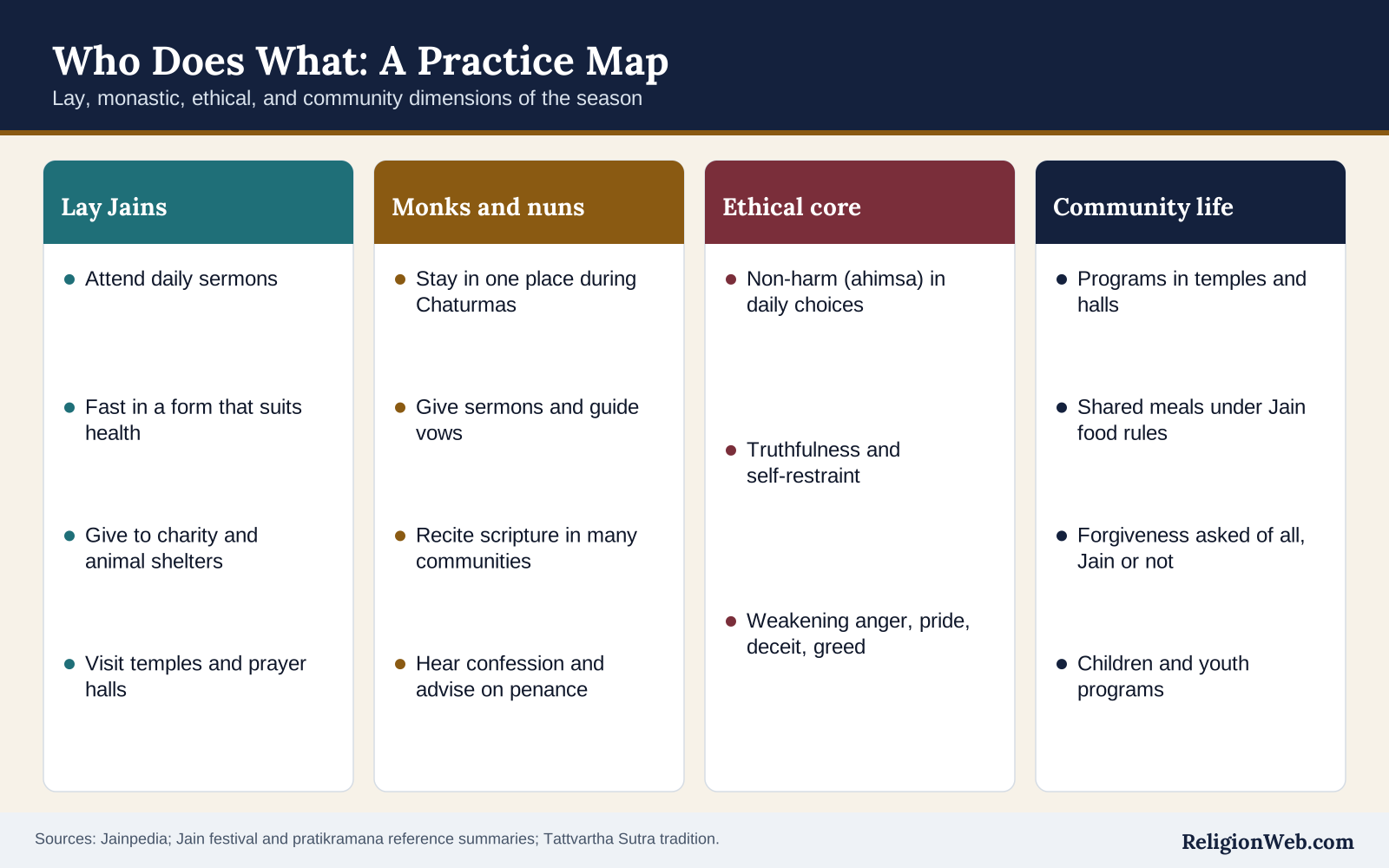
Lay, Monastic, and Community Life During the Season
Monastics and Laypeople Together
What monks and nuns do
For monks and nuns, Paryushana is not an extra layer of austerity but a period in which they put their teaching role at the center. They are already living under the five great vows, and their daily routine includes study, meditation, and pratikraman. During the festival they give sermons, hear confessions, guide laypeople in vows, and in some traditions recite the Kalpa Sutra. Because Jain monastics do not handle money or cook, they depend on lay support for food and lodging, and the festival is the time of year when that interdependence is most visible. Some monastics undertake long fasts of their own at the same time.
What laypeople do
Laypeople take on a version of monastic discipline suited to a household. They may reduce work, avoid travel, simplify meals, wear plain clothing, attend the daily lecture, join in prayer, and give to charity. Families with a member undertaking a long fast organize their routines around that person, and neighbors and relatives visit to offer encouragement. Householders also contribute labor: preparing the hall, serving meals to visitors, caring for the elderly, and organizing the program. In many Jain communities, the festival is as much an exercise in community organization as in individual devotion.
Ethics in Public Life
Protecting life and the slaughterhouse question
The first of the five annual duties, amari pravartan, is about protecting life, and it has public consequences. Reference sources note that several Indian states with large Jain populations, including Rajasthan, Gujarat, and Maharashtra, have kept slaughterhouses closed for one to eight days during the festival, and that Jainpedia and other summaries report a 2008 ruling of the Supreme Court of India that upheld a ban on slaughter in Ahmedabad during Paryushana. Supporters point to long precedent for such restrictions, including medieval rulers who limited slaughter on Jain holy days at the request of Jain teachers. Critics emphasize the rights of other communities to follow their own dietary customs and livelihoods, and the disputes have become part of wider debate over religion, food, and law in India. The article on ahimsa in Jainism places these disputes in the context of the tradition’s longer history of efforts to protect animals.
Charity, community meals, and consideration for neighbors
Charity has a place at every level. Families donate to animal shelters (panjrapols), hospitals, and schools, and community kitchens serve meals prepared according to Jain rules, which exclude root vegetables and food prepared after dark. Jains who live in mixed neighborhoods typically try to explain their practices to non-Jain neighbors and colleagues, and some invite them to attend a lecture or share a meal. The tradition’s approach to outsiders is explanatory and not evangelical, and most Jain communities do not seek converts.
Modern and Diaspora Practice
Forgiveness by message and call
One of the most visible modern changes is the way Michchhami Dukkadam travels. Where earlier generations visited or wrote letters, many families now send greetings by phone call, text message, or social media, and the phrase has become widely familiar well beyond the Jain community. Jain teachers have mixed views of this change. Some welcome it as a way to keep ties alive across continents; others caution that a mass message is a poor substitute for face-to-face reconciliation with a person one has actually wronged, and encourage people to send at least a personal note to those with whom there has been a rift.
Passing the season to the next generation
Jain centers in North America, Europe, and East Africa increasingly place children and young adults at the center of the festival’s program. Educational sessions, youth-led pratikraman instruction, and community service days have been added in many places, and organizations such as the Federation of Jain Associations in North America, founded in the early 1980s, coordinate resources across temples. These programs reflect the tradition’s concern that the season not become a ritual performed by elders and watched by the young, and its recognition that a festival centered on self-examination cannot be delegated.
Common Misconceptions About Paryushana
Misconception 1: Paryushana is mainly a fasting contest
Where the misunderstanding comes from
News reports and social media tend to feature the most dramatic parts of the season: a person finishing a month without food, a large procession honoring a faster, a crowd gathered at a temple for the ending of a fast. Those scenes are real, and in many communities they are occasions of pride. Because the rest of the festival, such as sermons, study, and pratikraman, is quieter and less photogenic, outside observers can easily conclude that endurance is the point.
The vocabulary of “records” and “challenges” in media coverage adds to the impression. When a fast is described in terms of days completed, it sounds like an achievement to be ranked, and the numbers invite comparison in a way that confession and study do not.
What the evidence and tradition actually show
Jain texts treat fasting as one of twelve austerities, six external and six internal, and they rank the inner ones, including atonement, study, and meditation, as the goal of the outer ones. The five annual duties of the Shvetambara festival include a three-day fast, but they also include protecting life, helping fellow Jains, asking forgiveness, and visiting temples. The festival’s central acts, the sermon cycle and the annual pratikraman, involve no fasting at all, and a person who cannot fast takes a full part in them.
Jain teachers themselves caution against fasting for display or in competition. A fast that increases pride or anger is considered to have defeated its purpose. Communities do honor those who complete long fasts, and that honor is real, but the doctrine measures the fast by the calm it produces and not by its length.
Discussion inside the community shows the same tension. Some Jain writers and teachers have questioned whether elaborate celebrations, public gifts, and costly feasts for long fasters fit the ideal of non-possession (aparigraha), while others defend them as joyful expressions of community support. The existence of the debate is itself evidence that the tradition does not equate the festival with a test of stamina.
Misconception 2: Every Jain fasts for the same number of days
Where the misunderstanding comes from
Because Shvetambara Paryushana lasts eight days and Digambara Das Lakshana ten, some readers assume that every observer fasts for the whole festival. English-language summaries sometimes encourage that reading by saying that “Jains fast” for the festival without describing the range. The fact that the longest fasts are the best-known and the most photographed adds to the impression.
What the evidence and tradition actually show
Fasting is voluntary and graded. Reference summaries describe fasts ranging from one day to a month or more, and many Jains take a lighter discipline, such as giving up green vegetables or eating one meal a day. Common patterns include a full fast on Samvatsari, a three-day fast during the last days, or a set of shorter fasts spread across the week. A smaller number undertake the eight-day athai or a month-long fast, usually after preparation and with a teacher’s advice.
The practice also depends on health, age, and circumstances. Teachers advise older people, children, pregnant women, and those with medical conditions to choose gentler forms or to refrain from fasting, and they regard participation through study, charity, and forgiveness as complete. The range of observance within a single family can be wide, and no one is considered a lesser Jain for fasting less than others.
Digambara practice shows the same range. Some Digambara laypeople keep a vow of fasting or single daily meals for all ten days of Das Lakshana, while many choose particular days, such as the first, the last, or alternate days. The pattern is a matter of individual vow, taken with the advice of a teacher, and not of a rule applied to everyone alike.
Misconception 3: Paryushana and Das Lakshana are the same festival with two names
Where the misunderstanding comes from
Many general sources use “Paryushana” as an umbrella term for both, and they sometimes describe Das Lakshana as “the Digambara name” for Paryushana. The two festivals do overlap in season and purpose, they occur back to back or even partly on the same day in some years, and members of the two traditions living in the same city may greet each other with the same phrase. For non-Jains, the simplification is understandable.
What the evidence and tradition actually show
The two festivals have different lengths, different organizing principles, and different central texts. Shvetambara Paryushana lasts eight days and moves toward Samvatsari, the day of the annual pratikraman, with the Kalpa Sutra at the center in Murtipujaka communities. Digambara Das Lakshana lasts ten days and takes up one of ten virtues each day, drawing on the Tattvartha Sutra, with Kshamavani as the closing day. Their forgiveness days fall on different dates, and their ritual vocabulary differs, as in the contrast between Michchhami Dukkadam and Uttam Kshama.
The better description is that they are two related festivals with a shared purpose, a shared monsoon-season setting, and a shared emphasis on forgiveness. Some sources describe the Digambara festival as beginning on the day after Paryushana ends, others as starting on the same day as Samvatsari, and both descriptions reflect real differences in calendars from year to year. Treating them as identical overlooks the structure that gives each its character.
For a visitor, the practical consequence is simple: ask which festival a family or temple observes. A Digambara host will talk about the ten virtues and about Kshamavani, while a Shvetambara host will talk about the Kalpa Sutra, the fourteen dreams, and Samvatsari. Using the right name is a courtesy that both communities appreciate.
Misconception 4: Saying “Michchhami Dukkadam” automatically cancels the wrongs of the year
Where the misunderstanding comes from
The phrase is often glossed as “may my bad deeds be undone,” and in mass messages sent on Samvatsari it can look like a formula that clears the account for everyone at once. The popular image of forgiveness festivals as a “reset” encourages the same impression, and the sheer volume of greetings can make the exchange seem automatic.
What the evidence and tradition actually show
Jain teachers describe the phrase as an expression of regret and a request, not a ritual that works on its own. The tradition treats serious wrongs as requiring amends, and it expects the person asking to be sincere and to change. Even the monastic rule discussed earlier in this article, which requires disputants to appease one another, is aimed at ending the quarrel in fact and not merely at saying the words. The Uttaradhyayana passage quoted above speaks of the inner effects of begging forgiveness, such as peace of mind and goodwill, and not of any automatic cancellation of consequences. Karma in Jain thought is not erased by a spoken formula; it is worked through by changes in conduct and by the weakening of the passions.
The exchange is also mutual. The person asked is expected to forgive, and it is common for each to ask the other. Where a real quarrel exists, teachers encourage a personal visit or call in place of a mass message, since the aim is to loosen the hold of anger on both people.
Frequently Asked Questions About Paryushana
Questions About Meaning and Timing
What does Paryushana mean?
The word is usually explained as “abiding” or “coming together,” a reference to the rainy-season stay of monks and nuns in one place. Many Jain teachers also give a devotional reading, “burning away on all sides,” meaning that the season is meant to burn away karma. Both explanations are in use, and neither displaces the other.
When is Paryushana each year?
The festival is fixed by the lunar calendar: it ends on the fourth or fifth day of the bright half of the month of Bhadrapada (Samvatsari), and the Digambara festival runs from the fifth to the fourteenth day of that fortnight. In 2026 the Shvetambara days ran from September 8 to September 15, and the Digambara days were listed as about September 16 to 25. The dates for later years should be taken from a Jain calendar or from the local temple, because they vary by lineage and by location.
Is Paryushana the Jain New Year?
No. The Jain year, counted in the Vira Nirvana era, begins on the day after Diwali, which Jains observe as the anniversary of Mahavira’s liberation, as described in the article on Diwali. Paryushana comes a couple of months earlier and is a season of renewal in a spiritual sense, but it does not mark the start of the calendar year. Some writers describe it as a time to “close the books” before the new year, and the idea fits the festival’s emphasis on settling accounts.
Questions About Practice
Do all Jains fast during Paryushana?
No. Fasting is voluntary, and the form varies from skipping a meal to eating only one meal a day, to a full fast of several days. Many take only a limited discipline, and some, because of health or age, do not fast at all. The tradition regards study, worship, charity, and forgiveness as full participation.
Can non-Jains attend Paryushana events?
Many temples and centers welcome visitors, especially to the public sermons and to the community meals that follow. Visitors should ask the hosts about customs, which commonly include removing shoes, avoiding leather items, dressing modestly, and not bringing meat, eggs, or alcohol into the premises. Some portions, such as the pratikraman, are intended for participants who know the ritual, and a visitor may be asked to observe from the side.
What should one say on Samvatsari?
Jains say Michchhami Dukkadam, or Uttam Kshama in the Digambara tradition. A non-Jain friend or colleague who offers the greeting is generally received warmly, and a simple reply of the same phrase or of thanks is appropriate. The greeting is meant sincerely, so many people prefer to say it in person.
Questions About Ethics and Meaning
Why do Jains ask forgiveness from animals and other beings?
In Jain thought, all living beings have souls, and a person’s daily activities cause harm to many of them. The verse recited in the pratikraman is therefore addressed to all beings, as an acknowledgment of that cost. The practice does not claim to erase the harm, but it trains the attention to notice it.
Does asking forgiveness mean the wrong was permitted?
No. Asking forgiveness acknowledges that something was wrong. Jain teachers say that where a wrong has material or legal consequences, the person asking must also repair the harm and accept responsibility under the law.
How does Paryushana connect to the rest of Jain practice?
It brings together the practices that run through the year: fasting, study, worship, confession, and the ethic of non-harm. The Jainism article places it among the other Jain observances, such as Mahavir Jayanti and the nirvana observance at Diwali, and the article on Buddhist monastic life describes a separate rainy-season retreat tradition in another community, which illustrates how widely the monsoon shaped the religious calendar of South Asia.
Conclusion: What the Season Teaches
What the History Shows
From a rule about rain to a season of reconciliation
Paryushana began, as far as the sources show, as a rule for monastics: when the rains came, settle in one place, and avoid the harm that wandering would cause. Over the centuries it grew into a festival that draws in the whole community, with sermons, fasts, processions, and the annual pratikraman. The lay festival is in some respects far removed from the original rule, and it is also in line with it, since both are shaped by the same concern for the smallest forms of life and the same belief that restraint is learned together.
Two traditions, one aim
Shvetambara Paryushana and Digambara Das Lakshana take different routes through the season, one through the narrative of Mahavira’s life and the other through ten virtues, and both arrive at forgiveness. That convergence is one of the clearest indications of what the community considers central. A tradition that could have chosen fasting or ritual display as the climax chose instead the moment when people turn to each other and ask pardon.
How to Keep Exploring
Read the texts and the context
Readers who want to go further can start with the overview of Jainism and the life of Mahavira, then read the public-domain translations of the Kalpa Sutra and Uttaradhyayana Sutra by Hermann Jacobi, and the academic articles on Jainpedia. Each of these works has its own historical limits: the Kalpa Sutra is a Shvetambara scripture, and the Tattvartha Sutra is read differently by the two major communities, so it helps to keep track of which tradition is speaking.
Ask local communities
Because lived Jain practice varies by lineage, region, and family, the best source for the details of any year’s observance is the local temple or center, whose calendar and program set the dates and the form. Most communities are glad to explain what they are doing and why. The questions that tend to prompt the best answers are simple ones: what is the focus of this day, what is being asked of the participants, and what is meant by the words that people say to each other at the end.
Sources
The table below lists the principal external sources behind this article. Facts, dates and figures were checked against these and related primary, institutional and academic materials.
| # | Source | Publisher and type | Used for | Link |
|---|---|---|---|---|
| 1 | Jaina Sutras, Part I: Kalpa Sutra, Samachari (Rules for Yatis), tr. Hermann Jacobi, Sacred Books of the East vol. 22 (1884) | Internet Sacred Text Archive (sacred-texts.com) · Primary text | Rules 1 and 24 of the Samachari: start of Paryushana, rule on quarrels; quoted passages | sacred-texts.com |
| 2 | Jaina Sutras, Part II: Uttaradhyayana, Lecture 29, tr. Hermann Jacobi, Sacred Books of the East vol. 45 (1895) | Internet Sacred Text Archive (sacred-texts.com) · Primary text | Verse 17 on begging forgiveness (quoted); verses on repentance and self-denial | sacred-texts.com |
| 3 | Article: Paryusan, by M. Whitney Kelting | Jainpedia · Academic reference | Eight-day Shvetambara festival, Kalpa Sutra recitation, fasting, auctions, Das Lakshana, 2008 ruling | jainpedia.org |
| 4 | Paryushana | Wikipedia · Encyclopedia | 2026 dates, origin in the monsoon retreat, five duties, day-by-day pattern, fasting range, sect differences | en.wikipedia.org |
| 5 | Pratikramana | Wikipedia · Encyclopedia | Meaning, six avashyakas, five types of pratikraman and their timing, Samvatsari pratikraman | en.wikipedia.org |
| 6 | Jain festivals | Wikipedia · Encyclopedia | Kshamavani timing, Das Lakshana and Paryushana lengths, Anant Chaturdashi, Kalpa Sutra procession, fast names | en.wikipedia.org |
| 7 | Dharma (Jainism) | Wikipedia · Encyclopedia | The ten virtues of Das Lakshana and their English glosses | en.wikipedia.org |
| 8 | 6 facts about Jains in India | Pew Research Center (2021) · Demographic data | Pew India survey 2019 to 2020: 0.4% Jain, 109 Jain respondents, 92% vegetarian | pewresearch.org |
| 9 | Religious Composition of India, Appendix A: counts of people by religion and state (Census of India 2011) | Pew Research Center (2021) · Demographic data | 2011 census count of Jains (about 4.45 million) and leading states | legacy.pewresearch.org |
| 10 | Global Religious Landscape: Other Religions | Pew Research Center (2012) · Demographic data | Estimate of fewer than 250,000 Jains outside India | pewresearch.org |
Last fact-check date: 2026-10-21.