Prophet Muhammad (born in Mecca around 570 CE, died in Medina on 8 June 632 CE) is the Arabian man through whom, in Muslim belief, God revealed the Qur’an, and whom Muslims honor as the last prophet and messenger in a line that began with Adam. He was a member of the Quraysh tribe, orphaned young, and worked as a merchant before he began receiving revelations at about the age of forty. After years of preaching in Mecca he migrated in 622 CE to the oasis town of Medina, where he led a growing community, and by the time of his death most of the Arabian Peninsula had come under the authority of that community. For Muslims, he is the central human figure of Islam, not as an object of worship but as the one chosen to deliver God’s message and to show how to live by it.
That distinction shapes everything in this article. Muslims believe that the Qur’an is God’s own speech, recited by Muhammad but not composed by him, and they hold that his words, actions, and silent approvals, preserved in reports called hadith, form a second source of guidance known as the sunna. About two billion people, roughly one in four on Earth according to Pew Research Center’s 2020 figures, identify as Muslim, and nearly all of them invoke blessings on Muhammad whenever his name is mentioned, pray in the manner he is remembered to have taught, and look to his example when they ask how to treat a neighbor, raise an orphan, or keep a promise.
Writing about Muhammad requires care about what kind of claim is being made. Historians work from sources that were written down mostly after the first Islamic century, and they disagree about how much detail those sources preserve. Muslim scholars have developed their own rigorous disciplines for sorting reliable reports from weak ones, and Muslims also relate to his life as sacred memory, not only as a set of historical data points. This article keeps those registers apart: what the sources report, what tradition holds, what Muslims believe and practice, and where scholars, Sunni and Shia authorities, and historians differ.
The chapters that follow move from the sources and the Arabia of his birth through the Meccan and Medinan years to his death, and then to how he is understood in Islamic belief, how his example shapes worship, ethics, and law, how Muslims honor him, and how his life is debated and taught today. Readers who want the broader context of the faith can begin with the overview of Islam, and readers interested in how his reported words are authenticated will find a full treatment in the article on hadith.
Prophet Muhammad at a Glance: Names, Dates, and Why He Matters
Who Muhammad was in brief
Name, lineage, and the meaning of “Muhammad”
His full name in Arabic is Muhammad ibn Abd Allah ibn Abd al-Muttalib ibn Hashim, meaning Muhammad son of Abd Allah, son of Abd al-Muttalib, son of Hashim. The last name belongs to the clan of Hashim (Banu Hashim), a respected but not especially wealthy branch of the Quraysh, the tribe that held custody of the Kaaba sanctuary in Mecca. He is also known by the kunya, or honorific parent-name, Abu al-Qasim, “father of al-Qasim,” after the first son he is reported to have had, who died in infancy.
The name Muhammad comes from the Arabic root h-m-d, associated with praise, and is usually translated “the praised one” or “highly praised.” The Qur’an uses the name four times in total, and it also contains a closely related form, Ahmad, in a verse about a messenger yet to come, which Muslim exegetes have traditionally understood as a reference to Muhammad. In daily Muslim speech he is more often called “the Prophet” (an-Nabi) or “the Messenger of God” (Rasul Allah) than by name alone.
The shape of the life in a few sentences
Muslim and historical sources agree on the broad outline. He was born into the Hashim clan around 570 CE, lost his father before birth and his mother in early childhood, and was raised by his grandfather and then by his uncle Abu Talib. In his twenties he took part in the caravan trade and married Khadija, a Meccan businesswoman, and the marriage is remembered as devoted and lasting until her death in 619. Around 610 he began to receive revelations, which he recited to a small circle and then publicly. Opposition from powerful Meccans grew, and in 622 he and his followers left for Medina, an event known as the Hijra.
In Medina he became arbiter, community leader, and teacher, and the following decade brought the battles of Badr, Uhud, and the Trench, the treaty of Hudaybiyya, the return to Mecca in early 630, and a final pilgrimage in 632. He died a few months later after a short illness and was buried in Medina. Each of these stages receives its own section below, together with the evidence on which the account rests.
Essential vocabulary for reading about the Prophet
Nabi, rasul, and the idea of prophethood
Islamic theology distinguishes between a nabi, a prophet who receives revelation from God, and a rasul, a messenger entrusted with delivering a scripture or a new body of law to a people. Many Muslim scholars hold that every messenger is also a prophet, but not every prophet is a messenger. Muhammad is called by both titles, and the declaration of faith, the shahada, joins his name to God’s: “There is no god but God, and Muhammad is the Messenger of God.” This sentence is the first of the Five Pillars of Islam.
Sunna, hadith, sira, and maghazi
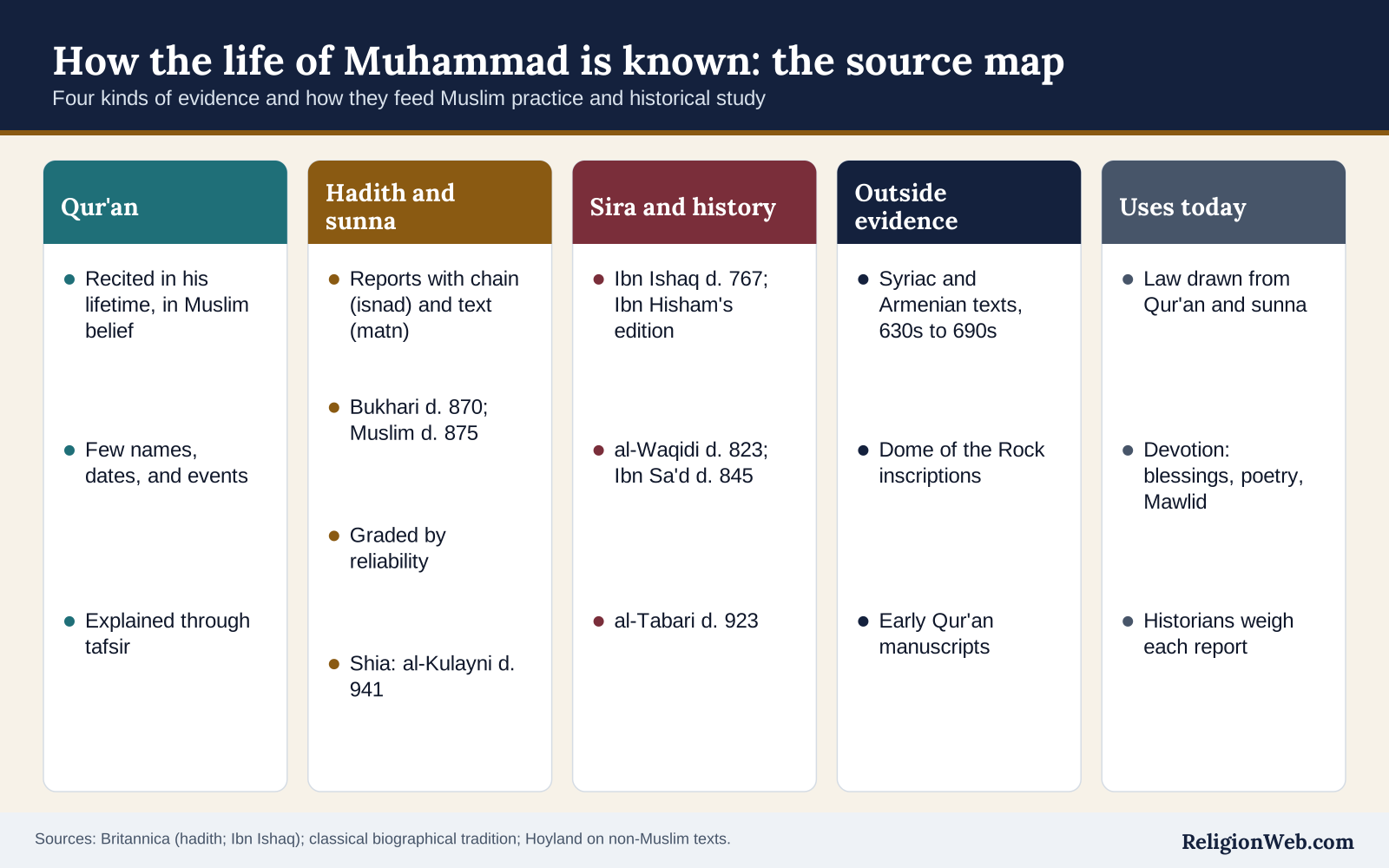
Four terms recur in any serious discussion of his life. The sunna is the model of conduct associated with him, and a hadith is an individual report, with a chain of transmitters, of something he said, did, or approved. The sira is a biography, from an Arabic word for “way” or “course of life,” and maghazi are accounts of his military expeditions, a genre that grew into the earliest biographical writing. The relationship among these categories is explained in the section on sources and charted in the infographic that follows it.
Hijra, ummah, and the Companions
The Hijra is the emigration of Muhammad and his followers from Mecca to Medina in 622, and it gave its name to the Islamic calendar. The ummah is the community of believers, a word that acquires particular weight in Medina. The sahaba, or Companions, are those who met Muhammad as believers and died in that faith, and their memories form the first link in most chains of transmission. Both Sunni Islam and Shia Islam honor the Companions, though they assess particular individuals and their roles in different ways, a point taken up later.
How to read this article
Three registers: history, tradition, and devotion
Three kinds of statement appear throughout. Historical statements describe what the earliest and best-attested sources support and how scholars weigh them. Traditional statements describe what the classical Muslim biographers and hadith collectors report, often with great precision about dates and names that modern historians cannot always confirm. Devotional and doctrinal statements describe what Muslims believe about him, which includes that he received genuine revelation, an assumption this site reports as belief and does not endorse or dispute. Where the three diverge, the text says so.
Honorifics and style
Muslims customarily follow the Prophet’s name with a blessing, in Arabic sallallahu alayhi wa sallam, usually rendered “peace and blessings be upon him” and abbreviated in print as “PBUH” or with a calligraphic symbol. The Qur’an itself instructs believers to invoke blessings on him (33:56). In this reference work the formula is not repeated after each mention, as is the convention in academic writing, but the practice behind it is described in the section on devotion and etiquette. “The Prophet” capitalized is used when the sources or Muslim usage are being described, and “Muhammad” is used in narrative.
Key dates in the life of Muhammad
A dated outline with source cautions
The table below gives the principal events in the sequence in which the classical sources place them. Dates before the Hijra are approximate and rest on later tradition, and many dates after it are given in the Hijri calendar (AH, anno Hegirae), converted here to the nearest year of the Common Era.
| Approximate date | Event | Note on the evidence |
|---|---|---|
| c. 570 CE | Birth in Mecca into the clan of Hashim; tradition links the year to the “Year of the Elephant” | Britannica gives c. 570; the precise year is not securely known |
| c. 577-578 CE | Death of his mother Amina, then of his grandfather Abd al-Muttalib; Abu Talib becomes his guardian | Known from the sira tradition; ages given are approximate |
| c. 595 CE | Marriage to Khadija bint Khuwaylid | Most sources give his age as about 25 and hers as about 40 |
| c. 610 CE | First revelation in the cave of Hira, traditionally in Ramadan | Reported in Sahih al-Bukhari and the sira; Muslims associate it with Qur’an 96:1-5 |
| c. 613 CE | Public preaching begins after a period of private teaching | Traditional chronology; the length of the private phase varies by source |
| c. 615 CE | First group of Muslims emigrates to Abyssinia | Reported in the sira; a refuge under a Christian ruler |
| 619 CE | Deaths of Khadija and Abu Talib; unsuccessful appeal at Ta’if | Khadija’s death in 619 is given by Britannica |
| c. 620-622 CE | Pledges with delegations from Yathrib (Medina) at Aqaba; Night Journey traditionally placed in this period | The date of the Night Journey is disputed even among classical authors |
| 622 CE (1 AH) | The Hijra to Medina; the Islamic era is counted from this year | Britannica gives 16 July 622 as the era’s first day |
| 624 CE (2 AH) | Change of the prayer direction; Battle of Badr in March | Badr is mentioned in the Qur’an (3:123) |
| 625-627 CE (3-5 AH) | Battle of Uhud; siege of Medina (the Trench); end of the Qurayza episode | Details are debated; see the section on contested episodes |
| 628 CE (6 AH) | Treaty of Hudaybiyya with the Quraysh | A ten-year truce according to the sira |
| 630 CE (8-9 AH) | Entry into Mecca; Battle of Hunayn; expedition to Tabuk | Hunayn is mentioned in Qur’an 9:25 |
| 632 CE (10-11 AH) | Farewell Pilgrimage in March; death in Medina on 8 June | Britannica gives 8 June 632 and an age of about 62 |
Reading Hijri and Common Era dates
Dates in Muslim sources are given in the Hijri calendar, which counts lunar years from the Hijra, so a single event can be written in two ways, for example “the second year of the Hijra” or “624 CE.” Because a lunar year is about eleven days shorter than a solar year, converting between the two systems is exact only when the day, month, and year are all known, and many early dates in the sources are known only to the year. In this article a year in parentheses, such as “(2 AH),” gives the Hijri year, and the Common Era year beside it is the nearest equivalent. The reason the count begins in 622 is taken up in the account of the Hijra.
How We Know About Muhammad: Sources, Method, and Their Limits
The Qur’an as a source for his life
What the Qur’an says about Muhammad and his time
The Qur’an is the earliest source in the sense that Muslims and most historians date its contents to Muhammad’s lifetime, and it addresses him directly more often than it describes him. It calls him a warner and a bearer of good news, tells him what to say (“Say: …”), consoles him in hardship, and corrects him on occasion. It names him only four times, but its references to events are enough to anchor the framework of the biography: it speaks of the failed plots against the Prophet and of a companion with him in a cave (9:40), of the victory at Badr (3:123), of the armies that besieged the believers (33:9), of a “clear victory” associated by the classical commentators with the treaty of Hudaybiyya (48:1), and of the rout at Hunayn (9:25).
One passage speaks directly to the Prophet’s early circumstances. It addresses him in the second person and reminds him of his own history, a moment that classical commentators place in the early Meccan period when the flow of revelation seemed to have paused.
Did He not find thee an orphan and protect (thee)? Did He not find thee wandering and direct (thee)? Did He not find thee destitute and enrich (thee)?
Qur’an 93:6-8, Marmaduke Pickthall, The Meaning of the Glorious Koran (1930)
Classical exegetes read these verses as pointing to the orphanhood, the search for guidance, and the later prosperity that the sira describes, which is why the passage is often cited in biographical discussion. Modern readers may note that “wandering” is rendered differently in other translations, and commentators have debated whether it describes spiritual searching or literal uncertainty. The translation here is the one named in the citation, and it is public domain.
What the Qur’an leaves unsaid
The Qur’an gives almost none of the details a biographer would want: it contains no birth date, no list of his wives and children, and no narrative of the journey to Medina beyond the cave. It treats the human story as secondary to God’s message, so its references are allusive and assume that the first audience already knew the background. For that reason the commentary tradition, known as tafsir, drew on stories about the circumstances in which particular verses were revealed (asbab al-nuzul), and those stories in turn became one of the building blocks of the biography.
The Qur’an’s own history of collection and its role in worship are covered in the article on the Qur’an. For present purposes, what matters is that biography and scripture are intertwined in Islamic tradition from early on, and that historians must ask whether a story preserved in a commentary reflects memory of events or an effort to explain a verse.
Hadith and the sunna
How a hadith report is built
A hadith has two parts: the isnad, a chain naming the people who passed the report down, and the matn, the content of what was said or done. Britannica notes that the six collections most authoritative for Sunni Muslims are those of al-Bukhari (died 870), Muslim ibn al-Hajjaj (died 875), Ibn Majah, Abu Dawud, al-Tirmidhi, and al-Nasa’i, and that Shia scholars regard four other works, beginning with al-Kulayni’s al-Kafi (died 941), as most authoritative. Because each collection arranges reports by topic, hadith provide material on worship, law, ethics, and the Prophet’s habits that biography does not, and a full guide to the genre is given in the article on hadith.
The reports vary enormously in weight. Some are narrated by many independent chains, and some by a single line. Muslim scholars graded them as sound, good, or weak according to the reliability of the narrators and the continuity of the chain, and this science, ilm al-rijal or the study of the transmitters, is among the most detailed examples of source criticism in the premodern world.
Muslim and modern critical evaluation
Modern academic study of hadith began in the nineteenth century with European writers such as William Muir and was put on a systematic footing by the Hungarian scholar Ignaz Goldziher (died 1921), who argued that many reports reflected the legal and theological debates of later generations rather than the Prophet’s own time. Joseph Schacht extended the argument to Islamic law in the mid-twentieth century. Britannica notes that some Western scholars take a radically skeptical view, arguing that hadith did not originate with Muhammad, while others accept the broad outline of the Muslim account but evaluate each report separately.
More recent work, such as that of Harald Motzki, tests reports by comparing chains and texts together, and has argued that some material can be traced back to the generation of the Companions’ students. Muslim scholars, for their part, observe that the classical collectors already rejected enormous numbers of reports and developed internal criteria, and they generally regard the major collections as sound in their reliable sections. These approaches do not reach identical conclusions, which is why a careful account of the Prophet’s life distinguishes between broad outlines widely agreed upon and individual details with a contested pedigree.
Biography: sira and maghazi
Ibn Ishaq, Ibn Hisham, and the surviving texts
The oldest complete biography is attributed to Muhammad ibn Ishaq, who was born around 704 in Medina and died in 767 in Baghdad, according to Britannica. His work on the Prophet’s life and campaigns does not survive in its original form. It is known through later editors, above all Ibn Hisham, who died some sixty years later and whose revision became the standard text. Ibn Hisham himself says, in a passage often quoted, that he omitted some material, and quotations from Ibn Ishaq also survive in the history of al-Tabari. Britannica adds that the jurist Malik ibn Anas criticized Ibn Ishaq, and that Ahmad ibn Hanbal accepted him as an authority on military campaigns but not for traditions with legal force, because he was not always exact in naming his informants.
This is the point on which much of the modern debate turns. Ibn Ishaq wrote about a century and a quarter after the events, and he gathered stories from informants in Medina, Egypt, and Iraq, some of which clearly came from family and tribal traditions that took pride in their ancestors’ roles in the early community. Historians therefore treat the work as an invaluable collection of early memory that cannot be taken as an eyewitness record.
Al-Waqidi, Ibn Sa’d, and al-Tabari
Later writers added to this foundation. Al-Waqidi (died 823) wrote a detailed account of the campaigns, and his secretary Ibn Sa’d (died 845) compiled a large biographical dictionary of the Prophet, the Companions, and their successors, which is a major source for the social history of the early community. Al-Tabari (died 923) produced a vast chronicle in which the Prophet’s biography forms the opening section after the pre-Islamic history, and he often preserves several versions of an episode, leaving the reader to choose. Their dates are those given in the classical biographical tradition.
These works differ in genre as well as detail. The sira tells the story as a connected narrative, whereas the classical dictionaries are organized by person or by generation, and the chronicles by year. Reading across them, scholars can sometimes see how a story grew, acquired names, and changed its emphasis between one generation of transmitters and the next.
Evidence from outside the Muslim tradition
Early non-Muslim writers
A small group of seventh-century Christian writers in Syriac, Greek, and Armenian mention Muhammad or his followers, and they are valuable because they were not shaped by the later Muslim community. A Syriac chronicle composed around 640, usually called the Chronicle of Thomas the Presbyter, refers to a battle in Palestine in 634 between the Romans and the “Arabs of Muhammad.” The Armenian bishop Sebeos, writing around the 660s, describes a merchant named Muhammad who taught the Arabs of the God of Abraham and led them to claim the promised land. The scholar Robert Hoyland has collected and discussed these texts. They confirm that a man named Muhammad was recognized as a leader of the movement within a few years of the traditional date of his death, though they say little about his earlier life and sometimes disagree with the Muslim tradition about details.
Inscriptions, coins, and manuscripts
Material evidence from the end of the seventh century also records his name. The inscriptions on the Dome of the Rock in Jerusalem, which Britannica dates to the late seventh century, name Muhammad as the messenger of God and invoke blessings on him, and later in that period coins issued in the Umayyad realm bear the same formula. Parchment fragments of the Qur’an, some of them radiocarbon dated to a period that overlaps with Muhammad’s lifetime, show that the text was being written down early, although scholars differ on how to interpret such dating. None of this replaces a continuous narrative, but it shows that the formative claims of the tradition were already in place within about sixty years of his death.
Method: three scholarly stances
Trusting the tradition, testing it, or setting it aside
Roughly three positions can be distinguished. Many Muslim scholars and some historians, among them William Montgomery Watt, treat the classical biography as a largely reliable framework that needs to be sifted for later accretions. A second group, represented by researchers who use transmission-critical methods such as Motzki, accepts that some early material survives and tries to identify it by comparing chains. A third, more skeptical group, associated with John Wansbrough and with Patricia Crone and Michael Cook in their early work, doubts that the tradition can be used to reconstruct events at all and looks instead to non-Muslim and documentary evidence. As Britannica’s article on hadith observes, Western scholarship on the traditions has ranged from radical skepticism to acceptance of the broad outline of the Muslim account combined with report-by-report evaluation.
How this article handles the differences
The great majority of historians accept that Muhammad was a real historical figure who lived in western Arabia in the late sixth and early seventh centuries and led a movement that expanded rapidly after his death. Disagreement concerns the details: how much of the Meccan biography is reliable, how to read the stories of the Medinan battles, and how the narrative changed in transmission. This article therefore presents the traditional narrative as the account Muslims have transmitted, marks dates as traditional when they are, and flags episodes where scholars of different outlooks disagree.
| Source type | Earliest written form | What it offers | Cautions |
|---|---|---|---|
| Qur’an | Muslims hold it was recited in Muhammad’s lifetime; early manuscripts date to the seventh century | Direct address to the Prophet; allusions to Badr, Hunayn, the Trench, Hudaybiyya, and the cave | Few names and dates; assumes background knowledge |
| Hadith collections | Compilations of the ninth century, such as al-Bukhari (died 870) and Muslim (died 875) | Sayings, practices, and approvals; detail on worship, law, and personal conduct | Vary greatly in reliability; arranged by topic, not by chronology |
| Sira and maghazi | Ibn Ishaq (died 767), preserved in Ibn Hisham’s recension; al-Waqidi (died 823) | A connected narrative from birth to death, including campaigns | Written about a century after the events; includes legendary and edifying material |
| Biographical dictionaries and chronicles | Ibn Sa’d (died 845); al-Tabari (died 923) | Social history of the early community; competing versions of events | Compilations of earlier reports; the compiler’s selection matters |
| Qur’anic commentary (tafsir) | Third and fourth Islamic centuries and later | Occasions of revelation; background of verses | Stories may be later explanations of verses |
| Non-Muslim writers | Syriac, Greek, and Armenian texts from the 630s to the 690s | Independent confirmation that Muhammad led the movement; outsider perspective | Brief and often hostile or confused; no detailed life |
| Inscriptions and coins | Late seventh century, including the Dome of the Rock | Early public statements of Muslim belief about Muhammad | Written after his lifetime; official, not biographical |

Arabia Before the Prophet: Mecca, Medina, and the Late Sixth-Century World
The Hijaz, Mecca, and the sanctuary
Mecca, the Quraysh, and the Kaaba
Muhammad was born in the Hijaz, the western strip of the Arabian Peninsula along the Red Sea, in a valley town that had grown up around a sanctuary. Britannica describes the Quraysh as the ruling tribe of Mecca at the time of his birth, with ten main clans, among them Hashim (his own), Zuhra (his mother’s), Taim (Abu Bakr’s), Adi (Umar’s), and Umayya (Uthman’s, and later the ruling house of the Umayyad caliphs). The tribe’s standing rested on its custody of the Kaaba, a cube-shaped shrine to which Arabs from many tribes came on pilgrimage, and on its position as a broker among the caravan routes.
Muslim tradition holds that the Kaaba was originally built by Abraham and his son Ishmael as a house for the worship of the one God, and that over centuries it came to hold images of many deities. Mecca was therefore both a commercial and a religious center, and its sacred territory, within which bloodshed was forbidden, helped to make it a safe place to trade. This blend of religion and commerce is essential to understanding the stakes of Muhammad’s preaching, because a message that condemned the images in the Kaaba also challenged the system that made Mecca prosperous. The later history of the sanctuary and its rites is treated in the article on Hajj.
Caravans and the wider Near East
Arabia was not isolated. In the late sixth and early seventh centuries the region lay between two great empires, the Byzantine (Roman) Empire to the northwest and the Sasanian Empire of Iran to the northeast, which fought a long and exhausting war between 602 and 628. Southern Arabia had been ruled by the kingdom of Himyar and then contested by the Christian kingdom of Aksum across the Red Sea, whose commander Abraha figures in the Muslim tradition of Muhammad’s birth year. Merchants from Mecca traveled to Syria and Yemen, and Christian and Jewish communities lived in oases and trading towns.
The Qur’an itself reflects awareness of these wider events. A sura titled “The Romans” opens by saying that the Romans have been defeated in a nearby land and will be victorious within a few years (30:2-4). Commentators have usually connected the verses to the Byzantine losses to Sasanian forces in the Near East during the 610s and to the Byzantine recovery later, and the passage shows how Muhammad’s audience followed distant politics with interest.
Religion and society before Islam
Polytheism, the High God, and monotheists in Arabia
Most Arabs of the Hijaz in this period worshiped multiple deities, among them figures the Qur’an names such as al-Lat, al-Uzza, and Manat, and the Kaaba is reported to have housed many images. Muslim sources also say that the Meccans knew a supreme God, Allah, whom they regarded as creator, while seeking the intercession of lesser beings. The Qur’an reproaches them for associating partners with God, and for this reason Muslim writers call the period before Islam the jahiliyya, usually translated as the “time of ignorance,” a term whose meaning and moral judgment are discussed in modern scholarship.
Alongside the polytheists were Jewish communities, particularly in Yathrib and in the oasis of Khaybar to its north, and Christians in places such as Najran in the south. The sources also speak of hanifs, individuals who rejected the images and worshiped one God without belonging to an organized community; the Qur’an uses the word of Abraham. Muhammad grew up among all these currents, and his message was articulated in a world already familiar with questions about one God, scripture, and prophecy.
Tribal law, honor, and the vulnerable
Social life was organized around clan and tribe. A person’s safety depended on the willingness of their kin to defend them, and the system of blood vengeance meant that a killing could lead to a cycle of feuds. Those without strong kin, including orphans, widows, slaves, and clients, were vulnerable. Hospitality, loyalty, courage, and poetry were the central values of the honor culture, and Arabic poetry was the main art of the period.
The Qur’an’s concern for orphans, the poor, and the powerless, and its stress on moral accountability before God, should be read against this background. For Muhammad personally, protection by his clan was decisive. As long as his uncle Abu Talib, the head of Banu Hashim, was alive, Meccan opponents hesitated to attack him, and this fact explains why the loss of Abu Talib in 619 became a turning point.
Yathrib, the oasis that would become Medina
An agricultural oasis and its clans
Yathrib, roughly 210 miles (340 kilometers) north of Mecca in a straight line, was a farming oasis dotted with fortified compounds and date palm groves. Its Arab population was divided between two main tribes, the Aws and the Khazraj, and the oasis was also home to several Jewish clans, of which the Banu Qaynuqa, the Banu Nadir, and the Banu Qurayza became best known in the sources. The two Arab tribes had been in a long conflict, and the sira tradition describes a major battle at Bu’ath in the years before the Hijra that left the oasis exhausted.
After the Hijra the town came to be called al-Madina, “the city,” and eventually Madinat al-Nabi, “the city of the Prophet.” Britannica gives its formal name as al-Madina al-Munawwara, “the luminous city,” and notes that it is regarded as the second holiest city of Islam.
Why Yathrib invited an outsider
Several delegations from Yathrib met Muhammad at Mecca during the pilgrimage seasons around 620 to 622, according to the sira. Their interest is generally explained by the internal conflict in the oasis. A leader from outside the clan structure, respected for his integrity and bringing a message of one God that Jewish neighbors could recognize, appeared to offer a basis for peace. In this account, the people of Yathrib invited him not to rule but to arbitrate and to bring a new bond of faith that could unite the rival tribes.
This invitation must be understood in the context of what had happened in Mecca by that time, a story that begins with Muhammad’s birth and upbringing.
Birth and Early Life in Mecca (c. 570 to c. 610 CE)
Birth, orphanhood, and guardianship
Birth and the Year of the Elephant
Britannica gives Muhammad’s birth as around 570 in Mecca. Muslim tradition adds that he was born on a Monday in the month of Rabi al-awwal, most often given as the twelfth day, though many Twelver Shia authorities prefer the seventeenth, a difference that affects how the birthday is observed. Tradition also ties the year to the “Year of the Elephant,” when an army led by Abraha, ruler of Yemen, approached Mecca with an elephant and was turned back. The Qur’an’s brief sura “The Elephant” (105) refers to this event without naming the year of birth.
Historians treat the link with caution. Arabs named years after notable events rather than numbering them, so the connection of the birth with a famous year is typical of how memory was organized, but it is difficult to fix the date of Abraha’s campaign independently. The “around 570” is thus a convenient approximation that Muslim and non-Muslim scholars use, not a precise date.
The loss of parents and the care of Abu Talib
According to the sira, his father Abd Allah died before he was born, or shortly after, while returning from a trading trip. The infant was placed for a time with a Bedouin wet nurse in the desert, as was customary among urban families, and the tradition names her as Halima of the Banu Sa’d. His mother Amina died when he was about six, and he passed to the care of his grandfather Abd al-Muttalib, who died two years later. From then on his uncle Abu Talib, the new head of Banu Hashim, was his guardian.
The picture of a child who had lost the protectors that most children could count on has a special resonance in Muslim memory, partly because the Qur’an reminds him of his own orphanhood (93:6-8, quoted above) and partly because care for orphans is a recurring theme of its ethical teaching. The details of the childhood narrative are preserved in later sources and should be read as the community’s memory.
Youth, work, and reputation
Caravan trade and the name al-Amin
Like many young men of his clan, Muhammad worked in the caravan trade. Tradition holds that he accompanied Abu Talib on a trading journey to Syria as a boy, and that later he managed caravans for others, earning a reputation for honesty that gave him the nickname al-Amin, “the trustworthy.” A story about a monk named Bahira who recognized signs of prophethood in the boy on that early journey circulates widely in the sira, but even classical Muslim scholars discussed its reliability, and modern historians generally treat it as a devotional embellishment, which is the position of some medieval authorities as well.
The reputation for trustworthiness is more securely woven into the larger narrative, because it explains how the Meccans’ later rejection of his claims to prophecy could be framed around the fact that his character was not in question. The sources return to this reputation for truthfulness again and again as the starting point of his appeal, a theme taken up in the account of his public preaching.
Pacts, arbitration, and the rebuilding of the Kaaba
Two episodes in his youth are often used to illustrate his standing in Meccan society. In the first, he is said to have witnessed a pact called the Hilf al-Fudul, in which several clans agreed to protect the rights of strangers and the wronged, and he later spoke of it with approval. In the second, when the Quraysh rebuilt the Kaaba after a flood, the clans quarreled over who should have the honor of setting the Black Stone in place. Tradition reports that the Meccans agreed to accept the judgment of the next man to enter the enclosure, who was Muhammad, and that he resolved the matter by placing the stone on a cloak and having each clan lift a corner.
Both stories belong to the sira rather than to hadith collections focused on law, and historians treat them as traditional. They matter for the picture of him as a person who, before revelation, was already trusted to resolve disputes, and they foreshadow his role as arbitrator in Medina.
Marriage to Khadija and family life
Khadija bint Khuwaylid
Khadija was a wealthy merchant of the Quraysh who, according to Britannica, hired Muhammad when he was in his early twenties to manage a caravan to Syria and then proposed marriage herself. Most sources give her age as about forty and his as about twenty-five, though Britannica notes that the number of children she bore him suggests she may have been younger. The marriage lasted about twenty-five years, until her death in 619, and the tradition records that Muhammad took no other wife while she lived.
She occupies an exceptional place in Muslim memory. In the tradition of the first revelation she is the first to reassure him, and she is generally counted as the first person to believe his message. Her name is honored in Sunni and Shia communities alike, and Muslims know her among the “Mothers of the Believers,” the title the Qur’an gives to the Prophet’s wives (33:6).
Children and household
The tradition counts several children from this marriage. Sons named al-Qasim and Abd Allah died in infancy, and Sunni sources name four daughters who survived: Zaynab, Ruqayya, Umm Kulthum, and Fatima. Shia tradition places greater stress on Fatima and, as Britannica notes, counts her as the only daughter. Fatima’s descendants through her marriage to Ali, known as sayyids or sharifs, have held a distinct honored place in many Muslim societies.
The household also included Ali, the son of Abu Talib, who is reported to have been raised by Muhammad and Khadija as a child during a time of hardship for his father, and Zayd ibn Haritha, a young man who had been enslaved before being freed and who was close to Muhammad as an adoptive son. These are among the first people the tradition names as believers.
The seeker before revelation
Retreats to the cave of Hira
As he approached the age of forty, the sources say, Muhammad began to spend periods of time in solitude. A hadith narrated by his wife Aisha and recorded as the third report in Sahih al-Bukhari says that revelation began with true dreams that came as clear as the dawn, and that he came to love solitude and would stay for many nights worshiping in a cave on Mount Hira, above Mecca, taking provisions with him and returning to Khadija to replenish them. The hadith describes the practice with the Arabic verb tahannuth, which the report itself glosses as worship, and it gives no further detail.
The report does not say what form the worship took, and Muslim scholars have understood it variously: as reflection on the Creator, as a continuation of the monotheism associated with Abraham, or simply as prayer in a form not yet defined. What the account does establish is that the revelations came at the end of a period of inward seeking in which he was already attentive to the question of God.
What the sources say about his religious life before 610
The sources are cautious about any specific beliefs he held before prophethood. Muslim theologians have generally held that prophets are preserved from major sin and from idolatry before as well as after their commission, so the standard Muslim account is that he never worshiped the Kaaba’s images. Historians neither confirm nor refute such statements, because the sources are not contemporary.
The Qur’an addresses another question: whether he had a prior education in earlier scriptures. One verse tells him that he was not a reader of any scripture before the Qur’an and did not write it with his right hand (29:48). Muslim commentators drew on this and on the Qur’anic description of him as ummi to conclude that he could neither read nor write, and that the Qur’an therefore could not have been his own scholarly composition. Some modern interpreters read ummi differently, as “of the people without a scripture,” in contrast to the communities that already had one. Either way, the verse presents the revelation as new to him, and the tradition is consistent that it began suddenly in the cave.
Revelation and the Meccan Years (c. 610 to 622 CE)
The first revelation
The experience in the cave of Hira
The earliest account of how revelation began, narrated by Aisha and placed at the start of Sahih al-Bukhari, says that an angel came to Muhammad in the cave and told him to read. He answered that he was not able to read, and the angel pressed him tightly, repeating the command three times, before reciting the opening of what is now the 96th sura. In Muslim belief the angel was Gabriel (Jibril), and the first five verses of that sura are widely held to be the beginning of the Qur’anic revelation.
Read: In the name of thy Lord Who createth, Createth man from a clot. Read: And thy Lord is the Most Bounteous, Who teacheth by the pen, Teacheth man that which he knew not.
Qur’an 96:1-5, Marmaduke Pickthall, The Meaning of the Glorious Koran (1930)
Commentators have read the first command, iqra, as “read” or “recite,” and many note that the opening verses of the first revelation emphasize creation, generosity, and teaching by the pen. Traditional commentators found in this an emphasis on knowledge, while others have focused on the idea of recitation as the Qur’an’s defining form. The report is frank about the experience’s effect: Muhammad returned shaken to Khadija and asked to be wrapped up until his fear subsided.
Khadija, Waraqa, and the pause in revelation
According to the same report, Khadija reassured him by listing his qualities: that he kept ties of kinship, bore the burdens of others, supported those in need, honored his guests, and helped people struck by hardship. She then took him to her cousin Waraqa ibn Nawfal, an elderly man who had adopted Christianity before Islam and knew Hebrew writing. After hearing the account, Waraqa said that the one who had come to him was the same who had come to Moses, and he added that he wished he were young enough to support him when his people drove him out. Muhammad asked whether they would really expel him, and Waraqa replied that every prophet with a similar message had been met with hostility.
The report adds that Waraqa died soon after and that revelation paused for a time. The sources later call this interval the fatra, and they describe it as a period of anxiety for Muhammad, which the sura of the Morning (93) is understood to address. When revelation resumed, the tradition says, it was accompanied by instructions to rise and warn. Historians observe that this narrative is a pillar of the Muslim tradition and is not independently attested, while recognizing that its themes of fear, reassurance, and consultation are consistent with how the Qur’an itself describes his experience.
The Night of Power and the month of Ramadan
Muslims associate the beginning of the Qur’an’s revelation with the month of Ramadan, based on verses that say the Qur’an was sent down in that month and on a “Night of Power” (Laylat al-Qadr), which many commemorate on one of the last odd-numbered nights of the month. The traditional reading is that the first revelation in the cave fell in this period, which is why the fast and the night vigils of Ramadan are linked in Muslim practice to the memory of the Qur’an. The month’s rites are described in the article on Ramadan. How the Night of Power relates to the first cave experience, and exactly which night it is, are matters on which Muslim scholars and communities hold different views.
The private call and public preaching
The first believers
The sira names Khadija as the first to accept his message, followed by Ali, then a boy or young adolescent in Muhammad’s household, by Zayd ibn Haritha, and by Abu Bakr, a respected Meccan merchant whose conversion brought other figures into the movement. Many early followers came from the edges of Meccan society: young men from the leading clans, people without strong tribal protection, freed slaves, and enslaved persons. Bilal ibn Rabah, a formerly enslaved man of Abyssinian origin, became famous for his steadfastness under pressure and later served as the first muezzin of the community.
The tradition says that for a period of about three years he spoke privately to a small circle. The length of this phase varies between sources and the dating of its end, around 613, rests on later chronology. During this time, according to the sira, believers met in a house near Mount Safa, prayed together, and learned the early revelations.
The message of the early Meccan suras
The Qur’anic revelations of the Meccan period are generally short, rhythmic, and urgent. They speak of the oneness of God (tawhid), of God’s signs in nature, of the Last Day and the weighing of deeds, and of the duty to feed the poor, care for orphans, and refrain from cheating in trade. They criticize the arrogance of wealth and the practice of burying unwanted infant daughters, a custom mentioned in the Qur’an that scholars debate as to its extent. In the Meccan suras the polemic is aimed chiefly at the worship of other deities and at the social habits that went with it.
The Meccan suras also reassured the small band of followers, repeating stories of earlier prophets who were rejected by their own people and later vindicated. These narratives gave his followers a way of understanding their own situation as part of a long pattern, a theme that continues in the Medinan revelations and that Muslims see as the foundation of the Qur’an’s claim to confirm earlier messengers.
The public call at Safa and the Quraysh response
A report narrated by Ibn Abbas and recorded in Sahih al-Bukhari describes a turning point. After a verse commanded him to warn his near kindred (26:214), Muhammad climbed Mount Safa and called out to the Quraysh clans. When they gathered he asked whether they would believe him if he said a cavalry was about to attack from behind the hill. They replied that they would, because they had never known him to lie. When he then warned them of a severe punishment, his uncle Abu Lahab cursed him, and the short sura that bears Abu Lahab’s name (111) is held to have been revealed in response.
The story illustrates two aspects of the early encounter: the reputation of the messenger and the social cost of the message. The Meccan elite did not at first view him as a danger to public order. What they objected to, according to the sources, was his condemnation of their gods, his claim that their forefathers had been wrong, and his teaching about resurrection and judgment, which struck at the system of honor and status on which the clan structure rested.
Opposition, boycott, and refuge
Pressure on the early community and the emigration to Abyssinia
As the community grew, the Quraysh responded with ridicule, economic pressure, and violence against the weakest, who lacked the protection of strong clans. The tradition preserves the names of individuals who were tortured, including Bilal and the family of Yasir, whose wife Sumayya is remembered as one of the first martyrs of Islam. Believers with kin to protect them were sometimes treated less harshly.
Around 615, on Muhammad’s advice, a group of Muslims emigrated across the Red Sea to Abyssinia (Aksum), where the Christian ruler, whom the sources call the Negus, gave them refuge. In the sira account, the Muslim spokesman Ja’far ibn Abi Talib recited the opening of a Qur’anic sura about Mary before the Negus, and the Meccan delegation sent to bring the refugees back failed. This episode is one of the best-known instances of a theme that recurs in Muslim memory: the first Hijra was a flight to safety under a ruler who respected the believers’ right to worship.
The boycott, the Year of Sorrow, and Ta’if
The sira reports that the leading Meccan clans organized a boycott of the Banu Hashim and their allies, forbidding trade and marriage, an arrangement that lasted for about three years until it collapsed. In 619, within a short time of one another, Khadija and Abu Talib died. The sources describe this as the “Year of Sorrow,” because Muhammad lost both his closest companion and his political protector. Britannica confirms the date of Khadija’s death in 619.
Without Abu Talib, he was exposed to attack. He traveled to the hill town of Ta’if, east of Mecca, to seek support from its leaders, who rejected him and, according to tradition, set the townspeople to drive him out with stones. He returned to Mecca under the protection of a sympathetic Meccan notable. The account of Ta’if is regarded in Muslim memory as a moment of exceptional patience, and it is often cited in sermons about perseverance.
The Night Journey and the road to Medina
The Isra and Mi’raj
Sometime in the later Meccan years, the tradition places the Night Journey (Isra) and the Ascension (Mi’raj). The Qur’an refers to the first in a single verse, praising God who carried his servant by night from the Sacred Mosque to the Farthest Mosque (17:1). Hadith and the sira expand this into a night journey to Jerusalem and an ascent through the heavens in which Muhammad meets earlier prophets and receives, according to many reports, the duty of five daily prayers. The story is the foundation of the special place of Jerusalem in Muslim devotion and of many devotional texts and festivals.
Classical authors debated its details: whether it was a single event or two, whether it took place in body or spirit, and when it occurred. Britannica notes the Dome of the Rock is associated with the Ascension. Later Sunni theology widely holds that it was physical, while some early authorities and modern interpreters read it as a vision. The role of the five daily prayers in this narrative connects to the article on Salah.
The pledges at Aqaba
During the pilgrimage seasons around 620 to 622, Muhammad met small groups of men from Yathrib at a site called Aqaba, near Mecca. The sira describes a first meeting with six men, followed by a pledge by twelve, and then a larger meeting in 622 at which about seventy-five men and two women pledged to defend him as they would their own families. A representative from Mecca, Mus’ab ibn Umayr, was sent to teach the converts in Yathrib, and by the time of the second pledge Islam had spread among both Arab tribes.
The pledge was an extraordinary commitment, because it bound the people of Yathrib to protect an outsider against the wishes of the strongest tribe in the region. For that reason the people who welcomed the migrants in Medina became known as the Ansar, “the helpers,” and those who left Mecca as the Muhajirun, “the emigrants.” The sources add that the Meccan leaders learned of the arrangement and resolved to stop the migration, which brings the story to the Hijra.
The Hijra and the Medina Years (622 to 630 CE)
The Hijra: leaving Mecca
The journey and the arrival
By 622 most of the Meccan Muslims had already left for Yathrib in small groups, and the sources say the Quraysh leaders, alarmed at the prospect of a hostile base on their trade route, plotted to stop Muhammad himself. The sira reports that Ali slept in Muhammad’s bed to mislead watchers while Muhammad and Abu Bakr slipped out of Mecca and hid for several days in a cave on Mount Thawr, south of the city, before turning north by an unfrequented route. The Qur’an alludes to the cave, describing two men in it, the Prophet telling his companion not to grieve because God was with them (9:40).
They arrived on the outskirts of Yathrib in the month of Rabi al-awwal, according to the tradition, and the first mosque is said to have been established at Quba. The sources tell that as Muhammad entered the town the people vied to host him, and that he let his camel choose, and she knelt on land that became the site of his mosque and house. From then on the oasis was known as Medina.
First institutions: the mosque, the call to prayer, and the brotherhood
The mosque of Medina was a plain building of palm trunks and mud brick with a courtyard, used for prayer, for meetings, for the care of the poor, and for the reception of delegations. The call to prayer (adhan) was introduced in these early years, and Bilal, the former slave from Mecca, became the first to give it. The practice is described in the article on Salah.
The sources also describe a pairing of Meccan emigrants, who had left property behind, with Medinan helpers who shared homes and resources with them, a bond sometimes called a “brotherhood.” The Ansar’s generosity features in the Qur’an (59:9) and in the memory of the community. These arrangements were practical responses to a refugee crisis and, in Muslim tradition, a model of solidarity.
Building the community of Medina
The Constitution of Medina
Ibn Ishaq, in Ibn Hisham’s recension, preserves a document that modern scholars call the Constitution of Medina, in Arabic sahifat al-Madina, a short text that appears to regulate relations among the believers and between them and other groups in the oasis. A parallel version appears in the work of Abu Ubayd al-Qasim ibn Sallam. The text describes the believers of the Quraysh and Yathrib and those who joined them as one community (ummah) distinct from other people, provides that members will cooperate in paying blood-money and ransom, and states that the disputes of the signatories are to be referred to God and to Muhammad.
Its provisions on the Jewish clans allied with the Medinan tribes are notable: it states that they belong to the community with the believers, that they have their religion and the Muslims theirs, and that all will join in defending Medina against attack. The text also declares the interior of Medina a sacred area. Scholars treat it as one of the most important early documents, while noting that it survives only in the later transmission.
How scholars read the document
The date, the number of documents, and the nature of the text are all discussed. R. B. Serjeant proposed that the text combines several agreements made over the years, while others, including W. Montgomery Watt, treat it as a single early text from shortly after the Hijra. Some historians read it as a negotiated agreement among the parties, and others, such as Bernard Lewis, as a proclamation issued by Muhammad. Most accept it as broadly authentic, partly because its terms, including the inclusion of non-Muslims in the same political community and the lack of any protection for the Quraysh, do not correspond to later Muslim ideals.
For Muslims, the document is often discussed as evidence of the pluralism of the first community and its ethic of mutual defense. Modern historians emphasize that it must be read in the context of a tribal oasis in which different groups needed a framework for security, and caution against projecting later concepts such as constitutions or nation-states onto it.
Worship, law, and ritual in the Medinan revelations
The change of prayer direction and the rites of the Muslim year
In the early years the Muslims had faced Jerusalem in prayer, and the tradition places the change toward the Kaaba in the second year after the Hijra, around early 624, when a revelation instructed Muhammad to turn his face toward the Sacred Mosque (2:144). Muslim scholars regard the new direction, the qibla, as a defining marker of the community, and it remains the direction of prayer for Muslims worldwide.
The same period saw the institution of other rites. Fasting in the month of Ramadan was prescribed in the second year of the Hijra, according to the tradition, and the festival at its end, Eid al-Fitr, is said to have been first celebrated that year along with the obligation of the alms of fast-breaking. The obligatory alms tax (zakat) was also formalized in Medina. These practices, together with the daily prayers and the pilgrimage, are the foundation of the Five Pillars of Islam, and the detailed forms developed in the following decades.
Social and legal teaching
Much of the legal and social guidance in the Qur’an belongs to the Medinan period. It deals with marriage and divorce, inheritance shares for family members including women, the care of orphans’ property, the prohibition of usury (riba) and fraud, and the regulation of contracts. The community also had to decide how to handle punishment for crimes and how to deal with captives, and the Qur’an and the Prophet’s practice are the basis of centuries of juristic discussion on each of these.
These rulings should be read against the background of the seventh-century Arabian society that received them. Muslim jurists generally hold that the Medinan legislation improved the position of the vulnerable in that setting, for example by giving women a defined share of inheritance and the right to hold property, while modern debate concerns how its principles are best applied in other times. The relation between the Prophet’s example and the law is considered later in this article.
Conflict with the Quraysh
The Battle of Badr (624)
The first major battle took place in March 624 at Badr, southwest of Medina. Britannica notes that the Meccan force outnumbered Muhammad’s by about three to one, and that the early Muslims saw the victory as a divine intervention. The sira gives the Muslim force as around 300 against roughly a thousand Meccans. The Qur’an refers to the event, reminding the believers that God had already given them victory at Badr when they were weak (3:123), and many Muslims remember the battle as a proof that God supported the community.
The aftermath included the capture of prisoners and the death of several Meccan leaders, among them Abu Jahl. Historians see Badr as a decisive turning point in prestige: it showed that the Medinan community was a force the Quraysh had to reckon with, and it made the Quraysh determined to avenge their losses.
Uhud (625) and the Trench (627)
The Quraysh returned the next year and fought the Muslims at Mount Uhud, north of Medina. According to the sources, the Muslims gained an early advantage but lost it when a group of archers left their post, and Muhammad was wounded and rumored to be dead. The Qur’an reflects on the setback at length in the third sura, including the reminder that Muhammad is only a messenger and that messengers have passed away before him (3:144, quoted below).
In 627 a larger coalition of Meccans and their allies besieged Medina. The Muslims, on a proposal ascribed in the tradition to Salman al-Farisi, dug a trench to protect the open side of the city, and the siege failed after weeks of bad weather and discord among the besiegers. The Qur’an describes the “hosts” and the unseen forces sent against them (33:9). The aftermath included a confrontation with the Jewish clan Banu Qurayza, a controversial episode discussed in the section on contested questions.
The Treaty of Hudaybiyya (628)
In 628 Muhammad set out with some 1,400 followers, unarmed for war and in the garb of pilgrims, to perform the lesser pilgrimage at Mecca. The Quraysh refused them entry, and after negotiation both sides agreed to the treaty of Hudaybiyya, a ten-year truce under which the Muslims would turn back that year and be allowed to return the next. Some of the terms seemed to disadvantage the Muslims, and the sources say that some Companions were distressed. The Qur’an’s 48th sura, which begins by announcing a clear victory (48:1), is held by the tradition to have been revealed on the return journey, and it mentions the pledge sworn to the Prophet under a tree (48:18).
The truce gave Muhammad time to consolidate relations with the tribes of Arabia, to send letters to rulers beyond the peninsula according to the tradition, and to take the oasis of Khaybar. It collapsed after the Quraysh and their allies attacked a tribe allied to the Muslims, which led to the march on Mecca in 630.
| Event | Date | What the sources report | Why it matters in Muslim memory |
|---|---|---|---|
| The Hijra and arrival at Medina | 622 CE (1 AH) | Departure from Mecca, hiding in the cave, arrival at Quba and Medina | Basis of the Islamic calendar; birth of the Medinan community (Qur’an 9:40) |
| Constitution of Medina | 622 CE or soon after; date disputed | Agreement defining the ummah and its relations with other groups | Cited as an early model of communal organization |
| Change of qibla | c. early 624 CE (2 AH) | Prayer direction turns from Jerusalem to the Kaaba | Marks the community’s distinct identity (Qur’an 2:144) |
| Battle of Badr | March 624 CE (2 AH) | Muslim victory over a larger Meccan force | Seen as proof of divine support (Qur’an 3:123) |
| Battle of Uhud | 625 CE (3 AH) | Early Muslim advantage lost; Muhammad wounded | Taught patience and obedience (Qur’an 3) |
| Siege of Medina (the Trench) | 627 CE (5 AH) | A trench defeats a large coalition | Survival of the community (Qur’an 33:9) |
| Treaty of Hudaybiyya | 628 CE (6 AH) | Ten-year truce; pilgrimage deferred a year | Described in the Qur’an as a clear victory (48:1) |
| Entry into Mecca | Early 630 CE (8 AH) | Largely peaceful takeover; cleansing of the Kaaba | Return to the sanctuary; end of Quraysh opposition |
| Hunayn and Tabuk | 630 CE (8-9 AH) | Battle with the Hawazin tribes; expedition toward Syria | Consolidation of authority (Qur’an 9:25) |
| Farewell Pilgrimage | March 632 CE (10 AH) | Final pilgrimage; sermon at Arafat | Source of the rites of Hajj as practiced |
The Meccan and Medinan phases at a glance
Two settings, two kinds of leadership
Muslim scholars classify the suras of the Qur’an as Meccan or Medinan according to when they are believed to have been revealed, and the standard Egyptian printing of the Qur’an labels about 86 suras as Meccan and 28 as Medinan. The classification is a rough guide, since a Medinan sura may contain Meccan verses and the reverse, but the difference in tone is real. Meccan revelations are shorter and concentrate on God’s oneness, the afterlife, and moral accountability, whereas Medinan revelations contain more detail on law, community organization, and relations with other groups.
The two phases also represent different roles. In Mecca, Muhammad was a preacher with a small, vulnerable following. In Medina he was also a leader, judge, and commander, and the revelations began to speak to the problems of a community with responsibility for its own security and order. The table below summarizes the phases.
Phases of the life summarized
| Phase | Approximate dates | Setting and situation | Typical concerns of the Qur’anic revelation |
|---|---|---|---|
| Before revelation | c. 570-610 CE | Orphan, merchant, husband of Khadija; retreats at Hira | Not applicable |
| Private call | c. 610-613 CE | A small circle of family and friends in Mecca | God’s creation and generosity; prayer; the pause and reassurance |
| Public preaching and opposition | c. 613-619 CE | Ridicule, pressure, migration to Abyssinia, boycott | Oneness of God, Last Day, justice for the poor, stories of earlier prophets |
| Crisis and search for protection | 619-622 CE | Loss of Khadija and Abu Talib; Ta’if; Aqaba pledges | Patience, trust in God; the Night Journey |
| Early Medina | 622-624 CE | Refugees and helpers; mosque; agreement among groups | Community rites, prayer direction, fasting, early rules of conduct |
| Conflict and consolidation | 624-628 CE | Badr, Uhud, the Trench, Hudaybiyya | Fighting and its limits; steadfastness; law and social order |
| Return and final years | 628-632 CE | Mecca, Hunayn, Tabuk, delegations, Farewell Pilgrimage | Completion of rites; reconciliation; the community’s duties |
The Return to Mecca, the Final Pilgrimage, and the Death of the Prophet (630 to 632 CE)
Mecca, Hunayn, and the year of delegations
The entry into Mecca
In early 630, in the month of Ramadan of the eighth year of the Hijra, Muhammad marched on Mecca with a large force, reported by the sira to number about ten thousand. The immediate cause, according to the tradition, was a breach of the Hudaybiyya truce by allies of the Quraysh. The city surrendered with little fighting. Muhammad entered, performed circuits around the Kaaba, and had the images that surrounded and filled it removed, an act that Muslims remember as the restoration of the sanctuary to the worship of one God, in line with the legacy of Abraham.
The Meccan leaders who had fought him for twenty years expected reprisals. The traditional accounts stress instead a general amnesty, with a few named exceptions, and the conversion of many Quraysh leaders. Historians see the event as a masterpiece of political judgment as well as a religious milestone, since it ended the main source of opposition without a long conflict. Muslim scholars see in it an illustration of mercy toward defeated enemies.
Hunayn, Tabuk, and the delegations
Soon after the surrender of Mecca, a coalition of tribes, chiefly the Hawazin, gathered against the Muslims and met them at the valley of Hunayn. The Qur’an remembers that the believers’ large numbers did not help them at first and that they turned back, before they were rallied (9:25). Tradition holds that the Prophet then besieged the nearby town of Ta’if, which later entered the community peacefully.
In 630 Muhammad also led an expedition to Tabuk, in the north, in response to reports of Byzantine concentrations on the frontier. No battle was fought, but the march, which took place in the heat of summer and met reluctance in some quarters, is regarded as a test of commitment, and it is discussed at length in the ninth sura. The following months are known in the sources as the year of delegations, because envoys from tribes across Arabia came to Medina to make agreements with the Prophet and to convert.
The Farewell Pilgrimage and its sermon
The pilgrimage of the tenth year
In March 632 (Dhu al-Hijja, 10 AH), Muhammad led the pilgrimage to Mecca, the only full Hajj of his life after the Hijra, which Muslims call the Farewell Pilgrimage (hajjat al-wada). Tens of thousands are said to have attended. A report in Sahih Muslim narrated by Jabir has the Prophet throwing pebbles at the pillar of Aqaba on the Day of Sacrifice and telling the people to learn their rites from him, adding that he did not know whether he would perform the pilgrimage again. That instruction is one reason Hajj rites are done as they are, and why the form of the pilgrimage is the subject of detailed jurisprudence in all the legal schools. Hajj and its rituals are described in the article on Hajj, and the day of sacrifice in the article on Eid al-Adha.
The sequence of rites that Muslims follow today, including the standing at Arafat on the ninth of Dhu al-Hijja, the night at Muzdalifa, the stoning, the sacrifice, and the circuits of the Kaaba, is derived from reports of this pilgrimage. Where the reports differ in detail, the legal schools have differing rulings, a diversity that Muslims understand as a legitimate result of reading the sources.
The sermon at Arafat and Ghadir Khumm
The sermon attributed to the Prophet at Arafat is known from several lines of transmission, which vary in wording and length, and no single verbatim text is agreed upon. The themes that recur include the sanctity of life, property, and honor of Muslims, the abolition of the blood feuds and usurious debts of the pre-Islamic period, the rights of women and the duty to treat them with kindness, the equality of people before God regardless of lineage, and the instruction to hold fast to the guidance left to the community. Many Sunni versions name the Qur’an and the Prophet’s sunna as that guidance, while a widely transmitted report, accepted by Shia and by many Sunni scholars, refers to the Qur’an and the Prophet’s family (ahl al-bayt).
On the way back, the sources report, Muhammad halted at a pond called Ghadir Khumm, between Mecca and Medina, on the eighteenth of Dhu al-Hijja, and spoke of Ali, saying that whoever had him as mawla had Ali as mawla as well. Sunnis and Shia broadly agree that the event is reported, but they differ on its meaning: Shia understand it as the designation of Ali as successor in authority, while Sunni authorities generally understand mawla as friend or supporter and see the statement as an expression of affection and honor. This disagreement lies at the heart of the history of Shia Islam, and it is treated further in the article on Sunni Islam.
Illness, death, and burial
The last illness and the death
Some months after returning to Medina, Muhammad fell ill with a fever and headaches. The sources say he spent his last days in the house of Aisha, with the consent of his other wives, and that when he was too weak to lead the prayer he asked Abu Bakr to do so, an incident that Sunni tradition later cited in support of Abu Bakr’s claim to lead the community. Britannica gives the date of his death as 8 June 632 and his age as about sixty-two; the tradition places it on a Monday, the twelfth of Rabi al-awwal in the eleventh year of the Hijra.
He was buried in the room where he died, in Aisha’s house beside the mosque. The area was later enclosed within the expanded Prophet’s Mosque, and the green dome that rises over the tomb is one of the best-known landmarks of Medina. Visiting the mosque and greeting the Prophet there is a widely observed practice, which is described in the section on devotion.
Abu Bakr’s words and the question of succession
The news of the death, the sources tell, shocked the community, and Umar is reported to have denied it. Abu Bakr then addressed the people. According to a report narrated by Aisha in Sahih al-Bukhari, he said that whoever had worshiped Muhammad should know that Muhammad had died, and whoever worshiped God should know that God is living and never dies, and he recited a verse of the Qur’an.
Muhammad is but a messenger, messengers (the like of whom) have passed away before him. Will it be that, when he dieth or is slain, ye will turn back on your heels? He who turneth back on his heels doth no hurt to Allah, and Allah will reward the thankful.
Qur’an 3:144, Marmaduke Pickthall, The Meaning of the Glorious Koran (1930)
The verse became a touchstone of the community’s understanding of his role: a messenger of God, honored, but mortal. While the body was being prepared for burial, a group of the Ansar met at a hall called the Saqifa of the Banu Sa’ida to discuss leadership, and Abu Bakr, Umar, and others joined them. The outcome, the recognition of Abu Bakr as the first caliph (khalifa, “successor”), was accepted by most of the community and is regarded as legitimate by Sunni Muslims. Shia Muslims hold that Muhammad had designated Ali, and the debate over authority after the Prophet is the origin of the divide that is discussed in the articles on Sunni and Shia Islam.
Muhammad in Islamic Belief: Prophet, Messenger, and Model
Prophethood and finality
Prophet and messenger in a line of prophets
In Islamic belief, Muhammad is the last of a series of prophets that includes Adam, Noah, Abraham, Moses, and others, each of whom brought the same basic message of the oneness of God and accountability before Him. The Qur’an names twenty-five prophets, according to the standard count, and holds that a prophet was sent to every community. The Qur’an also presents Muhammad’s mission as universal, and a verse addressed to him says that he was sent as a mercy for the peoples (21:107).
The description “Muslim” is thus applied to the line of prophets, since Islam in this sense means submission to God. Muhammad’s distinctive position is that he is the one through whom the final scripture was revealed, and that his community has the task of preserving and acting on it. A fuller account of Islamic beliefs about God, scripture, and the afterlife is given in the overview of Islam.
The seal of the prophets
The doctrine of finality rests chiefly on a verse that describes Muhammad as the messenger of God and the “seal of the prophets” (33:40), which Sunni and Shia exegetes have read as meaning that no prophet will come after him. The belief is the common ground of nearly all Muslim communities, and the declaration of faith affirms it. A hadith in which the Prophet speaks of himself as the one who completes a building also circulates widely in this connection.
The Ahmadiyya movement, which arose in nineteenth-century Punjab and which regards itself as Muslim, interprets finality as compatible with a subordinate, non-law-bearing prophet within Muhammad’s dispensation. The great majority of Sunni and Shia authorities reject that reading and consider it incompatible with finality, and in Pakistan the constitution has, since 1974, declared Ahmadis non-Muslims. The dispute illustrates that questions about the Prophet’s status can also be questions about the boundaries of the community.
A human being chosen by God
Muhammad as a mortal servant
Alongside his exalted status, the Qur’an insists on Muhammad’s humanity. It instructs him to say that he is only a mortal, and that what distinguishes him is the revelation he receives.
Say: I am only a mortal like you. My Lord inspireth in me that your God is only One God.
Qur’an 18:110 (first two sentences), Marmaduke Pickthall, The Meaning of the Glorious Koran (1930)
Hadith collections contain many accounts that illustrate this. In Sahih al-Bukhari, a report narrated by Umar from the pulpit has the Prophet asking his followers not to praise him excessively and to call him God’s servant and messenger. In another, narrated by al-Mughira, a solar eclipse occurred on the day that the Prophet’s young son Ibrahim died, and people linked the two events. The Prophet is reported to have said that the sun and moon do not eclipse for anyone’s death or birth, and that when people see an eclipse they should pray and call on God. Muslim scholars cite this as an example of a teacher correcting a belief that would have enhanced his own standing.
Signs and miracles
Muslims believe that every prophet was given signs, and the greatest sign of Muhammad, in the dominant Sunni and Shia view, is the Qur’an itself, whose inimitability (i’jaz) is held to testify to its divine origin. The tradition also contains many reports of miracles, such as water flowing from his fingers, the splitting of the moon, and the Night Journey. Some scholars, ancient and modern, accept these as historical events, while others stress the Qur’an as the sole abiding miracle and read some of the reports as symbolic or of lesser reliability. A few Qur’anic verses, such as the opening of the 54th sura, are read by some commentators as a reference to the splitting of the moon and by others as an eschatological sign.
Religious scholars and historians approach these claims differently, and this site presents them as belief. What is relevant for the study of religion is the function of such accounts: they affirm that the Prophet was supported by God, and they establish a repertoire of stories that feature in sermons and children’s education.
Protection from error and intercession
Infallibility (isma) in Sunni and Shia thought
The doctrine of isma holds that prophets are protected by God from certain kinds of error. Sunni theologians generally teach that prophets are protected from major sins and from error in conveying the message, while allowing that they may make lapses of judgment in worldly matters, which the Qur’an sometimes notes and corrects. Twelver Shia theology teaches a more extensive infallibility for the prophets and also for the Imams, the descendants of the Prophet, who are regarded as sinless and divinely guided in matters of religion.
These positions affect how Muslims read difficult episodes in the biography. A reader who holds a broad conception of isma will look for an explanation that preserves the Prophet’s integrity, whereas one with a narrower conception may accept that a prophet erred and was corrected. The differences are discussed at greater length in the articles on Sunni Islam and Shia Islam.
Intercession on the Last Day
The doctrine of intercession (shafa’a) holds that, on the Day of Judgment, God will permit Muhammad to plead for his community. Hadith collections contain extensive reports about it, and the belief is held across Sunni, Shia, and Sufi traditions, with the qualification that it takes place only by God’s leave. The Qur’an itself says that no one can intercede with God except by His permission, and Muslim theologians have worked within that statement.
The disagreement concerns present practice: whether it is legitimate to ask the Prophet to intercede now, for example at his tomb, or whether supplication should be directed to God alone. Many Sunni and Sufi scholars permit and encourage invoking the Prophet’s intercession, while Salafi and Wahhabi-influenced scholars regard direct requests addressed to the dead as improper. The subject returns in the section on devotion.
The Prophetic Example: Sunna in Worship, Ethics, Law, and Daily Life
The Qur’anic basis for following the Prophet
“A good example” and the authority of the sunna
Muslims base the practice of following Muhammad’s example on several Qur’anic verses. The best known describes the Messenger of God as a model for those who hope for God and the Last Day and who remember God often.
Verily in the messenger of Allah ye have a good example for him who looketh unto Allah and the Last Day, and remembereth Allah much.
Qur’an 33:21, Marmaduke Pickthall, The Meaning of the Glorious Koran (1930)
Classical commentators read the phrase “good example” (uswa hasana) in two ways: as an invitation to imitate his conduct in the moral and devotional life, and as a general principle that the community should look to his practice to understand how the Qur’an was lived. A related verse tells him to say that those who love God should follow him (3:31). From these and other verses jurists concluded that his practice is a source of religious authority, and Britannica notes that al-Shafi’i (died 820) argued for the sunna as a legal proof second only to the Qur’an, a position that became central to Sunni legal theory.
Different communities, different sources of the sunna
The practical meaning of the sunna depends on the community. Sunni Muslims rely chiefly on the six canonical hadith collections and on the legal schools’ interpretations of them. Twelver Shia Muslims rely on the hadith collections that they regard as authoritative, such as al-Kulayni’s al-Kafi, which also contain the sayings of the Imams, and they treat the Imams’ teachings as a continuation of the Prophet’s guidance. Ibadi Muslims have their own collections. A small modern current known as Quranists rejects hadith as an independent authority and relies on the Qur’an alone, a position that the great majority of Muslims regard as untenable, because the Qur’an itself does not describe how to perform the daily prayer or the pilgrimage.
This diversity does not mean that each community has a different Prophet. In every community the Prophet is the model, and the differences concern the methods by which his example is recovered, the weight given to specific reports, and the role of later authorities in interpreting them. The article on hadith describes how the reports are classified.
The Prophet’s example in worship
Prayer: “as you have seen me pray”
The Qur’an commands prayer but does not give its form. The form, with its standing, bowing, prostration, and recitation, is transmitted by the example of the Prophet. In a report narrated by Malik ibn al-Huwayrith in Sahih al-Bukhari, a group of young men who had stayed with the Prophet for twenty days were told, as they prepared to return to their people, to teach them and to pray as they had seen him pray, with one calling the adhan and the eldest leading. Muslims cite this report as the root of the practice of learning prayer through imitation.
The Prophet’s name also enters the prayer itself. In the sitting position near the end of each prayer unit, worshipers recite a blessing on the Prophet and his family, in a formula that Sunni and Shia communities perform in slightly different forms. The structure of the daily prayers, the call to prayer, and the preparation of ritual purity are described in the article on Salah.
Fasting, festivals, pilgrimage, and charity
His example governs other rites as well. The month of Ramadan is observed according to the reports of how he fasted, broke the fast, and spent the nights, and the community’s distinctive practices, such as the meal before dawn and the breaking of the fast with dates, are justified by appeal to his practice. The two festivals are celebrated with the congregational prayer that he is reported to have performed on the mornings of Eid al-Fitr and Eid al-Adha.
The pilgrimage is the clearest case, since pilgrims follow the rites he performed in 632, as the earlier section noted. The obligatory alms and the charity of the Prophet’s household are likewise cited as models. Voluntary acts, such as extra night prayers and fasting on certain days, are called sunna in the narrower legal sense of recommended acts, which are rewarded but not obligatory. The overview of the Five Pillars of Islam explains how the obligatory acts are classified.
Ethics and character
Character as the heart of the example
Muslim tradition gives equal weight to the Prophet’s character and to his ritual practice. The Qur’an addresses him as being of a tremendous nature (68:4, in Pickthall’s translation), and the hadith collections preserve many descriptions of his gentleness, humor, patience, and generosity. A report narrated by Abdullah ibn Amr in Sahih al-Bukhari says that he was never coarse in speech and that the people most worthy of honor are those with the finest character. Khadija’s description of him after the first revelation, as one who maintained family ties, bore the burdens of others, and honored his guests, is often read as a summary of the qualities that made him trusted before he was a prophet.
For ordinary Muslims, these accounts supply a vocabulary for everyday ethics. Truthfulness in business, kindness to neighbors, gentleness with children, and care for animals are taught through anecdotes about how he behaved, and children learn his stories long before they learn the details of the law.
Mercy, justice, and the vulnerable
Several themes recur in the reports of his teaching about society. One narrated by al-Nu’man ibn Bashir in Sahih al-Bukhari compares believers in their mutual compassion to a single body, in which the whole feels the pain of one part. The tradition emphasizes the rights of orphans, of widows, of the poor, and of workers, and it presents generosity as a mark of faith. Reports on warfare, such as a report narrated by Ibn Umar that records his condemnation of the killing of women and children in a campaign, form part of the sources from which classical jurists derived rules for the conduct of war.
On questions such as slavery and the status of women, which have aroused much debate, Muslim scholars and historians give different assessments. Classical jurists read the sources as regulating institutions that existed in the seventh century and encouraging the emancipation of enslaved people, and most Muslims today consider slavery to be abolished in practice and not allowed under modern law. Modern interpreters argue that the reforms of the seventh century point toward further development in the direction of equality, while others stress continuity with classical rulings. These are live debates inside the tradition, and this site does not try to settle them.
Law and community life
From example to jurisprudence
The science of Islamic legal theory (usul al-fiqh) is the discipline that explains how rulings are derived from the Qur’an and the sunna. Sunni jurists distinguish categories of acts, from obligatory and recommended to permitted, disliked, and forbidden, and they assess hadith by their strength and by whether the Prophet’s act was an example for all believers or reflected a circumstance peculiar to him. The four main Sunni schools, the Shia Jafari school, and the Ibadi school differ in how they weigh these considerations.
The result is a body of law that shows both unity and diversity. All the schools agree that the Prophet’s practice is the model, and they agree on the great majority of ritual details, but they differ on matters such as the positioning of the hands in prayer or the timing of certain rites. Muslim scholars generally regard these differences as legitimate outcomes of interpreting the same sources, not as a sign that some believers follow a different Prophet.
Everyday sunna: the habits of a believer
Many of the practices that Muslims describe as sunna belong to daily life. They include greeting others with “peace be upon you,” beginning actions with the invocation “in the name of God,” eating with the right hand, cleaning the teeth with a twig toothbrush (miswak), and sleeping and rising with set supplications. Others concern appearance, such as the grooming of the beard among men, the styles of dress, and the modesty of conduct, and the forms they take vary greatly across regions. A Muslim in Indonesia, Senegal, and Turkey may express the same wish to follow the Prophet through quite different styles of dress and food.
Scholars distinguish between acts that are obligatory, those that are recommended, and those that reflect the customs of seventh-century Arabia, such as particular garments, which many Muslims regard as cultural. Where a particular act falls on this spectrum is itself a topic of debate. For most Muslims, the underlying aim of imitation is not mimicry of external forms but the cultivation of the character and the attitude of mind that those forms are believed to express.
Honoring the Prophet: Names, Blessings, Mawlid, and Remembrance
Names, blessings, and etiquette
Sending blessings on the Prophet
The Qur’an says that God and His angels bless the Prophet and instructs believers to ask blessings on him and to salute him with a worthy salutation.
Lo! Allah and His angels shower blessings on the Prophet. O ye who believe! Ask blessings on him and salute him with a worthy salutation.
Qur’an 33:56, Marmaduke Pickthall, The Meaning of the Glorious Koran (1930)
On the basis of this verse, Muslims follow the mention of the Prophet’s name with a formula, usually sallallahu alayhi wa sallam, “may God bless him and grant him peace.” Shia Muslims commonly add “and his family.” The practice, known as salawat or durud, is spoken, recited in the prayer, written after his name, and repeated as a devotion in its own right on Fridays and in daily litanies. In printed text it is often abbreviated with a calligraphic symbol or the letters “PBUH,” and its omission in an academic work, as here, is a matter of convention, not disrespect.
Names, titles, and forms of address
The Prophet’s name is among the most widely given by Muslim parents, in forms such as Muhammad, Ahmad, Mahmud, and Mustafa, and in compounds like Ghulam Muhammad, “servant of Muhammad,” in South Asia. Figures from the Office for National Statistics, as reported in the press in 2024 and 2025, showed Muhammad in its main spelling as the most common boys’ name registered in England and Wales in 2023 and 2024. Many Muslims avoid addressing him by name alone, preferring titles such as “the Messenger of God,” and the Qur’an itself instructs believers not to raise their voices above his (49:2).
| Title or role | Arabic | Basis | Meaning and use |
|---|---|---|---|
| Messenger of God | Rasul Allah | The Qur’an; the declaration of faith | Central title; named in the call to prayer and the shahada |
| Prophet | An-Nabi | The Qur’an | Most common everyday form of reference |
| Seal of the Prophets | Khatam an-Nabiyyin | Qur’an 33:40 | Finality of his prophethood in nearly all Muslim communities |
| Servant of God | Abd Allah | The Qur’an; hadith | Emphasizes his humanity and devotion; part of the Prophet’s own request in hadith |
| Mercy to the worlds | Rahma lil-alamin | Qur’an 21:107 | Used in sermons on compassion and in the names of charities and schools |
| The trustworthy | Al-Amin | Sira tradition | His reputation before prophethood |
| The chosen one | Al-Mustafa | Hadith; devotional literature | Popular title and given name |
| Intercessor | Ash-Shafi | Hadith; creeds | His expected role on the Last Day, by God’s permission |
| Model of conduct | Uswa hasana | Qur’an 33:21 | Basis of the sunna and of Muslim ethics |
Mawlid: celebrating the Prophet’s birth
Origins and forms of observance
Mawlid (or mawlid al-nabi) is the observance of the Prophet’s birthday. Britannica reports that the Fatimid dynasty in Egypt observed the festival by the end of the eleventh century and that it was not popularly celebrated until the thirteenth century, spreading with Sufism under the Ayyubids. Other accounts credit a public celebration in Irbil in the early thirteenth century, and the Ottoman state made it an official observance in the late sixteenth century. The date among most Sunnis is the twelfth of Rabi al-awwal, the third month of the Hijri calendar, while many Twelver Shia prefer the seventeenth, and the days between are sometimes observed together as a “Unity Week” in Iran and elsewhere. In 2026, the date fell in late August, with exact days differing by country according to moon sightings and national calendars.
The forms vary widely. Common elements include processions and decorated streets in South Asia, gatherings (mahfil) at which poetry in praise of the Prophet is recited, public lectures on his life, the distribution of food and charity, and the recitation of well-known texts such as the Burda. In Turkey the occasion is marked as a night of reflection and prayer; in Indonesia and Malaysia, in parades, recitations, and communal meals. In parts of Africa and the Middle East the celebration forms part of the calendar of Sufi orders.
Why Muslims disagree about Mawlid
Mawlid is among the most debated practices in contemporary Islam. Salafi and Wahhabi scholars regard it as a religious innovation (bid’a) with no basis in the practice of the Prophet or of the first generations, and in Saudi Arabia it is not a public holiday. Many other scholars defend it. Al-Suyuti, the Egyptian polymath of the fifteenth century, described it as a good innovation, and Ibn Hajar al-Asqalani held that it is permissible when it consists of thanksgiving, recitation, charity, and a meal. Scholars of the Deobandi tradition in South Asia take an intermediate position, accepting remembrance of the Prophet’s life while objecting to practices that they regard as excessive or as presented as obligatory.
These arguments are conducted within Islam and reflect different views of how far a new custom may go in expressing love for the Prophet. Both sides appeal to the Prophet: one to his example of simplicity, the other to the Qur’an’s call to honor him. Many Muslims celebrate and many do not, and each group regards its own practice as a faithful expression of devotion.
| Observance | Calendar rule | What people do | Variation among Muslims |
|---|---|---|---|
| Laylat al-Qadr (Night of Power) | One of the last ten nights of Ramadan, most often sought on the odd nights | Night prayer, Qur’an recitation, supplication | Sunni communities commonly stress the 27th night; Shia communities commonly stress the 19th, 21st, and 23rd |
| Isra and Mi’raj | Commonly 27 Rajab, though the date is debated | Sermons, recitation, special prayers in some regions | Not observed in all communities; some scholars question the date |
| Hijri New Year | 1 Muharram | Reflection on the Hijra; limited celebration | Some regard it as an occasion for remembrance, others do not mark it |
| Mawlid al-Nabi | 12 Rabi al-awwal (most Sunnis); 17 Rabi al-awwal (many Twelver Shia) | Processions, recitation of praise poetry, lectures, charity, meals | Observed widely; rejected by Salafi and Wahhabi scholars as innovation |
| Ghadir Khumm (Eid al-Ghadir) | 18 Dhu al-Hijja | Gatherings, prayers, and sermons | Observed chiefly by Shia communities |
| Day of Arafat and Eid al-Adha | 9 and 10 Dhu al-Hijja | Standing at Arafat for pilgrims; fasting for others; festival prayer and sacrifice | Linked to the Farewell Pilgrimage across communities |
Praise poetry, devotional texts, and the visit to Medina
Poetry and devotional literature
Praise of the Prophet has been a major literary theme across the Muslim world. Tradition remembers Hassan ibn Thabit as the poet of the early community, and later generations produced a large body of verse, often called madih nabawi. The most widely known work is the Qasida al-Burda by al-Busiri, an Egyptian poet of the thirteenth century, which is recited in many regions as an expression of love and as a prayer for blessing. Another work, the Dala’il al-Khayrat of the Moroccan Sufi al-Jazuli (died 1465), is a collection of blessings on the Prophet that has been read and memorized across North Africa, West Africa, and the Ottoman lands.
In South Asia, the genre of na’t in Urdu, Punjabi, and other languages is performed in homes, mosques, and on recordings, and in Turkey and the Balkans, the genre of ilahi and mevlid plays a similar role. These forms demonstrate that the Prophet’s presence in Muslim culture is carried as much by song, calligraphy, and story as by law and doctrine. The mystical dimension of this devotion is considered in the article on Sufism.
Visiting the Prophet’s Mosque in Medina
Pilgrims to Mecca for Hajj or the lesser pilgrimage (umra) commonly travel to Medina to pray in the Prophet’s Mosque and to greet the Prophet at his tomb, a visit called ziyara. It is not one of the rites of the pilgrimage and is not obligatory, but it is widely regarded as recommended, and Medina is the second holiest city in Islam according to Britannica. Visitors pray in the area between the tomb and the pulpit, known as the Rawda, and greet the Prophet and his first two successors, Abu Bakr and Umar, who are buried alongside him.
The conduct at the tomb is debated. Many scholars teach that visitors should greet the Prophet and ask God for blessings, while those who follow Salafi and Wahhabi teaching on the subject urge that no supplications be directed to the dead and that the tomb not be treated as a place of worship, and the Saudi authorities who administer the site regulate behavior accordingly. Visitors from other traditions may express their devotion differently, and the differences are visible in the way that worshipers approach the site.
Images, relics, and the limits of reverence
The question of depicting the Prophet
Most Sunni Muslims avoid visual depictions of the Prophet, and many Sunni authorities consider them forbidden. The Qur’an does not contain an explicit prohibition of images of the Prophet, and the reasons given are drawn from hadith that criticize image-making in general and from the concern that images might become objects of worship. The rule has a long history of exceptions: Persian and Ottoman manuscripts from the thirteenth to sixteenth centuries show Muhammad receiving revelation or ascending to heaven, at first with his face visible and later, from the fifteenth century on, veiled or surrounded by a flame. Calligraphic panels known as hilye describe his appearance in words instead of an image.
Shia authorities have been more varied; images of the Prophet, Ali, and the Imams are common in Iran and some other Shia communities, and some contemporary Shia scholars permit respectful depiction. The controversy has acquired a public dimension since 2005, when the publication of cartoons in a Danish newspaper provoked protests in many countries, and in 2015, when twelve people were killed in an attack on the Paris office of a satirical magazine. Many Muslim scholars and organizations condemned the killings while also objecting to the cartoons, and the events are widely seen as examples of how a devotional norm of a religious community can become the subject of public disputes about speech and offense.
Relics and the boundaries of veneration
Objects associated with the Prophet, such as hairs, a mantle, and footprint impressions, are kept in a number of places and have been venerated in devotional traditions. Their authenticity is a matter of local belief and of historical dispute, and none of them is a requirement of faith. Some scholars have regarded such objects as legitimate sources of blessing, and others, especially in the Salafi tradition, have warned against practices that could lead to the veneration of objects.
The boundary that nearly all Muslim traditions maintain is the one between honoring and worshiping. Veneration of the Prophet, whether through blessings, poetry, or pilgrimage, is understood as a consequence of the commitment to worship God alone, and the Prophet himself is reported to have discouraged excessive praise, as the report discussed earlier notes. Disagreements concern where the line falls, not whether it exists.

Sunni, Shia, Sufi, and Other Muslim Perspectives on the Prophet
What Muslims share and where emphases differ
Common ground across communities
Muslims of every school agree on the central claims about Muhammad: that he is the Messenger of God, that he received the Qur’an, that he is the last of the prophets, and that his example is a model. The declaration of faith is common to Sunni, Shia, Ibadi, and Sufi Muslims, and the daily prayer, the fast, the pilgrimage, and the reverence for the Qur’an are shared. This common ground is substantial, and it is the reason Muslims from different communities can pray side by side at the Kaaba and in the Prophet’s Mosque.
The differences concern the sources through which his life and teaching are known, the people who are authorities after him, and the devotional practices that surround his memory. They are not differences about whether he is the Prophet. Those differences developed over the first centuries, as the sections on his death and on the Farewell Pilgrimage have shown, and each tradition has its own articles on this site.
Companions and the family of the Prophet
Sunni Muslims honor all the Companions as the generation that transmitted the Qur’an and the Prophet’s example, and they give special reverence to the first four caliphs, Abu Bakr, Umar, Uthman, and Ali, as the “rightly guided” successors. They also honor the Prophet’s family, but they generally do not ascribe to it a separate authority. Shia Muslims give central place to the Prophet’s family, the ahl al-bayt, meaning chiefly Ali, Fatima, and their descendants, and for Twelver Shia the Imams descended from them are the divinely guided interpreters of the faith. Shia communities assess some of the Companions critically, because of their role in the events following the Prophet’s death, which Sunni communities do not accept.
These emphases shape what stories are told. Sunni preaching tends to draw widely on the reports of Abu Bakr, Umar, and Aisha, while Shia preaching gives prominence to the sayings of Ali and the Imams and to the commemoration of Husayn at Karbala. Each tradition regards its own transmission as a faithful preservation of the Prophet’s legacy, and the articles on Sunni Islam and Shia Islam describe how those assessments developed.
Mystical, reformist, and modern emphases
The Sufi portrait: the perfect human and the Muhammadan Light
In the Sufi tradition, devotion to the Prophet has a special depth. Sufi authors speak of him as the “perfect human” (al-insan al-kamil) and as the first and best of God’s creation, and some, following thinkers such as Ibn Arabi, developed the idea of the Muhammadan Light (nur Muhammadi), a cosmic principle of which his earthly person is the manifestation. The idea is held in a number of orders and is reflected in devotional poetry, but it is not accepted by all Muslims. Scholars such as al-Ghazali and Ibn Taymiyya are reported to have rejected the idea that the bodily Muhammad existed before his birth, holding that only God’s knowledge or decree preceded it.
In every case Sufi writers affirm that Muhammad is a created being and a servant of God, as the Qur’an states. Their devotion is typically expressed through the recitation of blessings, the study of his biography, and the observance of his sunna as the foundation of the spiritual path, as described in the article on Sufism.
Reformist, Salafi, and modernist emphases
Reform movements from the eighteenth century onward have urged Muslims to return to the practice of the Prophet and the first generations, and they have often emphasized the strict monotheism of his message and caution about practices they regard as later accretions. Salafi currents in particular stress following the Prophet as recorded in the hadith and refrain from practices such as Mawlid or tomb-visiting supplications. Modernist thinkers, from Muhammad Abduh to later scholars, have focused on the Prophet’s ethical example and on the Medina community as a model of consultation and justice, and have sometimes reinterpreted the sources in light of modern concerns.
These emphases coexist in many societies. A single mosque community may include members with different views, and individuals may combine them, as when someone respects the Mawlid in family life but follows a reformist reading in matters of law.
| Tradition | Main emphasis in understanding Muhammad | Principal sources for his example | Typical devotional expression |
|---|---|---|---|
| Sunni Islam | Last prophet; model transmitted by the Companions | Qur’an; the six canonical hadith collections; the legal schools | Salawat, Mawlid in many regions, visiting the Prophet’s Mosque |
| Twelver Shia Islam | Last prophet; the Prophet’s family as guides after him | Qur’an; hadith of the Prophet and of the Imams, such as al-Kulayni’s al-Kafi | Salawat including the family; Ghadir; commemoration of the Imams |
| Ibadi Islam | Last prophet; community leadership by merit | Qur’an; Ibadi hadith collections | Restrained devotion; emphasis on the sunna |
| Sufi orders | The perfect human; guide of the inner path | Qur’an; hadith; teachings of the order’s masters | Litanies of blessing, praise poetry, Mawlid |
| Salafi and reformist currents | Strict monotheism; return to the practice of the first generations | Qur’an; hadith as assessed by reformist scholars | Emphasis on sunna; caution about Mawlid and tomb practices |
| Ahmadiyya | Seal of the prophets, with a different understanding of finality | Qur’an; hadith; writings of Mirza Ghulam Ahmad | Salawat and sunna; contested status in many Muslim-majority states |
Contested Episodes and Hard Questions in the Biography
Episodes debated by Muslim scholars and historians
The Banu Qurayza (627)
After the siege of Medina in 627, the sources report, Muhammad’s forces besieged the Jewish clan of Banu Qurayza, who were accused of having entered negotiations with the besiegers in breach of their agreement. According to Ibn Ishaq, the clan surrendered, and Sa’d ibn Mu’adh, a leader of their Arab allies the Aws who was appointed to judge, ruled that the fighting men be killed and the women and children be taken captive. Ibn Ishaq’s figures for those executed range from 400 to 900. The Qur’an alludes to the event in the 33rd sura (33:26-27), speaking of the People of the Scripture who had supported the attackers and were brought down from their strongholds.
Muslim scholars have generally explained the event as punishment for treason in wartime, under the norms of the age and by a judgment that was not the Prophet’s own. Historians disagree. W. Montgomery Watt and others interpret it as a political punishment, the scholars W. N. Arafat and Barakat Ahmad have argued that the scale was smaller than the sources suggest, because later transmitters may have embellished the story, and other historians question whether sources written long after the events can bear the weight of the full narrative, noting among other things that the Constitution of Medina does not name the Qurayza. The episode has also been used in polemic from several directions, and a careful reader should separate the sources from the uses made of them.
The “Satanic verses” report
A report found in al-Tabari’s history and in Ibn Sa’d, though not in Ibn Hisham’s recension, says that during the Meccan years Muhammad recited verses of the 53rd sura that appeared to allow intercession by the goddesses of the Quraysh, and that he later withdrew them as inserted by Satan. The story attracted attention in the nineteenth and twentieth centuries, and a few historians, including Watt, considered it likely to reflect a real episode. In 1988 it gave its name to a controversial novel.
The great majority of Muslim scholars reject the report, both because its chains of transmission are considered weak or broken and because it conflicts with the doctrine that prophets are protected in conveying revelation. Some classical scholars who took the report seriously offered interpretations that preserved that doctrine. This is a case where the question of whether a story is historical and the question of whether it is theologically acceptable have been debated together, a point that illustrates the interplay of the source-critical and confessional perspectives on the life.
Marriages and family
The Prophet’s wives
After the death of Khadija, Muhammad married several times. Muslim sources name about a dozen wives in all, with different totals in different accounts, and nine of them are usually said to have survived him. The Qur’an gives the wives a special status as “Mothers of the Believers” (33:6) and addresses them in several passages. Among those named are Sawda bint Zam’a, Aisha, Hafsa, Umm Salama, Zaynab bint Jahsh, and Safiyya.
Muslim scholars explain the marriages in various ways. Many point to the care of widows whose husbands had died in battle or in exile, to the creation of bonds between clans and tribes in the political circumstances of the time, and to the transmission of knowledge, since the wives were a source of reports on the Prophet’s private life and teaching. Critics and historians have raised questions on each of these points, and the sources offer a mix of social, political, and religious motives, with the detail often supplied by later narrators. The Qur’an gave the Prophet a special ruling on marriage in some passages (33:50-52), which Muslim jurists regard as specific to him.
Aisha’s age at marriage
Sahih al-Bukhari reports Aisha’s own statement that she was six years old at the time of the marriage contract and nine when the marriage was consummated. Ibn Sa’d gives six or seven at the contract and nine at consummation, and the majority of classical authors accepted them. Historians note that classical biographers rarely mention the age of brides, that the figures may serve to emphasize Aisha’s youth and purity in narrative, and that marriage practices in seventh-century Arabia differed from those of most societies today.
In the twentieth century several Muslim writers, including Abbas Mahmoud al-Aqqad, recalculated her age to the early teens, using chronological arguments from other reports, while conservative scholars defended the traditional figures on the basis of the hadith sciences. The issue is now an active subject of debate within Muslim societies, with consequences for discussions of marriage law, and it is also used in polemic outside them. This site reports the sources and the debate and leaves the evaluation to the reader.
War, politics, and the uses of his memory
Fighting in the Medinan period
The Prophet led or sent expeditions in the Medinan period, and the Qur’an’s passages on fighting belong largely to that setting: first permission to fight those who had wronged the believers, then regulation of conduct, then rulings for the later period of consolidation. Classical jurists drew on these passages and on reports such as the condemnation of killing women and children to build a law of war, which included rules on proportion, on treatment of captives, and on the protection of those who did not fight.
Modern militant groups have invoked selected verses and episodes to justify violence, and mainstream Muslim scholars and institutions have widely rejected these claims, stressing that the verses were revealed in specific historical circumstances and that classical law set strict limits. Distinguishing the sources from the actions of particular groups is essential. The behavior of an individual or a movement is not the teaching of the tradition, and attributing it to all Muslims is as inaccurate as attributing the actions of any political body to the faith it claims.
Polemic and the writing of the life
Accounts of Muhammad have often been shaped by polemic, both from outside the Muslim community, in the medieval and early modern writings that portrayed him in hostile terms, and from within, in the devotional literature that sought to magnify him. Modern academic writers have tried to move beyond both. Some, like Watt, treated the sources as largely reliable guides after critical evaluation, while others, like Hoyland, emphasize the importance of the non-Muslim and documentary evidence.
Readers should therefore ask of any account of the Prophet who wrote it, for whom, and with what aim. A reference work can only place the main positions side by side. The remarks in the section on sources apply here: a reliable historical life of Muhammad is constrained by the nature of the evidence, and what can be said with confidence is less than the tradition says and more than the most skeptical positions allow.
Muhammad in the Modern World
The Prophet in the lives of two billion Muslims
Numbers and geography
Pew Research Center’s 2025 report on the global religious landscape found that Muslims made up 25.6 percent of the world’s population in 2020, up from about 23.8 percent in 2010, and that the Muslim population grew by 347 million over that decade, more than the growth of all other religious groups combined. The report counts 53 Muslim-majority countries and territories and finds that 59 percent of Muslims live in the Asia-Pacific region. The figures describe 2020, not the present day, and they are the most recent comprehensive estimates available.
These numbers matter for understanding the Prophet’s place in the world. For most of the Muslims alive today, Muhammad is not a figure of distant history but a daily presence in language and practice, invoked in the greeting, the call to prayer, the sermon, the child’s naming, and the last words of the dying. His memory is carried in Arabic, Indonesian, Urdu, Turkish, Persian, Swahili, and hundreds of other languages.
Where the Prophet is encountered today
The Prophet’s Mosque in Medina, which receives very large numbers of visitors each year, many of them during the Hajj and umra seasons, is among the most visited sacred sites in the world. At home, he is encountered in the study of the sira in mosques and classes, in children’s books, in Friday sermons that begin and end with blessings on him, and in digital media that spread his sayings and stories. In many countries the Mawlid is a public holiday, and in others it is an occasion celebrated in homes and neighborhoods.
Muslim minorities in Europe, North America, and elsewhere also draw on the Prophet’s example in the practice of daily life, from the rules of food and prayer to the ethics of work, charity, and civic engagement. For them the sunna provides a way to maintain continuity with the tradition while living as citizens in secular societies.
Scholarship and public understanding
Academic study of the life
Academic research on the early Islamic period has grown considerably. Scholars such as Nicolai Sinai, the Oxford specialist who wrote Britannica’s article on Muhammad and the author of a historical-critical introduction to the Qur’an, work on the dating and structure of the text, while historians such as Robert Hoyland and Fred Donner study the wider context of the Near East and the early community. Muslim scholars at institutions such as Al-Azhar, in the seminaries of Najaf and Qom, and in universities continue their own traditions of study of the sira and hadith.
The discussion between these approaches is lively but not hostile in principle. Many Muslim historians use critical methods, and some non-Muslim historians give weight to the tradition. Public understanding, however, often lags behind: popular accounts tend either to repeat the traditional narrative as if every detail were established fact or to dismiss it as legend.
Teaching and talking about the Prophet
For teachers, journalists, and interested readers, a few principles are helpful. Use the community’s own terms and honorifics when describing what Muslims believe, and mention the sources when describing what is known. Distinguish the Prophet from the actions of individuals who invoke him. Notice that Muslims differ about the Prophet’s life in details, from the dating of the Night Journey to the wording of the Farewell Sermon, and that these disagreements are not signs of confusion but of a long and intense engagement with the sources.
The following sections address the common misunderstandings that arise when these principles are neglected, and then answer the questions that readers most often ask.
Common Misconceptions About Prophet Muhammad
Misconception 1: The Hijri calendar begins with Muhammad’s birth
Where the misunderstanding comes from
Many readers meet the Islamic calendar only as a set of dates marked “AH” and assume that it works like other dating systems that count from the life of a central figure. Since the Prophet’s birth and the beginning of the revelation are the best-known moments of his life, it seems natural that the count would start at one of them. The assumption is reinforced by the fact that his birth is tied in tradition to a famous year, the Year of the Elephant, and that Muslims commemorate his birthday every year.
A second source of confusion is the habit of describing the Islamic calendar as the “Muslim version” of the familiar Western one. In fact the two differ in kind: the Western calendar is solar, whereas the Hijri calendar is purely lunar, and its months move through the seasons. A reader who sees Ramadan in a different season each decade may also assume that its dates are loosely fixed, when they follow a precise lunar rule.
What the evidence and tradition actually show
The Hijri era counts from the emigration to Medina in 622, not from his birth. Britannica explains that the caliph Umar introduced the era in the late 630s and that its first day is 1 Muharram, which corresponds to 16 July 622 in the Julian calendar. A report in Sahih al-Bukhari narrated by Sahl ibn Sa’d says that the Companions chose neither the day he was sent as a prophet nor the day of his death as the starting point, but the day he arrived in Medina. Later accounts add that the matter came up when a governor complained that official letters carried no year, a detail that comes from historical writing about the era and not from the Qur’an.
The choice reflects what the early community regarded as its founding moment: the point at which the believers became a community able to live by its own law. The Prophet’s birthday is observed on 12 Rabi al-awwal by most Sunnis, but it has no role in numbering the years. Because the Hijri year is lunar, with about 354 days, the dates also do not line up with the solar calendar, and conversions between the two are approximate unless the specific day is known.
The date of the birth itself is not a single fixed point in the tradition. Most Sunni authorities give 12 Rabi al-awwal, many Twelver Shia authorities give the seventeenth, and some scholars hold that the day cannot be known. These differences in the month’s day do not affect the era, which was never tied to the birth, but they explain why the Prophet’s birthday is observed on different days in different communities.
Misconception 2: Every detail in the later biography has the same historical status
Where the misunderstanding comes from
Popular books, sermons, and school texts usually retell the Prophet’s life as a single smooth narrative, without indicating which parts rest on the Qur’an, which on well-attested practice, and which on a single report preserved in a later biography. Readers who hear the story this way naturally assume that all of it stands or falls together. Some conclude that every detail is established fact, while critics sometimes argue that because some stories are legendary, the entire account must be doubted.
The confusion is deepened by the fact that the same story may appear in a children’s book, a sermon, a classical biography, and a university lecture, each time with a different degree of qualification. The sermon is not obliged to cite its chain of transmission, while the university lecture is not obliged to affirm its meaning for faith, and a reader who moves between them may not notice that the questions being asked have changed.
What the evidence and tradition actually show
Muslim scholars themselves have never treated all reports alike. The hadith sciences grade reports as sound, good, or weak, and the major collections of al-Bukhari and Muslim were compiled by selecting a small fraction of the material in circulation. Biographers such as Ibn Ishaq and Ibn Sa’d included stories that they did not claim to be equally reliable, and later Muslim scholars, such as al-Dhahabi in the case of the Bahira story, noted the weakness of particular narratives. A tale about a monk recognizing signs of prophethood in a child carries a different weight from the form of the daily prayer, which has been transmitted by the continuous practice of the community.
Modern historians add their own distinctions. The Qur’an is the earliest text, the practices that all Muslim communities share are among the best attested, and individual narratives in the sira are weighed according to how early they appear, how widely they are transmitted, and whether they serve a later purpose. The result is a graded picture: some elements are secure, such as Muhammad’s existence, his leadership of a movement in Mecca and Medina, and his role as the bearer of the Qur’an in Muslim belief, while others are traditional and uncertain. This article’s practice of labeling dates and episodes accordingly follows that gradation.
Misconception 3: Muslims worship Muhammad
Where the misunderstanding comes from
The belief that Muslims worship Muhammad has several sources. In older European writing, Islam was often called “Mohammedanism” and Muslims “Mohammedans,” terms modeled on how other religions are named after figures, which implied that Muhammad occupied the place that other founders or divine figures hold elsewhere. Muslim practice also gives the impression of intense devotion to him: his name is invoked with blessings, his birthday is celebrated, his tomb is visited, and poems in his praise are recited with emotion.
Observers who see pilgrims weeping at the Prophet’s tomb or crowds chanting his praises may reasonably wonder where the line between love and worship lies. The question is a fair one, and Muslims themselves ask it, which is why scholars have written at length about the proper limits of honor.
What the evidence and tradition actually show
Islam teaches that worship belongs to God alone, and that to direct worship to anyone else is the gravest sin (shirk). The declaration of faith places the oneness of God first and then names Muhammad as God’s servant and messenger, and the Qur’an instructs him to say that he is only a mortal who receives revelation (18:110). In Sahih al-Bukhari, Abu Bakr’s words after the Prophet’s death express the principle plainly: whoever worshiped Muhammad should know he has died, while God is living and never dies. The Prophet is also reported to have asked his followers not to praise him excessively and to call him servant and messenger.
Devotion to the Prophet takes the form of blessing, remembrance, and imitation, which Muslims regard as expressions of love and obedience and not as worship. The prayers are directed to God, and the blessings on the Prophet are themselves requests that God bless him. The Muslim community does disagree about where the boundary of appropriate honor lies, as the debates over Mawlid, tomb visitation, and intercession show, but the disagreement is among Muslims who agree that worship is for God alone. Muslims generally prefer to be called Muslims, and the term “Mohammedan” is regarded as inaccurate and unwelcome.
Misconception 4: Muhammad invented Islam as a new religion in the seventh century
Where the misunderstanding comes from
Reference works often call the central figure of a tradition its “founder,” and applied to Muhammad the word suggests that he created a new religion in 610. The idea is natural from the standpoint of history, where movements have identifiable beginnings in time and place, and the early Islamic community did take shape in the Hijaz in the lifetime of Muhammad. Popular summaries of world religions accordingly list Islam among the religions “founded” in the seventh century.
The impression is strengthened by the routine use of the word “founder” in reference works, which can lead readers to assume that the same relationship between a person and a tradition holds in every case. The way a tradition understands its own origin is part of what a reference work should explain, and in this case the Muslim and the historical accounts use the word differently.
What the evidence and tradition actually show
Muslims understand the matter differently. For them, Islam is the religion that God gave to every prophet, from Adam onward, and Muhammad was the last in the line and the one through whom the final revelation came; he did not found a religion but renewed and completed an existing message. The Qur’an presents itself as confirming earlier scriptures and as God’s own speech, and the Prophet is understood as the recipient and the exemplar, not the author or the inventor.
Historians approach the question with different tools and different vocabulary. They describe a community of believers forming around Muhammad in seventh-century Arabia, and they debate how quickly the movement acquired a distinct identity, with Fred Donner, for example, arguing in Muhammad and the Believers that the earliest community was a broad movement of monotheist “believers” from which a more separate Muslim identity gradually emerged. Both perspectives can be described accurately without adjudicating between them: the historian’s “founder” is a statement about the beginning of an institution, while the Muslim’s “final messenger” is a statement of belief about the nature of revelation.
Frequently Asked Questions About Prophet Muhammad
Questions about his life
When and where was Prophet Muhammad born?
Britannica gives the year of his birth as around 570 CE, and all sources agree that he was born in Mecca into the clan of Hashim. The tradition adds that it was a Monday in the month of Rabi al-awwal, most commonly given as the twelfth day, though many Twelver Shia place it on the seventeenth. The exact year is not fixed, because Arabs of the time did not number years, and the link with the Year of the Elephant is a traditional marker.
What was the Hijra, and why does it matter?
The Hijra was the emigration of Muhammad and the Meccan Muslims to Medina in 622, after about twelve years of preaching in Mecca. It matters for several reasons. It marked the point at which the believers became a community with its own institutions, it began the period in which much of the Qur’an’s legal and social guidance was revealed, and it gave its name to the Islamic calendar. The word Hijra also came to stand for leaving a place of oppression for one where faith can be practiced freely.
How did Prophet Muhammad die, and where is he buried?
He fell ill with a fever in Medina some months after the Farewell Pilgrimage and died on 8 June 632, according to Britannica, at about the age of sixty-two. He was buried in the room of his wife Aisha beside the mosque in Medina, a space that is now within the Prophet’s Mosque. His close companion Abu Bakr was chosen as the first caliph, while Shia Muslims hold that Ali had been designated as successor.
Questions about revelation and teaching
What did Prophet Muhammad teach?
His central message, as Muslims understand it, was the oneness of God (tawhid), accountability on the Last Day, gratitude to God, and a life of justice and compassion. The Qur’an and the reports of his teaching include prayer, fasting, almsgiving, and pilgrimage as forms of worship, as well as guidance on family life, commerce, the treatment of the weak, and the conduct of public affairs. The Five Pillars of Islam summarize the core practices.
Did Muhammad write the Qur’an?
Muslims believe that the Qur’an is the speech of God, revealed to Muhammad by the angel Gabriel and recited by him, and that he was not its author. The Qur’an says that he was not a reader of any scripture before it (29:48), a verse that commentators cite in support. Historians who study the text as a historical document typically speak of it as the text that Muhammad’s community received and preserved as his recitations, without making claims about its ultimate origin, which is a matter of faith. The article on the Qur’an discusses its structure and history.
Questions about devotion and etiquette
Why do Muslims say “peace be upon him” after his name?
The phrase fulfils the Qur’anic instruction to ask blessings on the Prophet and salute him (33:56). It expresses love and respect and is also regarded as an act of worship in itself, since it is a prayer addressed to God on his behalf. Many Muslims say or write it every time they mention him, and the same custom applies, with other formulas, to other prophets.
Why are there usually no pictures of the Prophet?
Most Sunni Muslims avoid images of him because of hadith that criticize image-making and a concern to prevent veneration from drifting into idolatry. The Qur’an itself contains no explicit rule, and historical manuscripts and Shia popular art show that practice has varied. Calligraphic descriptions of his appearance, called hilye, offer a way to honor him without a portrait.
What are good sources for learning more?
Readers who want the classical narrative can read Ibn Ishaq’s biography in A. Guillaume’s English translation, The Life of Muhammad. Martin Lings’s Muhammad: His Life Based on the Earliest Sources offers a devotional retelling by a Sufi-influenced writer, and W. Montgomery Watt’s Muhammad at Mecca and Muhammad at Medina give a historian’s reconstruction. Robert Hoyland’s Seeing Islam as Others Saw It collects the non-Muslim sources. Reading one work from each group gives a sense of how the picture changes with the questions asked.
Conclusion: A Life Known Through Layers of Memory
What the history shows
A figure at the center of a long tradition
Muhammad was born into a clan of modest means in a trading town in western Arabia, lost his parents young, worked as a merchant, and at about forty began to recite words that he and his followers believed came from God. Within twenty-three years, according to the tradition, he had moved from a persecuted preacher to the leader of a community that included much of Arabia. The outline is supported by the Qur’an, by early Muslim sources, and by the writings of outsiders who recorded his name within a few years of his death. The details come from later memory and are weighed differently by believers and historians.
A person honored as human and as messenger
What defines his place in Islam is the combination of the extraordinary and the ordinary: the one chosen to receive revelation is also the orphan, the husband, the neighbor, the leader, and the mortal man whose death had to be announced to a stunned community. Muslim devotion to him is intense and varied, but the common thread is that he is honored as the servant of God who showed how to live by the revelation. That thread explains why the same life can be told in such different ways by a scholar of hadith, a Sufi poet, a historian, and a schoolchild.
How to keep exploring
Related articles on ReligionWeb.com
Readers who wish to continue can move in several directions. The article on Islam gives the wider framework of belief and history. The articles on the Qur’an and hadith follow the two sources through which the Prophet is known. Those on Ramadan, Hajj, and Salah show how his example is lived out, and the articles on Sunni Islam and Shia Islam explain the communities that formed after his death.
Questions to bring to the sources
A useful way to continue is to ask of each account what kind of statement it makes. Is it a line from the Qur’an, a report with a named chain, a narrative composed generations later, a document written by an outsider, or a statement of faith? Asking this question does not require any reader to accept or reject a belief. It allows the sources to be read as what they are, and it makes the differences among Muslims, and between Muslims and historians, easier to understand and discuss with respect.
Sources
The table below lists the principal external sources behind this article. Facts, dates and figures were checked against these and related primary, institutional and academic materials.
| # | Source | Publisher and type | Used for | Link |
|---|---|---|---|---|
| 1 | The Meaning of the Glorious Koran (Pickthall, 1930), Sacred Texts edition | Internet Sacred Text Archive · Primary text | All Qur'an quotations and verse references (public-domain Pickthall translation) | sacred-texts.com |
| 2 | Muhammad (biography) | Encyclopaedia Britannica · Encyclopedia | Birth c. 570 in Mecca; death 8 June 632 in Medina aged about 62 | britannica.com |
| 3 | Islamic calendar | Encyclopaedia Britannica · Encyclopedia | Hijri era, Umar's introduction, epoch 16 July 622 (1 Muharram) | britannica.com |
| 4 | Quraysh | Encyclopaedia Britannica · Encyclopedia | Quraysh as Mecca's ruling tribe; ten main clans and their notable members | britannica.com |
| 5 | Hadith | Encyclopaedia Britannica · Encyclopedia | Isnad and matn, canonical collections, Bukhari and Muslim dates, al-Shafi'i, critical scholarship | britannica.com |
| 6 | Ibn Ishaq | Encyclopaedia Britannica · Encyclopedia | Dates (c. 704-767), the Sira, Ibn Hisham's recension, medieval assessments of Ibn Ishaq | britannica.com |
| 7 | Khadijah | Encyclopaedia Britannica · Encyclopedia | Khadija's marriage, ages, role at the first revelation, children, death in 619 | britannica.com |
| 8 | Mawlid | Encyclopaedia Britannica · Encyclopedia | Fatimid origins by the late 11th century; popular spread from the 13th century | britannica.com |
| 9 | How the Global Religious Landscape Changed From 2010 to 2020 | Pew Research Center · Demographic data | Muslims 25.6% of world in 2020; +347 million since 2010; 53 Muslim-majority places; 59% Asia-Pacific | pewresearch.org |
| 10 | Sahih al-Bukhari, English (hadith 3, 631, 1043, 3014, 3445, 3559, 3667, 3934, 4770, 6011) | Sunnah.com · Primary text | Hadith paraphrased: first revelation, Safa, Abu Bakr's words, eclipse, era's start; also Muslim 1297 | sunnah.com |
Last fact-check date: 2026-10-21.